

Thought of the Day
Rising Is the Real Victory
Sanjay K Mohindroo
Setbacks do not define us. The courage to rise again builds resilience, confidence, character, and lasting personal growth.
A meaningful life is not measured by perfect progress, but by the strength to return after disappointment.
The Moment After the Fall
Everyone admires success, yet much of our character forms when success disappears. A rejection, mistake, loss, or failed plan can make us question our ability and direction.
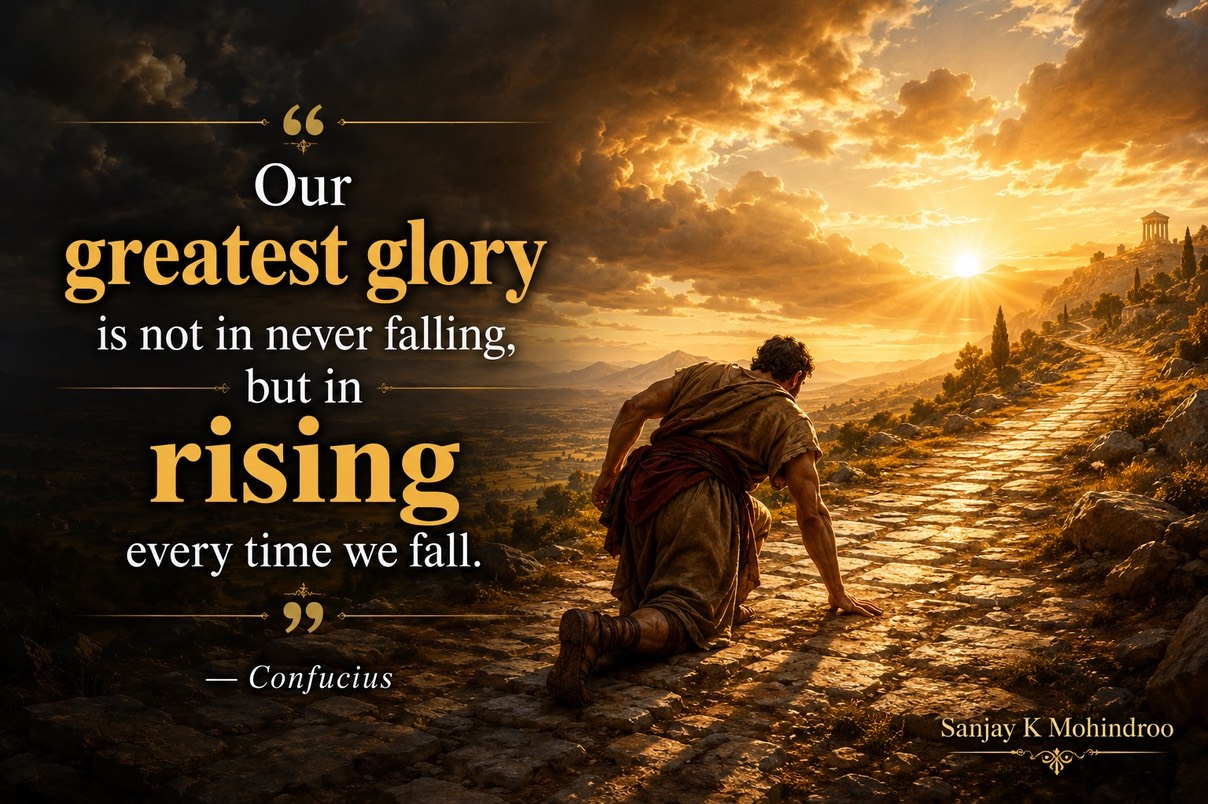
“Our greatest glory is not in never falling, but in rising every time we fall.” — Confucius
The emotional force of this idea comes from its realism. Falling is part of being human. The deeper question is whether we allow one difficult moment to become a permanent story about ourselves.
Rising does not erase the setback. It changes our relationship with it.
Setbacks Are Events, Not Identities
Separate the experience from the self
Failure often becomes heavier because we attach identity to it. A project fails, and we call ourselves incapable. A relationship ends, and we assume we are unworthy. A career plan stalls, and we begin to doubt our future.
That reaction is understandable, but it is rarely useful. A setback gives information about an event, decision, timing, or circumstance. It does not provide a complete judgment on a person.
Personal growth begins when we separate what happened from who we are. That separation creates room for reflection without shame and accountability without self-destruction.
Confidence Returns Through Action
Movement often comes before belief
People often wait to feel confident before trying again. In practice, confidence usually returns after we act.
The first step may be small. We make the call, revise the plan, apologize, apply again, ask for help, or start over. Each action sends a quiet message to the mind: this moment did not finish me.
That is where resilience becomes practical. It is not a personality trait reserved for unusually strong people. It is a repeated behavior.
We recover, adjust, and continue. Over time, those actions create evidence that we can handle difficulty.
Falling Can Improve the Way We Lead
Humility can become a source of strength
Leadership is often associated with certainty, control, and visible success. Yet leaders who have faced disappointment can develop something equally valuable: perspective.
A leader who has struggled may listen more carefully. Someone who has made mistakes may judge others less quickly.
A person who has rebuilt after failure can also understand the value of second chances. Clarity, support, and patience can often restore performance.
This does not mean every failure produces wisdom. Reflection matters. Without reflection, we can repeat the same pattern.
With reflection, setbacks can sharpen judgment and strengthen a leadership mindset grounded in humility.
Rising Does Not Mean Returning Unchanged
Recovery can include a new direction
Getting back up does not always mean returning to the same goal, role, relationship, or plan. Sometimes the strongest response is to change course.
Perseverance is not stubbornness. It means continuing toward a meaningful life while remaining willing to change the route.
A difficult experience can expose weak assumptions, misplaced priorities, or goals we no longer value. Rising may mean rebuilding. It may also mean letting go of something that no longer deserves our energy.
Conclusion
Make the next step your answer
The most useful response to a setback is not endless self-criticism. It is honest reflection followed by purposeful movement.
We cannot control every fall. We can control whether we stay defined by it. The practical lesson is simple: take responsibility, take the lesson, and take the next step.
A perfect record may look impressive. A person who keeps returning with greater clarity, courage, and humility has built something deeper.
#Resilience #PersonalGrowth #OvercomingFailure #LeadershipMindset #Perseverance #LifeLessons #Confidence #ThoughtOfTheDay
An enduring voice on character and conduct
Confucius was an ancient Chinese teacher and philosopher whose ideas shaped thinking about ethics, relationships, responsibility, and good conduct.
The quote matters because it places dignity in recovery rather than perfection.
The perspective remains relevant because people still face failure, uncertainty, and the need to begin again.
Failure Is Not the End of the Story
Sanjay K Mohindroo
Failure becomes useful when reflection turns experience into better judgment, stronger choices, and a wiser second attempt.
A setback gains meaning when it changes the way you begin again.
The Moment After a Setback
The next decision matters more than the last result
Failure often feels final while we are standing inside it. Confidence drops, plans look weaker, and past choices become easy targets.
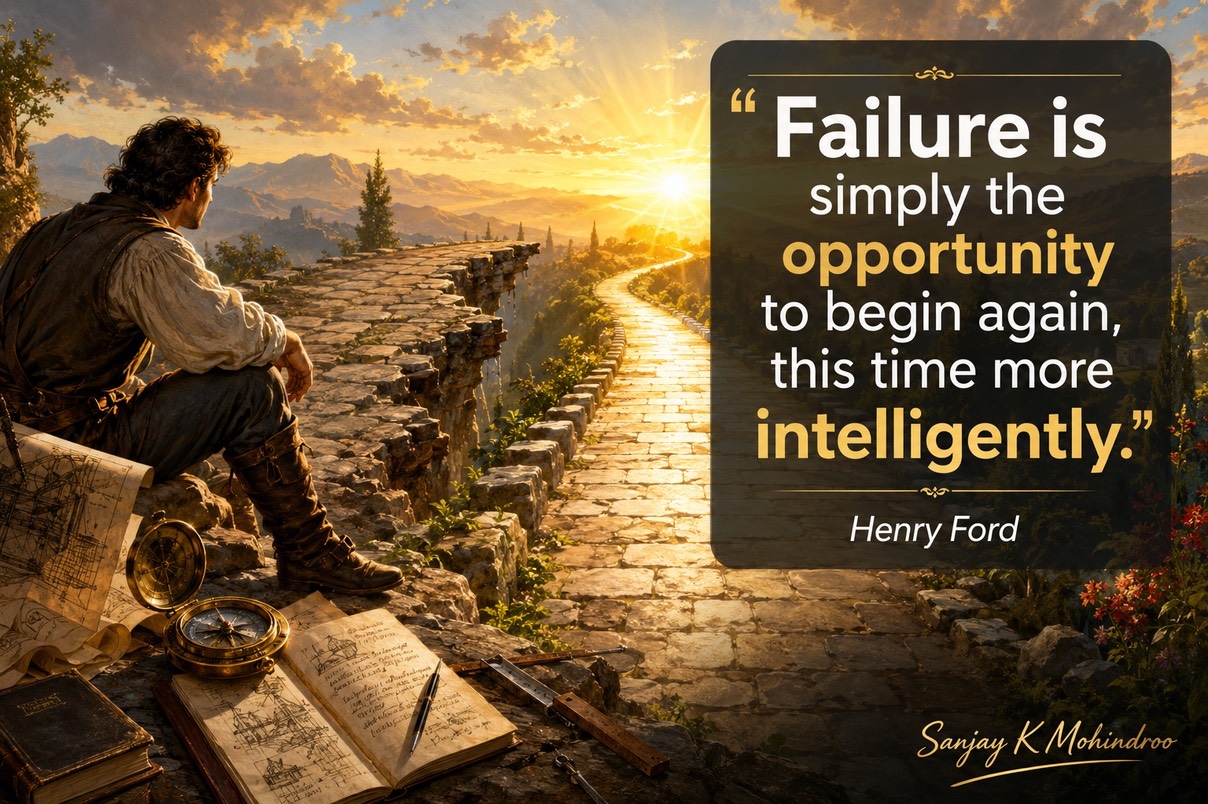
Henry Ford captured a more useful perspective: “Failure is simply the opportunity to begin again, this time more intelligently.”
The message is not that failure feels good or deserves celebration. A disappointing result can become valuable information when reflection turns experience into better judgment.
That distinction matters in careers, relationships, leadership, and ordinary life. Growth does not come from falling repeatedly. It comes from changing the way we stand back up.
Failure Does Not Automatically Create Growth
Experience needs reflection before it becomes wisdom
People often say that failure makes us stronger. That statement is comforting, but it is incomplete.
Failure can make someone stronger, but it can also create fear or bitterness. The outcome depends on what happens after the setback.
A person may repeat the same behavior while simply working harder. A leader may blame the team without questioning the original assumptions. Someone may avoid future risks because one attempt ended badly.
None of those responses creates intelligent failure.
Growth begins when we examine the result without hiding from it. Reflection separates bad luck from bad judgment and reveals which choices need to change.
The Real Value Is Better Judgment
A second attempt should carry evidence from the first
Beginning again does not mean pretending the first attempt never happened. It means carrying useful evidence forward.
That evidence may show that the timing was wrong. It may reveal weak preparation, unrealistic expectations, or a warning sign that went ignored.
This is where a growth mindset becomes practical rather than motivational. The next attempt should be different because the previous result taught us something concrete.
Intelligent failure asks better questions. Which assumption failed? Which signal did I miss? Which decision would I change today?
Those questions turn disappointment into direction.
Second Chances Require Change
Restarting without adjustment only repeats the pattern
Life gives many second chances, but second chances have limited value without changed behavior.
Someone can leave one unhealthy workplace and recreate the same boundaries elsewhere. A manager can restart a project while keeping the same flawed decision process. A person can repair a relationship without changing the habits that caused conflict.
Starting over is not enough.
A meaningful second chance includes reflection, accountability, and adjustment. The goal is not perfection on the next attempt. The goal is a more intelligent response than before.
Confidence Should Come from Adaptation
Strength is visible in the quality of the next decision
Many people connect confidence with certainty. Mature confidence often looks different.
It accepts that an earlier choice failed without turning that result into a permanent identity. It stays open enough to reassess, and steady enough to act again.
That mindset matters because fear often grows after failure. Reflection can reduce that fear by replacing vague regret with clear information.
When we understand what happened, the next step becomes less mysterious. We may still feel uncertain, but we are no longer starting from zero.
Experience becomes an advantage when it improves the next decision.
Begin Again with Better Information
The setback matters less than the intelligence you carry forward
Failure does not deserve worship, and success does not require dramatic mistakes. Yet setbacks remain part of any serious life.
The practical response is simple: examine what happened, keep the useful evidence, and change the next move.
The strongest comeback is rarely the loudest one. It is the moment when experience becomes judgment, and judgment changes behavior.
A failed attempt can close one chapter without closing the story. Begin again, but make sure the next beginning knows more than the last one did.
#Failure #GrowthMindset #Reflection #SecondChances #PersonalGrowth #Leadership #LifeLessons
The perspective behind the quote
Henry Ford founded Ford Motor Company and became one of the defining industrial figures of the twentieth century. The quote matters because it frames failure as information rather than a final verdict. That perspective remains relevant wherever people must make decisions, absorb setbacks, and try again with better judgment.
Risk Is the Price of Possibility

Sanjay K Mohindroo
Avoiding risk can feel safe, but inaction carries its own cost. A reflection on courage, choice, and thoughtful risk.
A meaningful life rarely comes from eliminating uncertainty; it comes from choosing which uncertainty deserves your courage.
The Cost of Standing Still
Safety can protect us, but it can also become a quiet form of retreat.
“If you don’t risk anything, you risk even more.” — Erica Jong
Most people think risk begins when we make a bold move. Yet risk also exists when we remain exactly where we are. Staying in the familiar may reduce immediate discomfort, but it can increase long-term regret. Opportunities close, confidence weakens, and important conversations remain unsaid.
The real choice is rarely between risk and safety. More often, we are choosing between two different kinds of risk.
Comfort Can Become Expensive
Avoiding discomfort today may create a higher cost tomorrow.
A stable job can feel safe while slowly draining ambition. A familiar routine can feel secure while keeping personal growth small. A leader can avoid a difficult decision to preserve calm, only to face a larger problem later.
This does not mean every uncertain choice deserves action. It means inaction deserves the same scrutiny we give action. We often calculate what might go wrong if we move, while ignoring what may be lost if we stay.
That imbalance can make caution look wiser than it really is.
Courage Needs Judgment
Thoughtful risk is very different from reckless behavior.
Courage is not the absence of fear, and it is not blind confidence. It is the willingness to act after considering consequences, limits, and available choices. Good decision-making asks whether the possible gain justifies the possible loss.
That principle matters in life and leadership. Strong leaders do not chase uncertainty for its own sake. They accept measured risk when standing still threatens progress, trust, relevance, or opportunity.
The same idea applies personally. A difficult conversation, career move, creative project, or honest boundary may feel uncomfortable. Yet each can protect something more important than comfort.
Small Risks Build Capacity
Confidence often grows after action, not before it.
Many people wait for certainty before making a meaningful move. Certainty rarely arrives on schedule. We gain confidence by testing ourselves through smaller acts of courage.
Speak when silence feels easier. Apply before you feel completely ready. Ask the difficult thing you have been avoiding. Share the idea before every detail feels perfect.
These choices may look modest, but they change our relationship with fear. Each thoughtful step provides evidence that uncertainty can be handled rather than escaped.
Over time, courage becomes less dramatic and more practical.
Choose the Risk That Serves Your Life
The goal is not to become fearless; it is to become more intentional.
Some risks should be refused. Others deserve preparation, patience, and a clear decision. The important consideration is whether fear is protecting something valuable or merely protecting familiarity.
A meaningful life is not built by eliminating uncertainty. It is built by choosing carefully, acting deliberately, and accepting that possibility always carries a price.
#ThoughtLeadership #Courage #PersonalGrowth #Leadership #DecisionMaking #LifeLessons #RiskTaking #GrowthMindset
A Voice on Freedom and Choice
Erica Jong has long written about personal freedom, identity, and human choice.
Jong is an American novelist, poet, and essayist whose work often examines independence and human desire. Her statement matters because it challenges the assumption that avoiding danger automatically creates safety. That perspective remains relevant because people still face choices where comfort and possibility pull in opposite directions.
The Only Competition That Lasts
Sanjay K Mohindroo
Personal growth becomes stronger when success is measured against your own progress instead of someone else’s pace.
A healthier definition of success begins when yesterday becomes the benchmark.
A Different Kind of Ambition
Progress feels lighter when comparison stops controlling the score
Most people are taught to notice who seems ahead of them. We compare careers, incomes, recognition, confidence, relationships, and even personal routines.
Yet status rarely tells us whether we are genuinely becoming better.
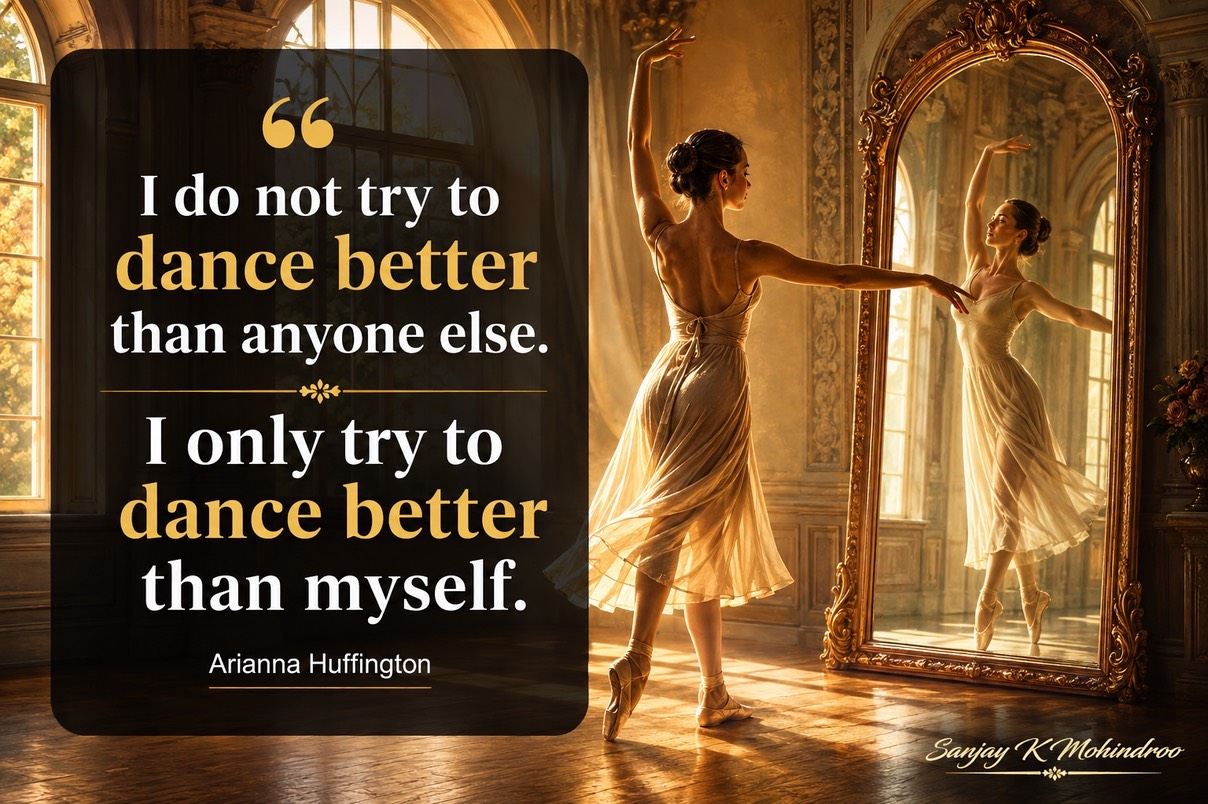
“I do not try to dance better than anyone else. I only try to dance better than myself.”
The idea shifts our attention away from ranking and toward personal development. It does not reject ambition, excellence, competition, or high personal standards. Instead, it places ambition where we hold the greatest influence: our choices, habits, effort, and standards.
The Comparison Trap
Someone else’s success can inspire you without becoming your measuring stick
Comparison becomes harmful when another person’s life becomes evidence about our value. We see their result while missing the tradeoffs, setbacks, support, preparation, and timing behind it.
A colleague receives a promotion, and suddenly our own career feels late. A friend buys a home, and we begin questioning our financial progress. Someone appears more confident or successful, and our own achievements suddenly seem smaller.
The problem begins when simple observation slowly turns into personal judgment. It can respect another person’s progress while remaining committed to personal growth.
The Better Benchmark
Personal progress creates a standard you can influence every day
A personal benchmark asks questions that keep attention on meaningful improvement. Did I handle pressure with greater calm and judgment than last month? Did I communicate with more clarity when the conversation became uncomfortable? Did I protect my time more carefully when competing demands appeared? Did I make a difficult decision with greater courage than before?
These measures may appear small publicly, yet they often reshape private lives. Self-improvement also creates a more durable and dependable definition of success. External validation can disappear quickly when titles, attention, or circumstances change.
Personal progress remains available because it depends on movement rather than position. The goal is a better response, stronger habit, clearer decision, or wiser boundary.
Growth Without Self-Punishment
Improvement works best when standards rise without turning into constant criticism
Competing with yourself can become unhealthy when every day becomes another test. Personal growth should create useful direction without producing permanent dissatisfaction or self-criticism.
There will always be seasons when meaningful progress appears slower than expected. Some days should focus on recovery, reflection, repair, or renewed perspective.
Sometimes improvement means saying no before resentment has time to build. Sometimes it means listening longer before rushing toward an immediate response. Sometimes it means choosing rest before exhaustion eventually makes that decision unavoidable.
A strong success mindset should make room for discipline and perspective together. It can demand meaningful progress while accepting that human performance remains uneven.
Success Becomes More Personal
The strongest goals reflect values rather than borrowed expectations
A useful life cannot be measured only through visible milestones and applause. Success also includes the person we become while pursuing meaningful goals.
That idea changes ambition from public comparison into more personal alignment. Instead of asking whether we are ahead, we can ask whether we are aligned. Instead of chasing every external marker, we can choose standards reflecting our values.
This is where life lessons become practical choices rather than abstract ideas. Betterment becomes less about proving worth and more about steadily building character.
The strongest competition is against habits, fears, excuses, and assumptions that repeat yesterday.
Keep Your Eyes on Your Own Progress
The most meaningful race is the one you can actually influence
Comparison can provide information, but it should never become the basis of identity. Other people can show possibilities, yet they cannot set our correct pace.
A better measure is becoming more thoughtful, capable, disciplined, courageous, or generous. That personal standard keeps ambition grounded while making progress more honest.
You do not need to outrun everyone standing somewhere around you. You need to become someone your previous self would clearly recognize as progress.
#PersonalGrowth #SelfImprovement #PersonalProgress #SuccessMindset #LifeLessons #ThoughtOfTheDay #GrowthMindset
A perspective connected to a broader conversation about success and well-being
Arianna Huffingtonfounded The Huffington Post and serves as founder and CEO of Thrive Global. She has written widely about well-being, performance, and broader definitions of success. Her perspective remains relevant because visible achievement still gets confused with meaningful progress.
Defeat Can Still Pay You Back

Sanjay K Mohindroo
A setback can become useful when reflection turns disappointment into better judgment, stronger choices, and renewed momentum.
Losing an outcome does not mean losing the value hidden inside the experience.
The Moment After the Result
A setback hurts most when we believe it has taken something from us without giving anything back.
“I will not lose, for even in defeat, there’s a valuable lesson learned, so it evens up for me.” — Jay-Z
That thought offers a demanding view of failure. It does not pretend defeat feels good. It asks us to look beyond the immediate score and examine what the experience has revealed.
A missed opportunity, rejected proposal, failed investment, or broken plan can still sharpen judgment. The result may be negative, yet the experience can produce lasting value.
Failure Becomes Useful Only After Reflection
Experience alone does not create wisdom.
People often say failure makes us stronger. That is incomplete.
Failure can also make us defensive, cautious, bitter, or eager to blame others. The difference comes from reflection.
A setback becomes useful when we examine the decisions behind it. Which assumption failed? Which signal did we ignore? Where did confidence turn into overconfidence? Which part was outside our control, and which part was ours to improve?
That process changes failure from an emotional event into usable information. Reflection gives disappointment a purpose without pretending the disappointment never mattered.
The Scoreboard Is Too Small
One result cannot measure every form of progress.
We often judge ourselves through visible outcomes: the promotion, contract, grade, launch, sale, or recognition.
These outcomes matter. Yet they capture only one moment.
A lost opportunity can improve future judgment. A poor decision can expose a blind spot before the stakes become larger. A difficult conversation can reveal where trust needs repair.
In each case, the immediate result may disappoint while the long-term value remains positive.
This does not mean every loss secretly counts as a win. It means the final value of an experience may take longer to calculate.
Accountability Makes the Lesson Valuable
Growth begins when explanation stops becoming an excuse.
There is comfort in blaming circumstances, competition, timing, or bad luck. Sometimes those factors are real.
But useful reflection also asks a harder question: What was mine to own?
Accountability restores agency. It helps us separate events we could not control from choices we can change next time.
Leaders need this habit because their losses rarely affect them alone. A failed decision can cost money, time, trust, and morale.
The mature response is not endless self-criticism. It is clear ownership followed by better action.
The best lesson from defeat is often behavioral: prepare earlier, listen longer, test assumptions, ask better questions, or walk away sooner.
Turning Pain into Better Judgment
Insight matters only when it changes the next decision.
Reflection without action can become another form of avoidance. Once the lesson is clear, it should alter behavior.
The value of a setback appears in the next meeting, next investment, next relationship, or next difficult choice. Better judgment is the return earned from an experience that initially felt costly.
This mindset also reduces fear. When every serious attempt must end in victory, people become cautious.
When failure can still produce information and growth, thoughtful risk becomes easier to accept.
Courage does not require believing you cannot lose. It comes from knowing that even a bad outcome can leave you better prepared for the next one.
Make the Setback Earn Its Place
A loss deserves neither denial nor worship.
Feel the disappointment. Study the result. Accept your part. Then take one useful insight into your next decision.
Winning is not only about avoiding defeat. It is also about refusing to leave defeat empty-handed.
#Leadership #LifeLessons #Failure #PersonalGrowth #Reflection #Success #Mindset
A Perspective Built Around Ambition
Jay-Z is an American rapper, entrepreneur, and cultural figure whose career has often centered on ambition, ownership, and reinvention. The quote matters because it treats defeat as something to examine rather than fear. That perspective remains relevant wherever people face uncertainty, competition, and high-stakes choices.
Curiosity Keeps Life Larger Than Certainty
Sanjay K Mohindroo
The most meaningful possibilities appear when we resist the comfort of believing we already know enough.
Curiosity keeps possibility alive by helping us question assumptions, notice opportunity, and remain open to better answers.
The Door We Cannot See
Attention often becomes the first step toward possibility.
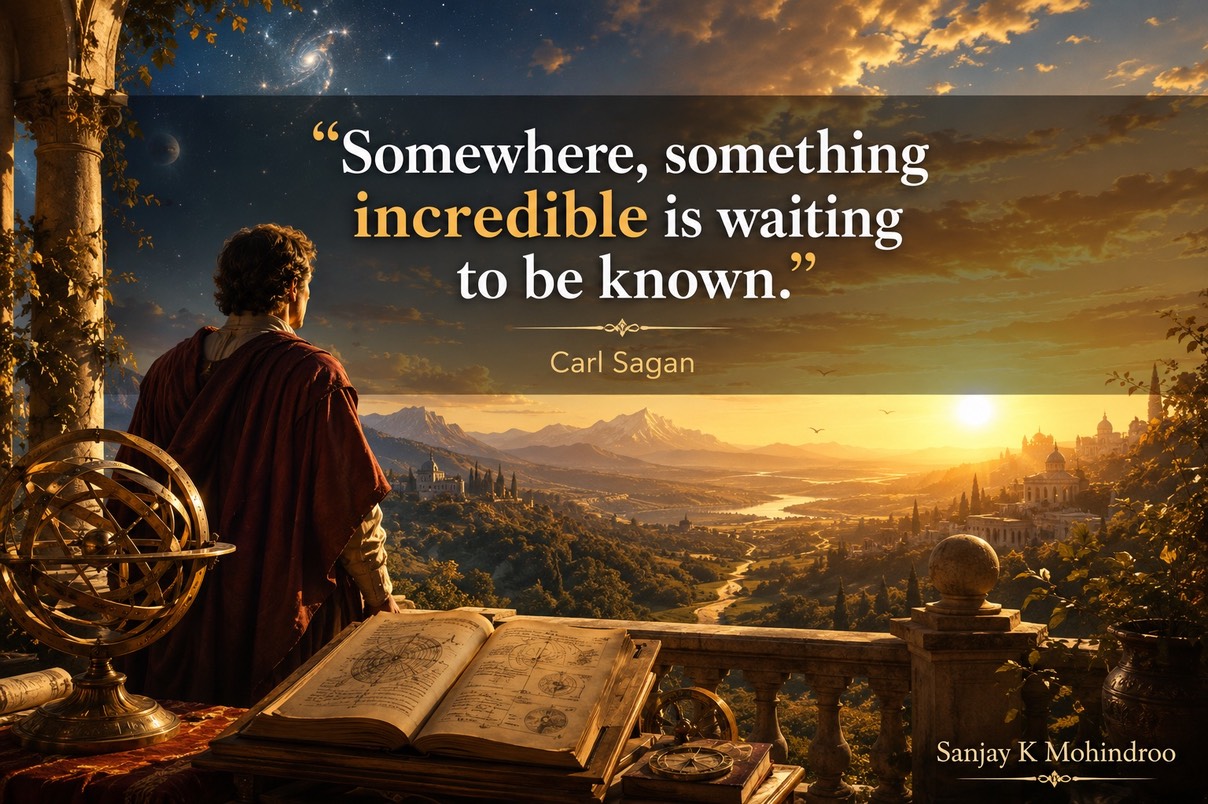
Important changes often begin before we can name their final destination. They begin with a question, an uneasy thought, or a quiet sense that more remains possible. Carl Sagan expressed that instinct beautifully: “Somewhere, something incredible is waiting to be known.”
The line carries hope, but it also places responsibility on us. The unknown does not ask us to admire possibility from a safe distance. It asks us to remain attentive enough to recognize possibility when it appears.
Curiosity matters because certainty can become comfortable before we notice its cost. Yet growth begins when we allow a familiar answer to become an open question.
The Comfort of Knowing
Experience can sharpen judgment while quietly narrowing our field of view.
Knowledge matters because it helps us make decisions with greater confidence. Experience gives us patterns, shortcuts, and lessons earned through real consequences. Yet those same strengths can make us dismiss promising ideas too early.
We often stop asking useful questions once something begins to appear settled. A career path becomes fixed because the same choices have worked so far. A business decision follows precedent because familiar precedent usually feels safer.
Curiosity interrupts this pattern without asking us to reject valuable experience. It asks whether yesterday’s answer still deserves the same confidence today. That small act of examination creates room for stronger judgment and better choices.
Questions Create Movement
A useful question can change direction before circumstances eventually force change.
Curiosity is sometimes mistaken for casual wondering without practical purpose. Meaningful curiosity requires discipline, attention, and a willingness to remain uncertain. It asks us to look again when a quick conclusion would feel easier.
Consider the questions that reshape important personal and professional decisions. Is this still the right goal for the person I am becoming? Which assumption could cause the most damage if it proved wrong? Whose perspective is missing from the conversation shaping this decision?
Those questions may not provide an immediate or comfortable answer. They widen the range of possibilities available to our judgment. In leadership, that habit can prevent confidence from becoming complacency. In relationships, it can replace quick judgment with deeper understanding. In personal growth, it can reveal options that routine keeps hidden.
Possibility Has an Address
The unknown contains possibilities that our present knowledge cannot yet name.
Literally, Sagan’s thought points toward knowledge that still sits beyond human reach. His work in astronomy made that idea natural because science depends on unanswered questions.
The deeper interpretation reaches easily into ordinary life. We rarely know which conversation, idea, failure, or unexpected turn will eventually change us. Much of what later becomes meaningful first arrives disguised as uncertainty.
The practical takeaway asks us to change our relationship with uncertainty. We should not treat every unknown only as a potential threat. Some uncertainty is unfinished information waiting for better questions and closer attention. Curiosity helps us approach uncertainty without pretending we control it.
Staying Open Without Losing Judgment
Curiosity works best when openness and discernment continue working together.
Being open-minded never requires us to believe every possible explanation. It means giving worthwhile questions enough attention before closing them down.
Strong judgment should help us test ideas rather than prevent us from considering them. Confidence should support thoughtful action instead of protecting us from new evidence.
A practical habit is to leave one assumption open during every important decision. Ask what evidence could make you reconsider your current view. Ask which voice remains absent from the conversation around the decision. Ask whether comfort is quietly being mistaken for truth.
That habit keeps curiosity grounded in action and judgment.
#Curiosity #ThoughtOfTheDay #PersonalGrowth #Leadership #LifeLessons #Mindset #Inspiration
A Voice for Wonder and Reason
Carl Sagan connected scientific curiosity with a deeply human sense of possibility.
Carl Sagan was an astronomer, author, and science communicator known for making complex ideas accessible. His perspective matters because he treated curiosity as both intellectual discipline and human possibility. That combination remains relevant whenever uncertainty tempts us to retreat toward familiar answers.
The Humility of Knowing Less
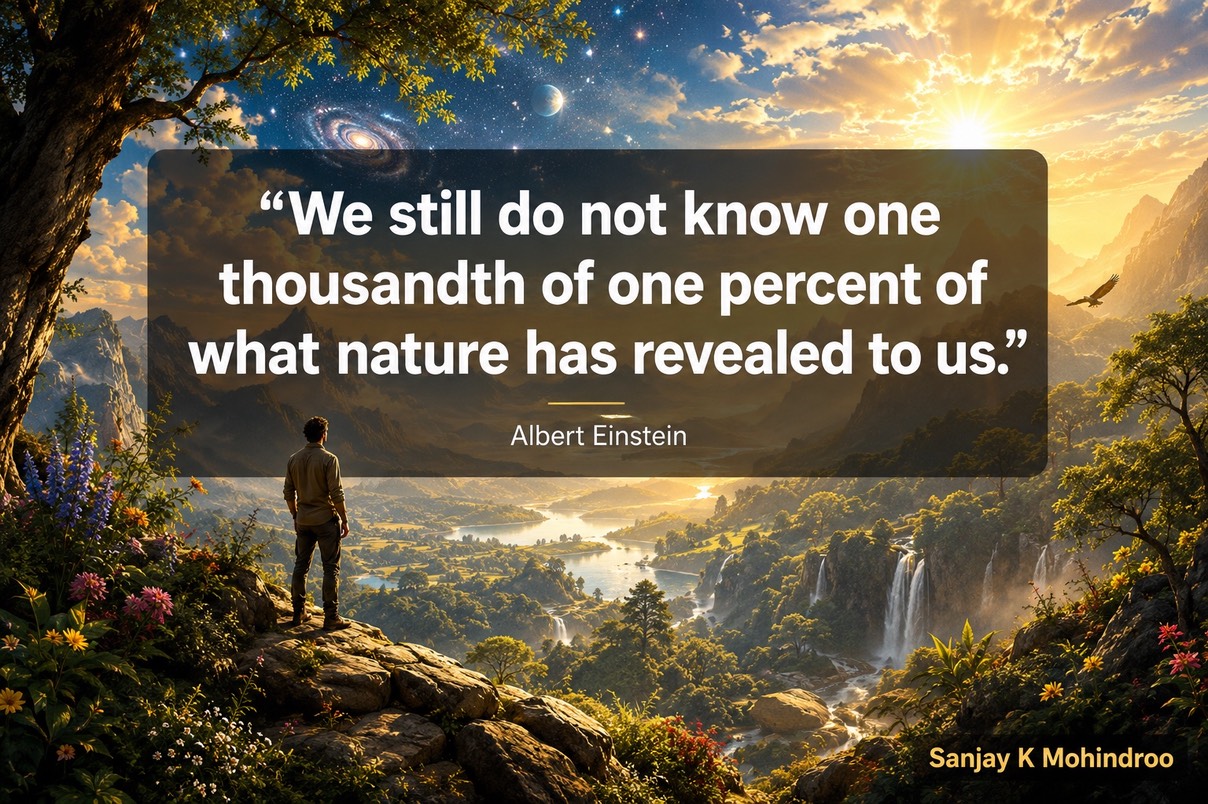
Sanjay K Mohindroo
A reflection on curiosity, humility, nature, and the wisdom of staying open to what we do not yet understand.
The more clearly we see life, the less convincing certainty becomes.
The Scale of the Unknown
Wonder begins where certainty becomes too small
Human beings like answers. Answers create comfort, control, and a sense of progress. Yet some of the richest moments in life begin when an answer gives way to a larger inquiry.
“We still do not know one thousandth of one percent of what nature has revealed to us.” — Albert Einstein
The emotional force of this thought comes from its humility. We may build systems, solve difficult problems, and explain complex patterns. Still, nature remains larger than our conclusions. That realization does not diminish human intelligence. It gives intelligence a better posture.
Curiosity is not a sign that we know too little. It is often a sign that we are paying closer attention.
Knowledge Should Make Us Humble
Understanding has limits, and wisdom notices them
Knowledge can create confidence. That confidence becomes dangerous when it hardens into certainty.
In leadership, relationships, science, and ordinary life, people often mistake experience for complete understanding. We see a pattern once and assume it will repeat. We succeed with one approach and begin treating it as a rule. We form an opinion and then protect it from new evidence.
Humility interrupts that habit.
It reminds us that our perspective is partial. It gives us room to listen longer, observe better, and revise our thinking without feeling diminished. The strongest minds do not need to pretend they have reached the final answer.
Curiosity Keeps Life Expansive
Inquiry protects us from becoming mentally fixed
Curiosity changes the way we move through life. It keeps familiar things from becoming invisible.
A tree, a conversation, a difficult colleague, a changing market, or a personal setback can all become sources of insight when we stop assuming we already understand them.
This life perspective matters for personal growth as much as leadership. A curious person asks, “What am I missing?” before deciding, “I know what this means.” That small shift can improve judgment and reduce unnecessary certainty.
Wonder also restores proportion. It reminds us that life is not only a problem to solve. Some parts of it deserve attention simply because they are astonishing.
Certainty Can Become a Blind Spot
The need to be right can stop better thinking
Certainty feels efficient. It shortens debate and gives decisions a clean edge. But certainty can also close the door too early.
Many poor decisions begin with an assumption that nobody tests. Many damaged relationships begin with an interpretation that nobody challenges. Many missed opportunities begin with a conclusion formed too soon.
A better habit is to hold conviction and curiosity together.
We can act decisively while remaining open to correction. We can trust our experience without worshiping it. We can form a view while leaving enough space for facts, people, and nature to surprise us.
That balance is a quiet form of wisdom.
Stay Amazed
A full life requires fewer final answers than we think
The point is not to celebrate ignorance. The point is to respect the size of what remains unknown.
Practical curiosity asks us to observe before judging, probe before assuming, and remain open after deciding. It keeps the mind flexible without making it passive.
The next time certainty feels complete, consider leaving one door open.
A wise life may not be measured by how many answers we collect, but by how deeply we continue to notice.
#Curiosity #Humility #Wisdom #PersonalGrowth #Leadership #Nature #LifePerspective #Wonder
A perspective that still challenges certainty
Albert Einstein was a theoretical physicist whose work reshaped modern physics. This quote matters because it pairs intellectual achievement with deep humility before nature. That perspective remains relevant wherever confidence risks becoming certainty.
The Comparison Trap
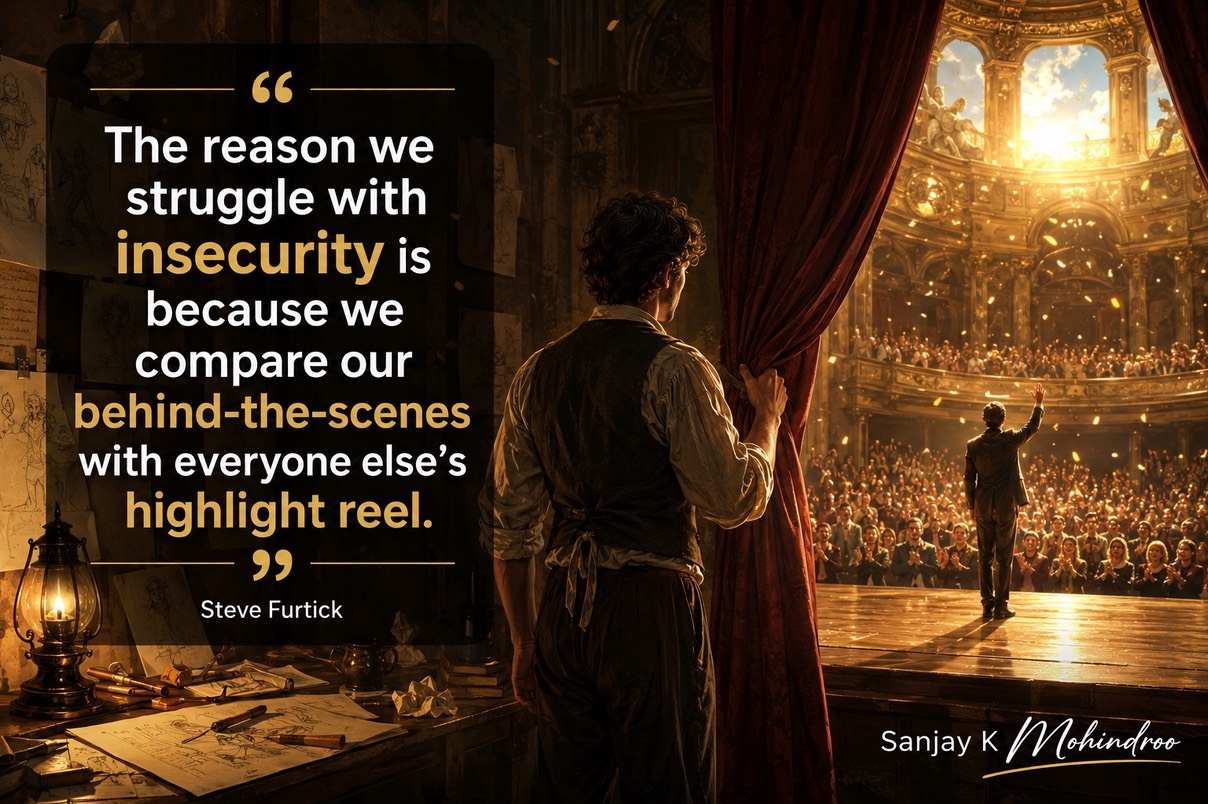
Sanjay K Mohindroo
Stop measuring your full reality against someone else’s polished moments. Build confidence through fairer comparison and self-awareness.
Confidence becomes steadier when we stop judging our private struggles against someone else’s public success.
The Unfair Scoreboard
We often compare two very different versions of reality.
Most insecurity does not begin with failure. It begins with comparison that feels reasonable but uses unequal evidence.
"The reason we struggle with insecurity is because we compare our behind-the-scenes with everyone else’s highlight reel." — Steve Furtick
We know every unfinished thought, delayed goal, awkward mistake, and private doubt in our own lives. Yet we often meet others through visible outcomes: the promotion, the celebration, the strong presentation, the successful launch, or the polished photograph.
That difference matters. We are comparing our raw footage with someone else’s edited scene.
Comparison Is Not the Enemy
The real problem is incomplete context.
Comparison can help us set standards, test assumptions, and see possibilities. The trouble starts when we treat partial information as complete evidence.
A colleague’s promotion may look effortless from the outside. We may not see years of rejection, extra responsibility, support from mentors, or personal sacrifice. A friend’s confidence may seem natural, while we never see the doubts they manage privately.
The visible outcome is real. The missing context is real too.
When we ignore that missing context, admiration can quietly become self-criticism.
Social Proof Can Distort Self-Worth
Repeated exposure to polished outcomes can change our internal standards.
Human beings naturally use other people as reference points. That instinct becomes risky when the reference point is heavily filtered.
We start asking, “Why am I not there yet?” instead of asking whether the comparison is fair. We judge our pace without knowing their starting point. We judge our progress without knowing their resources, timing, or trade-offs.
This can affect confidence at work, in relationships, and in personal growth. The mind turns another person’s result into evidence about our own value.
But another person’s success is not proof of our inadequacy.
Build a Better Personal Scoreboard
Measure progress using evidence you actually understand.
A healthier comparison starts closer to home. Compare your current choices with your earlier habits. Compare your present capability with what you could handle one year ago.
Ask whether you communicate more clearly, recover faster from setbacks, make better decisions, or act with greater consistency. These measures may look less dramatic, but they are more honest.
Self-awareness does not require ignoring other people. It requires placing their achievements in the right context.
Use others for inspiration, not as a verdict.
Confidence Needs Perspective, Not Perfection
A fuller view of progress creates steadier self-belief.
Confidence is often misunderstood as certainty. In practice, it is closer to trust: trust that you can keep moving while things remain unfinished.
That trust grows when you stop demanding a polished life from yourself every day. Real progress includes hesitation, wrong turns, slow seasons, and private effort.
A strong life is not one without messy chapters. It does not mistake those chapters for the entire story.
Keep the Comparison Fair
Your progress deserves to be judged with complete evidence.
The next time comparison triggers insecurity, examine the information behind the judgment. Are you comparing full context with a visible outcome?
If so, change the measure.
Track your own progress with honesty. Respect another person’s success without turning it into a sentence against yourself.
The most useful scoreboard is the one that helps you move forward without losing perspective.
#SelfAwareness #Confidence #PersonalGrowth #Mindset #SelfWorth #LifeLessons #ThoughtOfTheDay #Perspective
Steve Furtick is an American pastor, speaker, and author known for messages about faith, identity, and personal growth. This quote matters because it names a common mental error behind insecurity and comparison. The perspective remains relevant because public success is often far more visible than private struggle.
The Discipline of Staying Present

Sanjay K Mohindroo
A reflection on focus, letting go, and using the past without allowing it to control today.
The past deserves perspective, not permanent occupancy in your mind.
Attention Has a Cost
The moment in front of you needs more than whatever remains behind you.
“I never look back, darling. It distracts from the now.” — Edna Mode
The line is playful, but the idea is serious. We often treat reflection as proof of maturity. We revisit conversations, decisions, missed chances, and mistakes because we believe more thinking will produce more clarity.
Sometimes it does. Sometimes it becomes repetition disguised as reflection.
The past has value when it gives us perspective. It becomes expensive when it keeps taking attention from the present moment. That distinction matters in life, leadership, and decision-making.
The Past Is Data, not a Destination
Reflection should improve judgment without becoming a place to live.
Every useful experience leaves information behind. A failed decision can sharpen judgment. A difficult relationship can reveal boundaries. A missed opportunity can clarify what matters next.
The problem starts when memory becomes identity.
People can begin defining themselves by an old failure, an earlier title, a past relationship, or a version of success that no longer fits. The event may be over, yet its emotional authority remains active.
Healthy reflection asks, “What can I carry forward?” Unhealthy replay asks, “What if I could change what already happened?”
Only one of those questions gives the present more power.
Presence Is a Form of Discipline
Focus is not passive; it requires repeated choices.
Being present sounds simple until the mind has something unresolved to revisit. Attention naturally returns to unfinished emotional business.
That is why presence requires discipline.
You do not need to erase yesterday. You need to decide how much authority it receives today. The goal is not forgetting. The goal is placing the past in proportion.
This matters for leaders as much as it does for individuals. Teams can become trapped by earlier failures. Companies can keep protecting old assumptions because those assumptions once worked. People can keep repeating familiar patterns because familiarity feels safer than uncertainty.
Good judgment respects history without becoming obedient to it.
Momentum Begins with the Next Decision
Progress becomes practical when attention returns to action.
Personal growth rarely arrives through endless analysis. It often arrives through a better next choice.
Send the message. Change the habit. Admit the mistake. Set the boundary. Decide with the information available today.
That does not mean acting without thought. It means giving thought a purpose.
Reflection should eventually convert into action. Otherwise, it becomes a private loop that feels productive while producing little movement.
The present moment is where intention becomes behavior. It is also where confidence gets rebuilt, one decision at a time.
Letting Go Does Not Mean Dismissing
Acceptance gives the past a proper place without denying its importance.
There is a difference between moving forward and pretending nothing mattered.
Grief matters. Regret matters. Memory matters. Accountability matters.
But none of them require permanent residence in yesterday.
You can honor an experience without allowing it to run your next chapter. You can accept responsibility without turning one mistake into a permanent definition of yourself.
That is the balance: keep the meaning, release the grip.
Give Today Your Full Attention
Yesterday can inform you. Today still needs to be lived.
The strongest relationship with the past is neither denial nor obsession. It is perspective.
Take the lesson. Keep the gratitude. Repair what can still be repaired. Then return your attention to the decision, conversation, task, or person in front of you.
A meaningful life is not built by repeatedly editing yesterday in your head. It is built by using what happened to act with greater clarity now.
Respect the past, but do not hand it the steering wheel.
#PresentMoment #Focus #PersonalGrowth #Leadership #Reflection #DecisionMaking #MindfulAction #LettingGo
A Fictional Voice with a Sharp Point
Humor can carry a serious truth with surprising precision.
Edna Mode is the fictional fashion designer from Pixar’s The Incredibles, known for confidence, wit, and absolute conviction. Her line matters because it turns a complex idea about focus into a memorable statement. The perspective remains relevant because distraction from the past is still one of the quietest ways people lose contact with the present.
Courage Is the Backbone of Character
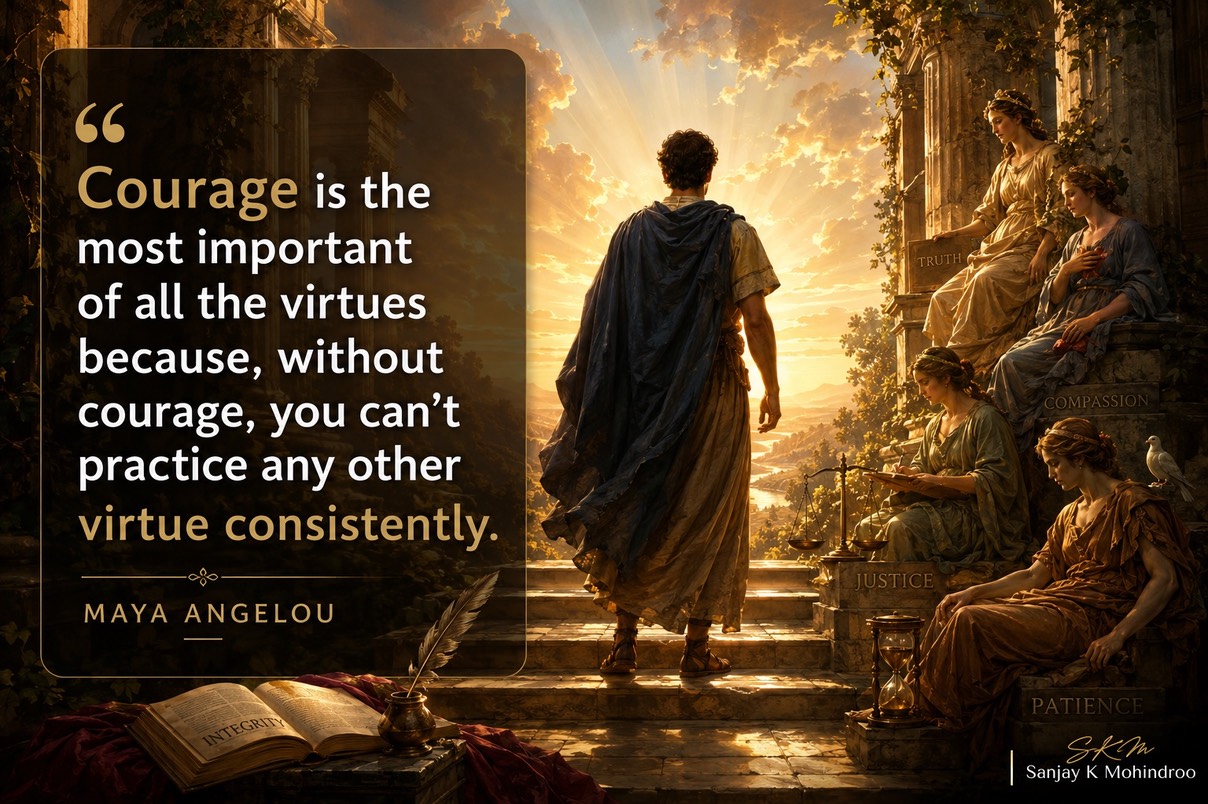
Sanjay K Mohindroo
Courage turns values into consistent action when pressure, fear, and discomfort make easier choices tempting.
Character is not defined by the values we admire, but by the values we keep under pressure.
The Virtue Behind Every Other Virtue
Values become real when they begin to cost us
Most people can be honest, kind, patient, and fair when circumstances make those choices easy. Character becomes harder when truth creates tension, kindness requires risk, or patience demands restraint.
Maya Angelou captured that tension with unusual clarity: “Courage is the most important of all the virtues because, without courage, you can't practice any other virtue consistently.”
The emotional force of that idea comes from its striking simplicity. We often treat courage as dramatic bravery, reserved for crises or extraordinary people. Yet daily courage is quieter, more common, and far more demanding. It is the strength that allows our values to survive discomfort.
Character Appears Under Pressure
Principles matter most when convenience points elsewhere
Integrity sounds admirable until honesty may disappoint someone you respect. Compassion feels natural until helping another person asks for your time or reputation. Patience seems simple until frustration permits you to react.
These moments expose the real distance between our stated beliefs and our daily behavior. A principle that disappears under pressure may still be only an aspiration. Courage closes that gap by helping us act in line with our stated values.
This matters in life and leadership because people remember consistency. They notice whether your standards remain stable when decisions become difficult. Trust grows when others see that your values don't depend on comfort.
Courage Is Usually Quiet
Small acts often carry the greatest personal cost
We often associate courage with public acts, visible sacrifice, or heroic choices. Most courageous behavior, however, receives little attention from anyone else.
It can mean admitting you were wrong before someone forces the issue. It can mean raising a concern when silence would protect your position. It can mean setting a boundary with someone whose approval matters deeply.
These acts rarely look dramatic from outside, yet they can carry a severe internal cost. Inside, they may threaten belonging, certainty, status, approval, or personal pride. That is exactly why ordinary courage deserves more respect than it usually receives.
Consistency Requires More Than Good Intentions
Values need support when emotions pull us away
Good intentions are important, but they are unreliable under stress. Fear narrows attention, anger accelerates judgment, and insecurity can make self-protection feel reasonable.
Courage creates a deliberate pause between strong emotion and immediate action. That pause lets us choose a response that matches the person we want to become. Over time, repeated choices shape character more powerfully than occasional declarations.
This is where courage becomes practical rather than merely admirable in daily life. It protects integrity during conflict, patience during uncertainty, and kindness during disappointment. It helps values become steady habits rather than attractive statements we repeat.
Leadership Makes Courage Visible
People watch what leaders protect when pressure rises
Leadership gives courage a wider effect because individual choices influence other people. A leader who admits a mistake makes honesty safer for the team. A leader who challenges unfairness permits others to speak.
The opposite pattern is equally powerful when leaders abandon values under pressure. Employees notice when standards change because a decision becomes personally inconvenient. Culture is shaped less by posters and speeches than by repeated decisions with real consequences.
Courage in leadership does not require certainty, fearlessness, or dramatic public gestures. It requires acting with conviction while accepting that discomfort may remain.
Keep the Value When It Gets Hard
Courage turns conviction into character
The deepest test of any virtue arrives when practicing it becomes inconvenient. That is the moment when courage stops being an idea and becomes a choice.
A useful reflection prompt is simple: Which value becomes hardest when pressure rises? The answer often points directly toward the kind of courage worth practicing next.
Character is built when we keep choosing our values after comfort stops supporting them. Courage becomes the backbone that helps those difficult choices hold over time.
#Courage #MayaAngelou #Character #Integrity #Leadership #PersonalGrowth #LifeLessons #ThoughtOfTheDay
A voice shaped by dignity, truth, and human experience
Maya Angelou was an American poet, memoirist, performer, and civil rights activist whose work examined dignity and human strength. Her perspective matters because it connects courage with everyday moral consistency, rather than rare acts of heroism. That connection remains relevant wherever people must choose between comfort and conviction.
The Mind Beyond Worry

Sanjay K Mohindroo
Worry turns imagination toward fear. Redirect it toward preparation, perspective, and purposeful action.
Imagination becomes powerful when it serves action instead of rehearsing outcomes we cannot control.
When the Mind Runs Ahead
The future often becomes frightening long before it becomes real.
“Worry is a misuse of imagination.” — Sanjay K Mohindroo.
Most worry begins with a picture. We picture the conversation going badly, the plan failing, or the opportunity disappearing. The event has not happened, yet the body and mind begin responding as if it already has.
That is the hidden cost of worry. It spends mental energy on a future created by fear. The answer is not to stop thinking ahead. It is to use mindful thinking so imagination becomes a source of preparation, perspective, and choice.
Worry Can Feel Like Responsibility
Thinking longer does not always mean thinking better.
Many capable people confuse worry with seriousness. Leaders do it before difficult decisions. Parents do it when children take risks. Professionals do it before presentations, interviews, or major changes.
Concern can be useful because it alerts us to risk. Worry becomes costly when the mind keeps repeating possibilities without producing a decision.
Emotional intelligence begins with noticing that difference. Useful concern asks, “What can I do next?” Unproductive worry keeps asking, “What if everything goes wrong?”
One kind of thinking creates movement, while the other mostly creates mental noise.
Imagination Needs Direction
The same mental power can create fear or possibility.
Imagination itself is neutral. It can produce a frightening future, but it can also picture a measured response.
If you can imagine rejection, you can imagine recovering from it. If you can picture a project failing, you can also picture the safeguards that reduce the risk. If uncertainty creates ten negative scenarios, it can also create several constructive options.
This shift matters for personal growth and leadership mindset. Strong judgment does not come from pretending risk is absent. It comes from seeing risk clearly without allowing fear to become the only storyteller.
Give Concern a Useful Job
Turn mental repetition into a decision, action, or boundary.
The next time worry appears, test whether the thought contains information you can actually use.
If action is possible, name the next move. Prepare the conversation. Check the numbers. Make the call. Create a backup plan. Ask for help.
If no action is possible, recognize the limit. Replaying the same scenario will not create control. Managing uncertainty often requires knowing when preparation has ended, and rumination has begun.
That boundary protects attention while preserving imagination for the thoughts and actions that deserve it.
A Better Use of Mental Energy
Your attention should serve the life in front of you.
Worry pulls attention away from the present and invests it in an imagined loss. Purposeful thinking brings that energy back.
This does not mean becoming careless or blindly optimistic. It means refusing to suffer every possible future before one of them arrives.
The goal is not a mind without concern. The goal is a mind that converts concern into perspective, preparation, or acceptance.
Let Imagination Work for You
Fear may suggest the picture, but you decide whether to keep painting it.
A thoughtful life still contains uncertainty. Leadership still carries risk. Personal growth still asks us to enter situations without guaranteed outcomes.
The practical question is simple: Is your imagination preparing you for life, or pulling you away from it?
Use it to prepare where you can, accept what you cannot control, and return your attention to the present. The future deserves thoughtful preparation, not endless rehearsal.
#Worry #Imagination #MindfulThinking #EmotionalIntelligence #LeadershipMindset #PersonalGrowth #ThoughtOfTheDay #SanjayKMohindroo
The Edge Is Closer Than It Looks

Sanjay K Mohindroo
Growth begins when we test assumed limits, take measured risks, and move beyond the comfort of certainty.
Real progress often starts with one thoughtful step beyond what feels safely possible.
The Boundary We Accept
Our limits often become real only because we stop testing them.
“The only way of discovering the limits of the possible is to venture a little way past them into the impossible.” — Arthur C. Clarke
People naturally want certainty before making decisions that carry real personal or professional consequences. We want proof that a change will work before risking comfort, reputation, time, or effort.
Clarke challenges that instinct by questioning the line separating what seems possible from what seems impossible. That line often reflects experience, fear, habit, or expectations absorbed from other people.
Real limits deserve respect, but assumed limits deserve a fair and thoughtful test.
Comfort Can Make Limits Look Permanent
Familiar boundaries feel factual even when nobody has tested them recently.
Repeated experience can quietly turn an old assumption into something that feels like permanent truth. A career path looks fixed, a process feels untouchable, or a personal weakness becomes part of identity.
A growth mindset does not require blind optimism or constant pressure to exceed yourself. It asks you to separate proven constraints from beliefs that have simply gone unchallenged.
A leader may hear that a team cannot improve its pace without losing quality. A professional may believe greater responsibility belongs to someone more experienced or naturally confident.
Those beliefs may be correct, but certainty should come from evidence rather than habit.
Courage Works Best in Small Experiments
Progress usually needs a measured step rather than a dramatic leap.
Clarke’s wording points toward moving only slightly beyond the boundary we already understand. That small movement makes calculated risk practical, because the consequences remain visible and manageable.
You can test a new approach on one project before changing an entire process. You can speak once in a difficult meeting before judging your ability to influence others.
Small experiments replace imagined outcomes with evidence drawn from direct personal experience. Success expands confidence, while failure gives better information for the next thoughtful decision.
Either result creates more value than remaining trapped inside an untested assumption.
Leadership Requires Possibility Thinking
Good leaders challenge assumptions without confusing boldness with careless decision-making.
Leadership courage often appears before certainty because meaningful decisions rarely arrive with complete information. Strong leaders ask whether accepted constraints still serve the people, customers, and goals involved.
They question whether a process could become simpler, or whether someone could handle greater responsibility. They also test whether an old rule now protects comfort more than performance.
Possibility thinking matters because untested beliefs can quietly narrow choices long before decisions begin. Yet strong judgment still requires defining risk, limiting avoidable damage, and watching evidence carefully.
The purpose is not proving skeptics wrong, but preventing stale assumptions from controlling future choices.
Personal Growth Begins at the Edge
The next version of you often sits just outside familiar behavior.
Personal growth feels uncomfortable because identity prefers consistency and predictable stories about ability. We like believing we already know what we can handle and where we belong.
Confidence often follows action, while capability becomes visible only after responsibility actually arrives. Clarity also tends to appear after an imperfect attempt creates real information.
Pushing limits should therefore feel measured rather than theatrical or driven by ego. Choose one meaningful boundary, test it carefully, and notice what the experience reveals.
Then redraw that boundary using evidence instead of fear, habit, or inherited expectations.
Test Before You Accept
The safest assumption is not always the most accurate one.
Life contains real limits involving time, health, resources, responsibilities, and consequences that deserve respect. Wisdom means recognizing those realities without turning every uncomfortable boundary into a permanent rule.
Many limits survive because nobody applies enough pressure to see whether they still hold. When something matters, ask whether the boundary reflects evidence or merely repeated expectation.
One thoughtful step beyond certainty can quietly change the size of your future.
#GrowthMindset #PersonalGrowth #Leadership #Courage #PossibilityThinking #Inspiration
A futurist whose imagination repeatedly challenged accepted boundaries.
Arthur C. Clarkewas a British science fiction writer and futurist known for expansive thinking. His perspective matters because meaningful progress often begins as an idea others consider unrealistic. That perspective remains relevant wherever people balance imagination, evidence, courage, responsibility, and restraint.
The Quiet Freedom That Changes Everything

Sanjay K Mohindroo
A reflection on overcoming fear of judgment and building confidence in life, leadership, and business.
The courage to stop seeking approval often becomes the beginning of meaningful success.
The Weight We Carry
Every person carries an invisible audience.
Before speaking, changing careers, launching a business, or sharing an idea, many people pause and wonder whether others will approve. That silent question shapes far more decisions than most realize.
"Fear of what other people will think is the single most paralyzing dynamic in business and in life. The best moment of my life was the day I realized that I no longer give a damn what anybody thinks. That’s enormously liberating and freeing, and it’s the only way to live your life and do your business." — Cindy Gallop
Her words challenge one of the biggest limits we place on ourselves. They invite us to replace fear with conviction and hesitation with action.
The Approval Trap
When Acceptance Becomes the Goal
Seeking acceptance feels natural. We all want to belong.
The problem begins when acceptance becomes more important than authenticity. People stop asking whether an idea is right and start asking whether everyone will like it.
That shift slowly changes behavior. Honest conversations become shorter. Creative thinking becomes safer. Leadership becomes cautious instead of purposeful.
The greatest cost is rarely failure. It is the number of meaningful opportunities that never receive a chance.
Confidence Is Not Silence
Choosing Wisdom Over Validation
Ignoring every opinion is not confidence.
Strong leaders’ welcome thoughtful criticism because it sharpens judgment. They simply refuse to let random opinions determine their direction.
The difference is simple.
Constructive feedback helps you improve.
Constant approval keeps you standing still.
When people separate those two ideas, they begin making decisions with greater clarity and less fear.
Progress Begins Outside Comfort
Growth Demands Courage
Every meaningful achievement begins with uncertainty.
Starting a company, changing careers, writing a book, or speaking publicly all involve the possibility of criticism.
People who make lasting contributions are not fearless. They simply decide that their purpose matters more than temporary judgment.
History remembers those who acted despite criticism, not those who avoided it.
Living Without Permission
Freedom Creates Better Decisions
The most liberating realization is that everyone is occupied with their own lives.
Most people think about us far less than we imagine.
Once that truth sinks in, energy returns.
Instead of protecting an image, we invest our effort into learning, creating, serving others, and improving our work.
That shift changes careers, relationships, businesses, and personal happiness.
Freedom Is an Internal Decision
Real confidence is quiet.
It comes from knowing your values, accepting that criticism is unavoidable, and continuing to move forward anyway.
You cannot control every opinion.
You can control whether those opinions define your future.
The most meaningful life is rarely the one that pleases everyone. It is the one that remains true to what matters most.
#Leadership #PersonalGrowth #Mindset #SelfConfidence #Authenticity #LifeLessons #BusinessLeadership #Courage
Cindy Gallop is an entrepreneur, business leader, and marketing executive known for challenging conventional thinking. Her perspective encourages people to lead with authenticity rather than fear. Her message continues to resonate because today's connected society makes public judgment more visible than ever.
The Quiet Decisions That Shape Your Future
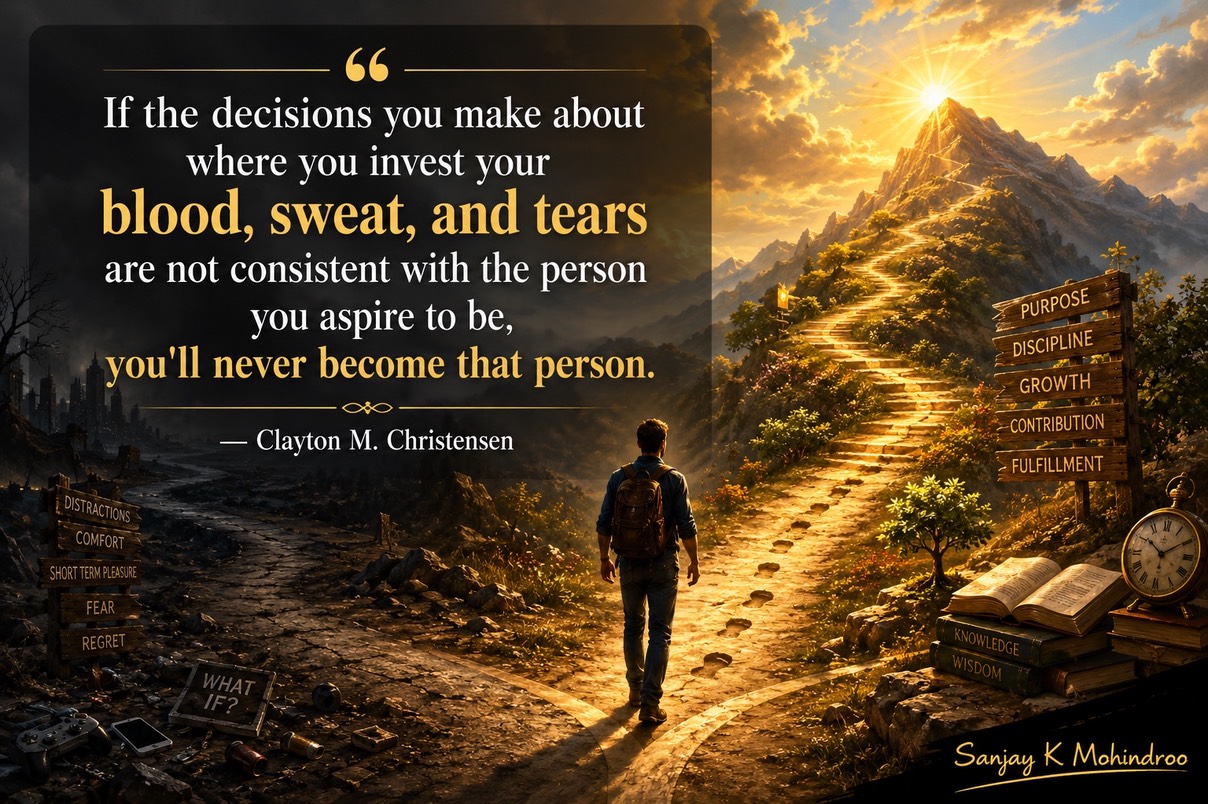
Sanjay K Mohindroo
Daily choices determine the person you become. Align your actions with your values and create lasting personal growth.
The future is rarely changed by one dramatic event. It is shaped by the choices we repeat every day.
Small Choices, Lasting Impact
The gap between who we are today and who we hope to become is often much smaller than we imagine. It is measured in everyday decisions rather than extraordinary moments.
“If the decisions you make about where you invest your blood, sweat, and tears are not consistent with the person you aspire to be, you’ll never become that person.” — Clayton M. Christensen
This idea challenges a common belief that success arrives through ambition alone. It reminds us that our calendar, our habits, and our priorities quietly define our future long before achievement becomes visible.
Every Investment Leaves a Mark
Time Is the Truest Reflection of Values
People often describe their goals with confidence. They speak about becoming healthier, wiser, stronger, or more successful. Yet the clearest evidence of those ambitions appears in how they spend their time.
Every hour carries an opportunity cost. Choosing one activity means choosing not to pursue another. Over weeks and years, those decisions create patterns, and those patterns become identity.
The person we become is rarely an accident. It is the outcome of repeated investments.
Consistency Beats Occasional Effort
Identity Grows Through Repetition
Many people wait for motivation before taking action. Lasting growth usually works the other way around. Action creates confidence, and confidence strengthens commitment.
One productive day cannot overcome months of neglect. In the same way, one difficult day does not erase years of disciplined effort.
When our daily routines match our long-term aspirations, progress becomes steady rather than dramatic. Small actions, repeated consistently, produce meaningful change.
The Hidden Cost of Misalignment
Success Without Purpose Feels Empty
People sometimes achieve impressive milestones while feeling disconnected from the life they truly wanted. That disconnect often begins long before success arrives.
It begins when short-term rewards repeatedly replace long-term priorities.
A career may grow while relationships weaken. Financial success may increase while health declines. Recognition may expand while personal fulfilment fades.
Alignment protects us from ending up at the wrong destination after years of hard work.
Choosing the Future Every Day
Purpose Lives in Ordinary Moments
Few decisions feel life-changing when they happen. Reading another chapter, exercising after work, making time for family, or learning a new skill may seem insignificant on their own.
Combined over months and years, those ordinary moments become extraordinary outcomes.
The future is built quietly. Every decision either reinforces the person we hope to become or strengthens the habits we hope to leave behind.
A Life Built One Decision at a Time
The greatest transformation rarely begins with a grand announcement. It begins with a single decision that is repeated until it becomes part of who we are.
Instead of asking whether a choice is easy or convenient, ask whether it reflects the person you want to become. When your actions consistently align with your values, progress becomes natural, and purpose becomes visible.
The life you build tomorrow is already taking shape through the decisions you make today.
#PersonalGrowth #Leadership #Mindset #SelfImprovement #Purpose #SuccessHabits #IntentionalLiving #ThoughtLeadership
The Mind Behind the Perspective
Clayton M. Christensen was a renowned business thinker, professor, and author best known for his work on innovation and leadership. Beyond business strategy, he often explored how personal choices shape meaningful lives. His perspective continues to resonate because it connects professional success with personal integrity and purposeful living.
The Quiet Promise That Builds a Meaningful Life

Sanjay K Mohindroo
Quiet courage often shapes lasting success. A reflection on persistence, hope, and the strength to begin again.
The greatest acts of courage are often invisible, yet they become the foundation of every meaningful achievement.
When Strength Speaks Softly
The Courage We Rarely Notice
We often picture courage as a dramatic act. We imagine bold speeches, difficult decisions, or moments that change history. Those moments deserve admiration, but they are only one form of courage.
Mary Anne Radmacher captured another side of bravery when she wrote, "Courage doesn't always roar. Sometimes courage is a quiet voice at the end of the day saying, 'I will try again tomorrow.'"
This thought reminds us that courage is not measured by volume. It is measured by the decision to continue. Every day presents opportunities to quit, settle, or surrender. Choosing to return with hope is often the bravest action we can take.
The Strength Hidden in Ordinary Days
Small Decisions Shape Big Outcomes
Life rarely changes because of a single dramatic event. More often, it changes through hundreds of ordinary choices made over weeks, months, and years.
The student studies after receiving poor grades.
The entrepreneur opens the laptop after a failed pitch.
The parent keeps showing up despite exhaustion.
The professional applies for another opportunity after rejection.
None of these moments attract attention. Yet each one quietly moves a person forward.
Progress grows from repeated decisions that appear insignificant in isolation but become powerful when viewed together.
Failure Is a Teacher, Not a Verdict
Every Setback Offers Another Beginning
Many people see failure as evidence that they are not capable enough.
In reality, failure usually reveals something far more valuable. It exposes weak assumptions, uncovers hidden gaps, and forces better decisions.
Every meaningful accomplishment carries a history of attempts that never succeeded.
The difference between those who eventually reach their goals and those who stop is rarely talent alone. More often, it is the willingness to treat failure as feedback instead of identity.
When people stop defining themselves by one difficult day, they regain the freedom to improve the next one.
Quiet Persistence Creates Lasting Confidence
Confidence Is Built Through Action
Confidence is often misunderstood.
People assume confidence appears before action. More often, it appears because of action.
Each time we choose to continue despite uncertainty, we strengthen our belief that we can face whatever comes next.
That confidence cannot be borrowed from motivational speeches or inspiring videos. It develops through lived experience.
The person who keeps returning to the work gains something far greater than success. They gain trust in themselves.
That trust becomes a steady source of strength during future challenges.
A Better Measure of Success
Judge Yourself by Your Willingness to Continue
Modern culture celebrates quick wins and visible achievements.
Life tells a different story.
The strongest people are not always those who move the fastest. They are often the ones who refuse to let disappointment define their future.
Every meaningful career, relationship, business, and personal dream requires moments when determination quietly outweighs doubt.
Those moments rarely receive applause.
They deserve it anyway.
Tomorrow Begins with One Decision
The most powerful promise we can make ourselves is not that everything will work perfectly.
It is that we will return with honesty, humility, and renewed effort.
Life rewards people who continue long after excitement fades. Every new attempt carries lessons from yesterday and possibilities for tomorrow.
Sometimes the bravest words we will ever speak are the ones no one else hears.
"I'll try again tomorrow."
#QuietCourage #PersonalGrowth #Mindset #LifeLessons #Perseverance #Leadership #SelfImprovement #Motivation #ThoughtOfTheDay
A Voice That Celebrates Everyday Courage
Mary Anne Radmacher is an American writer, artist, and speaker known for her reflections on courage, gratitude, and purposeful living.
Her work resonates because it celebrates the quiet strengths that shape ordinary lives rather than only extraordinary moments.
Her perspective remains relevant because today's constant pressure for immediate success makes gentle persistence more valuable than ever.
Glory Lives Beyond the Finish Line
Sanjay K Mohindroo
A thoughtful reflection on why overcoming life's greatest challenges creates lasting confidence, purpose, and personal growth.
Real achievement begins where comfort ends, and determination takes over.
When Difficulty Changes Everything
Every person hopes for success, yet very few welcome the struggle that often comes before it.
Epicurus captured this truth perfectly when he said, “The greater the difficulty, the more the glory in surmounting it.”
This idea reaches beyond achievement. It speaks to personal growth, leadership, careers, relationships, and every season where life demands more than we believe we can give. Difficult moments often become the chapters we remember most because they reveal strengths we never knew existed.
Every Challenge Has a Hidden Purpose
Pressure Reveals Potential
Comfort keeps life predictable. Challenges interrupt that comfort and force us to think differently.
When circumstances become difficult, people begin making choices with greater intention. They become more patient, resourceful, and disciplined. These qualities rarely appear during easy seasons.
The obstacle is not simply standing in the way. It is quietly preparing us for responsibilities we may not yet recognize.
The Value Behind Hard-Won Success
Achievement Means More When It Is Earned
Quick success often creates temporary satisfaction.
Success earned through persistence creates something deeper. It builds confidence because every lesson was paid for through experience.
That confidence remains during future uncertainty because it rests on evidence rather than hope. People who have overcome demanding situations trust themselves differently. They know they have already handled difficult moments before.
A Different View of Failure
Setbacks Become Teachers
Many people measure progress by counting victories.
Growth tells a different story.
Every setback provides information that success cannot offer. It exposes weak habits, incomplete preparation, and assumptions that need correction.
People who continue despite disappointment gradually replace fear with experience. Failure becomes less frightening because it becomes part of improvement instead of the end of the journey.
Leadership Begins with Endurance
Others Follow Quiet Strength
People rarely remember leaders who only appeared during comfortable times.
They remember those who remained calm under pressure, accepted responsibility, and continued moving forward when uncertainty surrounded everyone else.
Endurance creates credibility. Quiet consistency builds trust. Difficult seasons often become the foundation upon which lasting influence is built.
The Greatest Victory Is Personal
The obstacles we face today may become the stories that define tomorrow.
Life does not promise an easy path, yet it offers something far more valuable. Every challenge carries the opportunity to become wiser, stronger, and more confident than before.
The greatest reward is rarely reaching the destination. It is becoming the person capable of reaching it.
#Leadership #PersonalGrowth #Mindset #Success #Perseverance #LifeLessons #SelfDevelopment #ThoughtLeadership #Inspiration The Thinker Behind the Quote
Epicurus was an ancient Greek philosopher who encouraged people to pursue wisdom, balance, and lasting fulfilment.
His reflections continue to inspire because they focus on human nature rather than temporary circumstances.
His words remind us that meaningful achievement has always required courage, regardless of the century.
The Moment Has Already Begun

Sanjay K Mohindroo
Every meaningful chapter starts when we stop waiting for perfect conditions.
Stop waiting for perfect timing. Every day offers a chance to act, grow, and create meaningful progress.
The Opportunity Hiding in Plain Sight
There is a quiet belief that holds many capable people back.
We convince ourselves that success begins after the next promotion, the next qualification, the next conversation, or the next year. We picture a future moment when everything finally feels ready.
Then life quietly moves forward without asking whether we feel prepared.
"Do not wait for the perfect time and place to enter, for you are already onstage." — Sanjay K Mohindroo
This thought reminds us that life is already unfolding. Every interaction, every decision, and every response contributes to the story we are writing. Waiting does not pause the performance. It only delays our participation.
Recognizing the Present
Life Rarely Announces Its Biggest Moments
People often expect turning points to arrive with certainty and clarity.
Yet many defining moments appear ordinary as they happen. A conversation opens a new career. A simple act of kindness strengthens a relationship. A difficult decision builds character that lasts for years.
We rarely recognize these moments until we look back.
That is why treating every day with purpose matters. The present deserves our attention because it quietly shapes the future.
The Cost of Waiting
Perfection Can Become a Comfortable Excuse
Preparation is valuable.
Endless preparation is not.
Waiting for perfect timing often feels responsible because it appears thoughtful. In reality, it frequently hides fear of failure, criticism, or uncertainty.
No career advances without imperfect first attempts.
No meaningful relationship grows without vulnerable conversations.
No worthwhile idea succeeds without someone deciding to begin before every answer is available.
Action creates information that planning alone never can.
Showing Up Before You Feel Ready
Confidence Is Built Through Experience
Many people believe confidence leads to action.
The opposite is usually true.
Confidence grows after repeated effort, small wins, lessons from mistakes, and the willingness to continue despite discomfort.
The professionals we admire were once beginners.
The leaders we respect once faced uncertainty.
The entrepreneurs we celebrate once questioned whether anyone would believe in their ideas.
Their progress came because they kept showing up.
Every meaningful achievement is built on ordinary days when someone chose commitment over hesitation.
A Different Way to Measure Success
Presence Matters More Than Perfection
Success is not only measured by outcomes.
It is also measured by consistency.
People remember those who contribute with honesty, remain dependable during challenges, and continue learning instead of waiting for ideal circumstances.
The stage is not reserved for extraordinary people.
It belongs to ordinary people willing to act with intention every single day.
When we accept that life is already happening, we stop asking when to begin and start asking how to contribute.
Your Next Step Starts Today
Every day presents another opportunity to participate more fully in our own lives.
Perfect timing rarely arrives because life is always changing. What remains within our control is the decision to act with purpose, courage, and integrity.
The future is shaped less by dramatic moments than by ordinary decisions made consistently over time.
The most meaningful performance begins the moment we stop waiting for permission.
Beyond Yesterday's Story

Sanjay K Mohindroo
The life you imagine often becomes the life you build.
A reflective look at choosing possibility over limitation and creating a future shaped by vision rather than the past.
A Different Starting Point
Every meaningful change begins with a new picture of the future.
"Live out of your imagination, not your history." — Stephen Covey
Most people spend far more time explaining why something cannot happen than imagining what could. The past becomes comfortable because it is familiar. It feels safe, even when it limits growth.
Our history matters. It teaches valuable lessons and builds character. Yet it was never meant to become the blueprint for every decision that follows. The future is created by the ideas we are willing to believe before anyone else sees them.
The Weight of Yesterday
History Is a Teacher
Experience should provide wisdom, not limits.
Every success and setback leaves an impression. Over time, those experiences become assumptions about what is possible.
A missed opportunity becomes "I'm not ready." One failure becomes "I always fail." Small disappointments slowly turn into permanent beliefs.
History has value because it gives perspective. It loses value when it begins making decisions for us.
Imagination Creates Momentum
Every Achievement Exists Twice
It first appears in the mind before it appears in reality.
Great ideas rarely begin with evidence. They begin with possibility.
The entrepreneur imagines a company before the first customer arrives. The athlete pictures victory long before the competition. The leader sees potential in people before results become visible.
Imagination does not ignore reality. It expands it by asking what else could become true through consistent effort.
When people replace limiting stories with meaningful vision, their choices begin to change. Small decisions accumulate into remarkable outcomes.
A Better Question
Stop Asking Who You Were
Start asking who you are becoming.
Many people carry an invisible conversation throughout the day. They replay mistakes, missed chances, and criticism.
That conversation quietly shapes confidence.
A more useful question changes everything.
Instead of asking whether your past qualifies you, ask whether your future deserves your best effort today.
This shift creates responsibility without regret. It replaces excuses with intention and fear with direction.
Living Forward
Vision Becomes Action
A clear future inspires consistent progress.
Imagination without action remains a pleasant idea. Action without imagination often becomes routine.
The strongest combination is a compelling vision supported by steady daily choices.
You do not need certainty before taking the next step.
You need enough belief to begin.
Every meaningful accomplishment is built through ordinary actions repeated with extraordinary commitment.
The Story You Choose
Your future deserves a stronger voice than your past.
Life moves in the direction of the picture we hold in our minds.
The past offers lessons worth remembering. The future offers opportunities worth creating.
When imagination becomes your compass instead of history, every new day carries the possibility of becoming something greater than yesterday.
The life you build tomorrow begins with the thoughts you believe today.
#Leadership #Mindset #PersonalGrowth #StephenCovey #FutureThinking #SelfImprovement #Purpose #Inspiration
A timeless perspective on personal growth.
Stephen Covey was a respected leadership author, educator, and thinker known for encouraging principle-centered living. His ideas continue to influence professionals, leaders, and individuals seeking meaningful growth. This perspective remains relevant because lasting change always begins with the way we think before it appears in our actions.
Standing Firm Begins Long Before the Storm

Sanjay K Mohindroo
Strong decisions begin with clear values. Lasting success comes from choosing the right foundation before standing firm.
The choices we make before pressure arrives often determine who we become when it does.
The Quiet Strength Behind Every Great DecisionChoosing the Ground That Matters
"Be sure you put your feet in the right place, then stand firm." — Abraham Lincoln
Some advice becomes more valuable as life becomes more complicated.
People often admire confidence, determination, and persistence. Yet these qualities matter only when they are directed toward something worth defending. Standing firm has little value if we are standing in the wrong place.
The greatest decisions are rarely made during moments of pressure. They are made beforehand, when we choose the values that will guide us through uncertainty.
Building on the Right Foundation
Every Direction Starts with One Choice
Many people believe success belongs to those who refuse to quit. Persistence certainly matters, but persistence without purpose can lead us further away from what truly matters.
Every meaningful journey begins with a decision about what deserves our commitment. That decision becomes the foundation for every action that follows.
When our choices align with integrity, honesty, and responsibility, difficult moments become easier to face because we already know where we stand.
A clear foundation removes unnecessary confusion.
Pressure Reveals Preparation
Character Appears When Comfort Disappears
Life has a way of testing every belief we hold.
Deadlines become tighter. Opportunities become tempting. Shortcuts begin to look attractive. Opinions from others grow louder.
These moments do not suddenly create our character. They simply reveal it.
People who remain steady under pressure usually made their important decisions long before the challenge arrived. They decided what they would never compromise, what they would always protect, and what truly defines success.
Preparation is often invisible until it becomes necessary.
Consistency Builds Credibility
Trust Is Earned One Decision at a Time
Leadership is often associated with bold speeches or major accomplishments. In reality, people place their trust in those whose actions consistently match their words.
Every promise kept strengthens credibility.
Every difficult decision handled with integrity builds confidence in others.
Every quiet act of discipline becomes another brick in the foundation of lasting respect.
The strongest reputations are rarely built through dramatic moments. They are built through repeated choices that reflect clear principles.
Consistency speaks louder than certainty.
The Courage to Stay the Course
Conviction Creates Calm
Standing firm should never be confused with stubbornness.
Real conviction comes from thoughtful reflection rather than blind resistance.
People who know what they believe do not feel the need to argue with every opposing opinion. They remain open to learning while staying faithful to the values that define them.
That balance creates calm during uncertainty.
It also inspires confidence in those around them.
The strongest people are often the quietest because their confidence comes from within rather than from external approval.
The Ground Beneath Every SuccessStrength Begins Before Action
Every day offers countless decisions that appear small in the moment.
Taken together, those decisions become habits.
Habits become character.
Character shapes reputation.
The foundation we choose today quietly determines the future we build tomorrow.
Standing firm is never the first step.
Choosing the right place to stand always comes first.
#Leadership #PersonalGrowth #Mindset #Integrity #LifeLessons #Character #DecisionMaking #AbrahamLincoln #ThoughtLeadership
A Leader Remembered Beyond His TimeWisdom That Continues to Matter
Abraham Lincoln served as the sixteenth President of the United States during one of the nation's most difficult periods. His leadership reflected courage, moral conviction, and an unwavering commitment to principle. His words continue to inspire because they remind us that lasting strength always begins with clear values.
A Decision Stronger Than Every Excuse

Sanjay K Mohindroo
A thoughtful reflection on choosing action over excuses and building success through consistent commitment.
The difference between dreams fulfilled and dreams forgotten is often one decision made every single day.
The Moment That Defines Progress
When Intention Meets Reality
"If you really want to do something, you'll find a way. If you don't, you'll find an excuse." — Jim Rohn
Every person has ambitions. Some want to build a business. Others hope to improve their health, strengthen relationships, or create meaningful work. Yet many goals never move beyond good intentions.
The reason is rarely a lack of intelligence or opportunity. More often, it is the quiet habit of allowing excuses to become stronger than commitment.
This thought is not about working endlessly or pretending challenges do not exist. It is about recognizing that meaningful progress begins when we stop asking whether circumstances are perfect and start asking what we can do with the circumstances we have.
The Choice Behind Every Achievement
Commitment Creates Momentum
Goals are exciting in the beginning because possibilities feel endless. The real test comes when enthusiasm fades, and effort becomes routine.
People who accomplish meaningful things rarely have perfect conditions. They encounter setbacks, uncertainty, rejection, and unexpected obstacles. Their advantage lies in refusing to let those moments become permanent stopping points.
Commitment changes the questions we ask ourselves. Instead of asking whether something is possible, committed people ask what the next practical step should be.
That shift creates momentum, and momentum often becomes the greatest advantage anyone can have.
Excuses Usually Sound Reasonable
Comfort Can Quietly Delay Growth
Most excuses are believable.
There is never enough time. Resources feel limited. Confidence seems too small. Responsibilities compete for attention.
Many of these challenges are genuine. The problem begins when they become permanent reasons for standing still.
Comfort offers immediate relief, but it also postpones the future we say we want. Every postponed conversation, unfinished project, or delayed decision quietly strengthens the habit of waiting instead of acting.
Progress rarely demands perfection. It asks for persistence.
Small actions completed consistently almost always outperform perfect plans that never leave the notebook.
Action Builds Confidence
Movement Changes Mindset
Many people believe confidence comes first and action follows.
Life usually works in the opposite direction.
Confidence grows because we act. Every completed task, every difficult conversation, and every obstacle overcome provides evidence that we can handle the next challenge.
That is why progress often feels slow at first. We are not only building results. We are building belief in ourselves.
The person who keeps showing up gains something more valuable than experience. They develop trust in their own ability to move forward regardless of circumstances.
Responsibility Opens New Possibilities
Ownership Creates Freedom
Taking responsibility does not mean ignoring external challenges.
It means refusing to surrender control over the choices we still have.
When we accept ownership, our attention shifts away from what cannot be changed toward what can.
That mindset transforms frustration into problem-solving.
It encourages creativity instead of blame and persistence instead of resignation.
Every meaningful achievement begins with someone deciding that the next step matters more than the obstacle standing in the way.
The Habit That Shapes a Lifetime
Choosing Progress Every Day
Success is rarely defined by one dramatic moment.
It is built through ordinary decisions repeated over time.
Some days the next step will be easy. Other days it will require courage, discipline, or patience. Both days matter equally because consistency is what turns intention into achievement.
When faced with a choice between another excuse and another attempt, remember that the future is often shaped by the decision that seems small today.
Choose progress. Choose responsibility. Most importantly, choose to keep moving.
#PersonalGrowth #SuccessMindset #Leadership #SelfDiscipline #Motivation #Mindset #Growth #TakeAction
The Voice Behind the Quote
A Perspective That Endures
Jim Rohn was an entrepreneur, business philosopher, and one of the most influential personal development speakers of the twentieth century. His ideas focused on personal responsibility, disciplined habits, and continuous self-improvement. His message continues to resonate because the principles of commitment and consistent action remain timeless in every stage of life.
The Quiet Power of Doing Ordinary Things Exceptionally Well
Sanjay K Mohindroo
Small actions done with excellence create lasting success, stronger character, and meaningful personal growth.
The biggest achievements often begin with work nobody notices.
Every Great Journey Starts Small
Success Is Built Before It Is Seen
"If you can't yet do great things, do small things in a great way." — Napoleon Hill
Many people wait for a major opportunity before giving their best effort. They believe excellence belongs only to large projects, important titles, or life-changing moments. Reality works differently.
The quality of our future is shaped by the quality of our daily choices. Every conversation, every promise kept, and every task completed with care prepares us for greater responsibility. Excellence is not reserved for special occasions. It becomes a habit long before anyone notices it.
The Foundation of Excellence
Small Actions Reveal Big Character
Character becomes visible through ordinary behavior.
Returning calls on time, preparing thoroughly for meetings, listening carefully, and finishing work with attention all appear small. Yet these actions build credibility. People trust those who consistently honor even the simplest commitments.
The people who appear successful rarely become excellent overnight. Their reputation grows through repeated demonstrations of discipline.
Progress Before Recognition
Growth Happens Long Before Applause
Modern culture celebrates visible achievements while overlooking the years of preparation behind them.
A musician practices thousands of quiet hours before stepping onto a stage. An entrepreneur solves countless unnoticed problems before building a successful company. A leader earns confidence by making thoughtful decisions every day.
Recognition follows preparation. It rarely creates it.
When people commit to improving one small action every day, momentum begins to replace motivation.
Excellence Creates Opportunity
The Small Details Open Bigger Doors
Many career breakthroughs begin with responsibilities others considered routine.
The person who consistently delivers thoughtful work earns additional trust. That trust leads to larger assignments, stronger relationships, and greater influence.
Success often appears sudden to outside observers. Those living the journey understand that every opportunity was earned through countless unseen efforts.
Small actions become powerful because they compound.
A Daily Standard Worth Keeping
Greatness Is a Choice Repeated Daily
Life constantly presents ordinary moments.
We decide whether those moments receive ordinary effort or exceptional care.
Choosing excellence does not guarantee immediate rewards. It does create habits that prepare us for future success.
When excellence becomes part of our identity, larger achievements feel like a natural continuation rather than an unexpected breakthrough.
The Small Things Shape the Big Picture
Lasting Success Is Never Accidental
Every meaningful accomplishment begins with work that seems too small to matter.
The people who consistently choose quality over convenience build stronger skills, stronger relationships, and stronger character over time.
The next opportunity may not depend on doing something extraordinary. It may depend on doing today's ordinary work extraordinarily well.
#Leadership #PersonalGrowth #SuccessMindset #DailyHabits #Excellence #SelfImprovement #GrowthMindset #NapoleonHill
A Timeless Perspective
Napoleon Hillwas one of the most influential writers on personal achievement and success philosophy. His work emphasized mindset, discipline, and consistent action. His ideas continue to inspire people
When Curiosity Becomes the Greatest Teacher
Sanjay K Mohindroo
A reflection on why lifelong learning matters more than formal schooling in building wisdom, character, and lasting success.
The classroom may introduce knowledge, but life reveals its true value.
More Than a Diploma
Education begins where curiosity refuses to stop.
Most people associate education with classrooms, examinations, and certificates. Those experiences certainly matter, but they represent only one chapter of a much larger story.
Mark Twain once said, "I have never let my schooling interfere with my education."
The statement challenges a common belief. Schooling provides structure, while education is the lifelong process of observing, questioning, experimenting, and growing. The greatest lessons often arrive when no one is grading our work.
The Difference Between Schooling and Education
Knowledge Has Two Homes
One teaches facts. The other shapes understanding.
Schooling gives us a foundation. It introduces ideas, disciplines, and methods that help us understand the world. Without it, many opportunities would remain out of reach.
Education, however, continues long after the final examination. It grows through conversations with people from different backgrounds, mistakes that force reflection, books chosen out of curiosity, and experiences that challenge existing beliefs.
The diploma may mark the end of formal study, but it should never mark the end of learning.
Experience Gives Knowledge Meaning
Lessons Earned Through Action
Understanding deepens when ideas meet reality.
Reading about leadership differs greatly from leading a team through uncertainty. Learning financial principles differs from making difficult business decisions. Communication looks simple in theory until emotions enter the conversation.
Life has a remarkable way of turning information into wisdom.
Every setback offers feedback. Every success reveals habits worth repeating. Every unexpected situation teaches flexibility, patience, and judgment.
Experience does not replace education. It completes it.
Curiosity Creates Lifelong Growth
Questions Keep the Mind Alive
The willingness to learn matters more than the certainty of knowing.
Many accomplished professionals share one habit. They remain students regardless of their titles.
They read widely. They seek different viewpoints. They welcome constructive criticism. They stay open to changing their opinions when presented with better evidence.
Curiosity keeps the mind active because it removes the fear of not knowing. Instead of protecting existing knowledge, curious people continuously expand it.
In a rapidly changing society, the ability to keep learning often becomes more valuable than what we already know.
Success Belongs to Continuous Learners
Growth Is a Daily Decision
Progress comes from consistent improvement, not occasional inspiration.
Technology changes. Industries change. Careers change.
The people who continue to thrive are not necessarily those with the highest academic achievements. They are the individuals who remain adaptable and committed to improving their skills.
Continuous learning strengthens confidence because it builds competence over time.
Small lessons accumulated every day often create extraordinary results years later.
The Classroom Never Truly Closes
A curious mind is life's greatest advantage.
Formal education provides direction, but curiosity determines how far we travel.
Each conversation, challenge, failure, and opportunity has something to teach us if we choose to pay attention.
The most educated person is not always the one with the longest list of qualifications. It is often the one who never stops asking questions, embracing change, and turning everyday experiences into lasting wisdom.
The best education continues long after graduation.
#LifelongLearning #PersonalGrowth #Education #Leadership #GrowthMindset #Learning #MarkTwain #ThoughtLeadership #SelfDevelopment
A Voice That Still Speaks Across Generations
Perspective Beyond Time
Mark Twain was an American author, humorist, and keen observer of human nature whose insights continue to inspire readers worldwide.
His words remind us that true education extends beyond classrooms and formal instruction.
In an era of constant change, his perspective encourages lifelong curiosity, adaptability, and personal growth.
Where Growth Finds Its Home

Sanjay K Mohindroo
Small passions grow into lasting success when we create the right environment for them.
Every meaningful journey begins with caring for something worth cultivating.
Every Passion Starts with a Seed
The quiet power of appreciation
"Who loves a garden loves a greenhouse too." — William Cowper
This simple observation speaks about far more than plants. It reminds us that genuine appreciation naturally expands. When we truly care about something, we also value the conditions that help it thrive.
Growth is never an isolated event. It depends on patience, attention, and an environment that allows potential to become reality.
Caring Creates Commitment
Passion encourages responsibility
People who love meaningful work rarely settle for doing the minimum. They invest time, improve their skills, and create better habits because the work matters to them.
The same principle applies to relationships, leadership, health, and learning. Real commitment grows from appreciation rather than obligation.
When something becomes important, protecting it becomes equally important.
The Value of the Greenhouse
Every dream needs support
A greenhouse provides warmth, shelter, and stability while plants become strong.
People also need supportive environments. Encouraging mentors, thoughtful feedback, healthy routines, and positive communities help ideas mature into lasting achievements.
Talent may begin the journey, but the environment often determines how far it goes.
Small Efforts Build Lasting Results
Consistency beats intensity
Many people wait for the perfect opportunity before taking action. Growth usually rewards those who keep showing up instead.
Daily habits often matter more than occasional bursts of effort. Reading one chapter, practicing one skill, or having one meaningful conversation creates momentum over time.
Progress rarely announces itself in dramatic moments. It quietly appears through repeated care.
Plant Today, Benefit Tomorrow
Lasting success grows with patience
Every worthwhile achievement starts with something small that receives steady attention.
The question is not whether you have potential. The better question is whether you are creating the conditions that allow that potential to grow.
The future often reflects what we choose to nurture today.
#PersonalGrowth #GrowthMindset #Leadership #Success #LifeLessons #SelfImprovement #Reflection #ThoughtLeadership #LifelongLearning
A Poet of Everyday Wisdom
William Cowper's lasting perspective
William Cowper was an English poet whose writing often celebrated nature, faith, and ordinary life. His reflections connected simple experiences with deeper human values. His words remain meaningful because growth and care never lose their importance.
The Lessons That Shape a Lifetime

Sanjay K Mohindroo
Education reaches its highest purpose when it builds values that shape character and lifelong decisions.
Knowledge informs the mind, but values shape every meaningful decision.
Looking Beyond the Classroom
Education is more than information.
"The aim of education is the knowledge, not of facts, but of values." — William Inge
Many people associate education with textbooks, examinations, and qualifications. Those things matter, but they represent only one part of learning. The greater purpose of education is preparing people to make wise decisions, treat others with respect, and contribute positively wherever they go.
Facts provide information. Values provide direction.
Without values, knowledge can become powerful without being responsible. With values, even ordinary knowledge gains meaning because it serves people rather than personal ambition alone.
Knowledge Has an Expiration Date
Character rarely does
Technology changes rapidly. Industries transform. Skills that seem essential today may become outdated within a few years.
Values work differently.
Integrity, kindness, accountability, fairness, humility, and respect remain relevant across every generation. They influence relationships, leadership, business, and public life regardless of changing circumstances.
A person who combines competence with strong values earns trust. Trust creates opportunities that technical ability alone cannot sustain.
Education Builds More Than Careers
It shapes decisions
The greatest lessons often arrive outside formal education.
A teacher who encourages curiosity, a parent who models honesty, or a mentor who demonstrates courage leaves an impression that lasts far longer than memorized facts.
Every important decision eventually reflects personal values. Whether leading a team, raising a family, serving a community, or managing a business, character becomes the foundation of judgment.
That is why education should never focus only on producing capable professionals. It should also nurture thoughtful citizens and compassionate human beings.
Success Without Values Is Incomplete
Achievement gains meaning through purpose
Many accomplished people possess remarkable knowledge. The individuals who leave lasting positive influence usually share something deeper.
They understand that success is measured not only by what they achieve but also by how they achieve it.
Knowledge opens doors. Values determine what happens after those doors open.
When education encourages curiosity alongside humility, confidence alongside empathy, and ambition alongside responsibility, it prepares people for challenges that no textbook can fully predict.
The Legacy of Real Education
Every lesson should shape both the mind and the heart.
Degrees may open the first opportunity, but values determine the reputation we build over time.
The finest education does not simply answer questions. It helps us ask better ones, make wiser choices, and leave every place better than we found it.
The greatest achievement of education is not producing knowledgeable people. It is producing trustworthy people.
#Education #Leadership #Character #Values #PersonalGrowth #LifelongLearning #Wisdom #ThoughtLeadership #Ethics
A Thought That Still Matters
William Inge's enduring perspective
William Inge was an American playwright celebrated for his thoughtful observations about people and society. His words continue to resonate because they place character above credentials. His perspective reminds us that education should prepare people not only for work but also for life.
The Price of Comfortable Illusions

Sanjay K Mohindroo
Real growth begins when we question comforting illusions and choose honest reflection over convenient certainty.
The strongest barriers to progress often exist inside our own thinking.
Looking Beyond What Feels Safe
The stories we tell ourselves
"A great deal of intelligence can be invested in ignorance when the need for illusion is deep." — Saul Bellow
This observation feels uncomfortable because it challenges a common assumption. We often believe intelligence naturally leads to better decisions. Yet intelligence can also become a powerful tool for protecting beliefs we do not want to question.
Most people do not reject facts because they lack knowledge. They reject them because accepting those facts requires change. That change may affect identity, relationships, ambitions, or long-held opinions. In those moments, comfort quietly becomes more valuable than truth.
Seeing What We Want to See
Intelligence is not immunity
Being intelligent does not protect anyone from bias. In many cases, it makes bias harder to recognize.
People with strong analytical skills often become skilled at defending existing viewpoints. Every new piece of information is filtered through assumptions that already feel familiar. Instead of asking whether an idea is correct, we search for reasons to prove ourselves right.
This happens in business, leadership, politics, and everyday life. Organizations overlook warning signs because past success creates confidence. Leaders dismiss opposing views because experience reinforces certainty. Individuals stay in unhealthy situations because familiar discomfort feels safer than uncertain change.
The illusion survives because it feels reasonable.
The Quiet Cost of Self-Deception
Comfort rarely creates progress
Illusions are rarely dramatic. They grow through small decisions repeated over time.
We ignore difficult conversations because the timing never feels right. We postpone necessary changes because conditions seem imperfect. We convince ourselves that tomorrow will somehow be different without changing today's actions.
These choices appear harmless in isolation. Together, they shape careers, relationships, businesses, and personal growth.
The greatest cost is not making occasional mistakes. The greatest cost is refusing to recognize them.
Honest reflection demands humility. It asks us to separate our identity from our opinions. When we stop treating every disagreement as a personal challenge, learning becomes much easier.
Choosing Curiosity Instead of Certainty
Better questions create better decisions
Every meaningful improvement starts with a simple question.
"What if I am missing something?"
That question creates space for evidence, conversation, and fresh thinking. It reduces defensiveness and strengthens judgment.
Strong leaders encourage disagreement because they understand that different perspectives expose blind spots. Strong teams challenge assumptions before committing to major decisions. Strong individuals remain willing to revise their opinions when better information appears.
Changing your mind should never be viewed as weakness. It often reflects intellectual maturity.
The people who continue growing throughout life usually protect curiosity more carefully than certainty.
The Courage to See Clearly
Truth often asks for sacrifice before it offers progress.
Every person carries beliefs that feel comfortable. Some deserve confidence. Others deserve examination.
The difference lies in our willingness to ask difficult questions, especially when the answers challenge us.
The next opportunity for growth may not require greater intelligence. It may simply require greater honesty.
The strongest mind is not the one that always proves itself right. It is the one that never stops examining itself.
#Leadership #PersonalGrowth #CriticalThinking #SelfAwareness #Mindset #Wisdom #LifeLessons #ThoughtLeadership #Reflection
A Voice That Examined Human Nature
Understanding Saul Bellow
Saul Bellow was a Nobel Prize-winning novelist known for exploring identity, ambition, and the complexity of human behavior. His writing often examined the tension between intellect and emotion. His observations remain relevant because human nature changes far more slowly than technology or society.
The Place Within

Sanjay K Mohindroo
A thoughtful reflection on how our inner state shapes the way we experience life and every place we enter.
Sometimes the greatest change happens inside us before it appears around us.
Every View Tells Two Stories
One belongs to the place. The other belongs to us.
A mountain, a quiet street, or a busy office can inspire one person and overwhelm another. The difference often has little to do with the location itself.
Henri Frederic Amiel captured this truth when he wrote, "Any landscape is a condition of the spirit."
Those few words invite us to pause before blaming our surroundings for everything we feel. They suggest that our emotions, beliefs, and expectations quietly shape every experience. When we understand this connection, we gain something far more valuable than a better view. We gain greater awareness of ourselves.
Seeing Beyond the Surface
The Mind Is Always Present
Every place carries physical features that everyone can observe. Yet no two people experience those features in the same way.
Someone walking through a rainy afternoon may find it inconvenient. Another may notice peace. A third may remember childhood memories. The rain never changed. Their inner condition did.
This is true beyond nature. The same workplace can feel full of possibility for one employee and full of pressure for another. The same conversation can sound encouraging or critical depending on the emotional state of the listener.
Our experiences rarely begin outside us. They begin with the lens through which we interpret what we see.
The Stories We Tell Ourselves
Perspective Creates Meaning
Many people spend years trying to improve every external condition while giving little attention to their inner dialogue.
We often assume that a new city, a different career, or another achievement will automatically create happiness. Sometimes those changes help. Yet lasting fulfilment usually comes from developing patience, gratitude, curiosity, and emotional balance.
Our thoughts quietly influence our attention.
When we expect disappointment, we notice every flaw.
When we remain open to possibility, we recognize opportunities that previously escaped our attention.
Changing perspective does not mean ignoring problems. It means refusing to let problems become the only thing we notice.
The Quiet Strength of Reflection
Growth Begins Before Action
Modern life rewards constant movement. Reflection often feels unproductive because it produces no immediate result.
Yet thoughtful reflection changes the quality of every decision that follows.
Leaders who understand themselves communicate with greater clarity. Parents who manage their emotions create calmer homes. Friends who listen without judgment build stronger relationships.
Inner work rarely receives public recognition, yet it shapes almost every meaningful outcome.
The strongest foundation for lasting success is often invisible.
Living with Greater Awareness
Choose the Lens Before the Destination
Many people believe happiness waits somewhere else.
The next promotion.
The next house.
The next vacation.
The next chapter.
Those milestones can certainly bring joy. Yet if dissatisfaction travels with us, every destination eventually begins to feel familiar.
A healthier approach is to carry a mindset that allows appreciation to grow wherever we are.
This does not remove hardship.
It changes how we move through it.
Over time, perspective becomes one of the greatest sources of personal freedom because it cannot be taken away by circumstance.
The View Changes When We Do
The most meaningful journeys often happen within.
Every day offers moments that test our patience, optimism, and character.
Some moments are beautiful.
Others are difficult.
Both become part of the story we choose to write.
Before asking whether the environment should change, it is worth asking another question.
What part of my perspective deserves attention today?
That single question can quietly transform the way we experience our work, our relationships, and our lives.
Sometimes the most beautiful place we will ever find is a peaceful mind.
#Mindset #PersonalGrowth #SelfAwareness #Leadership #LifeLessons #Perspective #ThoughtLeadership #DailyReflection
A Thinker Who Studied the Human Mind
Lasting wisdom from careful observation
Henri Frederic Amiel was a Swiss philosopher, poet, and writer known for his thoughtful journals on human nature and self-awareness.
His reflections focused on the connection between inner life and everyday experience rather than outward success alone.
His words continue to resonate because human emotions remain as relevant today as they were in his lifetime.
Confidence Before Assistance

Sanjay K Mohindroo
True friendship builds confidence before offering help—a reflection on Epicurus' timeless wisdom about trust and support.
The greatest support often arrives long before anyone takes action.
The Hidden Gift of Friendship
Support begins in the mind before it appears in action.
"It is not so much our friends' help that helps us, as the confidence of their help." — Epicurus
Life teaches us an interesting lesson. During difficult moments, we often remember people who stood beside us. Yet, when we look closely, we realize many of them never actually solved our problems.
Their greatest contribution was something quieter.
They gave us confidence.
That confidence changed our decisions, strengthened our resolve, and allowed us to keep moving when uncertainty seemed overwhelming.
The Psychology of Knowing Someone Is There
Security Creates Courage
Confidence reduces fear before circumstances change.
People are wired for connection. When we believe someone will support us if needed, our minds become calmer. We stop imagining every possible failure and begin focusing on the next step.
This explains why strong teams consistently outperform talented individuals working alone. Their confidence comes from trust, not dependence.
The knowledge that someone will stand beside us permits us to take thoughtful risks.
Ironically, we often need less actual help because we feel strong enough to act independently.
Friendship Is Not Dependence
Support Should Build Strength
Healthy relationships increase confidence rather than create reliance.
There is an important difference between needing people and trusting people.
Dependence removes personal responsibility.
Confidence encourages personal responsibility.
Great friends do not carry our burdens forever. They remind us that we are capable of carrying them ourselves.
The best mentors behave the same way. Instead of providing every answer, they ask better questions. Instead of removing every obstacle, they strengthen our ability to overcome them.
Real support builds stronger people.
Leadership Follows the Same Principle
Belief Comes Before Performance
People grow when leaders communicate confidence.
This idea reaches far beyond friendship.
Exceptional leaders create environments where people feel trusted.
Employees who believe their manager has confidence in them often perform with greater initiative. Children thrive when parents express faith in their judgment. Athletes improve because coaches believe they can achieve more than they currently see.
Confidence becomes contagious.
People usually rise toward the expectations held by those they respect.
That is one of leadership's greatest responsibilities.
Confidence Leaves a Lasting Legacy
The Quiet Impact That Endures
Our presence often matters more than our solutions.
Many of us measure our value by how much we fix.
Yet the people we remember most are rarely those who solved every challenge.
We remember those who stayed calm during uncertainty.
Those who reminded us we were capable.
Those who stood beside us without taking control.
Their belief became our confidence.
Long after their advice faded, that confidence remained.
The Greatest Gift We Can Give
Sometimes belief is more powerful than intervention.
Every relationship offers an opportunity to strengthen another person's confidence.
That does not always require answers, money, or solutions.
Sometimes it requires presence.
Sometimes it requires encouragement.
Sometimes it requires nothing more than saying, "I believe you can handle this."
Those simple words often become the quiet foundation upon which remarkable achievements are built.
Real friendship is not measured by how often we rescue people.
It is measured by how confidently they continue walking because they know we are there.
#Friendship #Confidence #Leadership #PersonalGrowth #Mindset #Trust #LifeLessons #ThoughtLeadership #Epicurus
Wisdom Across Centuries
Ancient insight with lasting relevance.
Epicurus was an ancient Greek philosopher who emphasized peace of mind, meaningful relationships, and a balanced life. His reflections continue to resonate because they focus on timeless aspects of human nature. This quote reminds us that genuine support strengthens confidence, not dependence.
The Power of a Changed Mind

Sanjay K Mohindroo
Growth begins when we embrace better ideas. A reflection on wisdom, change, and the strength to rethink our perspective.
Real wisdom is not found in always being right. It is found in remaining open to becoming better.
The Power of a Changed Mind
Every meaningful life is shaped by moments of reflection.
"Only the wisest and stupidest of men never change." — Confucius
Few ideas challenge the human ego more than the suggestion that we should change our minds. We often associate consistency with strength and changing our views with uncertainty. Yet life has a remarkable way of teaching us that growth depends on our willingness to rethink what we once believed.
Every experience leaves us with new knowledge. Every success offers perspective. Every failure reveals something we could not have understood before. The question is not whether life changes us. The question is whether we are willing to let it.
Certainty Can Become a Prison
Holding firmly to every opinion limits personal growth.
Confidence is valuable, but unquestioned certainty can quietly become a barrier to learning. When we become emotionally attached to our beliefs, we stop evaluating whether they still serve us.
Many people continue defending ideas simply because they have held them for years. Pride often makes it difficult to admit that a different perspective might be more accurate. Yet wisdom does not demand that we know everything. It asks us to remain curious enough to keep learning.
Nature reminds us of this truth every season. Trees shed their leaves not because they are weak but because renewal requires change. Holding on to everything eventually prevents new growth.
Growth Begins with Humility
Every lesson starts with accepting that we do not know everything.
Some of life's greatest breakthroughs happen after we admit that our original thinking was incomplete. New experiences expand our understanding in ways that books and theories alone cannot.
The people we admire most are rarely those who refuse to change. They are individuals who continue refining their judgment throughout their lives. They ask better questions, listen carefully, and adjust their thinking when presented with stronger evidence.
Humility is not the absence of confidence. It is the confidence to recognize that learning never ends. #GrowthMindset flourishes when curiosity becomes stronger than ego.
Values Can Stay Constant While Ideas Improve
Adaptation strengthens principles rather than weakening them.
Changing your opinion does not require abandoning your values. In many cases, it means finding a better way to express those values in a changing environment.
A compassionate person may change their approach while remaining compassionate. A leader may adjust a strategy without compromising integrity. A professional may adopt new methods while pursuing the same standards of excellence.
Life rewards flexibility because circumstances constantly change. The ability to adapt allows our principles to remain relevant instead of becoming outdated. #Leadership grows when conviction is balanced with openness.
Every New Perspective Expands Possibility
The willingness to change often becomes the beginning of transformation.
Looking back, many of our most important decisions were shaped by a conversation, a challenge, or an experience that forced us to reconsider what we thought we knew.
Those moments are rarely comfortable. They ask us to leave familiar thinking behind and embrace uncertainty. Yet they often become the turning points that define our future.
Personal growth is not measured by how consistently we defend old opinions. It is measured by how thoughtfully we improve them. Every fresh perspective creates room for better decisions, stronger relationships, and greater understanding.
Stay Open to Becoming Better
Wisdom grows through reflection, not rigidity.
Life does not ask us to remain exactly as we were yesterday. It invites us to become a little wiser with every experience. The strongest minds are not those that never change. They are the ones that remain anchored in their values while allowing knowledge to reshape their thinking.
Every challenge, every success, and every conversation offers an opportunity to grow. When we welcome those opportunities instead of resisting them, we become more thoughtful, more compassionate, and more capable of making a meaningful contribution.
Growth is not a sign that yesterday's version of us was wrong. It is evidence that today's version has learned something new.
#ThoughtOfTheDay #GrowthMindset #Wisdom #LifelongLearning #PersonalGrowth #SelfImprovement #Leadership #Mindset #DailyReflection #Confucius
Wisdom Across Generations
A philosopher whose ideas continue to shape modern thinking.
Confucius was a Chinese philosopher and teacher whose ideas on ethics, character, education, and leadership have influenced societies for more than two thousand years. His teachings emphasized lifelong learning, self-improvement, and moral responsibility. His reflections remain relevant because they address timeless questions about how people can live with wisdom and integrity.
The View That Changes the Answer.

Sanjay K Mohindroo
Sometimes clarity comes from changing perspective rather than searching harder. A reflection on patience, nature, and wiser decisions.
The truth we seek is often waiting on the other side of a different perspective.
Looking Beyond the First View
Not every answer reveals itself at first glance.
"Perhaps the truth depends on a walk around the lake." — Wallace Stevens
When life becomes uncertain, our instinct is often to search harder for answers. We analyze, debate, and replay situations until our minds become exhausted. Yet some questions refuse to be solved through greater effort alone. They ask something different of us. They ask for distance, patience, and a willingness to look again.
Nature has always offered this lesson. A lake appears different from every point along its shore. The water remains the same, but the reflection, the light, and the surrounding landscape constantly change. Life works much the same way. The circumstances may not change immediately, but our understanding often does.
Perspective Is a Powerful Teacher
Every viewpoint reveals something the previous one could not.
We often mistake our first impression for the complete picture. In reality, every experience is shaped by where we stand emotionally, mentally, and even physically. A conversation viewed through frustration feels different after a night's rest. A career setback may later become the turning point that opened a better opportunity.
Changing perspective does not mean abandoning our beliefs. It means permitting ourselves to see beyond them. Growth begins when curiosity becomes stronger than certainty. #Perspective creates room for understanding that certainty often closes.
Nature Invites Reflection
Quiet moments often produce our clearest thinking.
There is a reason many people find clarity while walking, hiking, or simply sitting beside water. Nature slows the constant noise competing for our attention. It creates space where ideas can settle instead of colliding.
A walk is more than movement. It is an invitation to think without pressure. As our surroundings become calmer, our thoughts often become clearer. Problems that felt overwhelming indoors begin to look manageable beneath an open sky.
The answer is not hidden within the lake itself. It emerges because we become more present, more patient, and more willing to observe before reacting.
Time Changes Understanding
Not every decision deserves an immediate response.
Modern life celebrates speed. We are encouraged to reply quickly, decide quickly, and move quickly. While urgency has its place, wisdom often follows a different rhythm.
Some of the best decisions are made after allowing emotions to settle. Reflection separates temporary feelings from lasting truth. It helps us recognize patterns that are invisible during moments of stress.
Patience should never be confused with hesitation. It is an active choice to value thoughtful judgment over immediate reaction. #Mindset grows stronger when reflection becomes part of our decision-making.
The Journey Around the Lake
Every step change both the view and the person walking.
Walking around a lake is symbolic of something much larger. It represents the willingness to continue exploring when the first answer feels incomplete.
Each step expands our understanding. We begin to notice details we overlooked, hear ideas we once dismissed, and appreciate perspectives that once seemed unfamiliar. This journey shapes more than our conclusions. It shapes our character.
The people who make thoughtful decisions are rarely those with perfect information. They are those willing to keep learning until they see more clearly.
Clarity Rewards Patience
Sometimes changing your viewpoint changes everything.
Life's biggest questions rarely demand louder opinions or faster decisions. More often, they invite us to slow down long enough to see beyond our first assumptions.
The next time uncertainty appears, resist the urge to force an answer. Give yourself permission to pause, reflect, and look from another angle. A different perspective may not change the situation immediately, but it can completely change the way you understand it.
The truth is not always waiting farther ahead. Sometimes it is simply waiting where you have not yet looked.
#ThoughtOfTheDay #Perspective #Reflection #PersonalGrowth #Mindset #LifeLessons #NatureWisdom #Clarity #Leadership #DailyReflection
A Poet of Observation
Finding meaning in the ordinary.
Wallace Stevens was an American poet celebrated for exploring imagination, perception, and the relationship between reality and the human mind. His work encouraged readers to question easy answers and appreciate the richness of different perspectives. His ideas continue to resonate because thoughtful observation remains essential in a world filled with constant noise.
The Road Between Intention and Achievement.

Sanjay K Mohindroo
Lasting success comes from consistent action, not good intentions—a reflection on turning words into meaningful progress.
The journey from an idea to reality is measured not by promises, but by the steps we choose to take every day.
The Distance We Often Ignore
Every ambition begins with a promise, but only action gives it life.
"Between saying and doing, many a pair of shoes is worn out." — Iris Murdoch
Few things are easier than talking about what we hope to accomplish. We make plans, set goals, and picture the future we want to create. Those conversations are important because they give direction. Yet they are only the starting point. The real work begins after the excitement fades and ordinary days take over.
The distance between intention and achievement is rarely crossed in a single leap. It is covered through countless ordinary steps that often go unnoticed. Success belongs less to those with the boldest ideas and more to those willing to keep moving long after the initial enthusiasm has disappeared.
Good Intentions Are Only the Beginning
Dreams create direction, but discipline creates progress.
Every worthwhile goal starts as an idea. Whether it is improving our health, changing careers, building a business, or strengthening a relationship, the first step usually happens in our minds. We imagine a better version of the future and decide that it is worth pursuing.
The challenge is that intention can create the comforting illusion of progress. Simply deciding to do something often feels productive, even though nothing has changed yet. Many goals remain unfinished because planning becomes a substitute for action.
There is nothing wrong with preparing carefully. The problem appears when preparation becomes permanent. Growth begins only when thought turns into movement. #Consistency quietly transforms ambition into reality.
Progress Is Built One Step at a Time
Small actions repeated consistently shape remarkable outcomes.
We often underestimate the power of ordinary effort. A single workout rarely changes a person's health. Reading one chapter does not make someone an expert. One conversation seldom transforms a relationship.
Yet these small actions accumulate. Each step makes the next one slightly easier. Habits begin to replace hesitation. Confidence grows because experience replaces uncertainty.
Nature offers the same lesson. A river does not carve through stone because of one powerful surge. It succeeds through steady movement over time. Lasting achievement follows a similar pattern. Patience and persistence usually accomplish more than bursts of motivation.
Action Builds Character
Every challenge overcome strengthens the person taking the journey.
The greatest reward of consistent effort is not simply reaching a goal. It is becoming someone capable of reaching even greater ones.
Every obstacle teaches resilience. Every setback improves judgment. Every difficult day completed without giving up builds quiet confidence that cannot be gained any other way.
People often admire successful individuals for their results, yet those results are usually the visible outcome of countless unseen decisions. They kept showing up when progress felt slow. They continued working when recognition was absent. Their success reflects character developed through repeated action rather than extraordinary talent alone. #PersonalGrowth is earned one decision at a time.
The Journey Gives Meaning to the Destination
Every worn pair of shoes tells a story of persistence.
Looking back, we rarely remember every individual step. We remember what those steps allowed us to become.
The long hours spent practicing, the difficult conversations we avoided but finally had, the habits we built despite inconvenience, and the failures that taught better judgment all become part of our personal story.
Achievement is satisfying because of the effort invested along the way. Without the journey, success would have little meaning. Every challenge overcome adds value to the destination.
This perspective changes the way we view difficult days. Instead of seeing them as interruptions, we begin to recognize them as essential parts of progress.
Keep Walking
Progress belongs to those who continue after the excitement fades.
Most people can describe the life they hope to build. Far fewer are willing to accept the daily effort required to create it. The difference between intention and accomplishment is rarely talent, luck, or timing. More often, it is the willingness to keep taking the next step.
Every meaningful goal asks something from us. It asks for patience when results are slow, discipline when motivation disappears, and faith that today's effort will matter tomorrow.
Our words introduce our ambitions to the world, but our actions determine whether those ambitions become reality. Every step forward, however small, shortens the distance between who we are today and who we hope to become.
So, keep walking. The shoes may wear out, but each step carries you closer to a life built not on promises, but on purposeful action.
#ThoughtOfTheDay #Consistency #PersonalGrowth #Discipline #Perseverance #SuccessMindset #Leadership #LifeLessons #GoalSetting #SelfImprovement
A Thinker Who Valued Action
Wisdom rooted in philosophy and everyday life.
Iris Murdoch was a British novelist and philosopher whose work explored ethics, human behaviour, and the choices that shape our lives. Her writing often examined the gap between intention and action, reminding readers that character is revealed through what we consistently do. Her insights remain relevant because every generation wrestles with the challenge of turning aspirations into reality.
When Every Ending Begins to Bloom.

Sanjay K Mohindroo
Nature reminds us that every ending carries the promise of renewal, hope, and quiet beauty.
The greatest life lessons often arrive without asking for attention.
The Quiet Language of Nature
Beauty often becomes visible only after the work is complete.
"The Amen of nature is always a flower." — Oliver Wendell Holmes, Sr.
Nature has a remarkable way of expressing profound truths without speaking a single word. Seasons change without announcement, rivers patiently shape landscapes over centuries, and flowers bloom without seeking recognition. They simply become what they were meant to be.
Perhaps that is why flowers hold such universal meaning. They appear after months of unseen growth, reminding us that every meaningful process eventually reveals its purpose. Their beauty is not accidental. It is the final expression of patience, resilience, and time working together.
This lesson reaches far beyond gardens and forests. It offers a powerful way to think about our own lives.
Success Often Grows in Silence
The most important work is rarely visible at first.
Modern life rewards visible results. Promotions, awards, milestones, and public recognition often become our definition of progress. Yet nature follows a different rhythm. Long before a flower blooms, roots strengthen beneath the soil where nobody notices them.
The same pattern appears in people. Character develops during difficult seasons. Wisdom forms through repeated failures and thoughtful reflection. Confidence grows through countless ordinary decisions that receive little attention.
By the time others notice success, much of the real work has already been completed.
Every Ending Carries New Life
Completion is not the opposite of beginning.
A flower represents the completion of one cycle, but it also marks the beginning of another. It attracts pollinators, produces seeds, and prepares the next generation. Nature never treats endings as permanent conclusions. Instead, they become opportunities for renewal.
Life follows the same pattern. Finishing a project creates room for a new challenge. Leaving one career may open the door to a more meaningful purpose. Even moments of disappointment often redirect us toward paths we never expected.
Looking back, many endings that once felt painful eventually revealed themselves as necessary transitions.
Quiet Influence Lasts Longer
Gentle acts often leave the deepest impression.
Flowers do not compete for attention. They simply exist, bringing color, fragrance, and life wherever they bloom. Their presence changes an entire landscape without force.
People have the same ability. A thoughtful mentor, a patient teacher, a supportive friend, or a compassionate leader may never dominate headlines, yet their influence continues through the lives they touch.
Small acts of kindness often become lasting memories because they arrive exactly when someone needs them most.
This reminds us that meaningful impact is measured less by visibility and more by the positive change we leave behind.
Becoming the Flower
Our legacy is built through what continues after us.
Every person hopes their life matters. We often search for extraordinary achievements while overlooking everyday opportunities to make a difference.
Nature offers a simpler definition. A meaningful life leaves something beautiful behind. That beauty may appear as encouragement, wisdom, generosity, integrity, or hope. Like flowers returning each season, these qualities continue growing long after the original moment has passed.
Legacy is not built through a single remarkable event. It grows through consistent choices repeated over time.
Let Your Life Bloom
The greatest measure of success is what continues growing because of you.
Nature never rushes toward its final expression. Every season prepares the next with quiet confidence.
Perhaps we are invited to live the same way. Rather than chasing constant recognition, we can focus on becoming people whose actions leave encouragement, opportunity, and hope wherever we go.
Flowers remind us that beauty is often the final chapter of faithful effort. If we invest ourselves wisely today, something meaningful will bloom tomorrow—not only for us, but for everyone whose life we touch.
#ThoughtOfTheDay #NatureWisdom #PersonalGrowth #LifeLessons #Mindfulness #Hope #Renewal #InspirationalQuotes #Reflection #GrowthMindset
A writer who found profound wisdom in everyday life.
Oliver Wendell Holmes, Sr. was an American physician, poet, and essayist celebrated for connecting ordinary observations with timeless human truths. His writing blended science, literature, and philosophy into ideas that remain meaningful across generations. His reflections continue to inspire readers to notice the quiet wisdom present in everyday life.