

Thought of the Day
Confidence Is Not a Prerequisite for Success

Sanjay K Mohindroo
The most meaningful achievements often begin with uncertainty, sustained effort, and the willingness to keep moving.
Confidence grows through effort, preparation, and action. Explore Sonia Sotomayor's timeless lesson about overcoming self-doubt.
The Courage to Begin
Sometimes the greatest obstacle is not our ability, but our belief in that ability.
“A surplus of effort could overcome a deficit of confidence.” — Sonia Sotomayor
There is a quiet struggle that many capable people experience but rarely discuss openly.
They possess the skills, intelligence, and ambition to succeed, yet question whether they are truly ready.
They hesitate before accepting responsibility, pursuing opportunities, or stepping beyond familiar boundaries.
Often, the hesitation comes from believing that confidence must arrive before meaningful action can begin.
Sotomayor's observation challenges that assumption.
It suggests that effort can compensate for uncertainty, and that confidence often follows sustained action.
This distinction matters because waiting for complete self-assurance can become a lifelong excuse for standing still.
The Confidence Trap
Waiting to feel ready can prevent us from becoming ready.
We frequently imagine successful people as individuals who possess an unusual degree of natural confidence.
Their decisions appear certain, their communication seems effortless, and their achievements reinforce an impression of complete self-belief.
Yet visible confidence rarely reveals the uncertainty, preparation, and repeated attempts that preceded success.
A young professional may avoid speaking during meetings because experienced colleagues seem more knowledgeable.
An aspiring entrepreneur may postpone launching a business because every possible risk feels overwhelming.
A student may hesitate to pursue an ambitious opportunity because rejection seems more likely than success.
In each situation, uncertainty becomes a barrier before ability receives a fair test.
The problem is not always insufficient talent. Sometimes, it is the expectation of certainty.
Confidence becomes a trap when we treat it as permission to act.
Effort Creates Evidence
Self-belief becomes stronger when experience supports it.
Confidence built entirely on encouragement can disappear when circumstances become difficult.
Confidence supported by preparation and experience has a more dependable foundation.
Consider someone who fears public speaking.
Positive reassurance may provide temporary comfort, but repeated practice creates something more valuable.
Each rehearsal improves familiarity. Each presentation develops judgment. Each completed attempt reduces the fear of uncertainty.
Over time, the individual gains practical evidence of growing competence.
The same principle applies to leadership, career transitions, relationships, and personal ambitions.
Consistent effort does not guarantee success, but it increases capability and makes progress visible.
More importantly, it changes the conversation we have with ourselves.
Instead of asking whether we possess enough confidence, we begin asking whether we have prepared sufficiently.
That is a question we can actually answer through action.
The Difference Between Effort and Exhaustion
Working harder matters only when effort moves us forward.
There is an important distinction between productive persistence and endless activity.
Simply working longer does not automatically create confidence, competence, or meaningful results.
Effort must have direction.
A person who repeats the same ineffective approach without reflection may accumulate frustration rather than ability.
Progress requires practice, honest feedback, thoughtful adjustment, and sufficient recovery.
This is especially important in professional environments where visible busyness sometimes receives more recognition than genuine improvement.
Strong leaders understand that confidence grows through achievable challenges, not constant pressure.
They create opportunities for people to attempt difficult tasks while receiving constructive support.
The objective is not to eliminate discomfort.
It is to make discomfort manageable enough that people continue developing their abilities.
Small Victories Change Our Identity
Repeated progress gradually reshapes the stories we tell ourselves.
Major achievements attract attention, but personal confidence often develops through smaller moments.
Completing a difficult assignment, handling an uncomfortable conversation, or mastering an unfamiliar skill can shift our self-perception.
Each accomplishment challenges an earlier assumption about our limitations.
The person who once believed they could not lead begins recognizing their ability to make decisions.
Someone who feared failure starts understanding that mistakes are manageable rather than defining.
These changes rarely happen overnight.
They emerge through repeated experiences that slowly replace imagined limitations with demonstrated capability.
This is why small, consistent actions often matter more than occasional bursts of motivation.
They establish a pattern of progress that becomes increasingly difficult to dismiss.
Confidence and Humility Can Coexist
Real confidence does not require pretending to know everything.
One misconception deserves particular attention: confident people must always appear certain.
In reality, sound judgment often begins with acknowledging what we do not know.
An effective leader can admit uncertainty while remaining committed to finding a responsible solution.
A capable professional can request help without questioning their overall worth.
Confidence becomes healthier when it reflects trust in our ability to respond, rather than certainty about every outcome.
This perspective also makes ambition more sustainable.
We stop measuring ourselves against an impossible standard of perfection.
Instead, we measure progress through preparation, responsibility, adaptability, and continued improvement.
Begin Before You Believe
The first step does not require certainty, only a willingness to try.
The most valuable lesson is not that confidence is unnecessary.
It is that confidence need not be the starting point.
We can act responsibly while uncertain, prepare while afraid, and improve while questioning our abilities.
Choose one meaningful task you have postponed because you do not feel ready.
Break it into a manageable action, complete that action, and evaluate what it teaches you.
Repeat the process with patience and purpose.
Confidence may not arrive before the journey begins.
Sometimes, it is the reward for having the courage to continue.
#ThoughtOfTheDay #SelfConfidence #PersonalGrowth #LifeLessons #SelfBelief #GrowthMindset #Leadership #Perseverance
An enduring perspective shaped by determination and achievement.
Sonia Sotomayor is an associate justice of the United States Supreme Court and the first Hispanic justice to serve on it.
Her perspective reflects the importance of preparation, perseverance, and ambition despite personal uncertainty.
Her message remains relevant wherever people confront self-doubt while pursuing meaningful opportunities.
The Quiet Strength of Being Authentic

Sanjay k Mohindroo
Trust, meaningful relationships, and lasting influence begin when we dare to be genuine.
Explore the power of authenticity in building trust, strengthening relationships, and creating meaningful personal growth.
The Human Need for Something Real
Beyond appearances lies our deepest desire for genuine connection.
We live surrounded by carefully chosen words, polished appearances, and expectations about who we should become. People often feel pressure to present their best selves, even when that presentation hides their true feelings.
Yet something remarkable happens when we encounter someone who speaks with honesty and acts with conviction. We feel more comfortable. We become less guarded. We begin to trust.
Actress Constance Wu captured this human instinct in a simple observation:
“People's passion and desire for authenticity is strong.”
Her words reveal something important about human nature. We do not simply want impressive people around us. We want people whose actions reflect their words and whose intentions feel sincere.
This desire shapes our relationships, influences our choices, and determines whom we trust.
Authenticity Begins with Self-Awareness
Being genuine requires understanding ourselves before seeking acceptance from others.
Authenticity is often mistaken for saying whatever comes to mind or refusing to compromise. Neither captures its deeper meaning.
Being authentic means understanding our values and allowing those values to shape our behavior.
It requires recognizing our strengths without exaggeration and acknowledging our limitations without shame.
Consider someone who admits they do not know the answer to an important question. That admission may initially seem like weakness. Yet it often demonstrates maturity, confidence, and respect for the truth.
Self-awareness also helps us distinguish between personal growth and the pressure to please others.
We can improve ourselves without abandoning the qualities that make us distinctive.
The goal is not to remain unchanged. It is to grow without losing our sense of identity.
Trust Grows Where Honesty Lives
People build deeper connections when sincerity replaces performance.
Trust rarely develops through grand declarations. It grows through ordinary moments when words and actions consistently align.
A friend who offers honest advice demonstrates care, even when the conversation feels uncomfortable.
A colleague who acknowledges a mistake shows responsibility rather than hiding behind excuses.
A leader who communicates uncertainty invites cooperation instead of creating false confidence.
These behaviors share a common quality: they place truth above appearances.
Authenticity does not require sharing every thought or emotion. Healthy relationships still need discretion, empathy, and boundaries.
It means communicating truthfully while respecting the people affected by our words.
When sincerity becomes a habit, trust becomes easier to build and sustain.
Authentic Leadership Creates Lasting Influence
Credibility comes from consistent character, not authority or perfect answers.
Leadership often carries an expectation of certainty. People expect leaders to remain confident, decisive, and composed.
Yet constant displays of confidence can create distance when they conceal genuine concerns.
Effective leaders recognize that credibility does not depend on pretending to be infallible.
They acknowledge challenges, explain decisions, and remain accountable when circumstances change.
This approach creates psychological safety, allowing people to contribute ideas without unnecessary fear.
Employees become more willing to raise concerns when leaders respond with openness rather than defensiveness.
Customers also respond to organizations that communicate honestly and fulfill their commitments.
Authentic leadership does not mean abandoning difficult decisions to remain popular. It means making those decisions with integrity, transparency, and respect.
Authority may secure compliance, but character earns lasting trust.
The Courage to Resist Approval
Personal freedom begins when external validation stops controlling our choices.
Much of our behavior reflects an understandable desire to belong.
We adjust our opinions, soften our preferences, and sometimes conceal our ambitions to avoid judgment.
Adaptation is not inherently dishonest. Social awareness helps us maintain relationships and work effectively with others.
The problem begins when acceptance requires repeatedly compromising our core values.
Authenticity asks us to examine whose approval matters and whether pursuing it serves our well-being.
Sometimes that means expressing a different opinion respectfully. Sometimes it means declining an opportunity that conflicts with our principles.
These choices may feel uncomfortable, especially when agreement promises immediate rewards.
Yet the confidence gained from living consistently with our beliefs often outlasts temporary approval.
Being accepted for a carefully constructed image can feel surprisingly lonely. Being understood for who we are creates a deeper sense of belonging.
Authenticity Is a Daily Practice
Small, honest choices shape the character others eventually recognize.
Authenticity is not a personality trait reserved for outspoken or unconventional individuals.
Quiet people can demonstrate it through dependable actions, thoughtful conversations, and principled decisions.
It begins with small moments: keeping a promise, acknowledging a mistake, or expressing appreciation sincerely.
It also requires accepting that different situations call for different forms of expression.
Professionalism, courtesy, and thoughtful restraint do not make someone less genuine.
The important question is whether our behavior reflects our values or merely protects an image.
Over time, consistent choices build a reputation that needs little explanation.
Let Character Speak Louder Than Appearance
The most meaningful impression is the one rooted in truth.
Authenticity does not promise universal acceptance, effortless relationships, or freedom from criticism.
It offers something more enduring: the opportunity to live with integrity and build connections grounded in trust.
We cannot control all the opinions others form about us. We can control whether our choices reflect the principles we claim to value.
Before your next difficult conversation or important decision, ask whether you are protecting an image or honoring your values.
Perfection may attract attention, but sincerity gives people a reason to stay.
#Authenticity #LifeLessons #ThoughtOfTheDay #Leadership #BuildingTrust #PersonalGrowth #SelfAwareness #MeaningfulConnections
An artistic perspective on the human desire for sincerity.
Constance Wu is an American actress known for Fresh Off the Boat and Crazy Rich Asians. Her observation highlights the emotional importance of genuine expression and meaningful human connection. Her perspective remains relevant as people navigate social expectations, personal identity, and public perception.
The Quiet Power of Paying Attention

Sanjay K Mohindroo
The most meaningful lessons often arrive when curiosity interrupts our routines.
Explore Kurt Vonnegut's perspective on curiosity, mindful observation, personal growth, and the quiet value of everyday experiences.
The Moments We Almost Miss
Life has more to offer than our schedules allow us to notice.
We spend much of our lives moving from one responsibility to another. Our attention stays fixed on deadlines, obligations, and the next important task. Somewhere along the way, we begin treating ordinary moments as interruptions rather than opportunities.
Kurt Vonnegut offered a different perspective:
“Anything can make me stop and look and wonder, and sometimes learn.”
His words carry a simple but powerful reminder. Meaningful experiences do not always announce themselves as important. Sometimes, they appear as unexpected conversations, small surprises, or familiar scenes viewed differently.
The challenge is not finding more extraordinary experiences. It is becoming more attentive to the experiences already around us.
Curiosity Gives Ordinary Moments Meaning
Attention changes the value of what we experience.
Consider two people walking through the same neighborhood. One focuses entirely on reaching the destination. The other notices a restored building, an unfamiliar conversation, or a small act of kindness.
Both complete the same journey, but their experiences differ.
The difference lies in curiosity.
Curiosity encourages us to question what we usually accept without reflection. It creates space for new perspectives and makes familiar surroundings feel less predictable.
Personal growth often begins with this willingness to notice something unexpected.
We do not need extraordinary circumstances to deepen our understanding. We need enough openness to recognize that ordinary circumstances can still surprise us.
Attention Is Becoming a Rare Strength
Being present matters more than being constantly occupied.
Modern life rewards speed, responsiveness, and visible productivity. We celebrate packed calendars and immediate answers, sometimes overlooking the value of thoughtful observation.
Yet constant activity does not guarantee meaningful progress.
A person can attend countless meetings without understanding the people involved. Another can spend hours reading without questioning a single assumption.
Attention requires something different.
It asks us to remain mentally present rather than simply physically available. It encourages us to examine experiences instead of rushing toward conclusions.
This habit strengthens mindful observation and supports better judgment.
Sometimes, slowing our response creates the clarity that greater effort cannot provide.
Curiosity Makes Better Leaders
Understanding begins when certainty gives way to thoughtful questions.
Leadership often appears connected with confidence, decisiveness, and clear direction. Those qualities matter, but they become less effective without curiosity.
Consider a manager facing declining team morale.
An immediate response might involve new targets, tighter supervision, or additional incentives. An attentive leader first notices changes in behavior and asks thoughtful questions.
Perhaps employees feel unheard. Perhaps expectations remain unclear. Perhaps an overlooked process creates unnecessary frustration.
The answers may not be obvious until someone pays attention.
Curiosity does not weaken authority. It makes decisions more informed and relationships more genuine.
The same principle applies beyond organizations. Families, friendships, and communities benefit when people replace quick assumptions with sincere interest.
Good judgment begins with the recognition that our first interpretation may be incomplete.
Small Experiences Shape Lasting Personal Growth
Meaning often becomes visible through reflection.
We frequently associate life lessons with major achievements, painful setbacks, or dramatic turning points.
Yet personal growth also emerges through smaller experiences.
An unexpected compliment can change someone's confidence. A disagreement can expose an assumption. A stranger's kindness can restore faith in human connection.
These moments rarely demand our attention. Their significance becomes apparent when we reflect on them.
This is where curiosity becomes a practical habit.
At the end of the day, consider one experience that surprised you. Ask whether it challenged an opinion, revealed something meaningful, or changed your behavior.
Not every experience needs a profound interpretation.
Sometimes, appreciation itself is enough.
The purpose is not to extract productivity from every moment. It is to remain receptive to the richness of everyday life.
A More Attentive Life
The quality of our attention shapes the quality of our experiences.
A fulfilling life is not measured only by accomplishments, possessions, or milestones. It also reflects our ability to appreciate moments that carry no obvious reward.
Curiosity helps us remain open. Reflection helps us recognize meaning. Attention helps us connect more deeply with people and experiences.
Tomorrow, notice one thing you would normally overlook. Give it a moment of genuine consideration.
A small change in attention may become a lasting change in perspective.
#ThoughtOfTheDay #KurtVonnegut #LifeLessons #Curiosity #PersonalGrowth #Mindfulness #Leadership #SelfReflection
An enduring voice on human nature and everyday experience.
Kurt Vonnegut was an American novelist known for his satire, humor, and thoughtful examination of human behavior. His observation highlights the value of curiosity and openness to unexpected experiences. His perspective remains relevant wherever routine, distraction, and certainty limit thoughtful engagement with life.
The Courage to Be Different: The Real Meaning of Being Irreplaceable

Sanjay K Mohindroo
The qualities that make us different often become the very strengths that make us valuable.
Explore Coco Chanel's timeless lesson on individuality, authenticity, personal growth, and the courage to stand apart.
The Quiet Power of Individuality
Standing apart begins with the courage to stop seeking everyone's approval.
There is a quiet pressure in life to become more like the people around us. We imitate successful people, follow accepted paths, and measure ourselves against expectations we rarely question.
Yet the people we remember most often share one remarkable quality: they remain unmistakably themselves.
Coco Chanel captured this idea beautifully:
“In order to be irreplaceable, one must always be different.”
Her words offer more than encouragement to stand out. They challenge our understanding of success, acceptance, and personal worth.
Being different does not require rebellion or constant attention. It requires the confidence to recognize what makes us valuable and the discipline to develop it.
The Hidden Cost of Fitting In
Acceptance brings comfort, but conformity can quietly limit our potential.
From childhood, we receive subtle messages about acceptable behavior, respectable careers, and conventional definitions of success.
These expectations provide structure, but they can also discourage independent thinking.
We sometimes abandon promising ideas because others might disagree. We soften our opinions to avoid uncomfortable conversations. We choose familiar paths because uncertainty feels frightening.
Over time, this habit can weaken our sense of identity.
The danger is not that we become similar to others. It is that we stop examining whether our choices reflect our own values.
Belonging matters, but belonging should never require surrendering our judgment.
A meaningful life allows room for both connection and individuality.
Authenticity Creates Lasting Value
Originality becomes powerful when it serves a meaningful purpose.
Being different is not automatically an achievement.
Unusual behavior may attract attention, but attention alone rarely creates lasting value.
Authenticity requires something deeper: understanding our strengths, accepting our limitations, and acting consistently with our principles.
Consider the leaders who earn genuine respect. They don't necessarily have the loudest voices or the most unconventional personalities.
They bring clarity when others feel confused. They demonstrate conviction when circumstances become uncomfortable. They make decisions that reflect their values rather than temporary popularity.
Their distinction comes from character, not performance.
The same principle applies to personal growth and professional success.
Our experiences, perspectives, and abilities combine in ways no one else can exactly reproduce.
The opportunity lies in developing those qualities rather than hiding them.
The Courage to Think Independently
Independent thinking demands judgment, humility, and the willingness to be misunderstood.
Original ideas often meet resistance before they receive recognition.
People naturally trust familiar approaches because familiarity reduces uncertainty.
Challenging established assumptions can therefore feel uncomfortable, even when change is necessary.
But independent thinking does not mean rejecting every popular opinion.
It means evaluating ideas honestly and choosing conviction over convenience when evidence supports that choice.
Sometimes independence requires speaking up. At other times, it requires listening carefully and changing our minds.
True confidence leaves room for correction.
The strongest thinkers remain open to better ideas without abandoning their ability to judge for themselves.
That balance makes individuality a source of wisdom rather than stubbornness.
Becoming Valuable Without Becoming Someone Else
Personal growth should strengthen your identity, not replace it.
Many people approach success by studying admired personalities and attempting to reproduce their habits.
There is value in observing excellence. Mentors and role models can help us recognize possibilities we previously overlooked.
But imitation becomes limiting when we confuse someone else's path with our own destination.
A better approach begins with honest reflection.
Which abilities come naturally to us? Which values shape our decisions? Which problems genuinely deserve our attention?
The answers reveal where our distinctive contribution may emerge.
We then strengthen that contribution through practice, curiosity, and consistent effort.
Being irreplaceable should never mean making others dependent on us.
It means contributing genuine value through a combination of skill, character, perspective, and care.
Individuality Is a Daily Practice
Small acts of courage gradually build an unmistakable personal identity.
Authenticity rarely announces itself through dramatic decisions.
It appears when we express a thoughtful disagreement respectfully. It grows when we pursue meaningful interests without seeking constant validation.
It strengthens when we admit mistakes rather than protect an artificial image.
These choices may seem ordinary, but their cumulative effect shapes our reputation and self-respect.
The challenge is to remain consistent when external rewards encourage compromise.
Not every difference deserves celebration. Some habits need improvement, and some beliefs deserve reconsideration.
Personal growth requires distinguishing between qualities worth preserving and behaviors worth changing.
Our goal should never be difference for its own sake.
Our goal should be a more honest, capable, and purposeful expression of who we are.
Become More Fully Yourself
The greatest distinction comes from substance, not the need to stand apart.
Chanel's insight invites us to reconsider the relationship between individuality and achievement.
We cannot control whether everyone appreciates our choices. We can control the integrity, effort, and intention behind them.
Start by identifying one strength you have underestimated or one belief you have hesitated to express.
Give it attention. Test it through action. Allow experience to sharpen your judgment.
The aim is not to become impossible to replace in every role or relationship.
It is to create value without sacrificing the qualities that make your contribution genuinely yours.
You do not become memorable by trying to be unlike everyone else. You become memorable by becoming fully yourself.
#Authenticity #Individuality #PersonalGrowth #LifeLessons #Leadership #IndependentThinking #CocoChanel #ThoughtOfTheDay
The creative conviction behind an enduring philosophy.
Coco Chanel was a French fashion designer who transformed women's fashion through simplicity, comfort, and distinctive personal style.
Her perspective matters because she challenged established conventions and created a recognizable design identity.
Her example remains relevant wherever creativity, leadership, and personal conviction confront pressure to conform.
The Best Years Are Not Behind You

Sanjay K Mohindroo
Life becomes more meaningful when we stop measuring tomorrow against yesterday and start choosing our direction.
A reflection on Louise Hay's wisdom, personal growth, intentional living, and the choices that can shape a better future.
The Freedom to Begin Again
Yesterday may explain where we stand, but it does not determine where we must go.
There comes a moment when we begin to look at life differently.
Perhaps it follows a disappointment, a personal loss, a career change, or an unexpected turning point. Sometimes, nothing dramatic happens. We simply realize that time has passed faster than we imagined.
We start questioning whether our finest opportunities have already come and gone.
Louise Hay offered a powerful response to that uncertainty:
“I choose to make the rest of my life the best of my life.”
These words carry something more meaningful than optimism. They express a conscious decision to take ownership of the future.
They remind us that life does not become less valuable because some chapters have ended. Every new chapter still offers opportunities for purpose, connection, growth, and fulfillment.
The Past Is a teacher, not a Life Sentence
Our experiences can inform our decisions without controlling our future.
We often carry yesterday into tomorrow without realizing it.
Past failures become reasons to avoid risks. Missed opportunities turn into lasting regrets. Old disappointments quietly shape our expectations.
Experience certainly deserves respect. It helps us recognize patterns, understand consequences, and make wiser decisions.
But experience becomes a burden when we allow it to limit every possibility.
A failed business does not mean someone lacks entrepreneurial ability. A difficult relationship does not eliminate the possibility of meaningful companionship.
The important distinction lies between remembering the past and remaining trapped within it.
We cannot change what happened. We can change the authority we give those experiences over our future.
Wisdom begins when memory becomes a resource rather than a restriction.
A Better Life Requires a Different Definition of Success
Achievement matters, but fulfillment requires more than achievement alone.
For much of our lives, society encourages us to measure progress through visible accomplishments.
We pursue qualifications, promotions, financial security, recognition, and professional standing. These ambitions can create genuine opportunities and personal satisfaction.
Yet achievement alone cannot guarantee a meaningful life.
Someone may enjoy professional success while struggling with exhaustion or strained relationships. Another person may possess fewer material advantages but experience deeper contentment.
Neither example makes ambition wrong.
It simply reminds us that success has several dimensions.
As priorities change, our definition of a good life should change with them.
Health, relationships, personal freedom, meaningful work, and peace of mind deserve deliberate attention.
The goal is not to abandon ambition. It is to ensure our ambitions serve the life we actually want.
Personal Growth Begins With Responsibility
Taking ownership means recognizing our influence without pretending we control everything.
Life does not distribute opportunities, setbacks, or circumstances equally.
Some difficulties arise from forces entirely beyond our control. Others reflect decisions we would make differently today.
Accepting responsibility does not mean blaming ourselves for every disappointment.
It means identifying where our choices can still make a difference.
We can decide which relationships deserve attention. We can improve our habits, reconsider priorities, and respond differently to familiar challenges.
Even small decisions can gradually change the direction of our lives.
This principle applies equally to leadership.
Effective leaders cannot erase yesterday's mistakes. They can acknowledge them, rebuild trust, and establish better practices.
Personal growth follows the same pattern.
Responsibility gives us something more useful than regret: the ability to act.
The Future Is Built Through Ordinary Days
Lasting change usually emerges from consistent choices rather than dramatic reinvention.
We sometimes imagine that improving life requires a major turning point.
A new career. A different city. A financial breakthrough. An extraordinary opportunity.
Such changes can matter, but they are not the only path forward.
A better future may begin with an honest conversation, a healthier routine, or renewed attention to neglected relationships.
It may require setting boundaries, forgiving someone, or finally pursuing an interest postponed for years.
The real challenge lies in consistency.
A meaningful life rarely appears through one spectacular decision. It develops through repeated choices that reflect our values.
Each ordinary day offers another opportunity to move closer to the person we want to become.
Make the Next Chapter Count
The value of our remaining years depends on the intention we bring to them.
We cannot guarantee that tomorrow will be easier, more successful, or free from disappointment.
But we can approach it with greater awareness, courage, and purpose.
Instead of waiting for circumstances to improve, we can identify one meaningful change within our control.
Perhaps that means repairing a relationship, protecting our health, or pursuing work that matters.
The future does not need to surpass the past in every measurable way. It needs to reflect a deeper understanding of what makes life worthwhile.
The most meaningful chapter of life may begin the moment we decide to write it differently.
#LifeLessons #ThoughtOfTheDay #LouiseHay #PersonalGrowth #IntentionalLiving #PositiveMindset #NewBeginnings #LifeWisdom
A voice associated with self-acceptance, personal transformation, and the power of thought.
Louise Hay was an American motivational author and founder of Hay House, widely known for her work on positive thinking and self-acceptance.
Her perspective matters because it encourages people to reconsider limiting beliefs and take greater ownership of their choices.
Her message remains relevant today because uncertainty, regret, and the desire for meaningful change are enduring human experiences.
The Difference We Leave Behind

Sanjay K Mohindroo
A Life Defined by Our Choices
Our greatest contribution may not come from extraordinary achievements, but from the everyday decisions that shape other lives.
Explore Jane Goodall's timeless wisdom on meaningful choices, personal responsibility, leadership, and the lasting impact of everyday actions.
Every Life Leaves an Imprint
Our influence extends further than we imagine.
Most people want their lives to matter. We seek purpose through our careers, relationships, achievements, and contributions to society.
Yet we often overlook a simple truth: our influence does not begin when we achieve something extraordinary.
It begins with how we behave today.
Jane Goodall captured this responsibility in a powerful observation:
“What you do makes a difference, and you have to decide what kind of difference you want to make.”
Her words challenge us to reconsider our understanding of success, responsibility, and personal influence.
We cannot always predict the results of our actions. But we can decide which values shape those actions.
That distinction carries a profound life lesson.
The Quiet Power of Everyday Choices
Meaningful change often begins without recognition.
We tend to associate impact with remarkable accomplishments. We admire influential leaders, successful entrepreneurs, celebrated scientists, and people who transform entire communities.
Their achievements deserve recognition, but this narrow view can distort our understanding of contribution.
A teacher who encourages a struggling student may change that student's confidence for years.
A manager who treats employees with dignity can shape an entire team's culture.
A parent who listens patiently can create the emotional security a child carries into adulthood.
None of these actions requires public attention.
Yet each creates consequences that extend beyond the immediate moment.
The smallest decisions often become the foundation of meaningful relationships and lasting trust.
We should never confuse the visibility of an action with the value it creates.
Intention Gives Our Actions Direction
Being busy is not the same as being purposeful.
Modern life rewards movement. We celebrate packed schedules, ambitious targets, professional milestones, and constant activity.
But activity alone does not establish purpose.
Someone can achieve impressive results while damaging relationships, weakening trust, or compromising personal values.
Another person may accomplish less publicly while making a remarkable difference to those around them.
The distinction lies in intention.
Before making an important decision, we can ask ourselves whether it reflects our deepest priorities.
Are we acting from fear, convenience, ambition, compassion, or genuine conviction?
These motivations matter because they influence both our behavior and its consequences.
Purpose does not require a dramatic change in direction.
Sometimes it requires greater awareness of the direction we already follow.
Leadership Is Measured Through Its Effect on Others
True influence creates opportunity, dignity, and trust.
Leadership offers one of the clearest examples of this principle.
A leader's influence extends far beyond financial results or organizational performance.
Every interaction can strengthen confidence, encourage initiative, or discourage honest communication.
Consider two managers facing the same employee mistake.
One responds with humiliation, creating anxiety and silence. The other establishes accountability while helping the employee improve.
Both may correct the immediate problem.
Only one strengthens the conditions for better performance tomorrow.
This distinction applies equally to families, friendships, communities, and public institutions.
Authority can compel people to act. Respect can inspire them to contribute willingly.
The strongest leaders understand that their legacy lives in the people they influence.
Responsibility Begins Where Excuses End
We may not control circumstances, but our responses remain meaningful.
It is tempting to believe that individual actions carry little weight against enormous social challenges.
Environmental damage, inequality, conflict, and institutional failures can make personal contributions appear insignificant.
Yet collective outcomes emerge from countless individual decisions.
Choosing honesty strengthens trust. Supporting someone creates opportunity. Acting responsibly encourages others to reconsider their behavior.
Of course, personal responsibility cannot replace effective institutions or collective action.
Large problems demand coordinated solutions, adequate resources, and accountable leadership.
But this reality does not diminish individual influence.
It makes our willingness to participate even more important.
We cannot solve every problem. We can refuse to become indifferent to problems within our reach.
A Meaningful Legacy Is Built Before It Is Remembered
The most important measure of success may be what continues after us.
Many people imagine legacy as something established late in life.
We associate it with wealth, reputation, professional achievements, or institutions carrying someone's name.
But legacy develops through ordinary interactions long before anyone reflects upon it.
People remember who believed in them, who stood beside them, and who treated them fairly.
They also remember broken promises, unnecessary cruelty, and moments when someone chose convenience over courage.
Our behavior becomes part of other people's experiences.
That reality should encourage humility rather than perfectionism.
We will make mistakes. We will sometimes misunderstand situations or choose poorly.
What matters is our willingness to acknowledge those mistakes and act differently afterward.
A meaningful legacy requires neither fame nor flawless judgment.
It requires consistency between our values and our behavior.
Make Your Presence Count
A purposeful life grows through deliberate choices, repeated every day.
We rarely know the full effect of our actions.
A thoughtful conversation may restore someone's confidence. A principled decision may encourage others to act with integrity.
We cannot guarantee that every good intention produces a good outcome.
We can, however, examine our motives, consider the consequences, and accept responsibility when things go wrong.
Begin with one practical commitment today. Encourage someone, correct an injustice, honor a promise, or give your attention generously.
Meaning does not always arrive through extraordinary opportunities.
Often, it emerges from the ordinary moments we choose to handle extraordinarily well.
The measure of a meaningful life is not simply what we gain, but what becomes better because we were present.
#LifeLessons #JaneGoodall #ThoughtOfTheDay #PersonalGrowth #Leadership #PurposeDrivenLife #PositiveImpact #MeaningfulLife
A lifetime devoted to understanding life and encouraging responsibility.
Jane Goodall (1934–2025) was a renowned primatologist, conservationist, and advocate for animals, people, and the environment.
Her perspective matters because she connected scientific understanding with personal responsibility and compassionate action.
Her message remains relevant wherever individuals must balance personal ambition with their responsibilities toward others.
The Courage to Be Uncomfortable

Sanjay K Mohindroo
The moments that unsettle us often reveal the opportunities that matter most.
Explore how fear, courage, and thoughtful risk-taking shape personal growth, leadership, and meaningful decisions.
When Comfort Becomes a Constraint
The uneasy feeling before a meaningful decision
Some of life's most important moments arrive without the reassurance of certainty.
A new responsibility. An unfamiliar opportunity. A difficult conversation we have avoided for months.
Our instinct often tells us to retreat toward familiar ground.
Childish Gambino captures a different perspective:
“If it makes you nervous, you’re doing it right.”
The statement challenges our relationship with fear and the choices we make under uncertainty.
Nervousness can indicate vulnerability, but it can also reveal ambition, personal investment, and possibility.
The important question is whether our discomfort reflects genuine danger or the demands of meaningful growth.
The Comfort Zone Has an Invisible Price
Security protects us, but it can also limit us.
Comfort provides stability, predictability, and a welcome sense of control over our circumstances.
These qualities matter, particularly when life presents responsibilities that require careful judgment.
Yet comfort becomes limiting when we confuse familiarity with fulfillment.
We may remain in an unfulfilling career because changing direction feels uncertain. We may avoid expressing an unconventional idea because others might disagree.
Over time, these small decisions can create a life shaped more by avoidance than intention.
The greatest cost of excessive caution is often the opportunity we never seriously considered.
Personal growth requires recognizing when security serves our ambitions and when it quietly restricts them.
Fear Is Information, Not an Instruction
Understanding discomfort creates better decisions.
Fear performs an essential function by alerting us to potential threats and uncertain outcomes.
However, our minds do not always distinguish clearly between physical danger and social vulnerability.
A presentation before senior executives may trigger anxiety despite presenting little actual physical risk.
The possibility of criticism can feel as threatening as the possibility of failure.
This distinction matters because emotional intensity does not automatically determine the quality of a decision.
Instead of immediately withdrawing, we can examine what our nervousness is communicating.
Are we inadequately prepared? Are the consequences genuinely unacceptable? Or are we confronting something unfamiliar?
These questions turn emotional reactions into useful information.
Courage does not require ignoring fear. It requires understanding fear before deciding how to respond.
Meaningful Progress Demands Thoughtful Risk
Boldness works best when paired with judgment.
We often celebrate courageous decisions after they produce visible success.
Yet successful outcomes can conceal the preparation, uncertainty, and difficult choices that preceded them.
An entrepreneur launching a business must evaluate financial exposure alongside commercial opportunity.
A leader challenging an established practice must consider relationships, timing, and organizational consequences.
A professional changing career must balance aspiration with practical obligations.
In each situation, courage becomes valuable when supported by deliberate thinking.
Recklessness ignores consequences. Thoughtful risk-taking acknowledges them and prepares accordingly.
The objective is not to pursue discomfort for its own sake.
It is to recognize opportunities whose potential value justifies the uncertainty involved.
Confidence Is Often the Result, Not the Requirement
Action creates the evidence that hesitation cannot.
Many people wait to feel completely confident before making an important move.
Unfortunately, certainty rarely arrives while we remain outside the experience itself.
Confidence develops when preparation meets action and experience produces useful feedback.
The first public presentation may feel overwhelming. The tenth often feels more manageable.
The first difficult conversation may demand extraordinary effort. Later conversations become easier to approach.
Each experience provides evidence that we can handle situations once considered intimidating.
Psychologists describe a related principle through self-efficacy, our belief in our ability to perform particular tasks.
Successful experiences can strengthen that belief, especially when challenges remain realistic and manageable.
Progress begins when we stop treating confidence as permission to act.
Sometimes, taking the first reasonable step creates the confidence needed for the next.
The Decisions That Shape Our Lives
Growth becomes meaningful when courage serves a purpose.
Not every uncomfortable experience deserves our attention, energy, or commitment.
Some situations threaten our well-being, compromise our values, or demand sacrifices without sufficient benefit.
Walking away from those situations can represent wisdom rather than weakness.
The deeper lesson concerns choosing which challenges deserve our courage.
An honest conversation may strengthen a relationship. A demanding assignment may expand professional capability.
An unfamiliar path may reveal possibilities that familiar routines could never offer.
What connects these experiences is not discomfort alone, but the purpose behind accepting it.
A meaningful life requires both the courage to move forward and the judgment to choose wisely.
Let Purpose Be Stronger Than Fear
The next step matters more than perfect certainty.
Fear will accompany many decisions worth considering. Its presence does not automatically invalidate their promise.
Before retreating, examine the opportunity, prepare for the consequences, and identify one manageable action.
Sometimes caution will be the right choice. Sometimes progress will require accepting uncertainty.
The measure of courage is not how little fear we feel, but how wisely we act despite it.
#PersonalGrowth #Courage #LifeLessons #OvercomingFear #ComfortZone #Leadership #SelfConfidence #ThoughtOfTheDay
The Creative Voice Behind the Thought
Artistic independence and the willingness to take risks
Childish Gambino is the artistic name of Donald Glover, an American musician, actor, writer, and filmmaker. The attributed statement reflects the value of challenging familiar expectations and pursuing meaningful creative risks. That perspective remains relevant wherever people confront uncertainty in their careers, relationships, and personal ambitions. #PersonalGrowth #Courage #LifeLessons #OvercomingFear #ComfortZone #Leadership #SelfConfidence #ThoughtOfTheDay
The Courage to Build a Different Road

Sanjay K Mohindroo
Life rarely changes because circumstances become perfect. It changes when we decide that our direction matters more than our comfort.
A reflection on Dolly Parton's wisdom about personal growth, courage, changing direction, and taking ownership of life's choices.
The Road We Never Question
Sometimes the greatest obstacle to change is our attachment to familiar choices.
There comes a moment when we realize that the life we're living no longer reflects the life we want.
Perhaps a career has stopped offering fulfillment. A relationship has lost its meaning. A routine that once provided stability now feels restrictive.
Yet we continue moving forward, hoping something will change.
Dolly Parton captured this dilemma beautifully:
“If you don’t like the road you’re walking, start paving another one.”
Her words offer more than encouragement. They challenge one of our deepest assumptions: that we must continue along a path simply because we've already invested years traveling it.
The real question isn't whether our current direction feels comfortable. It's whether that direction still deserves our commitment.
The Hidden Cost of Staying Comfortable
Familiarity provides security, but it can quietly limit personal growth.
Human beings naturally seek predictability. Familiar routines reduce uncertainty and make everyday decisions easier.
This instinct serves us well when stability supports our ambitions. It becomes dangerous when stability replaces ambition.
Consider someone who remains in an unfulfilling career because they've already invested fifteen years building it.
Leaving feels like losing everything they've worked toward. Yet remaining may cost another fifteen years of meaningful opportunities.
Psychologists call this the sunk cost fallacy. We allow past investments to influence decisions that should focus on future value.
The years already spent cannot return. The years ahead still offer choices.
Recognizing this distinction can change our relationship with uncertainty.
Taking Responsibility Without Blaming Circumstances
Personal responsibility begins where excuses and external expectations lose their influence.
Not everyone starts with equal opportunities. Financial obligations, family responsibilities, health, and social circumstances can restrict our options.
Acknowledging these realities doesn't mean surrendering our ability to act.
Personal responsibility isn't the belief that everything lies within our control. It's the recognition that some meaningful choices remain available.
A dissatisfied employee might develop another skill before changing careers. An aspiring entrepreneur might test an idea while maintaining financial security.
Someone struggling with an unhealthy routine might begin with one manageable change.
These actions may appear insignificant individually. Together, they establish a different direction.
Agency grows when we focus on decisions we can influence rather than circumstances we cannot immediately change.
The Courage to Question Our Own Decisions
Changing direction requires honesty before it requires bravery.
One of life's most difficult admissions is recognizing that a decision we once celebrated no longer serves us.
We often confuse consistency with integrity. We believe changing our minds signals weakness or a lack of commitment.
But commitment to an outdated decision isn't necessarily a virtue.
A thoughtful leader revises strategy when evidence changes. A responsible investor reassesses assumptions when circumstances shift.
Our personal lives deserve the same intellectual honesty.
The important distinction lies between escaping temporary discomfort and recognizing a genuinely unsuitable direction.
Every worthwhile journey includes difficult stretches. Not every obstacle requires abandoning the destination.
Before making a major change, ask whether the problem lies with the destination, the approach, or a temporary setback.
Sometimes the answer requires patience. Sometimes it demands a completely different choice.
Wisdom lies in recognizing the difference.
Building Change Through Small Decisions
Lasting transformation rarely requires one dramatic leap.
We often imagine change as a defining moment: resigning from a job, relocating, launching a business, or ending a relationship.
But meaningful change usually begins long before these visible decisions.
It starts with an honest conversation, a new habit, a carefully considered plan, or an uncomfortable question.
Small experiments help us test possibilities without risking everything.
Someone considering entrepreneurship can validate customer demand before leaving employment. Someone seeking greater fulfillment can explore different responsibilities within an existing career.
This approach combines courage with judgment.
The objective isn't to eliminate uncertainty. It's to make uncertainty manageable while preserving forward movement.
Progress becomes sustainable when ambition works alongside preparation.
Redefining Success on Our Own Terms
The right direction must reflect our values rather than someone else's expectations.
Many people pursue goals they never consciously chose.
Society rewards visible achievements, professional titles, financial milestones, and conventional definitions of success.
These accomplishments can bring genuine satisfaction. They can also distract us from understanding what matters personally.
A prestigious career means little if its demands consistently undermine our deepest priorities.
Likewise, a modest ambition can carry enormous meaning when it reflects our authentic values.
Success isn't always about reaching a more impressive destination.
Sometimes it means choosing a direction that allows us to live with greater purpose, independence, and peace.
The Future Is Still Open
The past explains where we stand, but it doesn't have to determine where we go.
Changing direction doesn't require rejecting everything we've experienced.
Our previous choices have provided experience, perspective, relationships, and abilities that can support a different future.
The practical starting point is simple: identify one area where your present direction conflicts with your priorities.
Then choose one action that moves you closer to alignment.
You may not control the entire journey. You can still take responsibility for your next decision.
A meaningful life isn't measured by how faithfully we follow an old route, but by how courageously we choose the right one.
An enduring voice of independence, determination, and self-belief.
Dolly Parton is an American singer, songwriter, actress, entrepreneur, and philanthropist whose career spans decades. Her perspective matters because her achievements reflect creativity, persistence, and the courage to make unconventional choices. Her message remains relevant wherever people face difficult decisions about identity, purpose, and personal freedom.
#ThoughtOfTheDay #LifeLessons #PersonalGrowth #CourageToChange #SelfDetermination #Leadership #Mindset
Choosing Agency Over Resignation
The deeper meaning lies in recognizing our ability to influence the future.
At its simplest, the statement encourages people to change direction when their current circumstances no longer serve them.
Its deeper meaning challenges passive acceptance and the belief that past decisions permanently determine future possibilities.
The practical takeaway isn't to abandon responsibilities impulsively, but to reassess priorities and act with intention.
The first step toward a different future is accepting that continuing unchanged is also a choice.
A Life That Leaves Footprints

Sanjay K Mohindroo
The courage to stand firmly matters more than the comfort of passing unnoticed.
Explore how courage, conviction, and meaningful action create lasting impact in leadership, relationships, and everyday life.
The Quiet Cost of Playing Safe
Every meaningful life eventually faces a choice between comfort and conviction.
Most people want their lives to matter. We want to contribute, influence others, and leave something meaningful behind.
Yet we often approach life with an invisible caution. We soften our opinions, delay difficult decisions, and avoid situations that might invite criticism.
Sometimes caution reflects wisdom. But when avoiding discomfort becomes our guiding principle, we sacrifice something far more valuable than temporary peace.
Nobel Peace Prize laureate Leymah Gbowee captured this tension beautifully:
“You can never leave footprints that last if you are always walking on tiptoe.”
Her words challenge us to consider an uncomfortable possibility. Perhaps the greatest obstacle to making a difference isn't failure, but our determination to avoid it.
The lesson reaches beyond extraordinary acts of bravery. It speaks to everyday decisions about leadership, relationships, personal growth, and the courage to live authentically.
The Illusion of Safety
Comfort protects the present, but it cannot promise a meaningful future.
We naturally seek stability. Predictable routines, familiar relationships, and established beliefs give us a sense of control.
There is nothing inherently wrong with this instinct. Stability creates the foundation from which people build fulfilling lives.
Problems arise when safety becomes our highest ambition.
We may stay silent during an unfair conversation because speaking up could create tension. We may postpone pursuing a meaningful ambition because success carries no guarantee.
Each decision appears harmless when viewed alone. Together, these choices can gradually narrow our possibilities.
A life without unnecessary risks may seem attractive. But a life without meaningful commitments can become equally limiting.
The real danger isn't always taking the wrong step. Sometimes it's refusing to take any step that matters.
Courage Is Not the Absence of Fear
Meaningful action begins when conviction becomes stronger than hesitation.
We often imagine courageous people as naturally fearless. In reality, courage frequently involves acting while uncertainty remains.
A leader who challenges an unfair decision may worry about the consequences. An entrepreneur pursuing an unconventional idea may fear rejection or financial loss.
Their courage comes from recognizing that some values deserve action despite discomfort.
This distinction matters because waiting for confidence can become another form of avoidance.
Confidence often follows action rather than preceding it.
Every difficult conversation, responsible decision, and sincere attempt strengthens our ability to handle uncertainty.
Courage doesn't require dramatic gestures. Sometimes it means admitting a mistake, defending someone without influence, or refusing an easy compromise.
These moments rarely attract public recognition. Yet they establish the principles that eventually define our character.
Lasting Impact Requires Conviction
People remember the difference we make, not merely the approval we receive.
Modern life offers countless opportunities to seek validation. We measure success through recognition, professional advancement, and other people's opinions.
But popularity and lasting impact aren't the same thing.
Some decisions earn immediate applause while contributing little of enduring value. Others attract resistance because they challenge familiar habits or uncomfortable truths.
Meaningful leadership requires distinguishing between these outcomes.
Consider a manager who addresses a harmful workplace practice despite pressure to remain silent. The decision may create temporary discomfort, but it can strengthen trust across an entire team.
The same principle applies outside professional life.
Parents establish values through consistent behavior. Friends strengthen relationships through difficult honesty. Citizens contribute through responsible participation rather than passive criticism.
In each case, influence grows through actions that reflect genuine convictions.
A lasting legacy rarely begins with a desire to impress others. It begins with a commitment to serve something greater than personal comfort.
Boldness Needs Wisdom
Standing firmly doesn't mean moving carelessly.
The call to act courageously can easily become an excuse for impulsive behavior. But courage and recklessness are fundamentally different.
Recklessness ignores consequences. Courage considers them and accepts responsibility for a thoughtful decision.
Speaking honestly doesn't require humiliating someone. Challenging authority doesn't require rejecting every established practice.
Likewise, pursuing ambition doesn't justify neglecting relationships or ethical responsibilities.
The strongest convictions leave room for humility.
We should question our assumptions, consider opposing perspectives, and recognize when new evidence demands a different approach.
This balance makes courage sustainable.
It allows us to act decisively without becoming rigid, and to remain principled without becoming self-righteous.
The objective isn't to make the loudest statement. It's to make the most meaningful contribution.
The Footprints We Leave Every Day
Our ordinary choices gradually become our personal legacy.
We often associate legacy with extraordinary achievements. Yet most lasting influence emerges through repeated, seemingly ordinary decisions.
A teacher encourages a struggling student. A colleague takes responsibility when others look away. A friend offers honest support during a difficult period.
These actions may never receive public recognition.
Nevertheless, their effects can extend far beyond the original moment.
The practical challenge is to identify where excessive caution currently limits our contribution.
Perhaps an important conversation needs to happen. Perhaps an ambition deserves a serious attempt. Perhaps someone needs us to take a principled stand.
We don't need to transform everything overnight.
We can begin with one deliberate decision that reflects who we genuinely want to become.
Over time, those decisions form a pattern. That pattern becomes our character, and our character shapes the influence we leave behind.
Stand Firmly, Live Meaningfully
The measure of a life lies in the difference it makes.
Life doesn't offer certainty, and meaningful choices rarely arrive without discomfort.
We cannot control every outcome, but we can choose the principles that direct our actions.
Courage becomes practical when we stop treating approval as the measure of every decision.
Choose one situation where caution has kept you silent or inactive. Consider the consequences, then take one responsible step forward.
The goal isn't to abandon safety or pursue recognition at any cost.
It's to ensure that our desire for comfort doesn't quietly replace our capacity for contribution.
A meaningful life isn't measured by how carefully we avoided leaving a mark, but by what changed because we were here.
An example of courage expressed through collective action.
Leymah Gbowee is a Liberian peace activist and 2011 Nobel Peace Prize laureate who helped mobilize women for peace during Liberia's civil war. Her message carries particular weight because her activism demonstrates the power of conviction expressed through organized, peaceful action. Her perspective remains relevant wherever fear, conformity, or silence prevents people from challenging injustice.
#LifeLessons #ThoughtOfTheDay #Courage #Leadership #PersonalGrowth #MeaningfulLife #LastingImpact #Legacy
The Courage to Be Unapologetically Yourself

Sanjay K Mohindroo
Explore the power of authenticity, self-acceptance, and personal integrity in building confidence, trust, and meaningful relationships.
The freedom to live authentically begins when we stop confusing acceptance with approval.
The Magnetic Power of Authenticity
Some people command attention without ever trying to impress anyone.
There is something remarkably attractive about a person who feels completely comfortable being themselves.
They do not constantly adjust their personality to suit the room. They express their opinions without demanding agreement. They acknowledge their imperfections without treating them as reasons for shame.
Actor Don Cheadle captures this quality beautifully:
“I think it’s intoxicating when somebody is so unapologetically who they are.”
His observation speaks to something deeper than confidence or personal style. It describes the emotional freedom that comes from self-acceptance.
We often admire authenticity in others while struggling to practice it ourselves. Understanding that contradiction reveals an important lesson about identity, leadership, and the choices shaping our lives.
The Hidden Cost of Seeking Approval
Belonging matters, but constant validation can gradually erase individuality.
From childhood, we receive messages about acceptable behavior, desirable achievements, and appropriate ambitions.
Some expectations help us develop discipline and consideration for others. Others encourage us to hide qualities that make us different.
Over time, approval can become an invisible measure of personal worth.
We begin asking whether people will appreciate our decisions before considering whether those decisions reflect our values.
This habit carries an emotional cost.
Maintaining different versions of ourselves requires constant attention. We monitor reactions, soften opinions, and sometimes surrender preferences to avoid disagreement.
The result can be a life that looks successful externally but feels strangely disconnected internally.
Self-acceptance offers another possibility. It allows us to value relationships without surrendering responsibility for our own identity.
Authenticity Is Not the Same as Stubbornness
Being true to yourself requires honesty, humility, and the willingness to grow.
Authenticity sometimes receives an unfortunate interpretation. People use it to justify insensitive behavior, inflexible opinions, or an unwillingness to accept criticism.
Yet genuine authenticity does not excuse poor judgment.
A person can remain faithful to personal values while recognizing mistakes. Strong convictions can coexist with curiosity and respect for different perspectives.
In fact, self-awareness makes authenticity more meaningful.
When we understand our strengths, weaknesses, motivations, and fears, we become less dependent on appearances.
We can acknowledge uncertainty without feeling inadequate. We can change our minds without believing we have betrayed ourselves.
The distinction matters: authenticity protects our integrity, not our ego.
Personal growth becomes easier when we stop treating every correction as a threat to identity.
The Leadership Advantage of Being Genuine
People trust consistency more readily than carefully managed perfection.
In professional life, leaders often face pressure to appear certain, accomplished, and permanently in control.
However, an impressive image does not automatically create meaningful trust.
People notice the distance between what leaders say and what they actually do.
A leader who admits uncertainty, acknowledges mistakes, and treats colleagues consistently creates room for honest communication.
That honesty encourages others to contribute ideas without constantly worrying about appearances.
Authentic leadership also requires judgment.
Not every private thought belongs in a public conversation. Transparency must coexist with discretion, accountability, and consideration for others.
The objective is not unlimited self-expression. It is alignment between stated values and everyday behavior.
Ultimately, credibility grows when people can recognize the same principles behind our decisions, especially during difficult moments.
The Freedom to Stop Performing
Confidence becomes sustainable when personal worth no longer depends entirely on outside approval.
Many people associate confidence with speaking loudly, taking charge, or attracting attention.
But confidence can also be quiet.
It appears when someone declines an opportunity that conflicts with personal priorities. It appears when someone admits an error without making excuses.
It also appears when someone celebrates another person's success without feeling diminished.
These choices reflect a stable sense of identity.
Developing that stability takes practice.
Begin by noticing situations where your behavior changes mainly because you fear rejection. Consider whether those adjustments reflect kindness, professional judgment, or an unnecessary need for approval.
Then make small choices that better reflect your principles.
Authenticity rarely requires a dramatic declaration. More often, it grows through ordinary acts of personal honesty.
Become Someone You Can Respect
The strongest foundation for a meaningful life is an honest relationship with yourself.
Being unapologetically yourself does not guarantee universal admiration, professional success, or freedom from criticism.
It offers something more sustainable: the ability to live without constantly negotiating your identity.
We all need to adapt, cooperate, and reconsider our assumptions. But adaptation should expand our capabilities rather than erase our character.
Choose one area of your life where approval has become more important than personal conviction. Make one thoughtful decision that restores the balance.
A meaningful life is not built by becoming acceptable to everyone. It is built by becoming someone you genuinely respect.
#Authenticity #BeYourself #SelfAcceptance #AuthenticLeadership #PersonalGrowth #LifeLessons #SelfAwareness #Confidence
An actor whose observation connects individuality with human connection.
Don Cheadle is an acclaimed American actor, filmmaker, and advocate known for his versatile performances. His observation matters because it recognizes the powerful attraction of genuine self-expression. His perspective remains relevant as social expectations and professional pressures continue shaping how people present themselves.
The Courage to Begin Again.

Sanjay K Mohindroo
Life Beyond the Familiar
The greatest limitations in life often come from the possibilities we never permit ourselves to explore.
Explore how curiosity, new experiences, and small acts of courage create personal growth and a more fulfilling life.
The Quiet Danger of a Predictable Life
When comfort becomes a habit, possibility can become an afterthought.
There is a peculiar contradiction in human nature. We want excitement, fulfillment, and meaningful growth, yet often resist the very experiences that make them possible.
We build routines because they provide stability. We prefer familiar surroundings because they offer reassurance. Over time, however, the comfort we carefully construct can become an invisible boundary around our lives.
Dr. Seuss captured this tension beautifully:
“You’ll never get bored when you try something new. There’s really no limit to what you can do.”
Behind these playful words lies a serious life lesson about curiosity, courage, and human potential.
The greatest opportunities often begin where familiarity ends.
The Comfort Zone Is Not Always a Safe Place
Security protects what we have, but excessive caution can restrict what we become.
Comfort has undeniable value. It gives us emotional stability, predictable outcomes, and a sense of control.
The problem begins when we confuse comfort with progress.
A successful professional may avoid unfamiliar responsibilities because their current role feels secure. Someone may postpone pursuing a personal interest because they fear appearing inexperienced.
Neither person necessarily lacks ability. They may simply have stopped testing its boundaries.
There is an important difference between protecting your achievements and protecting yourself from every possibility of failure.
A fulfilling life requires both stability and exploration.
Curiosity Keeps the Mind Alive
Every unfamiliar experience gives us another way to understand ourselves and others.
Children approach unfamiliar experiences with remarkable openness. They ask questions, experiment freely, and rarely worry about appearing inexperienced.
Adults often replace that openness with the need to appear competent.
We become comfortable being knowledgeable in familiar situations and uncomfortable being beginners elsewhere.
Yet curiosity is essential to personal growth.
A new hobby can reveal unexpected creativity. Conversations with people outside our usual circles can challenge deeply held assumptions. Exploring an unfamiliar subject can change how we approach an old problem.
Curiosity does not require extraordinary talent or unlimited resources.
It requires a willingness to remain open.
Growth Requires the Courage to Be Inexperienced
Progress begins when we accept that competence follows effort rather than preceding it.
One of adulthood's most limiting assumptions is that we should pursue only activities we can perform well.
This belief makes unfamiliar experiences feel unnecessarily threatening.
We hesitate to speak a new language, attempt a different career path, or pursue an unfamiliar ambition.
We forget that every capable person was once inexperienced.
The first attempt rarely produces mastery. It produces awareness, feedback, and a clearer understanding of what improvement requires.
Failure, in this context, is not the opposite of growth. It is often part of the process.
The willingness to begin imperfectly creates possibilities that waiting for confidence never will.
New Experiences Change More Than Our Circumstances
The most valuable transformation often happens within us rather than around us.
Trying something unfamiliar does more than introduce variety into our routines.
It can reshape our understanding of personal capability.
Consider someone who volunteers to lead a difficult project despite having limited experience. The project may succeed or encounter setbacks.
Either outcome can strengthen judgment, adaptability, and confidence.
The same principle applies outside professional life.
Traveling alone, developing a creative interest, or forming friendships beyond familiar circles can expand our perspective.
These experiences remind us that our identity is not fixed.
We are capable of becoming more than our previous choices suggest.
Small Experiments Can Create Extraordinary Change
Meaningful transformation often begins with decisions too small to attract attention.
We sometimes imagine personal reinvention as a dramatic turning point.
In reality, sustainable change often begins quietly.
Accept an unfamiliar assignment. Start a conversation with someone whose experience differs from yours. Spend an hour pursuing an interest you have repeatedly postponed.
Not every experiment will produce a lasting passion or measurable success.
That is perfectly reasonable.
The objective is not constant novelty. Endless stimulation can become another form of distraction.
The real objective is intentional exploration that adds meaning, perspective, or capability to our lives.
Small experiments help us recognize which possibilities deserve deeper commitment.
A Life Expanded by Possibility
The future becomes more interesting when we stop demanding certainty before taking action.
Life does not offer unlimited time, energy, or opportunity. Our circumstances impose genuine constraints, and responsible choices still matter.
Yet we often underestimate how much remains possible within those boundaries.
The next meaningful chapter may begin with something surprisingly ordinary: an unfamiliar conversation, a new responsibility, or a long-postponed interest.
Choose one experience this week that stretches your familiar routine without compromising your responsibilities.
Approach it with curiosity rather than expectations.
A richer life is not necessarily one filled with more achievements. It remains open to more possibilities.
#ThoughtOfTheDay #LifeLessons #PersonalGrowth #Curiosity #TrySomethingNew #ComfortZone #GrowthMindset #DrSeuss #SelfDevelopment
The Imagination Behind the Wisdom
Dr. Seuss brought serious human insights into deceptively simple language.
Dr. Seuss, the pen name of Theodor Seuss Geisel, was an American children's author and illustrator celebrated for imaginative storytelling. His perspective matters because it connects curiosity with the courage to explore unfamiliar possibilities. That message remains relevant wherever adults struggle with routine, uncertainty, and the fear of beginning again.
The Quiet Fire

Sanjay K Mohindroo
Finding Strength When Life Tests Your Spirit
LIFE LESSONS | PERSONAL GROWTH | REFLECTION
The most important form of personal strength is often the one nobody sees.
Meta Description: A reflection on quiet persistence, inner strength, and protecting your sense of purpose through life's difficult seasons.
The Strength We Rarely Celebrate
Some of life's greatest victories begin long before anyone notices.
There are seasons when life moves forward effortlessly. Opportunities appear, confidence grows, and our ambitions feel within reach.
Then come the quieter seasons.
Progress slows. Plans unravel. Responsibilities accumulate, and the enthusiasm that once carried us begins to fade.
During these moments, we often question whether our efforts still matter.
Cormac McCarthy offered a powerful reminder:
“Keep a little fire burning; however small, however hidden.”
The beauty of this thought lies in its simplicity. It does not demand constant achievement, endless optimism, or extraordinary courage.
It asks us to preserve something more fundamental: our willingness to continue.
That small commitment can become the foundation of lasting personal growth.
The Power of Small Beginnings
Meaningful progress rarely announces itself.
We live surrounded by stories of dramatic breakthroughs and remarkable achievements.
These stories can create a misleading impression that success always requires extraordinary effort.
Yet most meaningful accomplishments emerge through ordinary actions repeated over time.
A student returns to difficult material. An entrepreneur makes another call after repeated rejection. A parent finds patience after an exhausting day.
None of these moments attracts public attention.
Each represents a quiet decision to remain committed.
Small actions matter because they preserve momentum. They remind us that progress remains possible, even when circumstances feel discouraging.
The size of our effort matters less than our willingness to make it.
The Courage to Continue Without Recognition
Character develops when nobody is watching.
Recognition can encourage us, but depending on it creates a fragile foundation.
Praise eventually fades. Results take longer than expected. People become occupied with their own concerns.
During these periods, we confront an important question.
Are we committed to our purpose, or merely attached to the rewards it promises?
Quiet persistence requires an answer rooted in personal conviction.
It means honoring commitments without immediate applause and maintaining standards when shortcuts seem attractive.
This principle matters especially in leadership.
Strong leaders cannot depend entirely on favorable circumstances or public approval. They must make thoughtful decisions during uncertainty and maintain trust through consistent behavior.
Their credibility develops through actions that others may never witness.
True commitment begins when external encouragement ends.
Protecting Your Energy Is Not Giving Up
Sometimes wisdom means adjusting the pace.
We often confuse determination with relentless activity.
This misunderstanding encourages people to ignore exhaustion, dismiss emotional strain, and treat rest as weakness.
But sustainable ambition requires a different approach.
There are moments when slowing down protects our ability to move forward.
A temporary pause can restore perspective. A smaller goal can rebuild confidence. Asking for support can prevent an avoidable setback.
None of these choices represents failure.
The real danger lies in believing that every difficult season demands the same intensity.
Life requires judgment as much as effort.
Protecting our inner strength sometimes means doing less today so we can remain committed tomorrow.
Persistence should sustain us, not consume us.
The Difference Between Motivation and Purpose
Motivation changes; meaningful commitments provide direction.
Motivation often depends on emotion.
A successful meeting creates enthusiasm. An unexpected setback weakens confidence. A difficult conversation can change our entire outlook.
Purpose operates differently.
It connects our daily choices to something we consider worthwhile.
A professional may remain committed to meaningful work despite slow advancement. An individual may continue rebuilding relationships despite uncomfortable conversations.
In both cases, purpose provides direction when enthusiasm becomes unreliable.
This does not mean every goal deserves endless pursuit.
Sometimes circumstances change, and maturity requires us to reconsider our priorities.
The essential question is whether our choices reflect our values rather than temporary frustration.
We can change direction without abandoning our deeper sense of purpose.
Building a Life Around Quiet Consistency
Small promises kept repeatedly create lasting confidence.
Self-belief rarely grows through positive thinking alone.
It develops when our actions provide evidence that we can trust ourselves.
Completing one difficult task, keeping one promise, or making one thoughtful decision creates that evidence.
Over time, these experiences strengthen our confidence.
The process need not be dramatic.
Choose one meaningful priority. Give it your attention. Accept imperfect progress, and return to it tomorrow.
When life becomes overwhelming, reduce the size of the commitment rather than abandoning it immediately.
This approach builds something more dependable than occasional inspiration.
It creates a relationship with ourselves based on trust.
Keep Something Worthwhile Alive
The future often depends on what we protect today.
Life will not always reward effort immediately.
There will be disappointments, unexpected detours, and periods when even simple responsibilities feel demanding.
These experiences do not automatically diminish our potential.
Often, they reveal which commitments truly matter.
We do not need to feel powerful every morning. We need enough clarity to identify the next worthwhile action.
Sometimes that means working harder. Sometimes it means resting, seeking help, or choosing a better direction.
The lasting lesson is simple.
A meaningful life is not built by feeling inspired every day. It is built by refusing to abandon everything that gives life meaning.
#LifeLessons #ThoughtOfTheDay #InnerStrength #PersonalGrowth #QuietPersistence #Leadership #FindingPurpose #DailyMotivation
Finding human meaning in struggle and uncertainty.
Cormac McCarthy was an American novelist known for exploring survival, morality, suffering, and human endurance. His words matter because they recognize the importance of preserving hope when circumstances offer little encouragement. This perspective remains relevant wherever people face uncertainty, disappointment, and difficult personal choices.
The Freedom to Be Disliked: Finding Peace Beyond Approval

Sanjay K Mohindroo
LIFE LESSONS · PERSONAL GROWTH · SELF-WORTH
The moment you stop trying to please everyone, you create space for authenticity, stronger relationships, and meaningful personal growth.
Meta Description: True confidence begins when you stop seeking universal approval. Explore self-worth, authenticity, rejection, and personal growth.
The Impossible Pursuit of Universal Approval
Even our finest qualities cannot guarantee acceptance from everyone.
Most of us grow up believing that being liked is a measure of personal success.
We work hard, treat people kindly, develop our abilities, and try to meet expectations. Somewhere along the way, we begin assuming that doing everything right should earn everyone's approval.
Yet human relationships rarely follow such predictable rules.
Dita Von Teese captures this uncomfortable truth through a wonderfully simple observation:
“You can be the ripest, juiciest peach in the world, and there's still going to be somebody who hates peaches.”
The message carries both humor and profound emotional wisdom.
Someone may dislike us despite our sincerity, competence, generosity, or best intentions. Their response may have little to do with our actual worth.
Understanding this distinction can fundamentally change how we approach relationships, leadership, and life.
The Approval Trap
Seeking acceptance becomes dangerous when it determines our identity.
Human beings naturally seek connection, belonging, and recognition from others.
These desires help us build relationships and function within communities. Problems arise when approval becomes the primary measure of our self-worth.
We begin adjusting our opinions to avoid disagreement. We suppress preferences, hide imperfections, and make choices based on anticipated reactions.
Eventually, we may receive widespread acceptance while feeling increasingly disconnected from ourselves.
The irony is difficult to ignore.
In trying to become acceptable to everyone, we risk becoming unfamiliar to ourselves.
Authenticity requires accepting that some people will appreciate our individuality while others simply will not.
That difference does not automatically make either person wrong.
Rejection Is Not Always a Verdict
Other people's preferences do not establish our value.
Consider two equally capable professionals presenting the same idea to different audiences.
One receives enthusiastic support, while the other encounters skepticism or indifference.
Does that mean one professional possesses greater ability?
Not necessarily.
People evaluate situations through their experiences, expectations, values, and personal preferences.
The same qualities that attract admiration from one person may create discomfort for another.
Confidence can appear inspiring to some and intimidating to others. Direct communication may signal honesty to one colleague and bluntness to another.
We cannot control every interpretation.
This does not mean criticism should be ignored. Constructive feedback can reveal genuine weaknesses and opportunities for improvement.
The essential skill lies in separating useful feedback from subjective judgment.
Not every rejection requires self-correction, and not every criticism deserves equal weight.
Leadership Requires the Courage to Disappoint
Meaningful decisions rarely satisfy every stakeholder.
Leadership makes the approval dilemma particularly visible.
Managers regularly balance competing priorities, expectations, and interests. A decision that benefits one group may disappoint another.
Leaders who prioritize popularity above principles often delay difficult conversations and avoid necessary decisions.
They may preserve temporary harmony while weakening long-term trust.
Effective leadership requires a different approach.
Listen carefully, evaluate evidence, remain open to correction, and explain decisions with respect.
Then accept that thoughtful choices may still attract disagreement.
Being disliked is not proof of effective leadership. However, universal approval is rarely evidence of it either.
The goal is not to become indifferent to people.
It is to remain accountable without becoming dependent on applause.
Authenticity Creates Stronger Connections
The right relationships do not require constant self-reinvention.
When we stop performing for approval, our relationships often become more honest.
We communicate boundaries without excessive guilt. We express disagreement without treating conflict as a personal failure.
We also become more comfortable allowing others their own preferences.
This shift creates space for genuine connection.
Relationships built on constant accommodation can feel comfortable but remain emotionally fragile. Relationships grounded in mutual respect can withstand differences.
Personal growth involves recognizing that compatibility and personal worth are separate questions.
Someone can respect us without choosing our company, ideas, or approach.
That distinction allows us to respond with maturity rather than resentment.
Building Confidence Without Becoming Defensive
Self-acceptance and personal improvement can coexist.
Rejecting the need for universal approval does not mean rejecting accountability.
Healthy self-confidence leaves room for reflection.
When criticism arrives, consider its substance before reacting emotionally.
Does it identify a recurring behavior? Does it come from someone whose judgment deserves consideration? Can acting on it improve your character or effectiveness?
If so, respond thoughtfully.
If the criticism reflects little more than personal taste, acknowledge it without surrendering your identity.
The difference matters.
Confidence is not the belief that everyone should appreciate us.
It is the ability to remain grounded whether appreciation arrives or not.
Choose Integrity Over Applause
Peace begins when personal worth no longer depends on unanimous approval.
Life becomes unnecessarily exhausting when every disagreement feels like rejection.
We cannot guarantee admiration, agreement, or acceptance, regardless of our intentions.
We can, however, choose how consistently we live by our values.
Be kind without becoming submissive. Stay open to feedback without surrendering your judgment.
Build relationships where respect matters more than constant agreement.
You do not need everyone's approval to live a life worthy of your own respect.
#LifeLessons #SelfWorth #Authenticity #SelfAcceptance #PersonalGrowth #Leadership #Confidence #EmotionalIntelligence
An unconventional career offers a lasting perspective on individuality.
Dita Von Teese is an American burlesque performer, model, and entrepreneur known for her distinctive artistic identity. Her observation highlights the limits of seeking acceptance through perfection or personal achievement. Her perspective remains relevant wherever social expectations pressure individuals to compromise their authenticity.
The Harbor Is Not the Destination

Sanjay K Mohindroo
A Thomas Aquinas life lesson on courage, purpose, and leadership: safety is a tool, never the reason we set sail.
Safety matters, but a life built only around protection never reaches its purpose.
The Calm Water Illusion
Comfort often feels like wisdom until we notice how little has moved.
Picture a beautiful ship, freshly painted, tied securely to a quiet dock on a calm morning. Nothing threatens it, and nothing is asked of it either. Year after year it stays perfect, polished, and completely pointless. Thomas Aquinas captured this tension centuries ago: “If the highest aim of a captain were to preserve his ship, he would keep it in port forever.” The line stings because most of us recognize ourselves in that captain. We protect our careers, relationships, and reputations so carefully that we forget why we built them. Today’s thought of the day looks at the cost of over-protection, the value of purposeful risk, and the balance every leader must strike.
The Cost of Playing Safe
Protection that never ends becomes its own quiet kind of loss.
Safety is a reasonable instinct, and it keeps us employed, solvent, and respected. Yet safety carries a hidden price that rarely appears on any balance sheet. Every opportunity declined, and every idea left unspoken adds to that bill. These costs feel invisible because nothing visibly breaks along the way. The ship stays intact while its purpose slowly fades at the dock. In organizations, this looks like teams defending last year’s plan instead of building next year’s. In personal life, it looks like dreams saved “for later” until later quietly disappears.
Purpose Gives Risk Its Meaning
A ship is defined by where it goes, not where it rests.
Aquinas was not praising recklessness at all; he was making a point about purpose. A ship exists to carry people and goods safely across open water. Its value appears only when it leaves the harbor and faces real conditions. Our talents work the same way, sharpening under pressure and testing. Character forms when our choices carry real stakes and real consequences. A manager grows by handling a difficult conversation, not by avoiding one. An entrepreneur grows by testing an idea in the market, not by perfecting it privately. Risk alone creates nothing, but calculated risk in service of a clear purpose creates almost everything.
Courage Without Carelessness
Good captains respect the sea while still sailing straight into it.
None of this means ignoring danger or dismissing the storms ahead. Experienced captains study weather, maintain their hulls, and train their crews with care. Preparation is not the opposite of courage; it makes courage sustainable over a long career. The real difference lies in the order of our priorities. A wise captain asks where the ship must go, then asks how to get there safely. A fearful captain asks only how to avoid harm, and so never leaves. Leaders face this choice daily when budgets tighten and markets shift without warning. Caution should shape the route, but it should never cancel the voyage.
Setting Sail in Everyday Life
Small departures build the confidence needed for larger journeys.
Leaving the harbor rarely requires a dramatic leap into the unknown. It usually starts with one honest question about what you are protecting and why. You might volunteer for the project nobody else wants to touch. You might share an unfinished idea with your team before it feels ready. You might finally have the conversation you have rehearsed for months. Each small departure stretches your comfort zone and quietly expands your capacity. Over time, these choices compound into personal growth, a life of meaning rather than mere maintenance.
Built for Open Water
Protection matters most when it serves a purpose bigger than itself.
Every one of us carries a ship we care about deeply and want to protect. It might be a career, a company, a family, or a hard-earned reputation. Caring for it is right, but keeping it docked forever betrays the reason it exists. Ask yourself today where your ship was always meant to go. Then prepare well, choose your weather wisely, and untie the ropes with intention. A harbor offers shelter for a season, but open water gives a life its story. #LifeLessons #Leadership #ThoughtOfTheDay #Courage #Purpose #PersonalGrowth #ComfortZone
A Philosopher Who Thought About Purpose
Medieval wisdom with a surprisingly modern edge.
Thomas Aquinas was a thirteenth-century Italian Dominican friar, theologian, and one of history’s most influential philosophers. This idea comes from his Summa Theologiae, where he argued that nothing reaches its highest good through mere self-preservation. His reasoning still speaks to modern leaders who confuse staying safe with staying successful.
The Hidden Price of Indecision

Sanjay K Mohindroo
Indecision feels safe, but waiting carries a cost. Thoughtful action creates clarity, momentum, and better judgment.
The choices we postpone can shape our lives as much as the choices we make.
The Decision We Never Count
Standing still is still a choice
“More is lost by indecision than a wrong decision.”
We usually think about decisions in terms of risk. What if we choose the wrong job? Back the wrong idea? Trust the wrong person? Start too early?
Those questions are reasonable. Yet they hide another question that deserves equal attention: What happens if we never decide?
Indecision feels harmless because nothing visibly goes wrong. There is no failed launch, rejected proposal, uncomfortable conversation, or embarrassing mistake.
But something is still happening.
Time is passing. Opportunities are changing. Confidence is weakening. Other people are moving.
Sometimes the greatest cost comes from the decision we kept postponing.
The Illusion of Safety
Waiting can feel responsible without being productive
Indecision often disguises itself as careful thinking.
We tell ourselves we need another week, another opinion, or more information. Sometimes we genuinely do. Important decisions deserve thought.
But reflection eventually reaches a point of diminishing returns.
Beyond that point, we are no longer improving the decision. We are delaying responsibility for making it.
That distinction matters in business, leadership, relationships, and personal growth. Waiting feels safer because it postpones the possibility of being wrong.
It also postpones the possibility of being right.
Wrong Decisions Produce Information
Movement gives us something reality can test
A thoughtful decision that proves wrong still creates value.
It reveals assumptions that failed. It exposes information we could not see beforehand. It tells us which direction needs correction.
Action creates feedback.
Imagine launching a new product that customers reject. The outcome hurts, but the response provides evidence. The company can change pricing, positioning, features, or even the product itself.
Now imagine spending years debating whether to launch.
There is no customer feedback because there are no customers. There is no market evidence because nothing entered the market. The organization remains protected from failure but also separated from progress.
The same principle applies to careers and everyday life.
Experience can correct a wrong turn. It cannot recover every opportunity lost while standing still.
Certainty Usually Arrives Late
Clarity often follows commitment
Many people assume confidence should come before action.
Life often works in the opposite direction.
We make a reasonable choice with incomplete information. Then experience reveals what theory could not. Each step makes the next one clearer.
Good decision-making does not mean acting recklessly. It means understanding when additional thinking improves judgment and when it simply delays action.
A useful question is simple: What information am I still waiting for, and could it genuinely change my decision?
If the answer is no, hesitation may no longer be caution.
It may be fear wearing the clothes of analysis.
Decide, Then Adjust
Strong decision-makers do not demand perfection
The goal should never be to make every decision correctly.
That standard is impossible.
A better goal is to make thoughtful decisions at the right time, observe the results, and adjust quickly when reality proves us wrong.
This changes our relationship with mistakes. A mistake becomes information rather than a permanent verdict on our judgment.
It also changes our relationship with uncertainty.
We stop waiting for certainty and start building clarity through experience.
That mindset matters because many meaningful opportunities have an expiration date. Conversations become harder. Markets move. Relationships change. Energy fades. Doors close.
Time rarely announces when an opportunity has disappeared.
Choose While the Choice Still Exists
Progress belongs to those willing to move
Good judgment requires patience, but patience should serve a decision rather than replace one.
Think carefully. Ask questions. Consider consequences. Seek advice when the stakes justify it.
Then choose.
You may need to change direction later. That is part of moving forward.
A wrong turn can often be corrected. A road never taken eventually disappears behind us.
The practical lesson is simple: when you have enough information to make a responsible choice, permit yourself to act.
Progress does not require certainty.
It requires movement. #DecisionMaking #LifeLessons #Leadership #PersonalGrowth #TakeAction #Courage #Mindset #ThoughtOfTheDay
The Discipline of Spending Life Well

Sanjay K Mohindroo
A reflection on removing distractions, acting on what matters, and treating limited time as life's most valuable resource.
Life becomes richer when we stop confusing activity with meaning.
The Clock We Prefer to Ignore
Life feels unlimited until something reminds us otherwise.
Paul Graham puts the lesson plainly:
“Relentlessly prune bullshit, don't wait to do things that matter, and savor the time you have. That's what you do when life is short.”
There is something uncomfortable about that thought because it challenges a comforting assumption. We behave as though there will always be another year, another opportunity, another conversation, and another chance to begin.
Yet the deeper message is not about death. It is about attention.
A meaningful life requires us to decide what deserves our limited time.
Remove Before You Add
Clarity often comes through subtraction.
When people want to improve their lives, they usually ask what they should add.
Another habit. Another project. Another goal. Another commitment.
But every addition consumes something finite: attention.
Some obligations matter. Others survive because we have never questioned them.
We attend meetings that accomplish little. We maintain relationships from habit. We chase goals inherited from other people's expectations. We spend hours consuming information that changes nothing about our decisions.
Removing these things is not laziness. It is prioritization.
The ability to say no protects the ability to say yes with conviction.
Stop Saving Meaning for Later
Important things rarely become easier through postponement.
People often delay meaningful ambitions until conditions feel right.
They will start the company after gaining more experience. Write the book when work becomes quieter. Travel when responsibilities decrease. Call someone when there is more time.
Sometimes waiting is sensible. Endless waiting is different.
There will rarely be a perfect season when responsibilities disappear and courage arrives automatically.
Meaningful action often begins while life remains inconvenient.
The question is not whether everything is ready.
The better question is whether waiting is actually improving the decision.
Attention Is the Real Currency
Where attention goes, life quietly follows.
Time is democratic. Everyone receives twenty-four hours each day.
Attention is different.
It can be fragmented, surrendered, protected, or intentionally invested.
Two people can spend the same hour very differently. One can be physically present while mentally elsewhere. Another can give a conversation complete attention and remember it years later.
This is where savoring matters.
Enjoying life does not require constant pleasure. It requires enough presence to notice what is already happening.
A meal with family. A difficult project worth completing. An ordinary evening with someone important.
These moments often reveal their value only after they become memories.
Urgency Without Anxiety
Mortality can sharpen priorities without making life frantic.
Remembering that time is limited can easily become another source of pressure.
That misses the point.
The goal is not to squeeze maximum productivity from every minute. A life optimized only for output can become another form of waste.
Rest matters. Play matters. Wandering conversations matter.
The distinction is between time consciously spent and time casually surrendered.
The strongest life lessons often ask us to become more deliberate, not merely more efficient.
Spend Your Days on Purpose
Your calendar eventually becomes your biography.
A meaningful life is built through repeated choices about attention.
Remove what repeatedly drains it. Begin important things before certainty arrives. Give worthwhile moments enough attention to actually experience them.
We cannot control how much time we receive.
We can become much more careful about what receives that time.
In the end, the question is remarkably simple: Did the things that mattered most receive enough of you?
#LifeLessons #IntentionalLiving #PersonalGrowth #TimeManagement #Priorities #ThoughtOfTheDay #MeaningfulLife
A perspective shaped by building, writing, and questioning convention.
Paul Graham is an essayist, programmer, entrepreneur, and co-founder of Y Combinator.
His observation matters because it connects limited time with deliberate choices about attention and action.
That perspective remains relevant as modern life creates endless competition for our focus.
Courage Is Built One Choice at a Time

Sanjay K Mohindroo
Courage grows through action. Small, repeated acts of bravery build confidence, inner strength, and the ability to face fear.
We do not become courageous before facing fear. We become courageous by repeatedly moving through it.
Courage Begins Before Confidence Arrives
The moments that test us are often the moments that strengthen us.
“Courage is like a muscle. We strengthen it by use.” — Ruth Gordon
Most people want to feel confident before taking a difficult step. We wait for certainty before speaking, deciding, changing direction, or taking a risk.
Yet courage rarely works that way.
Confidence often follows action. We take a step while still uncertain, survive the discomfort, and realize we are stronger than we assumed.
That experience becomes evidence. The next difficult step becomes slightly easier.
This is how courage grows.
The Myth of the Fearless Person
Courage does not require fear to disappear.
We often associate courage with extraordinary acts. We picture people making dramatic decisions under extreme pressure.
Everyday courage is usually much quieter.
It appears when someone admits a mistake. It appears when a leader makes an unpopular but necessary decision. It appears when someone starts again after failure.
Fear may remain present throughout these moments.
The difference is that fear no longer gets the final vote.
This changes our understanding of courage. Being brave does not mean becoming fearless. It means developing the inner strength to act despite uncertainty.
Small Acts Build Inner Strength
Repetition turns difficult choices into stronger habits.
A muscle becomes stronger because it encounters resistance. Our capacity for courage develops in much the same way.
Consider the person afraid of speaking publicly. Their first presentation may feel overwhelming. The tenth usually feels different.
The audience may not have changed. The person has.
Experience has given them evidence that anxiety can be managed. They have practiced acting despite discomfort.
The same principle applies to difficult conversations, leadership decisions, career changes, relationships, and personal boundaries.
Small acts of courage accumulate.
Over time, they shape character.
Action Creates Confidence
Waiting for certainty can become another form of avoidance.
People often say they will act when they feel ready.
Sometimes preparation is necessary. Yet endless preparation can disguise fear.
There may never be a perfect moment to ask the question, make the call, share the idea, apologize, apply, leave, begin, or try again.
Action interrupts that cycle.
Each attempt gives us information. Success builds confidence, while failure builds experience. Both can strengthen our ability to handle the next challenge.
Courage becomes less about predicting outcomes and more about trusting our ability to respond.
Courage in Leadership and Life
The strongest choices are not always the most comfortable ones.
Leadership regularly demands courage without certainty.
A leader may need to challenge popular thinking, acknowledge bad news, defend a principle, or decide with incomplete information.
Personal life asks the same of us.
We must sometimes say no, admit vulnerability, change direction, or walk toward something unfamiliar.
These choices rarely feel comfortable at first.
Yet repeated practice changes our relationship with discomfort. We stop treating fear as a command and start treating it as information.
That shift can change the way we live.
Take the Next Brave Step
Courage becomes stronger when we give it something to do.
You do not need to transform yourself overnight.
Find one conversation you have postponed. Make one decision you have avoided. Take one meaningful step toward something that matters.
The goal is not to eliminate fear before acting.
The goal is to prove that fear does not have to control the action.
Every brave choice becomes evidence for the next one.
Courage grows when we use it.
#Courage #LifeLessons #PersonalGrowth #InnerStrength #Leadership #Confidence #Mindset #ThoughtOfTheDay
Ruth Gordon understood the strength hidden inside human experience.
Ruth Gordon was an American actress, screenwriter, and playwright whose career spanned several decades. Her observation matters because it presents courage as something we can develop rather than simply possess. That perspective remains relevant whenever people face uncertainty, change, responsibility, or fear.
Leadership Is Earned Through Action
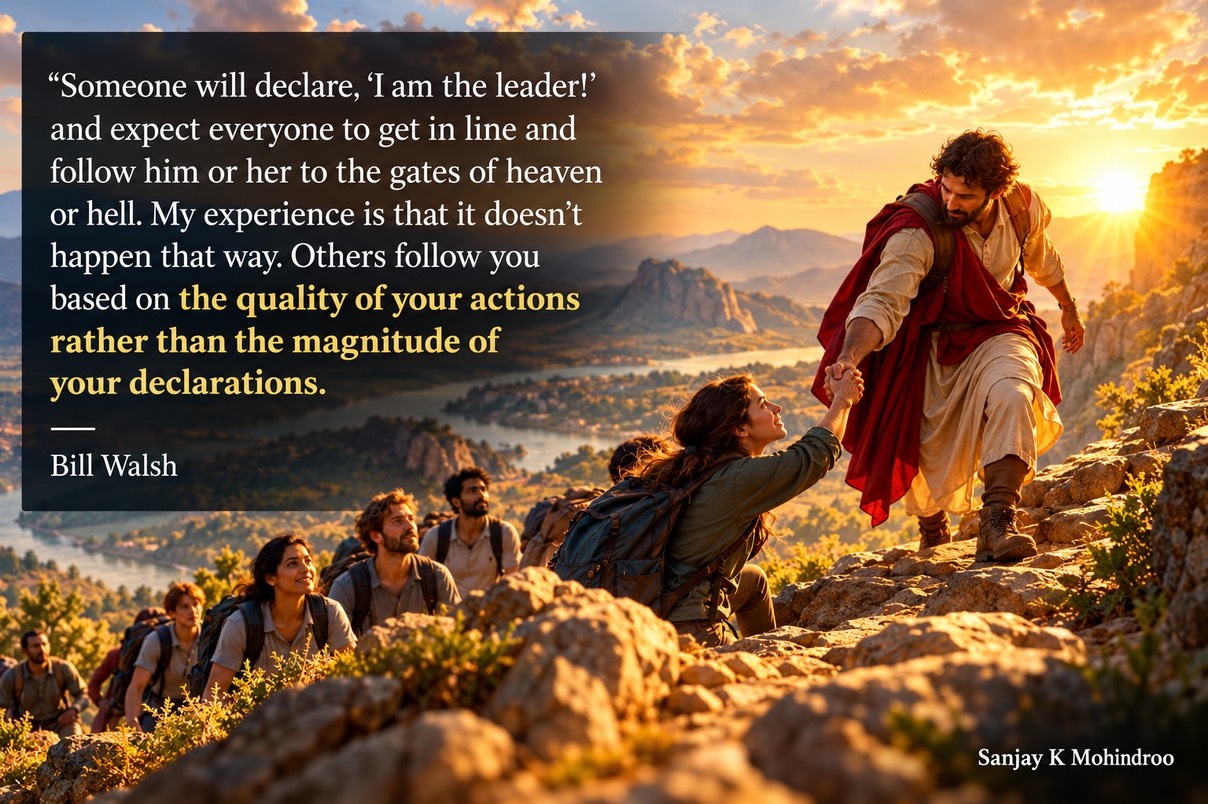
Sanjay K Mohindroo
True leadership is not announced. It becomes visible through the choices people make, especially when their actions carry more weight than their words.
Leadership is earned through consistent actions that build trust, credibility, and influence, not through titles or declarations.
Leadership Needs No Announcement
People Decide Whom They Are Willing to Follow
Leadership is easy to claim and much harder to demonstrate.
A position can place someone at the head of a table. A title can provide authority. Neither can guarantee that people will genuinely trust, respect, or follow that person.
Bill Walsh captured this distinction powerfully:
“Someone will declare, ‘I am the leader!’ and expect everyone to get in line and follow him or her to the gates of heaven or hell. My experience is that it doesn’t happen that way. Others follow you based on the quality of your actions rather than the magnitude of your declarations.”
His message reaches far beyond business or professional leadership. It speaks to something deeply human: we judge people less by what they claim and more by what they consistently show us.
The Illusion of Declared Leadership
Authority Can Be Assigned, but Influence Must Be Earned
Organizations need titles, reporting structures, and clear authority. Yet formal authority and genuine leadership are not the same thing.
A promotion may change how people address you. It does not automatically change how much they trust you.
People observe behavior closely. They remember who accepts responsibility when something goes wrong. They notice who shares credit when things go right. They see who remains fair under pressure and who abandons principles when those principles become inconvenient.
These moments create a reputation far more powerful than any introduction on a business card.
Leadership begins when actions give people a reason to believe in the person behind the title.
Actions Create Trust
Consistency Turns Intentions into Credibility
Anyone can behave well when circumstances are comfortable. Character becomes clearer when choices carry a cost.
A leader who promises transparency must communicate honestly when the news is uncomfortable. Someone who values teamwork must support colleagues when they struggle. A person who speaks about accountability must accept responsibility for personal mistakes.
This consistency creates trust.
Trust rarely arrives through a grand gesture. It accumulates through ordinary moments when words and behavior repeatedly match.
That principle applies beyond the workplace. Parents, teachers, friends, entrepreneurs, coaches, and community leaders all influence others through example.
People may forget many things we tell them. They rarely forget how our actions made them feel about trusting us.
Leadership Happens in Small Moments
Daily Choices Often Matter More Than Dramatic Gestures
We sometimes imagine leadership as something displayed during major decisions or crises. Those moments matter, but they usually reveal habits already formed.
Leadership happens much earlier.
It appears when someone listens before responding. It appears when credit is shared without hesitation. It appears when difficult feedback is delivered with respect. It appears when someone chooses the right decision even when nobody is watching.
These choices may seem insignificant individually. Together, they establish character.
That is why leadership is less about creating an impressive moment and more about building a dependable pattern.
When people know what they can expect from you, confidence grows. When that expectation is reinforced by integrity and competence, influence follows naturally.
The Quiet Power of Example
People Often Copy Behavior Before They Follow Advice
There is another lesson hidden inside Walsh's perspective.
Every action communicates something.
A leader who remains calm during uncertainty permits others to think clearly. A leader who admits mistakes makes honesty safer for everyone else. A leader who treats people with dignity establishes a standard that can spread through an entire team.
The opposite is equally true.
People quickly notice the distance between declared values and daily behavior. Repeated inconsistency weakens credibility because people begin trusting the pattern rather than the promise.
This is why example remains one of the strongest forms of leadership.
You cannot control whether people admire your words. You can control whether your actions deserve their trust.
Let Your Actions Speak First
Leadership Becomes Visible Before It Becomes Recognized
There will always be moments when leaders need to speak clearly, communicate direction, and state expectations. Silence is not leadership either.
The deeper lesson is that words need evidence.
If you want people to trust you, behave in ways worthy of trust. If you expect accountability, practice it yourself. If you want commitment, demonstrate your own.
Leadership does not begin when people recognize your authority.
It begins when your actions give them a reason to follow.
You can declare who you want to be. Your actions reveal who you actually are.
#Leadership #LifeLessons #ActionsOverWords #Trust #Influence #Integrity #PersonalGrowth #LeadershipLessons
A Leadership Philosophy Forged Through Performance
Bill Walsh was the legendary American football coach who led the San Francisco 49ers to three Super Bowl championships. His thinking extended beyond winning games into culture, preparation, standards, and human behavior. His perspective remains relevant because leadership still depends on earning trust through consistent performance.
Progress Has a Price

Sanjay K Mohindroo
Frederick Douglass reminds us that struggle can become a powerful force for growth, courage, and meaningful progress.
Resistance does not always mean you are on the wrong path. Sometimes, it means you are moving.
The Part of Progress We Prefer to Avoid
Growth often begins before life becomes comfortable
“If there is no struggle, there is no progress.” — Frederick Douglass
Most of us want progress without the uncertainty that often comes before it. We want stronger careers without difficult decisions. We want better relationships without uncomfortable conversations. We want personal growth without confronting habits that hold us back.
Life rarely works that way.
Struggle is not automatically valuable. Some hardship is unnecessary, unfair, or destructive. Yet resistance can also become a powerful teacher when we respond to it with purpose.
The real question is not whether we will face difficulty. It is what we will make of it.
Struggle Changes Our Relationship With Growth
Progress often demands more than ambition
It is easy to associate progress with visible achievements. Promotions, milestones, recognition, and financial success are easy to measure.
The harder changes often happen quietly.
A rejection can force us to examine our preparation. Failure can expose assumptions we never questioned. Conflict can reveal where communication has broken down. Uncertainty can make us confront choices we have postponed.
These moments rarely feel productive while we are experiencing them.
Yet they can create the conditions for personal growth because they demand a response. We must adapt, reconsider, practice, persist, or choose another direction.
Progress starts when resistance becomes information rather than an excuse to stop.
Comfort Can Hide Our Weaknesses
Ease rarely tests what we are capable of becoming
Comfort has value. We need stability, rest, safety, and moments when life feels manageable.
But comfort does not always reveal our limits.
Pressure can expose gaps in our skills and thinking. A demanding project can reveal whether we communicate clearly. A setback can test our patience. A difficult decision can show whether our stated values actually shape our actions.
This does not mean we should search for suffering.
It means we should avoid assuming that difficulty proves we are failing.
Sometimes resistance appears because we are attempting something larger than our current abilities. The challenge then becomes an invitation to expand those abilities.
That is where perseverance becomes meaningful. It is not endless endurance. It is the decision to keep improving while paying attention to what experience teaches us.
Productive Struggle Requires Reflection
Hardship alone does not create wisdom
There is an important distinction between experiencing struggle and growing through it.
Pain does not automatically produce insight. Failure does not automatically create better judgment. Repeating the same mistake for years is not perseverance.
Reflection turns experience into understanding.
After a setback, ask what was within your control. Examine which assumptions proved wrong. Consider which skills were missing. Decide what you would change before trying again.
This approach turns struggle into useful feedback.
The lesson may sometimes be persistence. At other times, the lesson may be patience, preparation, humility, or even the courage to walk away.
Real progress comes from knowing the difference.
Resistance Can Reveal Direction
Difficult moments often clarify what matters
Struggle has another unexpected effect. It can remove distractions.
When circumstances become difficult, priorities often become clearer. We begin separating what matters from what merely looked important.
Leaders experience this during crises. Entrepreneurs experience it when plans fail. Families experience it during periods of uncertainty. Individuals experience it whenever life forces a difficult choice.
Those moments can reveal character because comfortable circumstances rarely demand the same clarity.
We begin asking better questions.
What deserves my energy? What must change? What am I willing to work for? What should I stop carrying?
Those questions can redirect an entire life.
Do Not Waste the Resistance
The obstacle may contain information you need
The aim is not to celebrate hardship or pretend every struggle has a hidden reward.
The better response is to remain curious about what resistance can teach us.
When progress becomes difficult, examine the difficulty before abandoning the direction. It may expose a weakness that needs work, a belief that needs reconsideration, or a strength you have not yet tested.
Some struggles should end. Others should change us.
Wisdom lies in recognizing which one you are facing.
Progress does not require loving the difficult season. It requires refusing to leave it empty-handed.
Frederick Douglass and the Demand for Change
His words emerged from a struggle far greater than everyday inconvenience
Frederick Douglass was an American abolitionist, writer, orator, and formerly enslaved man who became a major voice against slavery. His perspective connected meaningful social change with resistance against entrenched injustice. That idea remains relevant whenever individuals or societies confront barriers that cannot be overcome through comfort alone.
#ThoughtOfTheDay #LifeLessons #PersonalGrowth #Progress #Perseverance #Leadership #Motivation
The Battles No One Sees

Sanjay K Mohindroo
Jesse Owens reminds us that life's deepest victories happen within, where character, discipline, and self-belief are formed.
The victories that shape us most rarely come with medals, headlines, or applause.
Beyond the Finish Line
Some of life's most important contests have no audience.
We naturally notice visible achievement. We celebrate the promotion, medal, successful business, impressive title, or public recognition. These moments matter, but they rarely tell the complete story.
Jesse Owens captured that distinction powerfully:
“The battles that count aren't the ones for gold medals. The struggles within yourself, the invisible, inevitable battles inside all of us—that's where it's at.”
Behind almost every visible achievement sits an invisible struggle. Someone had to overcome fear, doubt, disappointment, distraction, insecurity, or the temptation to stop.
That private struggle often shapes us more than the public result.
Success Has an Invisible Side
The outcome is visible, but the struggle usually is not.
We tend to judge success through outcomes because outcomes are easy to see. A medal provides evidence. A promotion changes a title. Revenue appears on a statement.
Internal progress offers fewer obvious signals.
Nobody sees every morning when you choose discipline over comfort. Few people notice when you remain patient during uncertainty. There is no public ceremony for rebuilding confidence after failure.
Yet these moments create the foundation beneath lasting achievement.
External success tells people what you accomplished. Internal growth determines who you became while accomplishing it.
The Opponent Often Lives Within
Our strongest resistance does not always come from outside.
It is tempting to believe circumstances are our greatest obstacles. Sometimes they are. Yet many defining struggles happen between competing voices inside us.
One says continue. Another says stop.
One asks for patience. Another demands immediate results.
One recognizes possibility. Another remembers every previous failure.
These tensions are part of being human. Courage does not require their disappearance. It means deciding which voice deserves authority.
That decision must often be made repeatedly.
Self-belief works the same way. It rarely arrives fully formed. We build it by keeping promises to ourselves, especially when nobody else is watching.
Character Is Built in Private
Repeated choices eventually become identity.
Character rarely changes through one dramatic moment. It develops through ordinary decisions repeated over time.
Consider the person who continues working after rejection. Think about someone who admits a mistake when hiding it would be easier. Consider the leader who remains calm while uncertainty surrounds the team.
These actions may attract little attention.
But each decision leaves something behind.
Discipline becomes stronger. Judgment becomes clearer. Confidence becomes less dependent on approval.
This is where personal growth becomes practical. We stop asking only whether we succeeded and begin asking whether our choices strengthened the person we want to become.
Winning Without Applause
Recognition can motivate us, but it cannot define us.
External recognition feels good because humans naturally value acknowledgment. Problems begin when recognition becomes our only measure of progress.
Some of our greatest victories may remain invisible to everyone else.
Choosing restraint during anger can be a victory. Starting again after disappointment can be another. Walking away from something that conflicts with your values may require more courage than pursuing something prestigious.
These moments rarely produce trophies.
They produce something more durable: self-respect.
When we recognize quiet victories, our definition of success becomes broader and healthier. Achievement still matters, but character becomes part of the measurement.
The Medal Within
The person you become matters as much as the finish line you cross.
Life will always contain visible contests. Careers, relationships, ambitions, and responsibilities naturally create goals worth pursuing.
But another contest continues beneath them.
We are constantly deciding whether fear or courage leads us, whether comfort or discipline shapes us, and whether setbacks define or strengthen us.
Pay attention to those choices.
Celebrate the promotion and the medal when they come. But also recognize the morning you continued when quitting seemed easier.
The crowd may never see that victory.
You will.
And sometimes, that is the victory that changes everything.
#ThoughtOfTheDay #PersonalGrowth #InnerStrength #SelfBelief #Discipline #Courage #LifeLessons #Leadership
Jesse Owens understood both public triumph and private struggle.
Jesse Owens was an American track and field champion who won four gold medals at the 1936 Berlin Olympics. His perspective matters because extraordinary public achievement demanded discipline far beyond the moments spectators witnessed. His message remains relevant because people still face private struggles that recognition alone cannot resolve.
The Courage to Go Through

Sanjay K Mohindroo
Robert Frost reminds us that real progress often begins when we stop avoiding difficulty and start moving through it.
Some difficulties disappear only after we stop searching for ways around them.
The Instinct to Escape
The hardest path may also be the most freeing.
Human beings naturally move away from discomfort. We postpone difficult conversations, delay decisions, and distract ourselves from problems we would rather not face.
Sometimes that instinct protects us. But avoidance can also keep us trapped inside the very situation we want to escape.
Robert Frost captured this tension in a remarkably simple line:
“The best way out is always through.” — Robert Frost
The message is not that suffering should be celebrated. Some problems lose their power only when we face them directly.
Moving forward may feel uncomfortable. Remaining stuck often costs far more.
Avoidance Has a Hidden Cost
Temporary relief can create lasting pressure.
Avoidance often feels good in the moment.
We postpone the conversation and feel immediate relief. We ignore the decision and temporarily escape responsibility. We hide from uncertainty and convince ourselves that more time will make everything clearer.
Sometimes time does help. Often, however, the unresolved issue follows us.
A difficult conversation becomes resentment. An ignored mistake becomes a larger problem. Fear of failure slowly becomes fear of trying.
The challenge itself may remain unchanged, but our anxiety around it grows.
That is the hidden cost of avoidance. We escape the moment without escaping the problem.
Action Changes Our Relationship with Fear
Confidence often follows movement rather than preceding it.
People commonly assume they need confidence before taking action.
Life frequently works in the opposite direction.
We speak despite feeling nervous. We decide without complete certainty. We attempt something knowing failure remains possible.
Then something changes.
The problem may still exist, but we are no longer standing motionless before it. Action gives us information. Experience replaces imagination. Uncertainty becomes something we can work with.
Courage is rarely the absence of fear. It is the decision that fear will not make every choice for us.
Through Does Not Mean Reckless
Facing reality still requires judgment.
Moving through difficulty does not mean forcing ourselves into every painful situation.
There are unhealthy relationships to leave, unnecessary conflicts to avoid, and circumstances where changing direction shows wisdom.
The deeper principle is about honesty.
Are we changing course because another path makes sense? Or are we running because facing the issue feels uncomfortable?
That distinction matters.
Sometimes progress means persistence. Sometimes it means admitting a mistake. Sometimes it means asking for help, apologizing, setting a boundary, or beginning again.
The form changes. The principle remains: face reality before deciding what comes next.
The Next Step Is Usually Smaller Than We Think
Progress rarely requires solving everything today.
Large problems can make action feel impossible because we imagine confronting everything at once.
But most progress begins much smaller.
Send the message. Make the appointment. Open the document. Admit the problem. Ask the question. Have the conversation.
One honest action creates momentum.
This matters in life, leadership, relationships, and personal growth. People who move forward are not always more fearless. They may simply become better at acting before fear disappears.
Forward Is a Practice
Difficult moments become manageable when movement replaces avoidance.
We cannot choose every difficulty that enters our lives. We can choose how long we allow avoidance to make those difficulties larger.
Facing something does not guarantee an easy outcome. It gives us the chance to influence what happens next.
When a problem feels overwhelming, reduce the scale of the question. Stop asking how you will solve everything.
Ask instead: What is the next honest step I can take?
Take it.
Sometimes the doorway forward appears only after we begin walking toward it.
#ThoughtOfTheDay #Courage #PersonalGrowth #LifeLessons #OvercomingFear #MovingForward #Mindset
A poet whose simple language carried deeper truths.
Robert Frost was an American poet known for writing about human choices, nature, work, and everyday experience. This thought matters because it turns a complex emotional struggle into a practical principle about courage and action. Its perspective remains relevant because avoidance, uncertainty, and difficult choices remain part of every human life. #ThoughtOfTheDay #Courage #PersonalGrowth #LifeLessons #OvercomingFear #MovingForward #Mindset
When Inspiration Fades, Habit Remains

Sanjay K Mohindroo
Inspiration comes and goes. Habit creates the consistency, discipline, and persistence that turn intentions into finished work.
Great work rarely depends on feeling inspired every day. It depends on returning to the work anyway.
The Problem with Waiting to Feel Ready
Inspiration feels powerful because it makes effort seem effortless.
We often romanticize inspiration. We imagine our best work arriving through sudden clarity, energy, or creative excitement.
Octavia Butler offered a much less romantic idea:
“First, forget inspiration. Habit is more dependable. Habit will sustain you whether you're inspired or not. Habit will help you finish and polish your stories. Inspiration won't. Habit is persistence in practice.”
Her point reaches far beyond writing.
Careers, relationships, health, leadership, and personal growth all require effort after enthusiasm disappears. Inspiration may create movement, but habit creates continuity.
That difference matters because much of life happens on ordinary days.
Inspiration Is a Spark, Not a System
Energy can begin the journey, but it cannot be trusted to sustain it.
Feeling inspired is wonderful. The problem begins when we make inspiration a requirement for action.
Our energy changes. Our confidence changes. Circumstances interrupt us. Some mornings bring ambition, while others bring distraction, doubt, or fatigue.
If action depends on motivation, progress becomes unpredictable.
Habit changes the equation. It reduces the number of emotional negotiations between intention and action. Instead of asking whether we feel like starting, we simply return to the practice.
That creates consistency, and consistency gives good intentions somewhere to go.
Ordinary Days Build Extraordinary Results
The least dramatic repetitions often produce the most meaningful progress.
We tend to notice breakthroughs because they make good stories. We rarely notice the hundreds of repetitions behind them.
A writer completes pages. An athlete repeats movements. A leader keeps difficult commitments. A professional improves through years of small decisions made with care.
None of these actions needs to feel remarkable.
That is precisely their strength.
Persistence allows skill to compound quietly. Repetition exposes weaknesses, creates feedback, and turns conscious effort into dependable behavior.
The goal is not endless repetition without thought. Strong habits include reflection and adjustment. Practice works best when we keep improving the practice itself.
Discipline Creates Freedom
Structure can feel restrictive until it starts removing unnecessary choices.
People sometimes treat discipline as the opposite of creativity or freedom. In practice, structure can protect both.
A dependable routine reserves time for what matters before competing demands consume it.
Writers do not need to search constantly for the perfect creative moment. Leaders do not need fresh motivation to honor every commitment. Anyone pursuing meaningful work can create conditions that make action easier to repeat.
This is where self-discipline becomes less about force and more about design.
A useful habit makes the desired behavior easier to begin and harder to avoid.
Finishing Changes Everything
Starting reveals possibility. Finishing turns possibility into something real.
Many people can begin when excitement is high. Fewer remain engaged through revision, repetition, setbacks, and boredom.
Yet those later stages often determine quality.
The first attempt reveals an idea. Repeated effort shapes it. Editing, correcting, testing, and returning transform rough potential into finished work.
Creative consistency matters because talent needs time to become visible.
The same principle applies to life. Character is rarely defined by one dramatic decision. It develops through repeated choices that gradually become part of who we are.
Build Something You Can Depend On
Your future needs more than occasional motivation.
Inspiration deserves a place in our lives. It can awaken ambition, create possibilities, and remind us what matters.
But we should not make progress dependent upon it.
Choose one important practice and make returning to it easier. Give it a time, place, or trigger. Keep the commitment small enough to survive difficult days.
Then return tomorrow.
The most powerful habit may simply be becoming someone who keeps showing up.
#Habit #Consistency #Discipline #Persistence #Motivation #PersonalGrowth #CreativeProcess #ThoughtOfTheDay
Octavia Butler and the Discipline Behind the Work
Her perspective came from a life devoted to serious creative practice.
Octavia E. Butler was an acclaimed American science fiction writer whose work earned major literary recognition. Her words matter because they connect creative achievement with persistence rather than romantic ideas about talent. That perspective remains relevant wherever people must produce meaningful work without waiting for perfect conditions.
The Mirror Within: The Art of Understanding Others

Sanjay K Mohindroo
Self-awareness opens the door to empathy, deeper relationships, and a more meaningful life.
Explore how self-awareness builds empathy, improves relationships, and helps us understand others through honest self-reflection.
The Journey Begins Within
The courage to understand ourselves
We spend much of our lives trying to understand other people. We interpret their words, question their decisions, and sometimes judge their actions. Yet, we rarely give ourselves the same attention.
Bruce Lee once observed, “We can see through others only when we can see through ourselves.”
This thought carries a powerful message about human nature. Our understanding of others depends greatly on how honestly we examine our own emotions, beliefs, and expectations.
Self-awareness is not simply about recognizing our strengths and weaknesses. It is about understanding how our inner experiences shape how we see people. When we begin looking inward, we create space for empathy, patience, and more meaningful connections.
The Mirror of Self-Awareness
Recognizing the person behind our reactions
Every interaction reveals something about us. A disagreement may expose our insecurities, while criticism may reveal our need for approval. Even a simple misunderstanding can uncover assumptions we never knew we held.
When we become aware of these patterns, we gain greater control over our responses. Instead of reacting emotionally, we can pause, reflect, and choose a more thoughtful approach.
Self-awareness also requires accepting uncomfortable truths. We may recognize moments when pride influences our decisions or fear shapes our judgment. This honesty is not a sign of weakness. It is an important part of personal growth.
The better we understand our own behavior, the less likely we are to project our feelings onto others.
Empathy Begins with Honest Reflection
Seeing beyond our personal experiences
Empathy allows us to recognize that everyone carries experiences we may never fully understand. People respond differently to challenges because their histories, values, and emotions are different.
However, our assumptions can easily become barriers to understanding. We may interpret silence as indifference, confidence as arrogance, or disagreement as disrespect.
Self-reflection helps us question these interpretations. It reminds us that our perspective is only one part of a much larger human experience.
When we listen with genuine curiosity, we make room for different opinions and emotions. Empathy does not require us to agree with everyone. It asks us to understand their perspective before forming a judgment.
The Impact on Relationships and Leadership
Building trust through thoughtful understanding
Self-awareness influences the quality of every relationship, from family connections to professional partnerships. People feel respected when someone listens carefully and responds without unnecessary judgment.
In leadership, this quality becomes particularly valuable. Leaders who understand their own reactions can manage disagreements with greater patience. They can accept feedback, acknowledge mistakes, and create an environment where others feel comfortable expressing themselves.
At home, self-awareness can prevent small misunderstandings from becoming lasting conflicts. In friendships, it encourages honest conversations and mutual respect.
Understanding ourselves does not remove every disagreement. It helps us approach differences with greater maturity and consideration.
Turning Awareness into Everyday Action
Making reflection a regular practice
Self-awareness grows through consistent attention to our thoughts and actions. It does not require dramatic changes or complicated routines. Small, deliberate moments of reflection can gradually transform how we relate to others.
Before reacting to a difficult conversation, consider what emotion is shaping your response. When someone challenges your opinion, ask whether you are listening to understand or simply preparing to defend yourself.
It also helps to invite honest feedback from people we trust. Their observations may reveal patterns that remain invisible to us.
Over time, these practices can strengthen emotional understanding and encourage more thoughtful decisions. The real value of reflection appears in the way we treat people every day.
Understanding Others Through Inner Clarity
A more thoughtful way to live
Understanding people begins with the willingness to examine ourselves honestly. Our beliefs, emotions, and past experiences influence every interaction, often more than we realize.
When we recognize these influences, we become more patient listeners, more considerate partners, and more thoughtful leaders. We also become better prepared to accept differences without feeling threatened by them.
The next time someone challenges your perspective, pause before concluding. Consider what your reaction reveals about your own expectations.
The path to understanding others starts with the courage to understand the person looking back at us in the mirror.
#SelfAwareness #Empathy #PersonalGrowth #EmotionalIntelligence #BruceLee #LifeLessons #MindfulLiving #ThoughtOfTheDay
The Philosophy of Bruce Lee
A perspective beyond martial arts
Bruce Lee was a martial artist, actor, and philosopher whose ideas explored personal growth, discipline, and human potential. His philosophy encouraged people to question limitations and develop a deeper understanding of themselves. His reflections on self-awareness and adaptability remain relevant to relationships, leadership, and the choices we make today.