
Sanjay K Mohindroo
Stop measuring your full reality against someone else’s polished moments. Build confidence through fairer comparison and self-awareness.
Confidence becomes steadier when we stop judging our private struggles against someone else’s public success.
The Unfair Scoreboard
We often compare two very different versions of reality.
Most insecurity does not begin with failure. It begins with comparison that feels reasonable but uses unequal evidence.
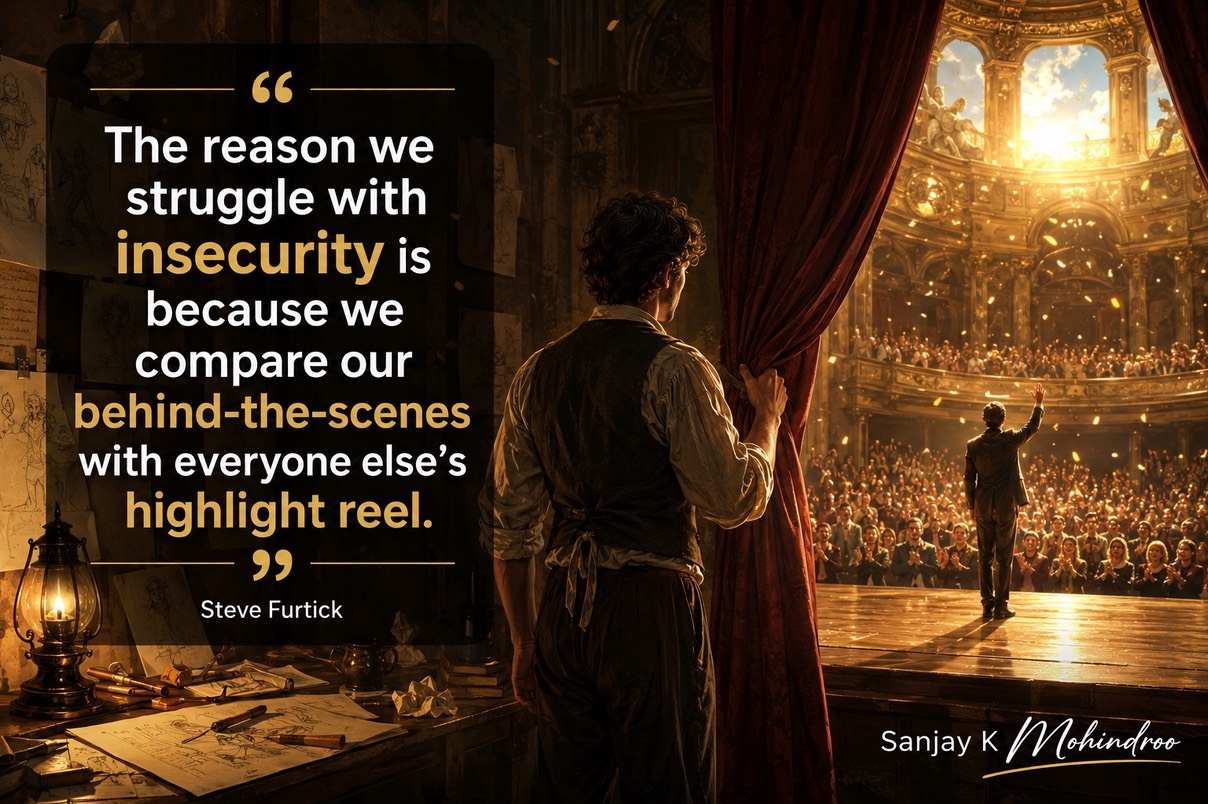
"The reason we struggle with insecurity is because we compare our behind-the-scenes with everyone else’s highlight reel." — Steve Furtick
We know every unfinished thought, delayed goal, awkward mistake, and private doubt in our own lives. Yet we often meet others through visible outcomes: the promotion, the celebration, the strong presentation, the successful launch, or the polished photograph.
That difference matters. We are comparing our raw footage with someone else’s edited scene.
Comparison Is Not the Enemy
The real problem is incomplete context.
Comparison can help us set standards, test assumptions, and see possibilities. The trouble starts when we treat partial information as complete evidence.
A colleague’s promotion may look effortless from the outside. We may not see years of rejection, extra responsibility, support from mentors, or personal sacrifice. A friend’s confidence may seem natural, while we never see the doubts they manage privately.
The visible outcome is real. The missing context is real too.
When we ignore that missing context, admiration can quietly become self-criticism.
Social Proof Can Distort Self-Worth
Repeated exposure to polished outcomes can change our internal standards.
Human beings naturally use other people as reference points. That instinct becomes risky when the reference point is heavily filtered.
We start asking, “Why am I not there yet?” instead of asking whether the comparison is fair. We judge our pace without knowing their starting point. We judge our progress without knowing their resources, timing, or trade-offs.
This can affect confidence at work, in relationships, and in personal growth. The mind turns another person’s result into evidence about our own value.
But another person’s success is not proof of our inadequacy.
Build a Better Personal Scoreboard
Measure progress using evidence you actually understand.
A healthier comparison starts closer to home. Compare your current choices with your earlier habits. Compare your present capability with what you could handle one year ago.
Ask whether you communicate more clearly, recover faster from setbacks, make better decisions, or act with greater consistency. These measures may look less dramatic, but they are more honest.
Self-awareness does not require ignoring other people. It requires placing their achievements in the right context.
Use others for inspiration, not as a verdict.
Confidence Needs Perspective, Not Perfection
A fuller view of progress creates steadier self-belief.
Confidence is often misunderstood as certainty. In practice, it is closer to trust: trust that you can keep moving while things remain unfinished.
That trust grows when you stop demanding a polished life from yourself every day. Real progress includes hesitation, wrong turns, slow seasons, and private effort.
A strong life is not one without messy chapters. It does not mistake those chapters for the entire story.
Keep the Comparison Fair
Your progress deserves to be judged with complete evidence.
The next time comparison triggers insecurity, examine the information behind the judgment. Are you comparing full context with a visible outcome?
If so, change the measure.
Track your own progress with honesty. Respect another person’s success without turning it into a sentence against yourself.
The most useful scoreboard is the one that helps you move forward without losing perspective.
#SelfAwareness #Confidence #PersonalGrowth #Mindset #SelfWorth #LifeLessons #ThoughtOfTheDay #Perspective
Steve Furtick is an American pastor, speaker, and author known for messages about faith, identity, and personal growth. This quote matters because it names a common mental error behind insecurity and comparison. The perspective remains relevant because public success is often far more visible than private struggle.