
Sanjay K Mohindroo
A reflection on why lifelong learning matters more than formal schooling in building wisdom, character, and lasting success.
The classroom may introduce knowledge, but life reveals its true value.
More Than a Diploma
Education begins where curiosity refuses to stop.
Most people associate education with classrooms, examinations, and certificates. Those experiences certainly matter, but they represent only one chapter of a much larger story.
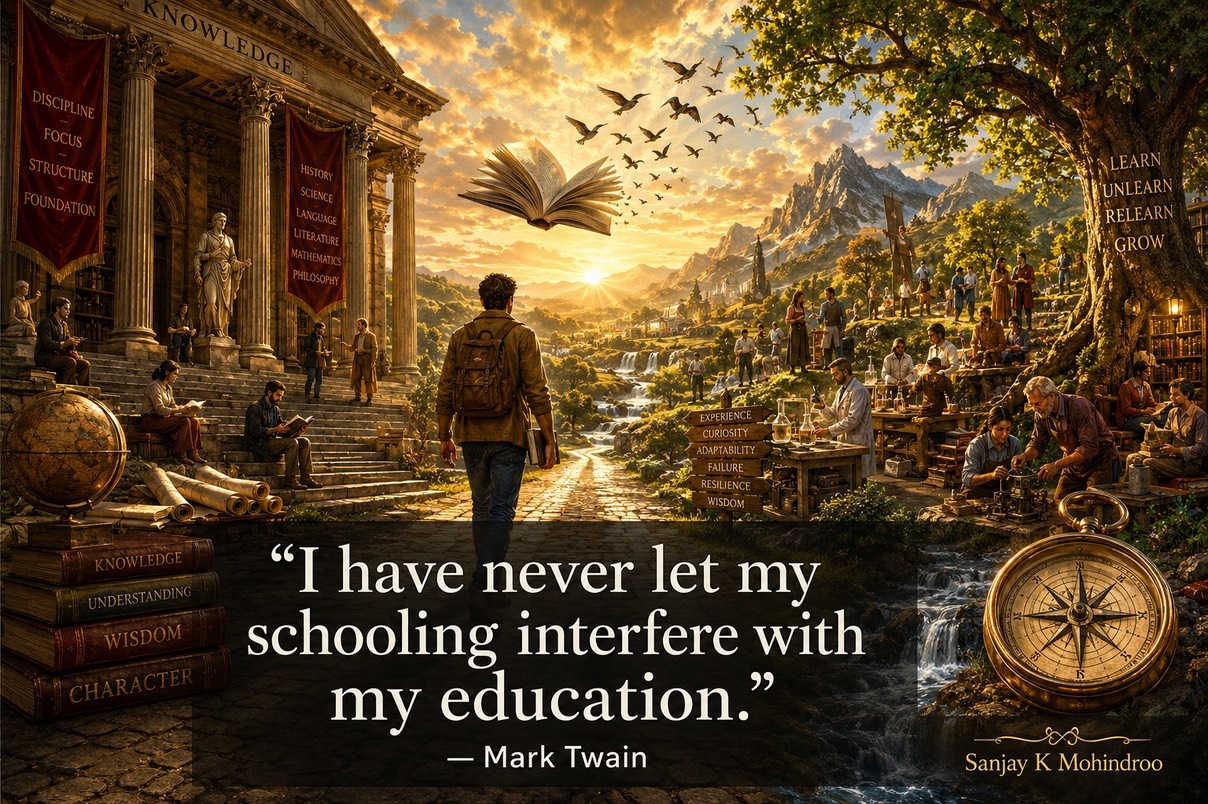
Mark Twain once said, "I have never let my schooling interfere with my education."
The statement challenges a common belief. Schooling provides structure, while education is the lifelong process of observing, questioning, experimenting, and growing. The greatest lessons often arrive when no one is grading our work.
The Difference Between Schooling and Education
Knowledge Has Two Homes
One teaches facts. The other shapes understanding.
Schooling gives us a foundation. It introduces ideas, disciplines, and methods that help us understand the world. Without it, many opportunities would remain out of reach.
Education, however, continues long after the final examination. It grows through conversations with people from different backgrounds, mistakes that force reflection, books chosen out of curiosity, and experiences that challenge existing beliefs.
The diploma may mark the end of formal study, but it should never mark the end of learning.
Experience Gives Knowledge Meaning
Lessons Earned Through Action
Understanding deepens when ideas meet reality.
Reading about leadership differs greatly from leading a team through uncertainty. Learning financial principles differs from making difficult business decisions. Communication looks simple in theory until emotions enter the conversation.
Life has a remarkable way of turning information into wisdom.
Every setback offers feedback. Every success reveals habits worth repeating. Every unexpected situation teaches flexibility, patience, and judgment.
Experience does not replace education. It completes it.
Curiosity Creates Lifelong Growth
Questions Keep the Mind Alive
The willingness to learn matters more than the certainty of knowing.
Many accomplished professionals share one habit. They remain students regardless of their titles.
They read widely. They seek different viewpoints. They welcome constructive criticism. They stay open to changing their opinions when presented with better evidence.
Curiosity keeps the mind active because it removes the fear of not knowing. Instead of protecting existing knowledge, curious people continuously expand it.
In a rapidly changing society, the ability to keep learning often becomes more valuable than what we already know.
Success Belongs to Continuous Learners
Growth Is a Daily Decision
Progress comes from consistent improvement, not occasional inspiration.
Technology changes. Industries change. Careers change.
The people who continue to thrive are not necessarily those with the highest academic achievements. They are the individuals who remain adaptable and committed to improving their skills.
Continuous learning strengthens confidence because it builds competence over time.
Small lessons accumulated every day often create extraordinary results years later.
The Classroom Never Truly Closes
A curious mind is life's greatest advantage.
Formal education provides direction, but curiosity determines how far we travel.
Each conversation, challenge, failure, and opportunity has something to teach us if we choose to pay attention.
The most educated person is not always the one with the longest list of qualifications. It is often the one who never stops asking questions, embracing change, and turning everyday experiences into lasting wisdom.
The best education continues long after graduation.
#LifelongLearning #PersonalGrowth #Education #Leadership #GrowthMindset #Learning #MarkTwain #ThoughtLeadership #SelfDevelopment
A Voice That Still Speaks Across Generations
Perspective Beyond Time
Mark Twain was an American author, humorist, and keen observer of human nature whose insights continue to inspire readers worldwide.
His words remind us that true education extends beyond classrooms and formal instruction.
In an era of constant change, his perspective encourages lifelong curiosity, adaptability, and personal growth.