

Thought of the Day
The Lessons Life Keeps Bringing Back

Sanjay K Mohindroo
Finding Meaning in Difficult Experiences
Every challenge carries the possibility of greater self-awareness, deeper understanding, and meaningful change.
Meta Description: Explore how recurring life challenges reveal valuable lessons, deepen self-awareness, and create opportunities for personal growth.
When Life Asks Us to Pay Attention
Some of life's most meaningful lessons arrive through experiences we would rather avoid. A difficult relationship, a repeated mistake, or an unexpected setback can leave us questioning our choices and direction.
Pema Chödrön expresses this perspective through a powerful observation:
“Nothing ever goes away until it teaches us what we need to know.”
Her words invite us to look beyond immediate discomfort and consider what our experiences reveal. Rather than treating every challenge as an obstacle, we can view it as an opportunity to understand ourselves better. This shift in perspective can change how we approach relationships, decisions, leadership, and personal growth.
The Patterns We Often Overlook
Recognizing the Messages Within Our Experiences
Life sometimes presents familiar situations in different forms. We may encounter similar conflicts in relationships, repeat unhelpful habits, or face the same doubts at important moments. These patterns can reveal beliefs, expectations, or behaviors that deserve closer attention.
However, repetition does not always mean that we have failed to understand a lesson. Circumstances can remain beyond our control, and some difficulties have no hidden meaning. The value lies in examining our responses and identifying where change remains possible.
Awareness allows us to recognize familiar patterns before they shape our next decision.
The Courage to Face Discomfort
Growth Begins Where Avoidance Ends
Human beings naturally seek comfort and certainty. When an experience causes emotional pain, avoiding it may seem like the easiest way forward. Yet unresolved feelings and unanswered questions can continue to influence our choices.
Facing discomfort does not mean accepting harmful situations or remaining in unhealthy relationships. It means giving ourselves space to acknowledge difficult emotions, understand our needs, and make thoughtful decisions.
When we replace avoidance with honest reflection, we create room for emotional maturity. We begin responding to situations with intention rather than allowing old reactions to dictate our behavior.
Turning Experience Into Wisdom
From Reflection to Meaningful Action
Understanding a difficult experience is only part of personal growth. The real change begins when insight influences our actions, decisions, and relationships.
A failed decision might encourage better judgment. A challenging relationship might teach us to establish healthier boundaries. A professional setback might reveal the importance of preparation, communication, or asking for support.
These lessons become valuable when we apply them without allowing the past to define our future. Growth does not require perfection. It requires a willingness to question old assumptions, accept responsibility, and make better-informed choices.
Applying Life's Lessons to Leadership
Awareness Creates More Thoughtful Decisions
The lessons we encounter personally can also influence how we lead others. Leaders who reflect on difficult experiences often become more attentive to communication, accountability, and the impact of their decisions.
Instead of repeating familiar responses, thoughtful leaders examine what worked, acknowledge mistakes, and remain open to different perspectives. This approach can build trust and encourage others to speak honestly about challenges.
In leadership and in life, experience becomes meaningful when reflection leads to constructive action. The ability to recognize our own patterns can help us create healthier relationships and more thoughtful environments.
Moving Forward with Greater Understanding
Life will not always provide clear answers or convenient opportunities for growth. Some experiences remain painful, and some questions may never receive satisfying explanations.
Still, we can choose how we respond to what happens. We can examine our patterns, accept our emotions, seek support when needed, and make decisions that reflect our values.
The next time a familiar challenge appears, pause before reacting. Ask yourself what you can understand, what you can change, and what you may need to leave behind.
The greatest value of an experience may not lie in what happened, but in the wisdom we carry forward.
#PersonalGrowth #LifeLessons #SelfAwareness #Mindfulness #EmotionalIntelligence #InnerWisdom #PositiveMindset #ThoughtOfTheDay
The Perspective of Pema Chödrön
Pema Chödrön is an American Buddhist nun, author, and teacher known for making Buddhist teachings accessible to everyday life. Her perspective emphasizes mindfulness, compassion, and the willingness to face uncertainty. Her reflections remain relevant because people continue to seek meaning, emotional balance, and a more thoughtful relationship with life's challenges.
Purpose Gives Life Direction

Sanjay K Mohindroo
A reflection on purpose, meaning, and the choices that turn existence into a life shaped by intention.
Birth starts the story. Purpose gives us a reason to shape it with intention.
The Question Beneath the Routine
A life can be full and still feel unfinished.
Many people spend years becoming busy before they become clear. We build careers, meet expectations, collect responsibilities, and move from one milestone to another. Yet a quieter question often remains underneath all that movement: What is this life for?
“The two most important days in your life are the day you’re born, and the day you find out why.”
The line speaks to a basic human need. We don’t just want to exist. We want our existence to mean something. Purpose gives our choices a center. It helps us decide where to invest our time, energy, talent, and attention.
Purpose Changes the Meaning of Success
Achievement feels different when it serves something larger.
Success is often measured through visible outcomes: money, status, recognition, influence, or titles. These things can matter, but they cannot answer every personal question.
Without a deeper reason, achievement can become strangely hollow. A person may reach a goal and still wonder why it mattered. Purpose changes that experience by connecting achievement to contribution.
The useful question is not only, “What do I want to accomplish?” It is also, “Who benefits if I accomplish it?” That shift can turn ambition into service and effort into meaning.
Purpose Is More Often Built Than Found
Clarity usually arrives through experience, not revelation.
The idea of “finding your purpose” can create unnecessary pressure. It can sound as though every person has one hidden answer waiting to be uncovered.
Life is rarely that tidy.
Purpose often develops slowly. Work shows us which problems we care about. Relationships reveal what we value. Failure removes borrowed definitions of success. Responsibility teaches us what we are willing to stand for.
This means uncertainty is not wasted time. Periods of searching can become the material from which purpose is formed.
Pay attention to recurring patterns. Notice the work that energizes you, the problems that hold your attention, and the people you feel called to help.
Purpose Requires Choice
Meaning becomes real only when it changes behavior.
A sense of purpose has little value if it remains a private thought. It must eventually affect how we live.
If family matters deeply, our calendar should show it. If service matters, our actions should create value for others. If integrity matters, it must survive inconvenient moments. If growth matters, we must keep stretching beyond comfort.
Purpose becomes credible when values and behavior begin to match.
That alignment also creates a useful filter. Many opportunities look attractive in isolation. A clear sense of direction helps us reject things that pull us away from the life we want to build.
Purpose Can Change Without Becoming False
Different seasons can call for different forms of meaning.
Purpose does not always remain fixed. At one stage, it may center on building capability. Later, it may focus on creating, leading, parenting, teaching, serving, or mentoring.
A changing purpose does not mean the earlier one was mistaken. It may simply mean life has widened your responsibilities.
The deeper thread often remains stable. The form changes, but the values underneath it continue.
A Life That Points Somewhere
Meaning is created when intention becomes practice.
We may never receive one perfect sentence explaining why we are here. That is not a failure.
A meaningful life can be built through repeated choices that reflect what matters most. Purpose gives those choices direction. It turns time into contribution and experience into something larger than personal achievement.
The important moment is not only realizing what matters. It is beginning to live as though it matters.
#LifePurpose #PurposefulLiving #PersonalGrowth #MeaningOfLife #ThoughtOfTheDay #LifeLessons #SelfReflection #MarkTwain
A familiar voice attached to an enduring idea.
Mark Twain was an American writer and humorist known for sharp observations about human nature and society. This quotation is widely attributed to him, although its exact origin is uncertain. The idea remains powerful because people still wrestle with the difference between merely living and living with purpose.
The Quiet Strength of Humility

Sanjay K Mohindroo
True humility protects confidence while reducing ego, creating space for stronger relationships, leadership, and personal growth.
Confidence becomes more meaningful when we stop needing every moment to confirm our importance.
Humility has little to do with making yourself smaller
Some people confuse humility with lowering their voice, hiding their achievements, or refusing recognition.
That interpretation misses the deeper point.
“True humility is not thinking less of yourself; it is thinking of yourself less.” — C.S. Lewis
The distinction is subtle, yet powerful.
You do not need to deny your strengths to become humble. You simply stop making your strengths the center of every interaction.
Humility allows confidence to exist without demanding applause. It shifts attention from protecting an image toward participating fully in the moment.
That change affects relationships, leadership, ambition, and even our sense of peace.
Humility Is Not Low Self-Worth
A healthy sense of self does not need constant reduction
Thinking poorly of yourself does not make you humble.
Someone who constantly minimizes their ability may still be deeply focused on themselves. Their attention remains fixed on personal value, judgment, approval, and comparison.
Healthy humility begins somewhere else.
It begins with knowing your worth without needing to repeatedly prove it.
A capable person can admit they are capable. An accomplished person can acknowledge their accomplishments. A confident person can take pride in work done well.
The difference appears in what happens next.
Secure confidence does not need every conversation to become evidence of superiority. It leaves enough emotional space to appreciate another person's talent without feeling threatened.
That is quiet confidence.
Ego Wants Attention
Humility redirects attention toward contribution
Ego constantly asks questions about position.
Did people notice me? Did I receive enough credit? Was my idea chosen? Do others understand my importance?
These thoughts are natural. Everyone experiences them.
Problems begin when they dominate our decisions.
When attention stays trapped around recognition, even good work can become exhausting. Every meeting becomes a test. Every disagreement feels personal. Someone else's success can feel like our loss.
Humility loosens that pressure.
Instead of asking whether we looked impressive, we can ask whether we were useful.
Instead of protecting status, we can focus on contribution.
The shift sounds small, but it changes behavior.
Strong Leadership Creates Room
People trust leaders who do not need to dominate every room
Leadership often exposes the difference between confidence and ego.
A leader driven by insecurity may need to have every answer. They may interrupt, defend weak ideas, or collect credit that belongs to the team.
A grounded leader behaves differently.
They can say, “I was wrong.”
They can ask someone else to take the lead.
They can listen without preparing a response while another person is speaking.
They can celebrate another person's success without inserting themselves into the story.
None of this reduces authority.
In many cases, it strengthens authority because people experience confidence that does not depend on control.
Humility creates psychological space. Other people feel safer contributing, disagreeing, experimenting, and taking ownership.
That makes humility practical, not merely admirable.
Freedom From Constant Comparison
Thinking about yourself less creates room for life itself
Humility also offers something beyond leadership.
It offers relief.
Much of our internal pressure comes from measuring ourselves against other people. We compare careers, recognition, appearance, wealth, relationships, and progress.
The comparison rarely ends because there is always another person ahead on some measure.
Thinking of yourself less interrupts that cycle.
Attention moves toward the conversation in front of you, the work that needs doing, the person who needs support, or the experience happening now.
You remain important.
You simply stop requiring yourself to be the main subject of every mental conversation.
That can be remarkably freeing.
Humility does not erase the self; it puts the self in perspective
The aim is not to become invisible.
The aim is to become secure enough that visibility is no longer the measure of your value.
Know your strengths. Build your abilities. Accept praise when it is deserved. Pursue meaningful ambition.
Then leave room for other people.
Listen without competing. Contribute without keeping score. Let another person shine without feeling diminished.
Humility becomes strongest when confidence no longer needs constant confirmation.
Sometimes the clearest sign that you know your worth is that you no longer need every moment to prove it.
#Humility #Leadership #SelfAwareness #PersonalGrowth #QuietConfidence #ThoughtOfTheDay #LifeLessons
A perspective that continues to resonate
C.S. Lewis was a British writer, scholar, and Christian thinker known for works on faith, morality, character, and human nature. The line attributed to him captures a useful distinction between humility and low self-esteem. Its message remains relevant because questions of ego, recognition, and self-worth still shape relationships and leadership today.
Time Is Going to Pass Anyway

Sanjay K Mohinsroo
A reflection on patience, perseverance, and choosing meaningful goals even when they take years to achieve.
The length of the road should not decide whether a meaningful dream deserves your effort.
The Clock Is Already Moving
A long timeline can make a good dream feel unrealistic.
We often admire ambition until it demands patience. A goal feels exciting when we imagine the result, yet much harder when we calculate the years between today and completion. That gap can make us hesitate before we begin.
“Never give up on a dream just because of the time it will take to accomplish it. The time will pass anyway.” — Earl Nightingale
The idea is simple, but uncomfortable. Time does not negotiate with us. It keeps moving whether we build, postpone, doubt, or begin.
The real choice is not whether the years will pass. The choice is what we want those years to contain.
The Timeline Can Become an Excuse
Distance can look like evidence that a goal is impractical.
People often abandon worthy ambitions before testing them. A degree may take years. A business may require patient work. A skill may need thousands of ordinary repetitions before it becomes exceptional.
We sometimes treat the length of the process as a reason not to start. Yet the same number of years will arrive whether we act or not.
When that future date comes, we may either hold the result of sustained effort or hold the same unfinished intention.
Patience changes when we see time as an asset rather than an obstacle.
Big Dreams Are Built in Ordinary Days
Progress rarely feels dramatic while it is happening.
Most meaningful achievements are formed through repeated, unremarkable choices. One page gets written. One client gets served well. One workout gets completed. One conversation strengthens a relationship.
The daily action may look small, but repetition gives it weight. This is why long-term goals can be misleading. We picture the final mountain instead of the next step.
A dream does not require you to complete everything today. It asks you to respect today enough to move forward.
Speed Is Not the Same as Progress
A slower path can still be the right path.
Modern culture often celebrates quick results. We notice sudden success and overlook the years that made it possible. This can create a false standard for our own lives.
Progress has no universal schedule. A meaningful goal may take longer because we are building skill, judgment, relationships, confidence, or financial stability alongside it.
The better question is not whether the result will arrive quickly. Ask whether the direction still matters and whether the next step remains worth taking.
Waiting Has a Cost Too
Doing nothing is still a decision about time.
Postponement can feel safe because it avoids failure. It also delays possibility. A year spent waiting for ideal conditions is still a year invested somewhere.
This does not mean pursuing every dream at any cost. Some goals should change as our values and circumstances change.
Mature persistence is not stubbornness. It is the ability to separate a difficult timeline from a wrong direction.
If the dream still matters, the passing years are not a reason to quit. They are a reason to begin with greater intention.
Give the Years a Direction
Time becomes meaningful when we decide what it should build.
There is freedom in accepting that worthwhile things can take time. We stop demanding immediate proof and start paying attention to steady progress.
Choose one ambition that still matters. Reduce it to a step you can take this week. Then repeat that discipline long enough for time to work with you rather than merely around you.
The years ahead are coming either way. Give them something worth carrying forward.
#Perseverance #Dreams #PersonalGrowth #Motivation #Purpose #LongTermThinking #Mindset
A Voice for Purposeful Living
An enduring perspective on ambition and personal responsibility.
Earl Nightingale was an American radio speaker and writer known for ideas about achievement, attitude, and personal responsibility. His perspective matters because it reframes patience as an active choice rather than passive waiting. That message remains useful whenever people feel pressured to measure success by speed.
Top of Form
Bottom of Form
The Trails We Carve With Every Thought
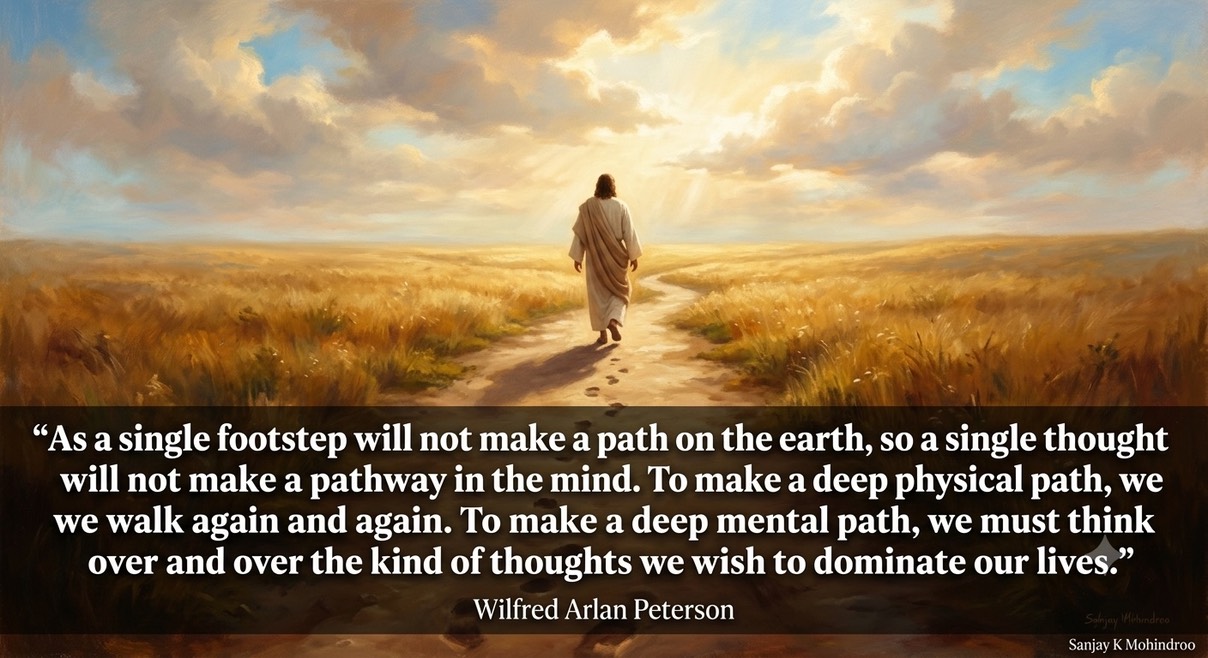
Sanjay K Mohindroo
Peterson's quote on repeated thought reveals how mental paths form and how to choose which ones deepen.
Repetition, not intensity, decides which thoughts come to define a life.
The Ground Remembers What You Repeat
Stand at the edge of an open field and take one step into the grass. Nothing changes. The blades bend and rise again within minutes. Walk that same line every morning for a season, and something different happens. The grass gives way. The soil compresses. A trail appears, not because any single step mattered more, but because the steps kept repeating.
Wilfred Arlan Peterson used this image to explain something the mind does too: "As a single footstep will not make a path on the earth, so a single thought will not make a pathway in the mind. To make a deep physical path, we walk again and again. To make a deep mental path, we must think over and over the kind of thoughts we wish to dominate our lives." A single flash of insight rarely changes a life on its own. What changes a life is the thought a person keeps returning to. This article looks at why repetition outweighs intensity, and what that means for the thoughts left to run unchecked.
Intensity Fades, Repetition Builds
Why One Big Thought Rarely Changes Anything
A powerful realization can feel like a turning point. Someone reads a book, hears a talk, or has a hard conversation, and for a day or two everything feels different. Then the feeling fades, and the insight sits unused in memory. This happens because a single thought, no matter how strong, has not yet worn a groove into daily behavior. It arrives, it registers, and it leaves no lasting trail unless walked again.
Peterson's comparison to a footpath works because paths are built by ordinary repetition, not dramatic events. Nobody clears a trail through a forest in one afternoon. It takes the same walk, taken often enough, before the ground starts to cooperate. Thought runs on the same timeline. A new belief needs to be walked, mentally, far more than once.
The Thoughts Already Running on Repeat
Most Mental Trails Form Without Permission
Few people deliberately choose which thoughts they want to dominate their lives. Instead, the mind defaults to whatever gets rehearsed most, often worry, self-criticism, or old resentment. A missed deadline gets replayed for hours. A careless remark gets reviewed at midnight. None of these thoughts were chosen with intention, yet each repetition deepens the groove and makes it easier to fall into next time.
This is the quieter half of Peterson's idea. Mental paths do not wait for permission. They form from whatever a person keeps feeding them, useful or not. Recognizing this shifts the question from whether a person is building mental habits to which ones they are building, often without noticing.
Choosing the Thought Worth Repeating
Direction Matters More Than Willpower
Building a better mental path does not require a burst of willpower. It requires the same thought, returned to often enough that it stops needing conscious effort. A person who wants more patience does not need one perfect calm moment. They need to choose patience again the next time it runs short, and again after that.
This reframes self-improvement as a matter of direction rather than intensity. The goal is not to think harder once. It is to walk the same useful thought until it becomes the path of least resistance, the one the mind reaches for automatically when pressure arrives.
A Trail Worth Walking
The Closing Thought
A life is shaped less by rare, dramatic thoughts and more by the ordinary ones repeated on quiet, unremarkable days. The mind, like the ground underfoot, keeps a record of what returns. Choosing a thought worth repeating, and walking it deliberately, is how a person decides which trail eventually runs the deepest.
#MindsetMatters #PersonalGrowth #ThoughtLeadership #DailyHabits #LifeLessons #MentalHabits #WilfredPeterson #Reflection
Wilfred Arlan Peterson was an American writer known for reflective, plainly written essays on character and daily living. His comparison between physical and mental paths has endured because it turns an abstract idea about habit into something anyone can picture and test in their own life. Readers still return to it because it offers no shortcut, only the honest observation that a mind, like a field, is shaped by what walks across it most often.
Preparation Wins Before the Moment Arrives

Success is built before opportunity appears. Preparation turns ambition into confidence, discipline, and lasting results.
The desire to succeed is common. The discipline to become ready is the real separator.
The Work Nobody Applauds
Success usually begins long before anyone can see it.
“It’s not the will to win that matters—everyone has that. It’s the will to prepare to win that matters.” — Paul Bryant
Most people want a good outcome. We want the promotion, the breakthrough, the strong performance, the healthier life, or the meaningful relationship. Desire is easy to recognize because it feels powerful in the moment.
Preparation feels different. It asks for effort before applause, discipline before certainty, and patience before results. That is why this idea reaches far beyond sports. It speaks to leadership, personal growth, career success, and life itself.
The Difference Between Wanting and Becoming
Ambition creates intention, but preparation creates capacity.
Wanting to win can inspire action, but desire alone cannot carry us through pressure. A person may want a result deeply and still be unprepared for the demands attached to it.
Preparation closes that gap. It turns vague ambition into repeated behavior. A presentation becomes stronger after rehearsal. A difficult conversation becomes clearer after reflection. A major career move becomes less intimidating after months of building skills and judgment.
The lesson is simple: goals describe where we want to go. Preparation changes who we are when we arrive.
Confidence Is Built, Not Borrowed
The strongest confidence comes from evidence.
People often treat confidence as a personality trait. In practice, much of it comes from preparation. We trust ourselves more when we have practiced, made mistakes, corrected them, and tried again.
That kind of confidence is quieter. It does not need to announce itself. It comes from evidence stored in memory: I have handled this before. I have studied this. I have put in the work.
Preparation cannot remove uncertainty, but it can reduce panic. When pressure rises, disciplined practice gives us something reliable to return to.
Small Habits Shape Big Moments
Important results often grow from ordinary routines.
Major opportunities can make success look sudden. A promotion, a winning pitch, a strong exam result, or a personal breakthrough may seem to happen in one defining moment.
Usually, the visible moment is only the final stage of a much longer process.
The real work happened earlier. It happened in the extra reading, the repeated practice, the difficult feedback, the early mornings, and the decision to continue when nobody was paying attention.
This is where preparation becomes a life philosophy. We cannot control every opportunity, but we can influence the person who meets it.
Preparation Also Means Knowing What Matters
More effort is not always better preparation.
Preparation is not endless activity. It requires judgment. Working harder on the wrong task can create exhaustion without readiness.
Good preparation asks sharper questions. Which skill matters most? Where am I weak? What could go wrong? What deserves repetition? What should I stop doing?
This turns discipline into intelligent effort. It also keeps preparation connected to purpose rather than fear.
Be Ready Before You Need to Be
Opportunity rewards people who have already done the quiet work.
Life rarely gives perfect notice before an important moment arrives. A door opens, a crisis appears, a responsibility grows, or a chance comes sooner than expected.
The best response is not to wish for more time. It is to build readiness as a habit.
Prepare before the meeting. Practice before the pressure. Strengthen the skill before the opportunity demands it.
The lasting advantage is not simply wanting a better future. It is becoming the person who is ready to meet it.
#Preparation #Discipline #SuccessMindset #PersonalGrowth #Leadership #Confidence #LifeLessons #ThoughtOfTheDay
A Standard Built on Discipline
Paul Bryant’s perspective came from a career shaped by preparation and performance.
Paul Bryant, widely known as “Bear” Bryant, became one of American college football’s most recognized coaches. His words matter because they separate emotional desire from disciplined readiness. That perspective remains relevant wherever performance depends on habits built before the decisive moment.
The Work Behind the Magic

Sanjay K Mohindroo
Extraordinary results often come from patience, repetition, persistence, and spending longer on the work that matters.
Excellence Often Appears Effortless After the Effort Becomes Invisible
The Part We Rarely See
Remarkable results usually hide remarkably ordinary hours.
We love the finished performance.
We admire the entrepreneur who seems to understand an opportunity before everyone else. We watch a musician perform with apparent ease. We see a leader make a difficult decision calmly.
Then we describe them using words such as gifted, brilliant, or exceptional.
Raymond Joseph Teller offers another possibility:
“Sometimes magic is just someone spending more time on something than anyone else might reasonably expect.”
Something is comforting and challenging about that thought.
It suggests that extraordinary ability may sometimes have less mystery behind it than we imagine. What appears effortless today may simply be the visible result of years spent practicing when nobody was watching.
That changes the way we should think about talent, patience, persistence, and success.
Talent Gets Too Much Credit
We often notice ability while overlooking accumulated effort.
Talent matters.
Some people begin with better instincts, natural ability, stronger opportunities, or better circumstances. Yet talent alone rarely explains sustained excellence.
The difference often appears later.
One person practices until something works.
Another practices until they understand why it works.
Someone else continues until they can reproduce the result under pressure.
That additional time creates depth.
Eventually, knowledge becomes judgment. Repetition becomes instinct. Experience becomes something that outsiders interpret as natural ability.
The result may look effortless because the effort occurred years earlier.
Mastery Lives Beyond the Comfortable Point
Progress often begins after most people feel they have done enough.
Almost every worthwhile pursuit contains a moment when continuing feels unreasonable.
The presentation already looks acceptable.
The article communicates the idea.
The product works.
The skill is good enough.
Stopping would be understandable.
Yet people who create exceptional work often continue beyond that point.
They ask another question. They make another revision. They practice the difficult movement again. They examine the detail everyone else ignores.
Those extra repetitions rarely produce dramatic improvements immediately.
They accumulate quietly.
Then one day, the difference becomes obvious.
Persistence Changes the Person
Time spent practicing improves more than the visible skill.
There is another reason sustained effort matters.
The work changes you.
A photographer begins noticing light differently. A negotiator starts hearing hesitation hidden inside ordinary sentences. A writer senses when a paragraph feels wrong before identifying the problem.
These abilities are difficult to teach because they are built through prolonged exposure.
Repeated effort develops pattern recognition.
You stop merely applying rules and begin understanding situations.
That is often the moment competence starts becoming mastery.
The Unreasonable Hour
Small amounts of extra attention can create unusually large differences.
Success does not always require working endlessly.
It requires knowing where additional attention actually matters.
An extra ten hours spent polishing something nobody values may achieve little. Ten thoughtful hours spent solving the hardest part of an important problem can transform the outcome.
Persistence needs direction.
The aim is not simply to spend more time.
The aim is to remain engaged long enough to notice what shorter attention misses.
That distinction matters in business, relationships, creative work, leadership, and personal growth.
Depth takes time.
Understanding takes time.
Trust takes time.
The strongest results often emerge when patience survives beyond convenience.
Stay With the Work
The extraordinary may be closer to persistence than perfection.
We should be careful when calling someone naturally gifted.
We may simply be seeing the final chapter of a story whose earlier pages contained years of repetition, frustration, adjustment, and quiet improvement.
There is also an encouraging lesson here.
You do not need every advantage before beginning.
You need enough curiosity to start, enough humility to improve, and enough patience to continue when progress becomes boring.
Spend time where the work deserves time.
Return to difficult problems.
Practice beyond familiarity.
Refine beyond adequacy.
The moment others call magic may simply be the moment your invisible work finally becomes visible.
#Persistence #Mastery #PersonalGrowth #LifeLessons #SuccessMindset #Excellence #DeliberatePractice #ThoughtOfTheDay
The Perspective Behind the Thought
Raymond Joseph Teller is an American magician, performer, writer, and half of the celebrated duo Penn & Teller. His career reflects decades of disciplined performance, experimentation, and refinement. His perspective remains relevant because people still underestimate the patience hidden behind exceptional work.
Flexibility: The Strength That Keeps Us Moving

Sanjay K Mohindroo
Resilience grows when we meet uncertainty with flexibility, clear values, and the courage to change our response.
Uncertainty does not always require more control. Sometimes it asks for a better response.
When certainty disappears
Life feels easier when plans work, people behave as expected, and outcomes remain predictable. Yet very little stays fully under our control.
“Resilience is when you address uncertainty with flexibility.” — Sanjay K Mohindroo
The idea is simple, but demanding. Strength is often mistaken for holding firm at all costs. Real endurance can require something different: enough stability to stay centered and enough adaptability to change course.
Pressure Reveals Our Relationship with Control
Rigid plans can become fragile under changing conditions
We often prepare for uncertainty by trying to remove it. We build plans, routines, forecasts, and backup options. These are useful, but they cannot eliminate surprise.
The trouble begins when we become attached to one route. A delayed decision, changed relationship, failed plan, health scare, market shift, or unexpected responsibility can suddenly make the old approach useless.
At that moment, pressure does not only test the plan. It tests our willingness to respond to reality as it is.
Flexibility Is Not the Absence of Conviction
Strong values and adaptable methods can coexist
Flexibility is sometimes confused with indecision. That misses the point.
A flexible person can remain deeply committed to a goal while changing the path toward it. A leader can protect core principles while revising a strategy. A family can preserve trust while changing routines. An individual can hold ambition while accepting that timing may need to change.
The key distinction is between values and methods. Values can provide the anchor. Methods should have room to move.
When we treat every method as permanent, we turn commitment into rigidity. When we know what must remain firm and what can change, uncertainty becomes easier to handle.
Adaptability Creates More Choices
A calm mind can see options that fear often hides
Uncertainty narrows attention. Under stress, people often reach for familiar responses because familiarity feels safe.
Yet an old response may not fit a new situation. Flexibility creates a pause between disruption and reaction. That pause gives us room to ask better questions.
Do I need to push harder, or change direction? Is this obstacle temporary, or has the situation changed? Am I protecting a principle, or merely defending a habit?
Those questions restore choice. Choice does not guarantee an easy outcome, but it prevents us from becoming trapped by a single response.
Resilience Is a Practice, Not a Personality
Small adjustments build strength before major tests arrive
People are not simply born good at handling uncertainty. The capacity grows through repeated practice.
It appears when we revise a schedule without losing the day, accept feedback without losing confidence, change an opinion when evidence changes, or rebuild a plan after disappointment.
These moments may seem ordinary. Yet they train the same mental habit required during larger disruptions: accept reality, protect what matters, and adjust the response.
Over time, that habit creates a steadier form of confidence. We stop needing every situation to go according to plan before we can function well.
Stay rooted, but keep room to move
The goal is not to welcome every disruption. It is to stop treating change as proof that the plan has failed.
A strong response to uncertainty combines two qualities: a clear center and a flexible approach. One keeps us from drifting. The other keeps us from breaking.
When circumstances change, ask what still matters and what now needs to move. That simple distinction can turn uncertainty from a threat into a moment of choice.
Strength is not always standing firm. Sometimes it is knowing exactly where to bend.
#Resilience #Flexibility #Adaptability #PersonalGrowth #Leadership #Mindset #LifeLessons
The Years Are Hidden Inside the Moments

Sanjay K /mohindroo
A reflection on mindful living, daily choices, and how ordinary moments quietly shape the direction of our lives.
Small Choices Become a Life
The future may feel distant, but we create it through the way we live today.
Life Happens Before the Milestones
The moments between major events often matter most
We tend to measure life through years, birthdays, promotions, anniversaries, achievements, and turning points. Yet very little of life actually happens at those milestones.
Most of it happens between them.
It happens during morning conversations, difficult decisions, quiet routines, small acts of patience, and choices nobody else notices.
Maria Edgeworth captured this beautifully:
“If we take care of the moments, the years will take care of themselves.”
There is something comforting and demanding about that thought. It removes some pressure from the distant future while placing greater responsibility on the present.
We may not know exactly where life will take us. We can still decide how we will live this hour.
The Future Is Built Quietly
Big outcomes often begin with ordinary behavior
People naturally think in long horizons.
We want better careers, stronger relationships, healthier lives, financial security, personal growth, and a greater sense of purpose.
Those ambitions matter. Yet ambitions alone rarely change anything.
The future takes shape through repeated behavior.
A person does not suddenly become dependable after ten years. Dependability develops every time that person keeps a commitment.
Trust does not appear because two people have known each other for decades. It grows through thousands of honest conversations and small acts of care.
Personal growth works the same way.
The years simply reveal what the moments have been building.
Small Decisions Carry More Weight Than They Seem
Repetition turns choices into character
One choice rarely transforms a life.
Repeated choices can.
Reading ten pages today may feel insignificant. Over time, it can reshape how someone thinks.
Taking one difficult conversation seriously may seem small. It can protect a relationship that matters.
Spending an uninterrupted hour with family may not appear productive. Years later, that hour may become one of the memories people value most.
This is the quiet mathematics of life.
Small actions gain power through repetition.
The important question is not always, “Where do I want to be in ten years?”
Sometimes the better question is, “What kind of person am I practicing being today?”
Presence Is Not the Same as Passivity
Caring about today does not mean ignoring tomorrow
Living in the present is sometimes misunderstood.
It does not mean abandoning ambition, planning, or responsibility. It means recognizing where influence actually exists.
We cannot act tomorrow today.
We can prepare for tomorrow. We can plan for it. We can worry about it.
But action always happens now.
That makes attention one of our most valuable resources.
When attention remains trapped in past regrets or future fears, the present becomes something we simply pass through. Yet the present is the only place where habits can change, apologies can be made, work can be done, and relationships can be strengthened.
Mindful living begins when we stop treating today as merely a bridge toward something else.
The Quality of a Life Often Hides in Ordinary Days
Meaning does not require constant achievement
Modern culture often celebrates visible progress.
We notice promotions, launches, awards, milestones, and dramatic transformations.
But many meaningful parts of life cannot be measured that way.
A calm response during conflict matters.
Keeping your word matters.
Listening fully matters.
Resting when your body needs rest matters.
Being kind when nobody is watching matters.
These moments rarely attract applause. They still shape character, relationships, and peace of mind.
A meaningful life may contain extraordinary achievements.
It is still built largely from ordinary days lived with intention.
Take Care of Today
The years eventually become the story of our moments
We cannot control every chapter ahead.
Unexpected events will interrupt plans. Opportunities will appear late. Some goals will change. Some paths will close.
But we retain influence over the moment directly in front of us.
We can give it attention.
We can make the better choice.
We can speak with greater care.
We can finish the task that matters.
We can appreciate someone before the chance passes.
The future does not need every answer from us today. It asks something simpler.
Live this moment in a way that makes the next one better.
#ThoughtOfTheDay #MindfulLiving #PersonalGrowth #LifeLessons #DailyChoices #PresentMoment #IntentionalLiving #MariaEdgeworth
A voice whose insight still speaks to modern life
Maria Edgeworth was an Anglo-Irish writer known for novels, essays, and writing for younger readers. Her observation matters because it connects long-term fulfillment with the quality of everyday behavior. The idea remains relevant because people still risk sacrificing the present while constantly preparing for the future.
The Architecture of Greatness

Sanjay K Mohindroo
Greatness grows through small, consistent actions. A reflection on discipline, patience, and the quiet accumulation behind lasting achievement.
Lasting achievement is rarely a single act of brilliance. It is the patient assembly of many small, deliberate choices.
The Work We Rarely See
Big outcomes often hide the small actions that created them.
We are naturally drawn to breakthrough moments. We celebrate the launch, the promotion, the finished painting, the winning performance, and the public success. Yet the visible moment is usually only the final layer.
Vincent van Gogh captured this truth clearly: “For the great doesn’t happen through impulse alone, and is a succession of little things that are brought together.”
Something is reassuring in that idea. Greatness does not demand that every day feel extraordinary. It asks that enough ordinary days contain useful work.
A thoughtful decision, a repeated practice, a difficult conversation, or another hour spent improving a craft may appear small. Together, those actions begin to form something much larger.
The Myth of the Big Moment
We often mistake the result for the process.
Success stories are usually edited after the fact. Years of uncertainty become a neat story about one decision, one opportunity, or one lucky break. That makes achievement look sudden.
Real progress is less dramatic.
A leader earns trust conversation by conversation. A writer develops a voice sentence by sentence. A business earns loyalty customer by customer. A person rebuilds confidence promise by promise.
The final result may look impressive, but its foundation is repetitive. This is where discipline matters more than excitement. Motivation can begin the work. Consistency gives it shape.
Small Actions Carry Weight
Repetition turns modest effort into meaningful progress.
One action rarely changes everything. Repeated actions can.
A short daily practice may seem too small to matter. Yet repetition creates skill, clarity, judgment, and confidence. The effect is easy to miss because progress does not always announce itself.
This principle applies beyond achievement. Relationships deepen through small acts of attention. Character forms through choices made when nobody is watching. Health improves through routines that seem unremarkable on any single day.
The lesson is simple: do not dismiss an action because its immediate result looks small. Its value may come from being repeated.
Patience Is Part of the Work
Progress often becomes visible long after effort begins.
One of the hardest parts of meaningful work is continuing before there is evidence that it is working.
People often stop too early because they expect effort to produce immediate proof. When results lag, they assume the method is failing. Yet many forms of progress have a delayed return.
Skill takes time to mature. Trust takes time to deepen. Reputation takes time to build. Creative work often requires several weak attempts before a strong one appears.
Patience is not passive waiting. It is the decision to keep placing useful pieces even when the picture remains incomplete.
Greatness Is an Assembly
The best outcomes are usually built, not summoned.
There is freedom in seeing achievement as construction rather than inspiration. It removes the pressure to produce something extraordinary in one attempt.
You do not need the perfect idea today. You need a useful one.
You do not need to transform your entire career this week. You need to make the next sound decision.
You do not need to feel inspired every morning. You need a practice strong enough to continue without inspiration.
This approach also changes how we judge ourselves. Instead of asking whether today was impressive, we can ask whether it added something valuable.
Add the Next Piece
Greatness becomes manageable when attention returns to the next useful action.
Big ambitions can feel intimidating when viewed as a finished destination. They become far more practical when broken into actions that can be completed today.
The goal is not to make every step remarkable. The goal is to make enough steps meaningful.
So when progress feels slow, resist the urge to dismiss it. The page, the practice, the conversation, the decision, and the correction all count. Keep placing the pieces with care. Over time, the structure becomes visible.
Greatness is often less about one extraordinary act than about refusing to neglect the ordinary ones.
#Greatness #Consistency #Discipline #PersonalGrowth #LifeLessons #SuccessMindset #DailyProgress
Vincent van Gogh understood creation as patient accumulation.
Vincent van Gogh was a Dutch painter whose work became one of the most influential bodies of art in modern history. The quote matters because it reflects the discipline behind creative achievement rather than treating greatness as spontaneous genius. That perspective remains relevant because meaningful work still depends on repeated effort, patience, and attention.
The Road That Builds the Climber

Sanjay K Mohindroo
Sanjay Hard roads can build patience, courage, and character. A reflection on struggle, growth, and the strength behind lasting success.
Hardship does more than slow progress; it can shape the strength required to sustain success.
The Road Tests More Than Ambition
“It is a rough road that leads to the heights of greatness.” — Lucius Annaeus Seneca
Most people admire the summit. Fewer talk about the road leading there.
Achievement often looks clean from a distance. We see the promotion, the breakthrough, the finished business, the healed relationship, or the person who finally seems certain of themselves. We rarely see the long stretch of doubt that came first.
Seneca’s words remind us that difficulty is not always an interruption. Sometimes, it is the very condition that develops the character needed for meaningful progress.
The Comfort Trap
Ease Can Feel Like Progress Even When Nothing Is Growing
Human beings naturally prefer stability. We want plans to work, effort to pay quickly, and uncertainty to disappear.
Yet comfort has limits. It can protect us from failure, but it can also protect us from growth.
A demanding road forces decisions. It exposes weak habits. It tests patience when results arrive slowly. It asks whether our commitment depends on applause, certainty, or immediate reward.
The point is not to glorify suffering. Pain does not automatically make anyone wiser. But when difficulty is met with reflection and discipline, it can become useful.
Pressure Reveals Capacity
Hard Moments Show Us What Easy Moments Never Need to Ask
People often underestimate themselves because they have never been required to use their full capacity.
A difficult season can change that.
When options narrow, priorities become clearer. When plans fail, judgment improves. When confidence disappears, discipline becomes more important than motivation.
This is true in careers, leadership, relationships, and personal growth. The rough road asks a simple question: can you continue acting with purpose when the emotional reward is missing?
That question matters because lasting success requires more than talent. It requires the ability to remain steady when conditions stop cooperating.
Progress Can Feel Like Failure
Growth Rarely Looks Impressive While It Is Happening
Some of the most important progress feels uncomfortable.
You may be starting again. You may be hearing no more often than yes. You may be working hard without visible recognition. You may even wonder whether the effort is worth it.
That does not mean every struggle should continue forever. Wisdom also means knowing when to change direction.
But difficulty alone is not evidence that the direction is wrong.
There is a difference between a road that is destroying you and a road that is developing you. The first drains meaning without movement. The second may be exhausting, but it keeps producing stronger judgment, clearer priorities, and deeper capability.
Greatness Requires Capacity
Reaching the Top Matters Less If You Cannot Remain There
We often think greatness is about arrival. In reality, it is also about becoming capable of carrying what arrival brings.
Leadership brings responsibility. Success brings pressure. Opportunity brings harder decisions. Visibility brings scrutiny.
The person who reaches greater heights must often be stronger than the person who first wanted them.
That is one reason difficult roads matter. They can prepare us for the weight of the very success we are pursuing.
Do Not Mistake Resistance for Defeat
A rough road should make you think, adjust, and sometimes change course. It should not automatically make you quit.
The practical question is not, “Why is this so hard?” It is, “What is this difficulty asking me to become better at?”
You do not need to love the climb. You only need to recognize that some heights demand a stronger climber.
#ThoughtOfTheDay #PersonalGrowth #StoicWisdom #LifeLessons #Greatness #Resilience #SelfDevelopment
A Stoic Voice Whose Ideas Still Challenge Modern Thinking
Lucius Annaeus Seneca was a Roman Stoic philosopher, statesman, and writer. His work examined adversity, character, self-command, and the wise use of life. His perspective remains relevant because ambition still means little without the inner strength to carry its demands.
The Enemy Within

Sanjay K Mohindroo
Self-doubt can become your strongest barrier. Build a healthier inner voice through awareness, action, and evidence.
The hardest opponent is often the voice that convinces you to stop before you begin.
The Quiet Battle Inside Us
“Make sure your worst enemy doesn’t live between your own two ears.” — Laird Hamilton
Some battles never appear on the outside. They begin quietly, inside a thought, a fear, or a harsh judgment. A person may have talent, support, and opportunity, yet still hesitate because the mind predicts failure.
That is the power of self-talk. It can prepare us for action, or persuade us to retreat. The difference often shapes careers, relationships, leadership, and daily choices.
The Mind Can Mistake Fear for Truth
A Protective Voice Can Become a Limiting One
Our minds naturally scan for risk. That instinct can protect us from poor decisions and real danger. Problems begin when every uncertain situation starts to feel like a threat.
A difficult conversation becomes “I will embarrass myself.” A new role becomes “I am not ready.” A setback becomes “I always fail.” These thoughts may feel factual because they arrive quickly and carry emotion.
But a thought is not automatically evidence. It is often an interpretation shaped by memory, fear, pride, or past disappointment.
Strong self-awareness begins when we separate the thought from the truth. We can hear doubt without obeying it.
Confidence Is Built After Action
Movement Creates Evidence the Mind Can Trust
Many people wait to feel confident before taking the next step. That order often keeps them stuck. Confidence usually grows after action, not before it.
You speak in the meeting, then realize you handled the room. You apply for the role, then see that your experience belongs there. You recover from a mistake, then understand that failure did not define you.
Each action creates evidence. Over time, that evidence weakens the old story that says you cannot handle uncertainty.
Courage is not the absence of doubt. It is the decision to move while doubt is still present.
Your Inner Voice Needs Standards Too
Self-Criticism Is Useful Only When It Produces Better Action
Reflection matters. Excuses help nobody, and blind positivity can hide real weaknesses. Still, self-criticism should lead somewhere useful.
Ask whether your inner voice is giving feedback or passing judgment. Feedback says, “That approach did not work. Adjust it.” Judgment says, “You are not good enough.”
The first response creates movement. The second creates shame and hesitation.
A strong inner voice should be honest without becoming cruel. It should challenge poor choices without attacking personal worth. That balance creates better decisions because clarity replaces panic.
Leadership Starts with Self-Leadership
People Often Hear the Story, You Tell Yourself
The way we speak to ourselves eventually shapes how we show up around others. Leaders who constantly doubt themselves may avoid decisions, seek endless approval, or react defensively.
Healthy self-leadership does not mean pretending to know everything. It means trusting yourself enough to face uncertainty without surrendering judgment.
That trust also changes how we treat others. People who can correct themselves without humiliation often give better feedback, handle conflict calmly, and create more room for honest conversation.
The relationship you have with your own mind rarely stays private. It appears in your choices.
Become a Better Voice to Live With
You cannot control every setback, rejection, delay, or difficult person. You can influence the meaning you assign to those experiences.
Notice the thought. Test it against evidence. Take one useful action. Then let that action become part of a new story about who you are.
Your mind should question you when needed, but it should not sabotage you. The goal is not constant positivity. The goal is an inner voice strong enough to tell the truth without becoming your enemy.
#Mindset #SelfLeadership #Confidence #PersonalGrowth #MentalStrength #SelfAwareness #ThoughtOfTheDay
A Perspective Forged Through Physical and Mental Discipline
Laird Hamilton is an American big-wave surfer known for testing physical limits in demanding conditions. His perspective matters because extreme performance requires control over fear, focus, and internal doubt. That lesson remains relevant wherever people face uncertainty, pressure, ambition, or change.
From Intention to Impact

Sanjay K Mohindroo
Great ideas matter only when action turns intention into progress, learning, and meaningful results.
The distance between imagination and achievement is filled with action.
The Comfort of Having a Great Idea
Thinking feels productive, but progress demands movement.
Ideas can make us feel capable before we have done anything difficult. A new project, personal goal, business concept, or life decision may seem exciting in our minds.
That excitement matters. It can create energy and direction. But it can also become a substitute for action.
“Ideation without execution is delusion.” — Robin Sharma
The statement is uncomfortable because it removes the romance from intention. It reminds us that imagined success and real progress are very different things.
A meaningful life is not built from ideas alone. It is built by repeatedly turning thought into action.
The Mind Loves Possibility
Imagination Feels Safe
Ideas carry potential without demanding proof.
An idea in our mind can remain perfect. It faces no criticism, resistance, delay, cost, or failure.
Execution changes that.
The moment we act, reality begins answering us. People may disagree. Plans may fail. Results may arrive slower than expected.
That discomfort explains why many people remain attached to planning. Planning allows possibility to stay beautiful.
But possibility without action eventually becomes frustration.
A person can spend years thinking about writing a book, starting a company, improving health, changing careers, or repairing a relationship.
The first meaningful step often matters more than another month of thought.
Action Creates Clarity
Movement Reveals What Thinking Cannot
Progress teaches lessons imagination cannot provide.
People often wait for clarity before beginning.
In many situations, the opposite approach works better.
Action creates clarity.
You understand a business idea after speaking with customers. You improve writing by publishing. You become better at public speaking by speaking. You understand your strengths after testing yourself under pressure.
Execution produces information.
Even failure has value because it replaces assumptions with evidence.
Thinking may tell us what could happen. Action shows us what actually happens.
That difference matters in leadership, business, relationships, and personal growth.
Perfection Can Become Avoidance
Preparation Has a Limit
At some point, improvement requires exposure.
Preparation is useful. Endless preparation is often fear wearing respectable clothes.
We tell ourselves we need more knowledge, better timing, stronger confidence, or a more complete plan.
Sometimes those concerns are valid.
Often, however, we are simply trying to avoid the vulnerability of beginning.
Execution rarely starts beautifully.
The first version may be awkward. The first attempt may be incomplete. The first response may disappoint us.
That is normal.
Progress usually begins before confidence arrives.
Confidence often comes later, after we have survived uncertainty several times.
Discipline Carries Ideas Forward
Motivation Starts; Discipline Continues
Consistent action matters after excitement disappears.
Ideas usually arrive with emotion. Execution eventually becomes routine.
This is where discipline matters.
The people who create meaningful results are not always the people with the most original thoughts. They are often the people willing to continue when novelty disappears.
They make the call. Write the page. Attend the meeting. Practice the skill. Review the mistake. Try again.
These actions may look ordinary.
Over time, ordinary actions produce extraordinary distance.
Execution is less glamorous than imagination, but it is far more powerful.
Give the Idea a Chance
An imperfect beginning can become a meaningful result.
A good idea deserves more than admiration.
It deserves a deadline, a first step, and a willingness to face reality.
You do not need complete certainty before acting. You need enough conviction to begin and enough humility to adjust.
The practical question is simple: what can you do today that moves your idea from thought toward reality?
Ideas may open doors in the mind.
Execution is what allows us to walk through them.
#Execution #PersonalGrowth #Leadership #Discipline #Mindset #Motivation #LifeLessons #PurposefulAction
A voice centered on discipline, leadership, and personal responsibility.
Robin Sharma is an author and leadership speaker known for writing about personal mastery and disciplined action. This perspective matters because it challenges people to measure themselves by behavior rather than intention. The idea remains relevant because modern life makes planning easy while consistent execution remains difficult.
Success Without Ego, Failure Without Defeat

Sanjay K Mohindroo
A reflection on staying humble in success, steady in failure, and emotionally balanced through life’s changing seasons.
The measure of character is not the height of the win or depth of the loss, but how steadily we carry both.
The Quiet Test Behind Every Outcome
Life rarely tests us only through hardship. Sometimes the greater test arrives after things go right.
“Never let success get to your head and never let failure get to your heart.” — Drake
The line speaks to emotional balance. Success can tempt us to believe we are untouchable. Failure can tempt us to believe we are incapable. Neither story is fully true.
A result is a moment. Character is what remains after the moment passes.
Success Can Distort Perspective
Winning Feels Good, but It Can Narrow Our Vision
Success brings recognition, confidence, and momentum. Those are valuable. The danger begins when achievement turns into entitlement.
A promotion can make someone forget the support that helped them rise. A profitable year can make a business leader assume every future decision will work. Praise can make a creator stop listening.
Healthy confidence says, “I did something well.” Ego says, “I cannot be wrong.”
That difference matters. The more successful we become, the more important it is to stay curious, grateful, and open to correction. Humility does not reduce achievement. It protects it.
Failure Should Inform, Not Define
A Bad Result Is Data, Not Identity
Failure hurts because effort carries hope. When something collapses, we often feel more than disappointment. We question our judgment, ability, and sometimes our worth.
That is where perspective becomes essential.
A failed project may expose weak planning. A rejected application may reveal a gap in preparation. A broken relationship may force difficult reflection. Each experience can teach us something useful without becoming a permanent label.
There is a major difference between saying, “I failed at this,” and saying, “I am a failure.”
The first statement leaves room for action. The second closes the door.
Emotional Balance Is a Form of Strength
Steadiness Matters More Than Constant Confidence
People often admire visible confidence, but steadiness may matter more.
Steady people do not need every win to prove their value. They also do not allow every loss to erase it. Their identity rests on deeper foundations: effort, values, relationships, discipline, and self-respect.
This mindset creates better decisions. Success becomes easier to handle because there is less need to impress. Failure becomes easier to examine because there is less need to defend the ego.
Emotional balance does not mean feeling less. It means giving feelings their proper place.
Carry the Lesson Forward
Growth Begins When Outcomes Stop Owning Us
Every success contains a lesson in gratitude. Every failure contains a lesson in adjustment.
The goal is not emotional detachment. Celebrate the good moments. Feel the difficult ones. Just do not surrender your judgment to either.
When things go well, ask what made the result possible and who helped along the way. When things go badly, ask what can be changed next time.
That habit turns both success and failure into useful teachers.
Conclusion
Stay Larger Than the Moment
Life will move between recognition and rejection, progress and delay, applause and silence.
The strongest response is not to become indifferent. It is to remain centered.
Enjoy success without building your identity around it. Face failure without handing it control of your self-worth. Keep moving with enough humility to listen and enough confidence to continue.
A moment can raise you or shake you. It should never own you.
#ThoughtOfTheDay #LifeLessons #PersonalGrowth #EmotionalBalance #Humility #SelfWorth #SuccessMindset #InnerStrength
A Voice from Music and Popular Culture
Drake is a Canadian rapper, singer, songwriter, and cultural figure whose work often reflects ambition, status, pressure, and personal emotion. The quote matters because it captures a tension familiar to anyone pursuing meaningful goals. Its perspective remains relevant because modern life makes both praise and disappointment unusually visible.
The Passport Is Already in Your Hands

Sanjay K Mohindroo
Happiness grows when we stop waiting for permission and take responsibility for meaning, choices, and inner direction.
A fulfilling life starts when we stop outsourcing our emotional
The Permission We Keep Seeking
Happiness often gets delayed by conditions we quietly create.
“You carry the passport to your own happiness.” — Diane von Furstenberg
The line sounds simple, but it carries a demanding idea. We often treat happiness like entry into a place controlled by someone else. We wait for approval, success, money, recognition, certainty, or the right relationship. We tell ourselves that life will feel complete once one missing piece finally arrives.
That belief gives too much authority to circumstances. Life will always contain unfinished plans, difficult people, unexpected losses, and changing ambitions. If happiness depends on everything becoming orderly, it will remain fragile.
The better question is not whether life is perfect. It is whether we are taking responsibility for the part of life we can shape.
The Cost of Outsourcing Happiness
External success can support fulfillment, but it cannot carry the full weight of it.
Ambition matters. Relationships matter. Achievement matters. Money can reduce stress and create options. None of these should be dismissed.
The problem begins when we make them the sole gatekeepers of emotional well-being.
A promotion may validate your work, but it cannot settle every insecurity. A partner may bring love, but cannot supply your entire sense of worth. Recognition can feel rewarding, yet applause fades quickly when self-respect is missing.
When happiness depends entirely on outside confirmation, control moves outward. Our mood rises and falls with people, outcomes, and events we cannot fully manage.
That is a difficult way to live.
Responsibility Is Not Constant Positivity
Owning your happiness does not mean pretending everything feels good.
Personal responsibility is sometimes confused with forced optimism. They are not the same.
There are seasons when disappointment is reasonable. Grief deserves space. Anger can reveal a boundary that has been crossed. Exhaustion can signal that something must change.
Owning your happiness means refusing to make pain your permanent identity. It means recognizing that even when circumstances limit your choices, some choices usually remain.
You can protect your time. You can change your expectations. You can seek better company. You can create meaningful routines. You can stop chasing approval from people who rarely give it. You can decide which goals still deserve your energy.
These choices may seem small. Together, they shape a life.
The Freedom of Internal Direction
Fulfillment becomes steadier when values lead and circumstances follow.
People often assume happiness is a reward for reaching a destination. Yet many meaningful moments appear long before the finish line.
They appear in work that feels useful. In conversations where we can be ourselves. In quiet mornings. In progress nobody applauds. In saying no without guilt. In choosing peace over comparison.
This kind of happiness is less dramatic, but more durable.
It does not remove ambition. It improves ambition by separating desire from dependence. You can want more without believing you are incomplete today. You can pursue success without making your self-worth wait for the result.
That balance creates emotional freedom.
A Practical Test
Notice where your happiness has been placed in someone else’s hands.
Think about one sentence you often tell yourself: “I’ll be happy when…”
Pay attention to what comes next.
If the answer depends entirely on another person, future event, or external milestone, ask what part of that need can be addressed now. Perhaps you need rest rather than escape. Meaning rather than praise. Boundaries rather than agreement. Connection rather than attention.
The answer will differ for everyone. The principle remains steady: reclaim the part that belongs to you.
Stamp Your Own Passport
Happiness becomes more available when we stop treating it as permission granted from outside.
A good life still needs effort, people, opportunity, and luck. Yet none of them should hold absolute authority over your inner state.
Take responsibility for the choices that shape your days. Build meaning before recognition arrives. Protect what gives you peace. Keep ambition, but do not make fulfillment wait at the finish line.
The passport is already yours. The next stamp is a choice.
#Happiness #PersonalGrowth #EmotionalFreedom #SelfWorth #InnerPeace #LifeChoices #ThoughtOfTheDay #PersonalResponsibility
A perspective shaped by independence, identity, and self-possession.
Diane von Furstenberg is a Belgian-American fashion designer, entrepreneur, and author known for a career built around confidence and personal independence. Her words matter because they place emotional agency back in the hands of the individual. That perspective remains relevant whenever people confuse success, approval, or status with a fulfilling life.
The One Right Turn That Changes the Story

Sanjay K Mohindroo
Failure does not define the outcome. Persistence, judgment, and one strong decision can change the direction of a life or business.
Progress often depends less on avoiding mistakes and more on staying in motion long enough to find the decision that works.
The Meaning Hidden Inside Failure
Most people fear failure because it feels permanent. A rejected idea, missed opportunity, or poor decision can seem like proof that the larger goal is slipping away.
Drew Houston offers a different frame: “Don’t worry about failure; you only have to be right once.”
That thought carries both comfort and responsibility. It permits us to make mistakes, but it also asks us to keep thinking, adjusting, and trying. The point is not to celebrate failure. It is to refuse to let one failed attempt define the outcome.
Failure Is Data, Not Identity
A bad result can still improve the next decision.
Failure becomes dangerous when we turn an event into an identity. A project fails, so we call ourselves incapable. An idea is rejected, so we assume our instincts are poor. One setback becomes a verdict.
Every attempt creates information. It reveals weak assumptions, poor timing, missing skills, or an approach that needs revision. That information can improve judgment if we examine it without ego.
A growth mindset does not mean pretending every setback is positive. Some failures cost time, money, trust, or confidence. The value comes from asking a better question afterward: what does this result tell me about the next move?
Success Is Often Uneven
Progress can remain invisible until one result changes everything.
We like to imagine success as steady improvement. Real progress is often much less orderly. People can spend months or years testing ideas without visible reward.
Then one decision works.
A founder finds product-market fit. A professional accepts the role that changes a career. A writer publishes the piece that reaches the right audience.
The breakthrough may look sudden from the outside. It rarely feels sudden to the person who lived through the attempts that came before it.
This is why persistence matters. It increases the number of thoughtful chances we give ourselves. It does not guarantee success, but quitting removes every future chance.
Courage Is Better Than Certainty
Useful action rarely arrives with complete confidence.
Many people wait for certainty before acting. They want proof that the idea will work, the timing is right, and the risk is manageable.
Life rarely offers that level of clarity.
Courage means acting with enough evidence to move, while accepting that some uncertainty will remain. It also means changing direction when new information proves an earlier assumption wrong.
That balance matters in leadership and entrepreneurship. Stubbornness repeats the same mistake. Persistence keeps the goal while improving the method.
One Good Decision Can Compound
A single right move can create effects far beyond the moment.
One successful decision can open doors that were previously invisible. It can create confidence, relationships, credibility, and new choices.
You do not need a perfect record. You need enough honesty to correct mistakes, enough patience to continue, and enough courage to act when a promising opportunity appears.
Comparison can also distort perspective. We often compare our uncertain middle with someone else’s visible result. We see the win, but not the rejected pitches, missed chances, and quiet adjustments behind it.
A better comparison is with your own judgment from a year ago. Are your decisions sharper? Are your assumptions stronger? Are you taking better risks? That is meaningful progress.
Stay in the Game Long Enough to Improve the Odds
Failure deserves respect, not fear. It can cost us something, but it can also make the next decision better.
The practical insight is simple: take thoughtful risks, review outcomes honestly, and improve the quality of each attempt. Persistence without reflection is repetition. Persistence with reflection becomes progress.
You may not control when the breakthrough arrives. You can control whether you remain prepared to recognize and act on it.
One right turn does not erase the wrong ones. It can give them meaning.
#GrowthMindset #Persistence #Success #Failure #LifeLessons #Leadership #Entrepreneurship #Courage #PersonalGrowth
The Entrepreneur Behind the Perspective
Drew Houston is the co-founder of Dropbox, a company built around solving a simple problem with file access and sharing. His perspective matters because entrepreneurship often requires repeated testing before an idea gains traction. The message remains relevant because careers, businesses, and personal goals still reward people who can absorb setbacks without surrendering judgment.
The Value Hidden Inside a Failed Attempt

Sanjay K Mohindroo
Failure becomes useful when we treat setbacks as information, adjust our approach, and keep moving with purpose.
Progress often begins when we stop treating unsuccessful attempts as final judgments.
A setback can become a source of better judgment.
Most people do not fear failure because of the result alone. They fear the meaning they attach to the result afterward. One rejected idea can feel like proof that we are not capable. One poor decision can seem larger than the experience itself.
Thomas A. Edison offered a different frame:
“I have not failed. I've just found 10,000 ways that won't work.”
The power of that idea lies in separating identity from outcome. An attempt can fail without making the person behind it a failure. Once that distinction becomes clear, setbacks become easier to examine and more useful to carry forward.
Failure Is Information
A result can disappoint you and still teach you something valuable.
Every serious attempt creates evidence that can improve the next decision. It shows which assumptions were weak, which choices were premature, and which conditions were missing. That information has value only when we are willing to study it without defensiveness.
This matters in life, leadership, business, and almost every difficult decision. People often hide mistakes because they fear judgment from others around them. Teams sometimes protect a bad idea because too much time has already been invested. Individuals may stay with an unsuitable path because changing direction feels like admitting defeat.
A healthier response is to ask what the result actually revealed. That question shifts attention from embarrassment toward understanding and better future choices.
Persistence Needs Adjustment
Continuing matters, but changing the method matters just as much.
Persistence is often praised as endurance through discomfort, doubt, and delay. Yet endurance without reflection can slowly become stubbornness instead of strength. Progress requires the courage to continue and the humility to change.
A useful attempt should leave you with more information than you had before. Perhaps the timing was wrong, even though the underlying idea remained sound. Perhaps the plan ignored an important constraint that deserved more attention. Perhaps the goal still makes sense, but the route needs revision.
This is where perseverance becomes intelligent rather than merely repetitive effort. You do not keep moving because every attempt deserves loyalty. You keep moving because each attempt can improve the next decision.
Detach the Ego From the Outcome
Growth becomes easier when results stop defining personal worth.
Failure feels heavier when ego becomes deeply attached to personal performance. We begin protecting our image rather than improving the choices we make. That reaction can make feedback feel threatening and experimentation feel unsafe.
Strong leaders create room for honest review without humiliating the people involved. They can admit that an approach failed without losing confidence in the larger purpose. A growth mindset asks individuals to practice the same discipline within their own lives.
Confidence is not the belief that every decision will work perfectly. It is the belief that you can respond well when one does not.
Turn Experience Into Better Decisions
The real value of a setback appears in the next choice.
A painful experience becomes useful when it changes future behavior. Reflection should lead to a sharper question, a revised plan, or a clearer boundary.
That does not mean every failure carries a hidden reward. Some losses remain difficult, unfair, costly, and painful long after they happen. The point is not to romanticize disappointment or minimize its consequences. The point is to refuse to waste the information inside it.
Personal growth often looks less like constant success and more like better decisions after imperfect outcomes.
Progress belongs to people who keep converting experience into judgment.
Life rarely offers complete certainty before we choose to take action. We make choices with limited information, then live with what those choices reveal. The people who grow are not those who avoid every wrong turn.
They are the people who examine the result, adjust without shame, and continue with greater awareness. A failed attempt may close one path, but it can also clarify the next step.
The goal is not simply to fail more often in life. The goal is to become better at using setbacks to improve your next decision.
#Failure #Persistence #GrowthMindset #LifeLessons #Leadership #PersonalGrowth #ThomasEdison #Perseverance
Edison’s perspective came from a life shaped by repeated experimentation.
Thomas A. Edison was an American inventor and businessman associated with major advances in practical electrical technologies. His perspective matters because invention depends on testing ideas that may not succeed immediately. That mindset remains relevant wherever progress requires patience, feedback, and repeated effort.
Progress Is Built Between the Misses

Sanjay K Mohindroo
Babe Ruth’s words remind us that setbacks can sharpen judgment, strengthen persistence, and move us closer to meaningful success.
Failure can become useful when every attempt leaves us wiser, steadier, and more prepared.
The courage to stay in the game
Most people admire success after it becomes visible. We see the promotion, the breakthrough, the finished business, the published book, or the winning performance. We rarely see the missed chances that came first.
“Every strike brings me closer to the next home run.” — Babe Ruth
The line carries a simple emotional truth. Missing hurts, but missing can also mean we are still participating. Life often rewards people who can absorb disappointment without allowing it to define them.
The goal is not to romanticize failure. The goal is to make failure useful.
Failure Is Not a Final Verdict
A result can be information, not identity
A setback feels personal when we attach our worth to the outcome. The rejected proposal becomes “I am not capable.” The lost opportunity becomes “I am falling behind.” The failed attempt becomes “I should stop.”
That interpretation is often more damaging than the event itself.
A poor result can tell us something valuable about preparation, timing, communication, judgment, or fit. It can reveal a blind spot that success might have hidden.
When we separate identity from outcome, we become more capable of examining the result without losing confidence.
That is where personal growth often begins.
Persistence Needs Reflection
Trying again should include adjustment
Persistence is often praised as if repetition alone creates success. It does not.
There is a difference between staying committed and staying unchanged. A person can repeat the same approach for years and call it determination. Real progress requires a willingness to ask better questions after every miss.
What did I misread? What could I prepare better? Which assumption failed? Did I move too early, too late, or without enough evidence?
This is where a growth mindset becomes practical. We do not simply endure setbacks. We convert them into better decisions.
The next attempt should carry something the previous attempt taught us.
Courage Lives in Continued Participation
You cannot succeed from the sidelines
Many people stop taking meaningful risks because they fear another disappointment. The instinct is understandable. Avoiding the attempt can protect the ego for a while.
It also protects us from possibility.
Careers, relationships, leadership, creative work, and entrepreneurship all involve uncertainty. No amount of preparation can remove every chance of failure. At some point, progress requires participation.
That may mean applying again after rejection. It may mean presenting another idea after one was dismissed. It may mean returning to a difficult conversation with greater maturity.
It may mean rebuilding confidence after a decision went badly.
Courage is not the absence of hesitation. It is the decision that the opportunity still matters enough to act.
Success Often Has an Invisible History
The outcome rarely tells the whole story
A visible win can create the illusion of effortless achievement. Yet many meaningful outcomes sit on top of failed experiments, awkward first attempts, wrong turns, and quiet corrections.
This matters because comparison can distort our sense of progress. We compare our current struggle with someone else’s finished result. We see their home run and miss the strikes that came before it.
A better measure is internal.
Are your decisions improving? Is your judgment sharper? Are you responding to setbacks with more clarity? Are you still willing to take worthwhile chances?
Those questions reveal meaningful progress before applause does.
Make every attempt earn its place
Failure deserves neither fear nor worship. It deserves attention.
When an attempt fails, take the lesson without carrying the shame. Keep what strengthens your judgment. Change what no longer serves you. Then step forward with greater awareness.
The most useful life lessons rarely promise that every effort will succeed. They remind us that an unsuccessful attempt can still move us closer to success when we refuse to waste the lesson.
#BabeRuth #Persistence #PersonalGrowth #GrowthMindset #LifeLessons #Success #Failure #ThoughtOfTheDay
The perspective behind the line
Babe Ruth was one of baseball’s most celebrated hitters and a defining figure in American sports history. His perspective matters because extraordinary achievement existed alongside frequent failure at the plate. That tension remains relevant today because meaningful ambition still requires persistence, adjustment, and the willingness to risk missing.
Permission Is Not the Starting Line

Sanjay K Mohindroo
A reflection on personal agency, courage, and taking action without waiting for unnecessary approval.
The strongest form of confidence begins when you stop outsourcing your first move.
The Permission Trap
Many limits arrive through hesitation before they ever appear in reality.
There is a quiet habit that holds capable people back. They wait for someone else to confirm that they are ready.
“The question isn't who is going to let me; it's who is going to stop me.” — Ayn Rand
The line feels bold because it changes the starting point. Instead of asking whether approval will arrive, it asks whether a real barrier exists.
That shift speaks to personal agency. It does not mean ignoring rules, people, or consequences. It means separating legitimate boundaries from imagined permission.
The Limits We Invent
Some barriers protect us, while others exist only because we keep obeying them.
People often treat uncertainty as a stop sign. They assume experience must come before opportunity, confidence before action, and approval before initiative.
Life rarely works in that order. Confidence usually grows after action begins. Experience comes from doing difficult things before they feel comfortable.
This matters in careers, relationships, creativity, and leadership. A person can spend years preparing for a moment that only action can create.
The question worth asking is simple. Is something truly preventing you, or are you waiting to feel authorized?
Agency With Responsibility
Personal freedom becomes meaningful when it is paired with judgment and accountability.
There is an important difference between courage and carelessness. Refusing unnecessary permission does not justify ignoring laws, commitments, ethics, or other people.
Strong personal agency carries responsibility with it. You choose the action, accept the risk, and remain accountable for the result.
That principle also strengthens leadership. Good leaders do not simply challenge limits. They understand which limits protect trust and which ones protect comfort.
Confidence without judgment becomes ego. Confidence with responsibility becomes credibility.
Action Creates Evidence
Movement gives you information that thinking alone cannot provide.
Many people wait for certainty before taking a meaningful step. Yet certainty is often the reward for movement, not its requirement.
Apply for the role before you feel perfectly qualified. Share the idea before every detail feels polished. Begin the project before every doubt disappears.
Taking action produces evidence. You see your strengths, expose your gaps, test assumptions, and build self-belief through experience.
That evidence is far more useful than endless internal debate. It replaces imagined failure with real information.
A Better Question
Replace the search for permission with a clearer test of readiness.
Before making a bold move, ask whether the action is ethical, responsible, and aligned with your values. Then ask whether the remaining resistance is external or internal.
Sometimes the answer will be a genuine constraint. Resources may be missing, timing may be poor, or another commitment may deserve priority.
But sometimes the only barrier is fear dressed as caution. In those moments, personal growth requires movement rather than another round of approval.
You do not need to feel fearless. You need enough courage to take the next responsible step.
Give Yourself the Starting Signal
A meaningful life is shaped by decisions you are willing to own.
Permission can be useful when authority truly matters. It becomes limiting when you use it to avoid responsibility for your own choices.
The practical lesson is not to oppose every boundary. It is to examine each one before allowing it to define you.
Personal agency begins when you stop asking others to certify your courage. Take the next responsible step, then let experience strengthen the person taking it.
#PersonalAgency #SelfBelief #Courage #Leadership #TakeAction #PersonalGrowth #Confidence #LifeLessons
The idea reflects a broader emphasis on individual choice and independence.
Ayn Rand was a Russian-born writer and philosopher associated with strong ideas about individualism. Her work often placed personal independence, ambition, and self-direction at the center of human action. Her perspective remains relevant because autonomy and responsibility continue to shape debates about ambition and personal choice.
Fear Is Not the Final Answer

Sanjay K Mohindroo
Courage grows through action. A reflection on fear, confidence, personal growth, and choosing the next meaningful step.
The boundary between comfort and possibility is often crossed before confidence arrives.
The Moment Before Movement
Fear becomes powerful when we mistake a feeling for a command.
Most meaningful changes begin with an uneasy moment. You consider speaking up, changing direction, starting something new, or admitting what you really want. Your mind quickly produces reasons to delay.
“Everything you've ever wanted is sitting on the other side of fear.” — George Addair
The line names a familiar tension. We often want growth while also wanting complete emotional safety. Life rarely offers both at the same moment. Fear can be useful information, but it becomes limiting when it makes every important decision for us.
The challenge is not eliminating fear. It is deciding whether fear deserves the final vote.
Fear Often Protects More Than Your Safety
Sometimes it protects your current identity, routine, and reputation.
Fear has a practical purpose. It helps us notice risk and avoid genuine danger. Yet many fears involve embarrassment, rejection, uncertainty, or loss of status rather than physical harm.
That distinction matters. A difficult conversation may feel dangerous because the outcome is uncertain. Applying for a larger role may feel risky because rejection could bruise confidence. Sharing an original idea may feel uncomfortable because other people can judge it.
Overcoming fear does not mean ignoring risk. It means separating real danger from emotional discomfort. That creates enough space to choose with greater clarity.
Comfort Can Become an Expensive Habit
Avoidance feels cheap today, but its cost often appears later.
Staying comfortable can look sensible. You keep the familiar role, postpone the conversation, delay the application, or wait for perfect preparation. Nothing immediately goes wrong.
That is exactly why avoidance becomes easy to repeat.
The cost appears quietly. Opportunities pass. Skills remain untested. Relationships stay shallow. Ideas never receive enough effort to become useful. Over time, regret can become heavier than the uncertainty you once avoided.
Personal growth often requires a trade. You exchange temporary comfort for a chance at a more meaningful outcome. The result is never guaranteed, but staying still also carries a price.
Action Creates the Confidence We Keep Waiting For
Confidence is often an outcome of movement, not a requirement for it.
People commonly assume they should feel ready before taking action. In practice, readiness is often built through experience.
The first presentation may feel awkward. The first difficult conversation may be imperfect. The first attempt at a new skill may expose gaps. Yet each attempt gives you evidence about what happened, what you handled, and what needs improvement.
That evidence changes fear. An imagined threat becomes a known experience. Confidence grows because you have proof that uncertainty can be managed.
This matters in leadership as much as in personal life. Strong leaders assess risk, accept uncertainty, and move when the purpose justifies the discomfort.
Make Courage Smaller
Big change becomes easier when the next action is clear and manageable.
Courage sounds dramatic when we imagine one enormous leap. Most progress is less theatrical.
You can send the email. Ask the question. Make the call. Submit the application. Share the draft. Say no. Say yes. Begin the first thirty minutes of work.
A small action reduces the emotional size of the challenge. It also creates momentum without demanding blind optimism. You are not promising a perfect outcome. You are refusing to let fear decide before reality gets a chance.
Taking action becomes practical when courage is measured by the next move, not the entire journey.
Move Before Fear Becomes a Decision
The next meaningful step matters more than feeling completely ready.
Fear will continue to appear around change, ambition, honesty, and uncertainty. Its presence does not automatically mean you are moving in the wrong direction.
Listen to the warning. Examine the risk. Then decide from your values rather than your nerves.
The goal is not a fearless life. The goal is a life where fear can speak without always being obeyed. Sometimes the future changes because you found enough courage for one ordinary step.
#Courage #OvercomingFear #PersonalGrowth #Confidence #TakingAction #LifeLessons #Mindset #Leadership
A Voice Associated with Courage
The power of the line comes from its direct challenge to hesitation.
George Addair is credited with this motivational line about fear and action. Its message matters because it turns courage into a practical choice rather than a personality trait. That perspective remains relevant whenever uncertainty stands between intention and meaningful progress.
The Quiet Advantage of Showing Up

Sanjay K Mohindroo
Talent creates potential, but disciplined effort turns potential into lasting progress in work, leadership, and life.
Ability may shape your starting point. Consistent action shapes what you become.
Potential Needs Motion
Some people begin with obvious gifts. They think faster, speak better, create more easily, or seem naturally suited to the task in front of them.
That advantage is real, but it is incomplete.
“Hustle beats talent when talent doesn’t hustle” — Ross Simmonds
The line speaks to a simple tension in life. Potential feels impressive, yet results depend on what we repeatedly do with it. Talent may create possibility. Effort converts possibility into evidence.
The message is not an invitation to glorify exhaustion. It reminds us that disciplined action often matters more than an impressive starting point.
Talent Is a Head Start, not a Finish Line
Ability creates opportunity, but it does not complete the work.
Talent can make early progress look easy. That is precisely why it can become dangerous. When ability brings quick rewards, a person may rely on instinct longer than they should.
Meanwhile, someone with less natural advantage may practice more carefully. They notice mistakes, seek feedback, build routines, and improve through repetition. Over time, the gap begins to close.
This is one of life’s quieter truths. People are rarely defeated by someone who was simply born better. They are often overtaken by someone who kept improving after they stopped.
Effort Compounds
Repeated action turns ordinary days into uncommon capability.
Consistency rarely looks dramatic in the moment. One focused hour does not transform a career. One difficult conversation does not create a strong leader. One workout does not create fitness.
Yet repetition changes the person doing the work.
Practice strengthens skill. Reflection improves judgment. Failure becomes useful information. Confidence begins to rest on preparation rather than hope.
This is where disciplined effort gains power. It compounds. The person who writes regularly becomes clearer. The manager who listens carefully becomes wiser. The entrepreneur who keeps testing ideas becomes sharper at seeing patterns.
Progress often arrives quietly before it becomes visible.
Hustle Without Direction Is Just Motion
Effort matters most when it is focused, thoughtful, and sustainable.
The word hustle can easily be misunderstood. It can suggest longer hours, constant urgency, or the belief that rest reflects weakness.
That version is neither healthy nor effective.
Useful hustle has direction. It means choosing meaningful work, staying with difficult tasks, and returning with attention after setbacks. It also means knowing when to stop, recover, and reassess.
Busyness can make people feel productive while keeping them far from meaningful progress. Directed effort is different. It asks a harder question: Is this action moving me toward something that matters?
Discipline is not measured by exhaustion. It is measured by consistency around the right priorities.
Character Grows Through Repetition
The deepest benefit of effort is not only achievement.
Repeated effort changes identity.
Each time we keep a promise to ourselves, we build self-trust. Each time we continue after disappointment, we strengthen patience. Each time we practice before recognition arrives, we become less dependent on applause.
That matters in careers, relationships, leadership, and personal growth.
Talent can earn attention. Character determines what we do after attention arrives.
People who build their lives around steady effort often develop something more valuable than a temporary advantage. They develop reliability. Others know they will prepare, follow through, and keep improving.
That reputation becomes its own form of strength.
Build the Advantage You Can Control
You cannot control every advantage you receive. Someone will always be more gifted, connected, experienced, or naturally confident.
You can control the quality of your effort.
Choose work worth doing. Practice it with attention. Rest before fatigue makes your decisions worse. Return the next day and continue.
Talent deserves respect, but it should never become an excuse for passivity. Consistency gives potential somewhere to go.
The most useful advantage may be the one nobody can see at first: the habit of showing up until your effort becomes capability.
#Consistency #Discipline #WorkEthic #PersonalGrowth #Leadership #Motivation #SuccessMindset #LifeLessons
A Perspective Rooted in Building
Ross Simmonds is an entrepreneur and marketing strategist and the founder of Foundation, a B2B content marketing firm. His work centers on content, SEO, distribution, and business growth, making sustained execution a natural lens for this idea. The perspective remains relevant because modern careers still reward people who pair ability with disciplined execution.
Progress Begins Before Conditions Are Perfect

Sanjay K Mohindroo
Real progress begins with present resources, practical action, and the courage to move before conditions feel perfect.
A reflection on resourcefulness, momentum, and the quiet power of beginning with what is already available.
The Distance Between Intention and Action
Progress often waits on a decision, not better circumstances.
Many people believe they need more before they can begin. More time. More money. More confidence. More certainty. That belief feels reasonable, yet it often becomes a polished form of delay.
Arthur Ashe captured a different philosophy: “Start where you are. Use what you have. Do what you can.”
The emotional force of this idea comes from its simplicity. It removes the pressure to control everything. It asks only for an honest response to the present moment. That shift can change the way we approach work, leadership, personal growth, and difficult transitions.
The Trap of Ideal Conditions
Waiting can look responsible while quietly becoming avoidance.
We often imagine progress beginning at some future point. We tell ourselves we will act once the schedule clears, the plan improves, or confidence arrives. Yet life rarely offers a perfectly prepared starting line.
Preparation matters, but endless preparation can become a substitute for movement. The better question is whether today already contains enough information and capacity for one useful step.
That question reduces the size of the challenge. It moves attention away from everything missing and toward what is possible now.
Resourcefulness Is a Form of Strength
Abundance helps, but usefulness begins with attention.
People frequently underestimate what they already possess. Experience, relationships, judgment, time, curiosity, and even past mistakes can become useful resources.
Resourcefulness begins by seeing these assets clearly. A limited budget may encourage sharper choices. A small network may create deeper conversations. A lack of certainty may force better questions.
This does not mean constraints are always beneficial. It means constraints do not have to remove agency. Leadership often begins with the ability to create motion before every resource arrives.
Action Creates Information
Movement often teaches what planning cannot.
One practical action can produce more clarity than another week of private thinking. A conversation tests an assumption. A first draft exposes a weak idea. A small experiment reveals what deserves more effort.
This is one reason momentum matters. Action gives feedback, and feedback improves judgment.
Confidence often follows the same pattern. We tend to wait until we feel ready, yet readiness often grows after we begin. Small wins create evidence that progress is possible.
Doing What You Can Is Not Settling
Practical action can be ambitious without being dramatic.
There is a difference between accepting limits and surrendering to them. Doing what you can means choosing the strongest useful action available within current conditions.
That may mean making one call, writing one page, asking one question, or fixing one process. These actions can look modest, but they reduce the distance between intention and result.
The aim is not constant activity. The aim is meaningful action that creates real movement.
Progress Favors the Present
The next step matters more than the perfect starting point.
A meaningful life is rarely built through one flawless decision. It is shaped through repeated moments of useful action.
Motivation rises and falls. Progress becomes more dependable when action does not depend entirely on feeling ready.
Look clearly at where you stand. Take stock of what is already available. Then choose the most constructive step you can take today.
You may not control the full path ahead. You can still influence the next few feet.
#PersonalGrowth #Motivation #Resourcefulness #Leadership #LifeLessons #Mindset #Progress #ArthurAshe
A champion whose perspective reached far beyond sport.
Arthur Ashe was an American tennis champion, humanitarian, and advocate known for discipline and dignity. His perspective matters because it connects achievement with practical courage rather than ideal circumstances. That message remains relevant whenever people face uncertainty, limited resources, or a difficult beginning.
Excellence Becomes Ordinary Before It Becomes Visible

Sanjay K Mohindroo
Lasting excellence grows from repeated habits, steady discipline, and standards practiced before results become visible.
The life you build depends less on rare breakthroughs than on the standards you repeat.
The Pattern Beneath Achievement
Results often appear after your identity has already started changing.
“We are what we repeatedly do. Excellence, then, is not an act but a habit.” — Will Durant, summarizing Aristotle
The line stays memorable because it shifts attention away from dramatic moments. Most meaningful growth begins through ordinary routines that rarely attract much attention. A strong presentation, trusted reputation, or healthier life may appear suddenly from outside. Yet each result usually rests on actions repeated long before anyone noticed them.
People often wait for motivation before they begin meaningful change. Repeated action reverses that pattern by creating evidence about who you are becoming. That evidence strengthens identity, and a stronger identity makes future action easier.
Repetition Shapes Identity
Your routines quietly teach you who you are becoming each day.
Every repeated habit produces an outcome while also shaping your self-image. Writing each morning reinforces the identity of someone who takes writing seriously. Preparing carefully before meetings reinforces the identity of a dependable professional.
Personal growth becomes practical when your standards fit inside ordinary days. You rarely need constant intensity when a repeatable routine carries the standard. Small actions gain power when they become familiar enough to survive resistance.
Leadership habits work through the same basic pattern of repeated behavior. People trust leaders whose conduct remains steady when pressure makes consistency difficult. That consistency builds credibility because others can predict the values behind decisions.
Motivation Is Useful, but Structure Wins
Discipline protects meaningful progress when enthusiasm naturally rises and falls.
Motivation can begin a change, but it cannot carry every difficult day. Energy changes with sleep, stress, workload, uncertainty, and competing responsibilities over time. A simple routine gives your behavior somewhere stable to return each day.
Discipline means deciding which actions matter before your mood gets a vote. That choice reduces friction and protects work connected to longer-term aims. Flexibility still matters because rigid routines can collapse when circumstances suddenly change.
The strongest habits remain realistic enough to survive demanding weeks consistently. A modest routine maintained for months creates more value than abandoned ambition. Sustainable excellence often looks ordinary today and powerful when viewed across time.
Excellence Needs a Repeatable Standard
High performance becomes durable when quality follows a dependable rhythm.
People sometimes confuse excellence with a requirement to perform perfectly every time. That belief creates pressure and turns normal mistakes into evidence of failure. A healthier standard treats excellence as repeated care, attention, and honest improvement.
In business, repeated excellence can mean preparing thoroughly and following through consistently. It can also mean listening carefully, accepting feedback, and correcting weak work. In life, the same standard appears through kept promises and protected relationships.
The aim should never be an impossible record without disruption or mistakes. A more useful aim is returning quickly whenever the pattern gets interrupted. Missing once matters far less than allowing one miss to become routine.
Build the Person Before the Result
Small actions become powerful when they become familiar and dependable.
The strongest question is whether your daily practice supports who you hope to become. Choose one behavior that reflects your standard and can survive ordinary pressures. Make that behavior meaningful enough to matter and simple enough to repeat.
Protect the repetition until the action feels familiar rather than constantly difficult. Visible excellence usually arrives after its foundations have become almost ordinary. Those foundations are built quietly through choices repeated across unremarkable days.
#Excellence #Habits #Consistency #Discipline #PersonalGrowth #Leadership #DailyPractice #ThoughtOfTheDay
The philosophy is ancient, while the familiar wording is modern.
Aristotle was an ancient Greek philosopher who examined character, virtue, choice, and human flourishing. Will Durant later used the familiar wording while summarizing Aristotle’s view that character grows through repeated action. The perspective remains relevant because habits still connect intention with consistent behavior across work, leadership, and life.
Control Begins Within

Sanjay K Mohindroo
A steady inner life gives us room to respond with clarity when circumstances refuse to cooperate.
Inner control, self-mastery, and calm leadership can turn uncertainty into clearer choices and stronger responses.
The Space Between Event and Response
Some days feel as if they are being written by everyone except us. Plans change. People disappoint us. News unsettles us. A single message can shift the mood of an entire morning.
Wayne Dyer captured a useful truth in one sentence: “You cannot always control what goes on outside. But you can always control what goes on inside.”
The idea is not an invitation to ignore reality. It asks us to notice where our influence actually begins. We may not choose the event, but we can shape the meaning we give it, the emotion we feed, and the action we take next.
The Limits of External Control
Certainty Is More Fragile Than It Looks
Much of our stress comes from treating preference as control. We want people to behave fairly, plans to stay intact, and outcomes to match our effort. Those expectations feel reasonable, but they can quietly become conditions for peace.
Life rarely honors those conditions.
Accepting limited control is not passive. It is accurate. Once we stop spending energy on outcomes we cannot command, we can put that energy toward preparation, communication, judgment, and action. That shift supports personal growth because it replaces helplessness with responsibility.
The Inner Response
Self-Mastery Starts with Attention
Our first reaction often arrives before conscious thought. Anger, worry, embarrassment, or disappointment can appear in seconds. The important choice comes after that first wave.
We can rehearse the insult, predict the worst, and strengthen the emotion. Or we can ask a better question: What response will serve me now?
That question creates distance between feeling and action. It does not erase emotion. It gives emotion less authority over behavior.
This is where self-mastery becomes practical. A pause before replying, a walk before deciding, or a few minutes of quiet reflection can protect judgment. Inner peace is not constant calm. It is the ability to return to balance without surrendering your direction.
Leadership Under Pressure
Your State Shapes the Room
Internal control matters beyond personal well-being. It also shapes leadership.
Teams watch behavior closely when pressure rises. A leader who reacts to every setback with blame spreads uncertainty. A leader who stays composed can still acknowledge urgency while keeping attention on the next useful move.
Calm leadership does not mean appearing emotionless. It means refusing to make other people carry the weight of an unmanaged reaction.
The same principle applies without a formal title. In families, friendships, classrooms, and workplaces, emotional steadiness changes conversations. People trust those who can face tension without becoming ruled by it.
Own the Next Move
We cannot build a life free from disruption. We can build a steadier way of meeting it.
The next difficult moment may still bring frustration, fear, or disappointment. Let those feelings speak, but do not let them make every decision.
A useful question can reset the moment: Which part of this still belongs to me?
Your circumstances may set the scene. Your inner response still helps write the next line.
#InnerControl #SelfMastery #InnerPeace #PersonalGrowth #Leadership #Mindset #EmotionalStrength #ThoughtOfTheDay
Wayne Dyer and the Discipline of Inner Choice
Wayne Dyer was an American author and speaker known for writing about personal responsibility, purpose, and inner life. This idea matters because it turns emotional strength into a daily practice rather than a personality trait. The perspective remains relevant because uncertainty will always exist, while our response still shapes the quality of our decisions.
The Story, We Tell Ourselves

Sanjay K Mohindroo
Difficult odds can inform a choice, but they should never become an automatic excuse to stop trying.
Probability can describe the road ahead. It cannot decide the quality of your response.
The Story, We Tell Ourselves
People rarely react to difficulty in the same way. One person sees a steep climb and becomes more focused. Another sees the same climb and quietly decides the result is already settled.
“Odds are something that people use as an incentive or excuse.”
That sentence matters because odds are neutral. They may be favorable, difficult, or uncertain. The emotional meaning comes from the story we attach to them.
We either treat them as information that sharpens our effort, or as permission to withdraw before the real test begins.
The Power We Give Probability
Facts Matter, but Interpretation Matters Too
Odds help us estimate risk. They can tell us what usually happens, what happened before, or how difficult a result may be. That makes them useful.
The problem begins when probability becomes identity. A difficult market, competitive examination, demanding career move, or personal setback can start sounding like a verdict.
Once that happens, we stop asking what preparation could change. We start asking whether effort is worth making.
Good judgment respects evidence without surrendering to it. Reality deserves attention, but it does not deserve control over every decision.
Incentive and Excuse Often Begin at the Same Point
The Difference Is the Meaning We Choose
Two people can hear the same bad news and move in opposite directions.
One becomes more disciplined because the challenge demands it. The other lowers expectations because failure now feels easier to explain.
That difference appears in leadership, business, sport, relationships, and personal ambition. The external condition may be identical. The internal response is not.
This does not mean every goal is achievable through willpower. Some barriers are real. Some risks are too high. Some plans need to change.
Maturity lies in separating a reason to adapt from a reason to abandon responsibility.
Control the Part That Still Belongs to You
Action Is More Useful Than Prediction
A useful life lesson is to move attention toward controllable factors.
Preparation can improve. Decisions can become sharper. Skills can strengthen. Effort can become more consistent. Timing can be reconsidered.
This shift changes the question.
Instead of asking whether the odds are good, ask whether your response is good enough for the situation.
That question creates agency. It also removes the comfort of blaming circumstances for choices we were still free to make.
Confidence Without Denial
Courage Works Best When It Sees Clearly
Optimism becomes valuable when it remains connected to reality.
Ignoring risk is not courage. Understanding risk and acting with judgment is.
Strong leaders do this well. They do not promise certainty where none exists. They acknowledge constraints, prepare for setbacks, and still create forward motion.
The same principle applies to personal life. You do not need favorable conditions before taking yourself seriously.
You need enough clarity to understand the risk and enough conviction to decide your next move.
Let the Odds Inform You, Not Define You
The practical lesson is simple. Respect the numbers, the history, and the difficulty. Then decide what they will mean for your behavior.
Sometimes the wisest response is persistence. Sometimes it is adjustment. Sometimes it is walking away.
The important part is making that choice consciously rather than hiding behind probability.
The odds may describe the situation. Your response still belongs to you.
#LifeLessons #Mindset #PersonalResponsibility #Leadership #DecisionMaking #Motivation #SuccessMindset #ThoughtOfTheDay
Resistance Is Sometimes the Beginning of Lift

Sanjay K Mohindroo
Pressure can sharpen judgment, strengthen character, and create momentum when you respond with clarity and purpose.
Difficult seasons can become turning points when resistance is met with judgment, patience, and purposeful action.
When the Wind Turns Against You
Difficulty can feel like a warning, even when it is preparing you for progress.
There are moments when effort seems to produce the opposite of progress. Doors close, plans fail, and confidence weakens when results refuse to match effort. In those moments, resistance feels personal, almost as if circumstances are asking you to stop.
Henry Ford captured another way to see that experience through this enduring image:
“When everything seems to be going against you, remember that the airplane takes off against the wind, not with it.” — Henry Ford
The image is powerful because it changes the meaning of opposition. Resistance does not automatically signal failure; sometimes it creates conditions demanding greater clarity and control.
Pressure Can Reveal More Than Comfort
Easy conditions often hide weaknesses that difficult moments quickly expose.
Comfort rarely tests our assumptions with enough force to expose their weaknesses. Pressure often reveals weak plans, vague priorities, fragile confidence, and relationships built around convenience.
That discomfort can be valuable because it shows where preparation or communication needs attention. A difficult project can reveal which habits remain dependable when pressure increases.
Hardship deserves no automatic praise because pain alone does not create meaning. Its value depends on the quality and honesty of our response.
Resistance Is Useful Only with Direction
Struggle creates growth when reflection turns difficulty into better decisions.
An airplane does not rise simply because opposing wind exists around it. It rises because design, speed, angle, and control turn resistance into lift.
The same principle applies to personal growth, life choices, and leadership decisions. Working harder without reflection can deepen the wrong pattern and waste valuable energy. Persistence matters, but sound judgment decides where that persistence truly belongs.
A leadership mindset treats pressure as information rather than as a verdict. Ask whether the pressure is sharpening your thinking, strengthening boundaries, or exposing an unworkable approach. Personal growth comes from using resistance wisely, not merely surviving it.
The Strongest Progress Often Looks Uneventful
Real momentum is often built through small choices made under difficult conditions.
People often imagine meaningful progress as a dramatic, visible breakthrough that changes everything. In practice, many lasting turning points begin quietly through ordinary decisions.
You make the uncomfortable call and revise the plan instead of defending it blindly. You return after rejection with better preparation and keep promises when nobody is watching.
These choices rarely feel heroic, yet they build self-trust and stronger judgment over time. They also create confidence for larger challenges that may arrive much later. Real momentum often begins long before visible results confirm that anything has changed.
Hard Seasons Need Discernment, Not Romance
Some resistance should strengthen you, while other resistance should redirect you.
There is an important limit to this metaphor that deserves careful attention. Not every obstacle deserves endless persistence, because some situations require a deliberate change in direction.
Overcoming adversity does not mean staying in every difficult situation indefinitely. A demanding goal can stretch your ability, while a harmful environment can drain it. One may deserve courage, while the other may require distance and firmer boundaries.
Strength means staying committed to purpose while remaining flexible about the path you choose.
Turn Pressure into Information
The wind against you can become useful when you understand what it is asking from you.
The next time circumstances feel unusually difficult, resist judging the entire journey too quickly. Study the pressure carefully, then decide what it is revealing about your direction.
Ask what the moment is exposing, what it is strengthening, and what needs changing. Move with greater intention once you understand what the resistance is telling you.
A difficult season is not proof that meaningful progress has stopped. Sometimes the resistance you feel becomes the place where your next strength begins.
#PersonalGrowth #Leadership #Mindset #Perseverance #OvercomingAdversity #SelfLeadership #ThoughtOfTheDay
Henry Ford and the Language of Persistence
His industrial career made persistence, experimentation, and practical problem-solving central themes in his public legacy.
Henry Ford was an American industrialist and the founder of Ford Motor Company. The quote matters because it reframes opposition as a condition that can support forward movement. That perspective remains relevant whenever people must make clear decisions under pressure.
The Courage to Get It Wrong

Sanjay K Mohindroo
Failure is not the end of success. It can sharpen judgment, deepen self-awareness, and help us move forward with clarity.
Real progress comes from accepting imperfect decisions, reflecting honestly, and using failure as information.
Progress is rarely a straight line.
We often admire success after the uncertainty has disappeared from view. We see the result, not the missed calls, changed plans, or private doubts that came before it.
Arianna Huffington captures that tension well: “We need to accept that we won’t always make the right decisions, that we’ll screw up royally sometimes – understanding that failure is not the opposite of success; it’s part of success.”
The emotional power of this idea comes from permission. It reminds us that getting something wrong does not automatically mean we are moving in the wrong direction. Sometimes it means we are making real choices, taking responsibility, and gathering the experience that better judgment requires.
The Trap of Perfect Decisions
Certainty can become a hiding place.
Most meaningful decisions arrive before we have complete information. Careers, relationships, leadership choices, investments, and personal commitments all require judgment under uncertainty.
The desire to avoid mistakes can feel responsible. Yet perfectionism often creates a different risk: delay. We keep researching, preparing, comparing, or waiting because action would expose us to the possibility of being wrong.
Good judgment does not mean predicting every outcome. It means making the best decision available, accepting uncertainty, and staying willing to adjust when reality gives us new information.
Failure as Useful Information
A mistake can reveal what confidence hides.
Success can confirm a decision, but it does not always explain why it worked. Failure often forces closer examination.
A poor outcome can expose weak assumptions, overlooked signals, rushed thinking, or misplaced confidence. That reflection can improve decision-making far beyond the original mistake.
This does not mean every failure is valuable by itself. Repeating the same avoidable error without reflection is not growth. The value comes from examining what happened, accepting responsibility, and changing the next decision.
That is where failure becomes part of success. It creates a feedback loop between action and judgment.
Leadership Without the Myth of Flawlessness
Credibility grows through accountability.
Leaders often feel pressure to appear certain. Teams, clients, investors, and families may look to them for direction. That pressure can make admitting a mistake feel risky.
Yet trust rarely depends on never being wrong. It depends on whether someone can recognize an error, communicate clearly, repair what can be repaired, and make a better call afterward.
The strongest response to failure is neither denial nor excessive self-criticism. It is disciplined ownership.
That mindset also changes how leaders treat other people. When mistakes are examined fairly rather than punished automatically, teams are more likely to raise concerns early, question assumptions, and share uncomfortable information.
A Better Relationship with Success
Progress becomes healthier when identity is not tied to every result.
One decision should not become a verdict on an entire career or life. Outcomes matter, but they are not the only measure of judgment, character, or potential.
A strong life includes wins, errors, reversals, recovery, and renewed effort. The goal is not to become comfortable with failure. The goal is to stop treating it as proof that progress has ended.
When we separate self-worth from a single result, we can examine mistakes more clearly. We become less defensive, more curious, and more capable of changing course.
Let the mistake teach before it defines you.
Failure becomes useful when it changes the quality of the next decision. Ask what you missed, what you assumed, what you would repeat, and what you would change.
Then act again with better judgment.
Success is not a record without mistakes. It is the capacity to keep turning experience into clearer choices.
#FailureAndSuccess #GrowthMindset #Leadership #DecisionMaking #SelfAwareness #PersonalGrowth #ThoughtOfTheDay
A voice that challenged narrow definitions of success.
Arianna Huffington is an author and entrepreneur whose work has often connected achievement with well-being, reflection, and healthier measures of performance. Her perspective matters because ambition without self-awareness can become costly. The idea remains relevant because people still confuse visible success with flawless decision-making.
When No Makes Room for a Better Yes

Sanjay K Mohindroo
Rejection can redirect us toward better opportunities when we treat it as information, not a verdict on our worth.
A refusal can close one path while quietly making space for a stronger one.
The Moment After No
The hardest part of rejection is believing the story has already ended.
“I can’t tell you how many times I’ve been given a no. Only to find that a better, brighter, bigger yes was right around the corner.”
Arlan Hamilton’s words capture a tension that most people know very well. Rejection feels immediate and personal, while opportunity often arrives much later. That delay can distort our judgment and make one refusal feel permanent. The real risk is allowing one no to define our ability, value, or future.
Rejection Is a Decision, Not a Definition
Someone can reject an option without defining the person behind it.
A job application can fail because the timing or internal priorities changed. A proposal can miss because the decision-maker wanted something different than expected. A relationship can end because two people no longer fit each other. None of those outcomes automatically proves that the rejected person lacked value.
We often give other people’s decisions more authority than they deserve. Their answer may reflect budget, timing, taste, pressure, risk, or simple preference. Rejection becomes healthier when we separate the event from our identity. Something can fail without proving that we, as people, are failures. This mindset protects self-worth and supports personal growth through career setbacks.
A No Can Contain Useful Information
Growth begins when emotion settles enough for honest reflection.
Not every rejection should be dismissed, because some refusals contain useful signals. Maybe the preparation was weak, or the message lacked enough clarity. Maybe the opportunity itself was never aligned with our strongest qualities.
The mature response combines honest review with enough self-respect to remain steady. Keep the facts that can improve your next attempt, and release needless shame. Persistence becomes more valuable when every setback sharpens the next decision.
Better Opportunities Often Need Open Space
An ending can remove the commitment that kept us unavailable.
People often cling to old possibilities because they invested time, hope, or identity. Yet a closed door can free attention for something more suitable. That better yes may be a stronger role or a more respectful partnership. It could also be a clearer business idea or a path matching your values.
Rejection does not guarantee a reward, and optimism should never pretend otherwise. It can still create movement toward opportunities we might otherwise have missed.
Persistence Needs Direction
Staying committed does not mean staying attached to one outcome.
Courage is often pictured as pushing harder, even when the fit is wrong. Sometimes courage means changing course without abandoning the larger ambition. You can stay committed to meaningful work while changing the company. You can stay committed to love while leaving the wrong relationship. You can stay committed to a business goal while changing the offer.
The greater skill is knowing what deserves persistence and what deserves release. That balance builds resilience without turning hope into denial or attachment.
Keep the Door Open in Your Mind
The next opportunity may not resemble the one you wanted.
Rejection deserves honesty because it can bruise confidence and force difficult reflection. Yet it does not deserve the power to write your final sentence. Take the useful signal, make the needed adjustment, and protect your self-respect. Then keep moving with enough hope to recognize a better opening.
A no can close one door without closing your imagination about the future.
#Rejection #Persistence #PersonalGrowth #Mindset #Courage #Opportunity #SelfWorth #ArlanHamilton
Perspective carries weight because it was shaped by repeated barriers.
Arlan Hamilton is the founder and managing partner of Backstage Capital, an investment firm. Her quote matters because her career reflects persistence through repeated rejection and exclusion. That perspective remains relevant wherever people must hear no without surrendering possibility.
The Quiet Value Hidden Inside Failure

Sanjay K Mohindroo
Success feels rewarding, but failure often gives the clearest insight for better choices, stronger leadership, and personal growth.
Celebration marks a moment. Reflection turns experience into better judgment.
The Lesson Behind the Result
The moments that hurt often reveal the information we most need.
Success is easy to enjoy because it confirms our effort, judgment, and direction. Failure feels different because it interrupts the story we hoped would continue.
“It's fine to celebrate success, but it is more important to heed the lessons of failure.” — Bill Gates
The idea is not an argument against success. It reminds us that success and failure provide different kinds of value. Success can strengthen confidence, while failure can sharpen awareness. One feels rewarding in the moment. The other can improve the choices that follow.
Success Deserves Celebration, Not Complacency
A good result can still hide weak assumptions.
Celebrating success matters because people need moments of recognition. Teams need to see that effort can produce meaningful results. Individuals also need proof that persistence can pay off.
The risk begins when success becomes evidence that every decision was correct. Sometimes timing helped. Sometimes favorable conditions mattered. Sometimes a flawed process still produced a strong result.
That is why thoughtful leaders examine wins with the same curiosity they bring to losses. They ask which decisions created value and which factors were outside their control. This habit protects judgment from becoming overconfident.
Failure Is Information in an Uncomfortable Form
Disappointment often points directly toward a blind spot.
Failure can expose weak preparation, poor timing, unrealistic assumptions, or unclear communication. It can also reveal where confidence exceeded evidence.
This does not mean every setback carries a perfect answer. Some failures result from chance, changing conditions, or factors no one could control. Yet even then, reflection can improve decision-making.
A useful response asks better questions. Which assumption proved wrong? Which signal was ignored? Which choice would change next time? These questions turn failure lessons into practical insight rather than personal defeat.
The goal is not to admire failure. The goal is to use it.
Reflection Converts Experience Into Growth
Experience becomes valuable when we examine it carefully.
Time alone does not create wisdom. Repeated experience without reflection can simply repeat the same pattern.
Personal growth often begins when we separate identity from outcome. A failed attempt does not define a person. It describes a result produced under a particular set of choices and conditions.
That distinction creates room for a growth mindset. It allows people to adjust without becoming defensive. It also helps leaders create teams where mistakes can be examined without hiding them.
Strong reflection is practical. It identifies the behavior, assumption, or system that needs adjustment. Then it converts insight into a different action.
Leadership Becomes Stronger When Failure Can Be Discussed
Honest teams improve faster because problems surface earlier.
Leadership lessons often appear after plans go wrong. The response matters as much as the original mistake.
A leader who punishes every failure can create silence. People begin protecting themselves instead of sharing risks. Small problems stay hidden until they become larger ones.
A leader who treats every failure casually creates a different problem. Standards weaken, and accountability becomes unclear.
The better approach combines candor with responsibility. Examine the facts, name the mistake, protect dignity, and change the process. This balance strengthens trust while keeping performance expectations clear.
Keep the Insight, Release the Shame
Failure has value only when it changes the next decision.
Success deserves a moment of celebration. Failure deserves a period of attention.
The practical habit is simple: after an important result, ask what should be repeated, stopped, or changed. That question works after a win and becomes even more useful after a setback.
A mature life is not measured by a perfect record. It is measured by the quality of judgment built from experience.
The strongest takeaway is simple: celebrate the outcome, but keep the lesson.
#FailureLessons #GrowthMindset #Leadership #PersonalGrowth #Reflection #DecisionMaking #Success #SelfImprovement
A Builder Focused on Results
Bill Gates has spent decades working across technology, business, and philanthropy.
Bill Gates co-founded Microsoft and became one of the most influential business figures of his generation. The quote matters because it places reflection above the comfort of achievement. That perspective remains relevant wherever people must make decisions, accept mistakes, and improve over time.
Dignity Without Conditions

Sanjay K Mohindroo
Arthur Ashe’s words invite us to pair firm boundaries with dignity, respect in conflict, and steady personal values.
The quality of our character becomes clearest when respect is hardest to give.
The Standard We Keep
Conflict reveals more than agreement ever can
It is easy to be gracious when people support us. The harder test comes when they challenge, disappoint, or oppose us.
Arthur Ashe captured that test with unusual clarity: “We must reach out our hand in friendship and dignity both to those who would befriend us and those who would be our enemy.”
The emotional force of this idea lies in restraint. Ashe does not ask us to ignore harm, erase disagreement, or trust everyone equally. He asks us to protect our own humanity while facing another person’s hostility. That distinction matters in life, relationships, and leadership.
Respect Is Not Agreement
Civility can exist beside firm boundaries
Many people treat respect as a reward. They offer it when others behave well and withdraw it when conflict begins. That makes dignity dependent on someone else’s conduct.
A stronger approach separates respect from approval. We can reject a decision without insulting the person who made it. We can end a relationship without cruelty. We can defend a position without turning disagreement into contempt.
This is respect in conflict at its most useful. It keeps a difficult moment from becoming a permanent stain on our character.
Friendship Does Not Mean Naivety
Openness and judgment can coexist
Extending goodwill does not mean giving everyone access, trust, or influence. Healthy relationships still require judgment. Strong boundaries still matter.
Friendship, in this sense, is an attitude before it becomes a relationship. It means approaching another person without needless hostility. It leaves room for conversation while keeping self-respect intact.
That balance requires emotional intelligence. We notice anger without letting anger make every decision. We recognize risk without turning every opponent into a permanent enemy.
Leadership Is Tested in Opposition
Authority means little without self-command
Leadership is often praised during calm periods, yet pressure gives us the clearer measure. A leader facing criticism can punish, humiliate, dismiss, or retaliate. Each response may feel powerful for a moment.
Real strength looks different. It listens without surrendering judgment. It answers firmly without stripping another person of dignity. It protects standards without making hostility part of the culture.
This is dignity in leadership. People remember whether a leader made disagreement safer or more dangerous. That memory shapes trust long after the argument ends.
Personal Values Need Friction
Principles matter most when they become inconvenient
Personal values are easy to claim when nothing tests them. Respect, fairness, patience, and courage become meaningful only when practicing them costs something.
An opponent may never return our courtesy. A colleague may misread restraint as weakness. A difficult person may remain difficult. None of that removes the value of choosing our own standard.
The point is not to control the response. The point is to control the part that belongs to us.
Keep Your Character in the Room
Dignity is a decision before it becomes a reputation
We cannot choose every conflict, but we can choose the manner in which we enter it. Firmness and kindness are not opposites. Boundaries and respect can stand together.
The practical insight is simple: before reacting, ask whether your response reflects the person you want to be. That question will not remove tension, but it can prevent tension from choosing your behavior.
A hand offered with dignity may change another person. Even when it does not, it keeps us from becoming what we oppose.
#Dignity #Leadership #EmotionalIntelligence #Respect #ConflictResolution #PersonalValues #ArthurAshe #ThoughtOfTheDay
The voice behind the thought
Arthur Ashe was an American tennis champion, public figure, and advocate whose influence extended far beyond sport. His perspective matters because he paired achievement with discipline, social conscience, and personal dignity. The idea remains relevant because conflict still tests whether our values are convictions or conveniences.
Perspective Changes the Picture
Sanjay K Mohindroo
A reflection on perspective, reframing, and choosing a more useful response to life’s challenges.
A different lens can change the meaning of the moment before the moment itself changes.
The story around the facts
Some moments feel permanent because the facts around them appear completely fixed. A rejection arrives, a plan fails, or a trusted person disappoints us. Our experience, however, is never built from facts and events alone. We interpret each moment through memory, expectation, fear, confidence, and hope.
“If you change the way you look at things, the things you look at change.” — Wayne Dyer
Dyer’s line points toward a quiet but powerful form of personal agency. We may not control every event, yet we can examine its surrounding frame. A changed frame can create a healthier emotional response and a clearer next step.
Perspective Is Part of the Experience
Events matter, but interpretation gives them emotional weight
Two people can face similar circumstances and carry away very different meanings. One may treat rejection as a verdict on personal ability. Another may treat it as information about timing, fit, or preparation. Neither person changes the event, yet each changes the event’s future influence.
This difference matters because interpretation shapes attention, behavior, confidence, and persistence. Narrow interpretations often produce narrow choices, especially when emotions run high. A wider perspective can reveal options that were present but emotionally hidden.
Reframing Is Not Denial
A useful perspective still respects reality
Healthy reframing never requires pretending that a painful reality does not exist. Loss still hurts, failure carries consequences, and real constraints deserve serious attention. The change begins in the meaning we assign after accepting those facts.
A missed opportunity may reveal a skill gap requiring better preparation. A conflict may expose an expectation that neither person had expressed clearly. A delay may create time for stronger work or wiser judgment. Reality remains unchanged, but our relationship with that reality becomes more useful.
Attention Shapes Possibility
The mind tends to reinforce the frame it already holds
When we expect failure, we often notice evidence supporting that expectation. When improvement seems possible, we notice openings that support constructive action. Belief does not magically alter circumstances, but attention influences our responses.
A leader who reads resistance as disrespect may become defensive too quickly. The same leader could treat resistance as missing context and ask better questions. A professional who reads feedback as rejection may withdraw from useful correction. The same feedback can become evidence for sharper judgment and stronger future work.
Perspective often changes our behavior before that behavior begins changing future outcomes.
A Better Question Creates a Better Response
Small shifts in language can create emotional distance
When emotions rise, the first interpretation often feels complete and unquestionably true. Creating a little distance can expose other realistic readings of the same event. Ask whether the facts fully support the story forming inside your mind.
Then consider another interpretation that remains accurate, constructive, and useful. The goal is not forced optimism; the goal is better judgment. That habit reduces the chance that temporary emotions become permanent conclusions.
Change the lens before judging the picture
Life will keep presenting events, decisions, and outcomes we did not choose. Our agency often begins with the meaning we assign after those events arrive. A useful perspective does not erase difficulty or excuse poor decisions.
It helps us meet difficult moments with greater clarity and intention. Before calling a situation hopeless, fixed, or personal, examine its frame carefully. The next opening may appear after the interpretation becomes more useful.
#Perspective #Mindset #PersonalGrowth #Leadership #SelfAwareness #Reframing #WayneDyer #ThoughtOfTheDay
A voice centered on personal responsibility and perception
Wayne Dyer was an American author and motivational speaker focused on personal growth. This quote matters because it connects perception directly with emotional response and action. His perspective remains relevant because people still face circumstances that initially feel fixed.