

Thought of the Day
Stumbling Blocks or Stepping Stones.

Sanjay K Mohindroo
Turn setbacks into opportunities by changing your perspective and choosing growth over defeat.
Every setback carries the chance to shape a stronger future.
The Moment That Changes Everything
Life rarely follows a perfect plan. Goals take longer than expected, people disappoint us, and unexpected problems appear without warning. Those moments often feel unfair, but they also reveal something important about our character.
“The difference between stumbling blocks and stepping stones is how you use them.” – Sanjay K Mohindroo
This quote reminds us that obstacles are not the final story. They are moments that test our thinking, our patience, and our willingness to keep moving. The challenge is never only the obstacle itself. The real question is whether we allow it to stop us or use it to build something stronger. Every setback offers a choice, and that choice shapes the person we become.
Every Obstacle Carries Two Paths
The event stays the same. The response changes everything.
Difficult moments visit everyone. Careers stall, relationships change, businesses struggle, and personal dreams face delays. While these situations feel different on the surface, they share one truth. They force us to make a decision.
One person sees failure as proof they should quit. Another sees the same experience as feedback that points toward improvement. The obstacle never changed. The mindset did. That shift turns frustration into progress and fear into action. #MindsetMatters
Perspective Shapes Progress
Your mindset decides the direction of your future.
Perspective is not wishful thinking. It is choosing to focus on the lesson instead of the disappointment. This approach creates better decisions because emotions no longer control every step.
People who continue growing rarely avoid setbacks. They simply refuse to let setbacks define them. They ask better questions, accept responsibility, and adjust their actions. Growth begins the moment excuses end. #PersonalGrowth
Strength Is Built During Difficult Seasons
Character grows when comfort disappears.
Many success stories begin with rejection, failure, or loss. Those chapters often receive little attention because people prefer celebrating victories. Yet the unseen moments matter far more.
Pressure reveals habits, values, and discipline. Every challenge develops patience, confidence, and wisdom when approached with purpose. The obstacle becomes part of the foundation instead of remaining a barrier. That is where lasting confidence comes from. #Growth
Small Decisions Create Big Change
Progress comes from consistent action.
Transformation rarely arrives through one dramatic event. It grows through daily choices. Choosing to try again after rejection. Choosing to improve after criticism. Choosing to remain focused while others give up.
These simple decisions create momentum. Over time, momentum builds confidence, and confidence creates opportunity. Success becomes the result of steady action instead of perfect circumstances. #KeepGoing
Choose the Story You Want to Tell
Every person faces moments that seem impossible while living through them. Those moments often become the stories that define courage, wisdom, and achievement later in life.
Life will continue placing obstacles along the road. The lasting difference comes from deciding whether they become reasons to stop or reasons to grow. Every challenge holds the chance to build a better version of yourself if you choose to use it well.
#MindsetMatters #PersonalGrowth #Growth #KeepGoing #SuccessMindset #Resilience #Motivation #Leadership #SelfImprovement #PositiveMindset
Wisdom Beyond the Rulebook.

Sanjay K Mohindroo
Wisdom Beyond the Rulebook.
Experience teaches more than rules ever can. A reflection on wisdom, judgment, and the value of real-life experience.
Experience has a way of changing how we see the world. In youth, rules often feel like the safest path. They provide structure, certainty, and direction. Yet life rarely unfolds exactly as expected. As situations become more complex, judgment begins to matter more than simple obedience.
As Oliver Wendell Holmes, Sr. once said, "The young man knows the rules, but the old man knows the exceptions."
This quote captures a truth about growth that many people only understand after years of experience. Rules are important because they create order. Exceptions matter because real life is filled with unique circumstances. The quote points toward the difference between knowledge and wisdom. One comes from study. The other comes from living.
Beyond Knowledge
Experience Gives Context to Principles
Most people begin their journey by learning rules. Students memorize formulas. Employees follow procedures. Professionals study standards and regulations. Rules provide a foundation that helps people avoid mistakes.
Yet every profession reveals situations where the rulebook alone is not enough. A doctor may face a patient whose symptoms do not fit a textbook description. A leader may encounter a challenge that no policy anticipated. A parent may realize that every child responds differently to guidance.
Knowledge tells us what should happen. Experience helps us understand what is actually happening. That distinction changes everything. It transforms rigid thinking into thoughtful judgment. It allows people to respond to reality rather than assumptions.
In many conversations about #Leadership and #DecisionMaking, this distinction separates competence from mastery.
The Hidden Value of Exceptions
Wisdom Lives in the Gray Areas
Rules often appear black and white. Life rarely does.
People sometimes view exceptions as weaknesses in a system. In reality, exceptions often reveal a deeper understanding of the system itself. Experienced professionals recognize patterns that are invisible to beginners. They know when a rule should be applied strictly and when flexibility serves a better outcome.
This does not mean ignoring standards. It means understanding their purpose. A person who understands only the rule may follow it blindly. A person who understands the reason behind the rule can make better decisions when circumstances change.
Many of history's most respected leaders earned trust because they balanced principle with judgment. They understood that fairness is not always sameness. They recognized that people and situations deserve careful consideration.
That balance remains a key lesson in #PersonalGrowth and #ProfessionalDevelopment.
The Risk of Certainty
Confidence Grows, Then Becomes Humility
Young professionals often feel pressure to have answers. They want certainty because certainty feels powerful. Experience brings a different perspective.
The more people encounter real-world complexity, the more they recognize how much remains unknown. This awareness does not weaken confidence. It strengthens it. Confidence rooted in experience becomes calmer and more measured.
Seasoned individuals rarely rush to judgment. They ask questions. They listen carefully. They look for details others miss. Their strength comes from understanding that every situation carries unique factors.
This is one reason wisdom often appears quieter than knowledge. Knowledge speaks quickly. Wisdom pauses before speaking.
A Balance Worth Pursuing
Principles and Judgment Work Together
The quote does not suggest that rules are unimportant. Without rules, there is chaos. Without judgment, there is rigidity.
The strongest individuals combine both qualities. They respect established principles while remaining aware of human complexity. They understand structure, yet they remain adaptable when circumstances demand it.
Organizations thrive when leaders possess this balance. Families thrive when parents possess it. Communities thrive when citizens possess it. Progress depends on people who can honor standards without becoming trapped by them.
Experience does not replace knowledge. It refines it. It transforms information into insight and turns lessons into wisdom.
The journey from knowing rules to understanding exceptions is a journey toward maturity. It reflects growth, perspective, and a deeper appreciation of life's complexity.
Rules teach us where to begin. Experience teaches us where to bend, adapt, and think carefully. The most effective people are not those who memorize every rule. They are those who understand when a situation calls for something more.
Wisdom is not the rejection of principles. It is the ability to apply them with judgment, humanity, and purpose.
#Wisdom #Leadership #DecisionMaking #PersonalGrowth #ProfessionalDevelopment #LifeLessons #Experience #SuccessMindset #CriticalThinking #Growth
Oliver Wendell Holmes, Sr. was an American physician, writer, poet, and lecturer. He was known for his sharp observations about human nature and practical wisdom. His insights continue to resonate because they connect knowledge with real-life experience.
The Strength Hidden in Choosing Less.
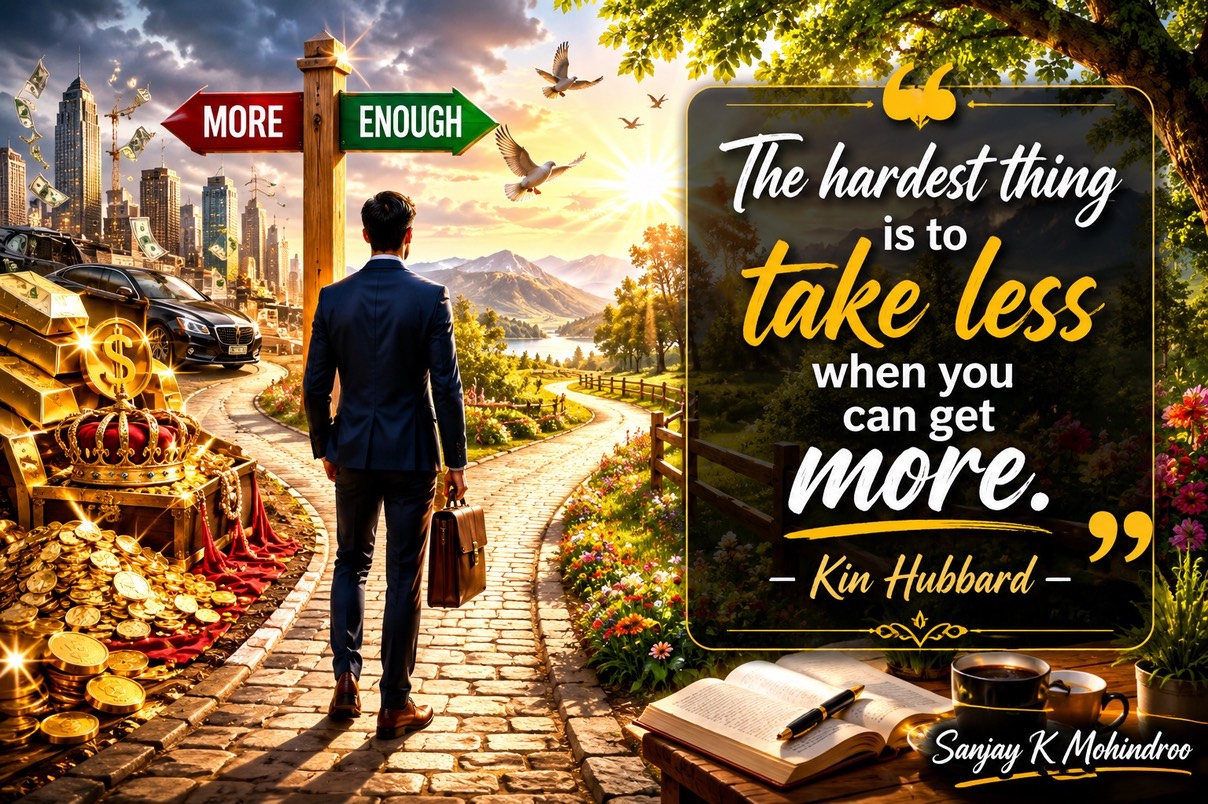
Sanjay K Mohindroo
Real strength appears when we choose restraint over excess, even when more is within reach.
Most people think strength means taking every advantage available. We celebrate bigger rewards, larger gains, and winning at any cost. Yet some of the most powerful decisions happen when a person chooses restraint instead of excess.
As Kin Hubbard once said, "The hardest thing is to take less when you can get more."
This idea speaks to a challenge that appears in business, relationships, leadership, and everyday life. The quote is not about settling for less. It is about having the discipline to stop when enough is enough. It highlights a quiet form of character that often goes unnoticed. While many people chase every possible gain, a few understand that true success requires judgment, self-control, and perspective.
The Temptation of More
Success Often Tests Character More Than Struggle
Most people expect challenges during difficult times. The real test often arrives when opportunities multiply. When more money, power, recognition, or influence becomes available, the desire for additional gain can grow stronger than reason.
History offers many examples of talented people who lost everything because they could not stop. Businesses have collapsed after aggressive expansion. Leaders have damaged reputations through greed. Investors have lost fortunes chasing one more profitable deal.
The desire for more is natural. The problem begins when desire replaces judgment. At that point, success becomes a trap rather than a reward. The hashtag #Leadership often highlights achievement, but the best leaders understand where limits matter.
Restraint as a Competitive Advantage
Self-Control Creates Long-Term Success
Modern culture rewards speed and accumulation. Bigger numbers often appear to signal greater success. Yet lasting success usually belongs to people who know when to pause, when to walk away, and when to accept enough.
Strong negotiators do not demand every possible concession. Effective leaders do not take all the credit. Trusted business partners do not maximize every short-term advantage.
This approach may seem counterintuitive. Taking less today can create stronger relationships tomorrow. A fair decision often produces more opportunities than an aggressive one. That is why #BusinessSuccess frequently depends on trust rather than pure gain.
People remember fairness. They remember integrity. They remember those who could have taken more but chose not to.
The Difference Between Scarcity and Wisdom
Choosing Less Is Not the Same as Settling
Some people misunderstand restraint. They assume it means lowering standards or accepting less than they deserve. The quote points toward something very different.
Choosing less from a position of weakness feels like sacrifice. Choosing less from a position of strength reflects wisdom.
A skilled professional may reject a lucrative offer that conflicts with personal values. A company may decline profits that require unethical practices. A leader may share recognition rather than claim it alone.
These choices are not losses. They are investments in reputation, credibility, and peace of mind. The hashtag #PersonalGrowth often centers on achievement, but growth also comes from understanding what truly matters.
The Quiet Confidence Behind Enough
Contentment Requires Courage
Many people spend years chasing external validation. They compare salaries, possessions, titles, and achievements. The comparison never ends because there is always someone with more.
Contentment breaks that cycle. It creates freedom from constant competition. It allows people to focus on purpose rather than endless accumulation.
This does not mean abandoning ambition. Ambition remains valuable when connected to meaningful goals. The difference lies in knowing when achievement serves your life and when your life starts serving achievement.
The strongest people are often those who can look at an opportunity, recognize its value, and still decide not to pursue it. That decision reflects confidence rather than fear. It demonstrates mastery over desire instead of submission to it.
The ability to take less when more is available may be one of the clearest signs of maturity. It requires discipline, self-awareness, and a strong sense of values. While many people measure success by what they acquire, lasting respect often comes from what they choose not to take.
The next time a chance for more appears, pause before reaching for it. Ask whether the additional gain truly serves your goals, your relationships, and your character. Sometimes the most powerful decision is not taking everything you can get. Sometimes it is knowing when enough is enough.
#Leadership #BusinessSuccess #PersonalGrowth #SelfControl #Character #SuccessMindset #Integrity #GrowthMindset
Kin Hubbard was an American cartoonist, humorist, and writer known for his sharp observations about human nature. His work often combined wit with practical wisdom, making complex truths easy to understand. Many of his quotes remain relevant because they address timeless challenges involving character, judgment, and personal conduct.
Between Distance and Presence: The Hidden Bridge Between Earth and Heaven.

Sanjay K Mohindroo
A reflection on the thin line between the ordinary and the sacred in everyday life.
Some ideas feel impossible at first glance, yet become more convincing the longer we sit with them. Augustus Hare captured one of those ideas when he wrote, "Nothing is farther than earth from heaven; nothing is nearer than heaven to earth."
This statement presents a striking contrast. Earth represents daily life with its struggles, limits, and imperfections. Heaven symbolizes peace, meaning, hope, and something greater than ourselves. On the surface, these two places seem separated by an impossible distance. Yet Hare suggests they may be much closer than we think.
The quote speaks to a truth many people experience. Life can feel heavy and uncertain, yet moments of kindness, purpose, and connection often appear without warning. The article explores the tension between distance and closeness, showing how the extraordinary often exists within the ordinary.
The Great Divide
When Life Feels Far from Something Higher
Most people understand the feeling of separation. Responsibilities pile up. Stress grows. Relationships become strained. During these moments, higher ideals can seem unreachable.
This is where the first half of Hare's statement feels true. The gap between our current reality and our highest hopes often appears enormous. We see conflict instead of peace. We see fear instead of confidence. We see limitations instead of possibilities.
Yet this distance is often emotional rather than physical. The barrier exists in perception. People frequently assume that meaning belongs somewhere else, waiting in a different place or a different time. That belief creates a sense of separation that feels larger than it truly is.
Signs Hidden in Plain Sight
The Sacred Within Everyday Moments
The second half of the quote turns the idea upside down. It suggests that what seems distant may already be present.
A parent comforting a child. A stranger offering help. A friend showing loyalty during a difficult season. These moments rarely make headlines, yet they reveal something profound about human nature.
Many people spend years searching for meaning in grand achievements while overlooking the quiet moments that carry real significance. A simple act of compassion can bring more clarity than a thousand ambitions.
This perspective changes the way we view life. Instead of searching for something beyond reach, we begin noticing what is already around us. That shift creates a powerful mindset reflected in #Mindfulness and #PersonalGrowth conversations today.
The Space Between Reality and Belief
Meaning Emerges Through Perspective
Human beings are storytellers. We constantly assign meaning to experiences. Two people can face the same challenge and walk away with completely different conclusions.
One person sees hardship as proof that life is unfair. Another sees it as an opportunity to grow stronger. The circumstances remain the same, but the interpretation changes everything.
This is where Hare's insight becomes practical. The distance between despair and hope is often smaller than expected. A new perspective can transform an experience without changing the facts.
Many of the world's greatest leaders, thinkers, and creators carried this belief. They understood that purpose is not something waiting at the finish line. Purpose is built through daily choices and consistent action.
A More Grounded View of Heaven
Bringing Ideals into Daily Life
The quote also challenges a common assumption. Many people treat higher values as abstract concepts. They admire them but rarely practice them.
Patience becomes meaningful only when tested. Courage matters only when fear is present. Compassion matters only when someone needs it.
The highest ideals become real when they enter ordinary situations. They stop being distant goals and become daily habits. This is where personal transformation begins.
People often look for dramatic moments to change their lives. Most lasting change comes from smaller actions repeated over time. Every decision either narrows or widens the gap between who we are and who we hope to become.
Augustus Hare's words remind us that distance can be deceptive. The gap between everyday life and deeper meaning often feels vast, yet it can disappear in a single moment of awareness.
The qualities we admire most are not hidden in some unreachable place. They appear in conversations, choices, relationships, and acts of character. The extraordinary is often woven into the ordinary.
When we start paying attention, we realize that the bridge between earth and heaven was never as far away as it seemed.
#Mindfulness #PersonalGrowth #LifeLessons #InspirationalQuotes #MeaningfulLiving #SelfReflection #Wisdom #Motivation
Augustus Hare was a British writer, historian, and travel author known for his reflective observations on life and human experience. His writings often blended history, philosophy, and personal insight. Many of his quotations remain relevant because they connect timeless ideas with everyday living.
The Spirit of Freedom and the Life It Creates.
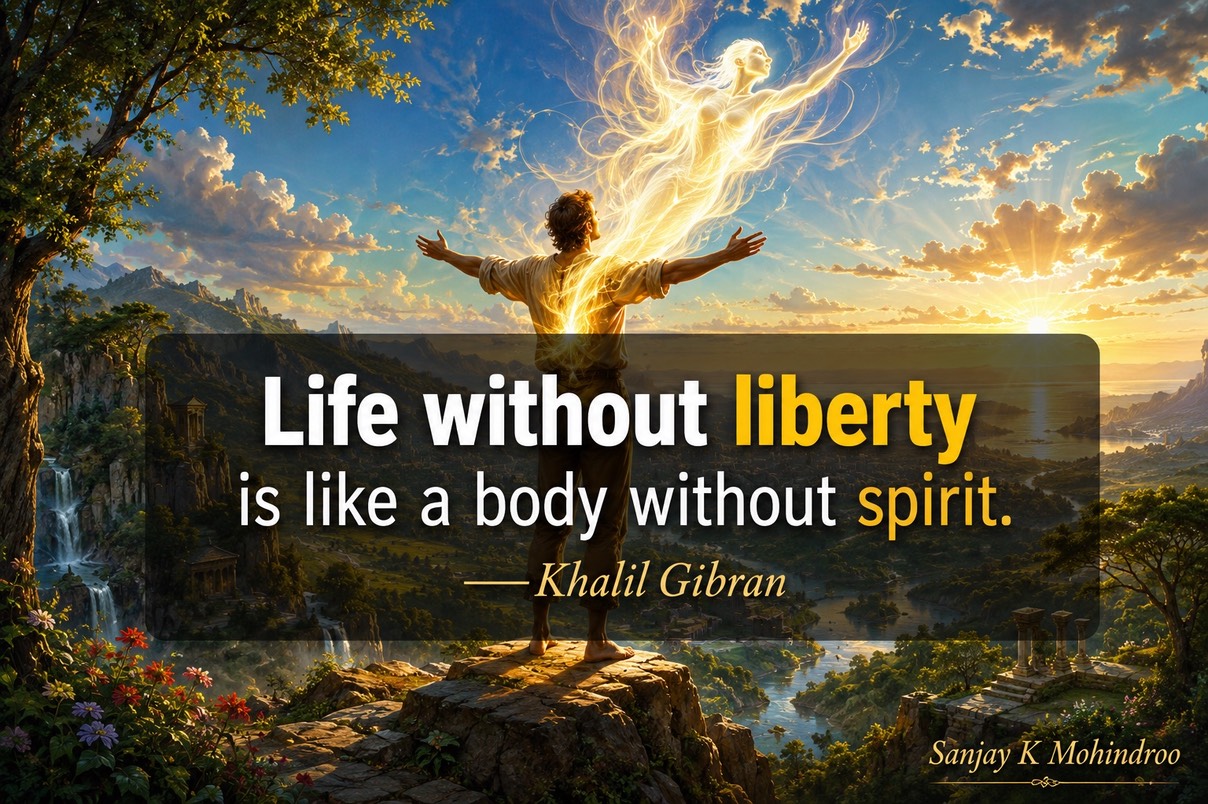
Sanjay K Mohindroo
Freedom gives life purpose, dignity, and direction. Explore the deeper meaning behind Khalil Gibran’s timeless reflection.
Many people move through life with full schedules, steady routines, and clear responsibilities. Yet something can still feel missing. That missing piece is often freedom.
As Khalil Gibran once said, "Life without liberty is like a body without spirit."
This powerful statement connects liberty with the very essence of being alive. A body can exist without energy, passion, or purpose, but it cannot truly thrive. In the same way, people may survive without freedom, yet they struggle to express their full potential. The quote reminds us that liberty is not a luxury. It is a vital force that gives meaning, dignity, and direction to human life.
Freedom Beyond Physical Boundaries
The Power to Choose
When most people think about liberty, they picture political rights or social freedoms. Those freedoms matter deeply, but liberty also lives in everyday choices. It appears when people speak honestly, pursue meaningful work, or make decisions based on their values rather than fear.
A person may have comfort, security, and material success, yet feel trapped by expectations. In contrast, someone with fewer possessions may feel deeply fulfilled because they have the freedom to live according to their beliefs. This contrast reveals an important truth. Liberty is not measured by what we own. It is measured by our ability to choose our path.
The strongest societies protect this ability because freedom fuels creativity, responsibility, and progress. It allows individuals to contribute their best ideas and build better communities.
The Hidden Cost of Lost Liberty
When Silence Replaces Expression
History offers countless examples of people living under restrictions that limited their voices, dreams, and ambitions. While the effects often appear political, the damage reaches much deeper. A lack of liberty affects confidence, imagination, and self-worth.
People naturally seek opportunities to express who they are. When that expression is blocked, frustration grows. Innovation slows. Relationships weaken. Communities become less vibrant. The absence of freedom creates an environment where fear begins to replace curiosity.
This reality extends beyond governments and institutions. People can also surrender freedom through self-doubt, social pressure, or the desire for approval. These invisible barriers can become just as limiting as visible ones.
Responsibility Gives Liberty Meaning
Freedom and Accountability Walk Together
Liberty is often celebrated, but its value becomes clear only when paired with responsibility. Freedom without accountability creates disorder. Responsibility without freedom creates control. Healthy societies and healthy individuals need both.
The ability to make choices carries an obligation to consider their impact. True liberty encourages people to act thoughtfully rather than impulsively. It strengthens character because every decision becomes an opportunity to exercise judgment and integrity.
This balance explains why lasting freedom requires effort. It must be protected, respected, and used wisely. People who understand this connection become stronger contributors to families, workplaces, and society as a whole.
A Life Filled with Purpose
The Spirit That Moves Us Forward
The image of a spirit giving life to a body speaks to something deeply human. People need more than survival. They need purpose, expression, and the ability to pursue meaningful goals.
Freedom allows individuals to dream, create, and grow. It inspires artists to produce great work, entrepreneurs to build new ventures, and ordinary people to shape lives they are proud to live. Every meaningful achievement begins with the freedom to think differently and act with intention.
This is why conversations about liberty remain relevant across generations. The desire to live authentically is universal. It reflects a basic human need that crosses cultures, professions, and backgrounds.
#Freedom #Liberty #HumanPotential #PersonalGrowth
Khalil Gibran's words remain powerful because they connect liberty with the essence of human existence. Freedom is more than a political concept. It is the force that allows people to express their values, pursue their purpose, and shape their future.
A life without liberty may continue, but it loses much of its vitality. When freedom exists alongside responsibility, people gain the ability to live with meaning, confidence, and authenticity. That combination brings energy to individuals and strength to societies. It is the spirit that turns existence into a truly lived life.
#Freedom #Liberty #KhalilGibran #PersonalGrowth #HumanPotential #PurposeInLife #FreedomOfChoice #LifeLessons #InspirationalQuotes #SelfDevelopment
Khalil Gibran was a Lebanese-American writer, poet, and philosopher known for his profound reflections on life, freedom, love, and human nature. His most famous work, The Prophet, continues to inspire readers around the world. His writings remain relevant because they combine simple language with timeless wisdom.
Facing the Light, Leaving the Shadows.
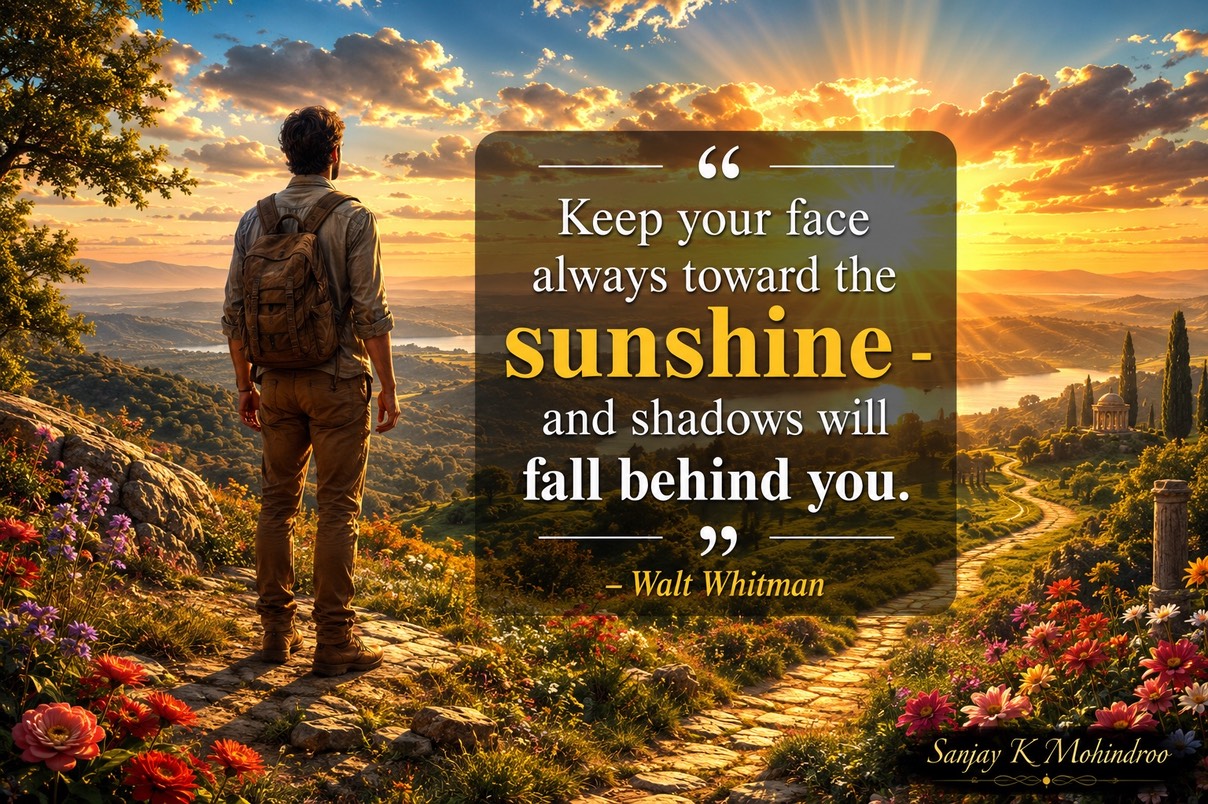
Sanjay K Mohindroo
A powerful reflection on optimism, focus, and the mindset that shapes the direction of our lives.
Life often feels like a tug-of-war between hope and fear. Some days, challenges seem larger than our abilities. Other days, opportunities appear hidden behind uncertainty. In those moments, a simple idea can change the way we move forward.
"Keep your face always toward the sunshine - and shadows will fall behind you." – Walt Whitman
This quote speaks to the power of attention. It reminds us that our focus shapes our experience. The message is not about ignoring hardship. It is about choosing where to direct our energy. When we turn toward possibility, growth, and purpose, difficulties lose their power to control our thinking. That shift in perspective can transform both our actions and our results.
The Direction of Attention
Where the Mind Looks, Life Often Follows
Human beings naturally notice problems. Our brains are wired to spot threats and risks. While this instinct helps us survive, it can also trap us in cycles of worry.
When attention stays fixed on setbacks, every challenge appears larger than it is. Small mistakes become evidence of failure. Temporary obstacles feel permanent. Over time, this mindset drains motivation and confidence.
Turning toward the "sunshine" means focusing on what can be done rather than what cannot. It means looking for solutions instead of collecting reasons to stop. This approach does not erase problems, but it changes our relationship with them. The obstacle remains, yet our ability to respond becomes stronger.
This principle appears across conversations about personal growth, positive mindset, and success habits. It reflects a simple truth: attention is a resource, and where we invest it matters.
Optimism Is Not Blindness
Seeing Reality While Choosing Hope
Many people misunderstand optimism. They assume it means pretending everything is fine. Real optimism is far more practical.
A skilled leader sees risks clearly but still moves forward. A committed athlete recognizes weaknesses but continues training. A determined entrepreneur understands uncertainty but keeps building.
Hope becomes powerful when it works alongside realism. Looking toward the light does not require denying the existence of shadows. It requires refusing to let them become the center of every thought.
This balance separates confidence from wishful thinking. Confidence acknowledges difficulty and acts anyway. That is why optimism often becomes a competitive advantage in work, relationships, and personal development.
The Hidden Cost of Looking Back
When Fear Becomes a Permanent Companion
Many people carry old disappointments longer than necessary. A failed project, a broken relationship, or a missed opportunity can quietly shape future decisions.
The danger is not the event itself. The danger comes from allowing the event to define the future.
People who remain focused on past failures often hesitate when new opportunities appear. Fear becomes a filter through which every situation is viewed. Growth slows because energy is spent protecting against loss instead of creating progress.
Moving toward the light requires a decision. At some point, the past must become a lesson rather than a destination. Only then can new possibilities enter the picture.
This idea connects strongly with #MindsetMatters and #PersonalGrowth. Progress rarely begins with perfect conditions. It begins with a new direction.
Light Creates Momentum
Small Choices Build Remarkable Results
A positive outlook is often built through ordinary actions. One encouraging conversation. One healthy habit. One difficult task was completed despite resistance.
These choices seem small at first. Yet they create momentum. Momentum creates confidence. Confidence encourages larger actions.
Over time, a person who consistently focuses on opportunities develops a different outlook on life. Challenges still appear, but they no longer dominate the landscape.
The sunlight in Whitman's message can represent purpose, gratitude, learning, ambition, or service to others. The exact source matters less than the direction. The act of moving toward something meaningful changes the way life feels and unfolds.
The most powerful part of this idea is its simplicity. We cannot control every circumstance, but we can control our direction. Life will always contain uncertainty, setbacks, and moments of doubt. Those shadows are unavoidable.
Yet shadows only lead when we keep facing them. When we choose purpose over fear, action over hesitation, and hope over defeat, they lose their position in front of us.
The path forward becomes clearer when our attention follows the light.
#MindsetMatters #PersonalGrowth #PositiveThinking #SuccessMindset #MotivationDaily #LifeLessons #GrowthMindset #SelfImprovement #Optimism #Inspiration
Walt Whitman was a celebrated American poet, essayist, and journalist. He is best known for his influential collection Leaves of Grass, which reshaped modern poetry. His work often explored human potential, optimism, freedom, and the beauty of everyday life.
Consequences Shape the Future Long Before Results Appear.
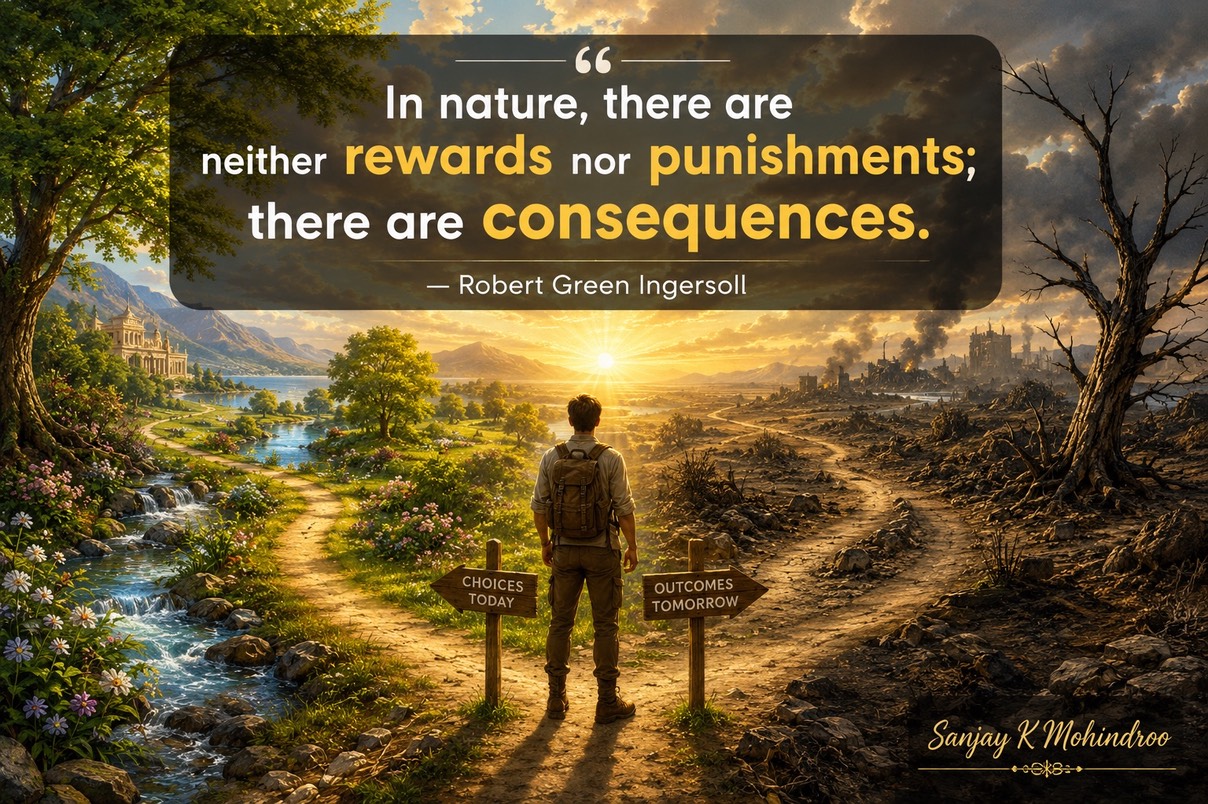
Sanjay K Mohindroo
Every choice creates a consequence. Explore the deeper meaning behind actions, responsibility, and lasting outcomes.
Most people spend their lives chasing rewards and avoiding punishment. They seek praise, promotions, approval, and success while fearing criticism, failure, and loss. Yet life often operates by a different set of rules. As Robert Green Ingersoll observed, "In nature, there are neither rewards nor punishments; there are consequences."
This statement shifts attention away from judgment and toward reality. It suggests that life is not keeping score in a moral ledger. Instead, actions create outcomes. Some outcomes help us grow, while others create challenges. The emotional signal behind this idea is both liberating and demanding. It removes the comfort of blaming fate and places responsibility back into our hands. It invites us to see life through the lens of cause and effect, where every decision leaves a mark.
The Silent Chain of Cause and Effect
Every Action Leaves a Trace
A farmer plants seeds in spring and harvests months later. The harvest is not a reward for effort. It is the natural result of preparation, care, and patience. The same principle appears in every part of life.
Relationships grow stronger through trust and attention. Health improves through consistent habits. Careers advance through competence and reliability. These outcomes are not gifts handed out by chance. They are the product of repeated actions over time.
This perspective encourages accountability. It reminds us that today's choices are creating tomorrow's reality, whether we notice it or not. #PersonalGrowth and #LifeLessons often begin with recognizing this simple truth.
Responsibility Without Blame
Owning Outcomes Creates Freedom
Many people view responsibility as a burden. In reality, it is a source of power. When we understand that actions shape outcomes, we stop waiting for external rescue.
This does not mean every result is fully under our control. Life includes uncertainty, setbacks, and circumstances we never choose. Yet our responses remain ours. The habits we build, the standards we keep, and the decisions we make influence the direction of our lives.
People who embrace responsibility often appear more confident. They spend less energy assigning blame and more energy creating better outcomes. That shift changes everything.
The Challenge Hidden Within the Quote
Good Intentions Are Not Enough
One reason this idea feels uncomfortable is that it separates intentions from results. Most people judge themselves by what they meant to do. The world responds to what actually happened.
A leader may have good intentions but make poor decisions. A company may ignore warning signs while believing everything is fine. A person may postpone healthy habits for years and then face the effects later.
The lesson is not harsh. It is practical. Intentions matter because they guide action, but actions create results. This distinction encourages honesty and self-awareness. It pushes people to examine outcomes rather than assumptions.
A More Mature View of Success and Failure
Outcomes Teach Better Than Judgment
Success often feels like a reward, while failure feels like punishment. Yet both can be viewed differently. Success reveals which actions worked. Failure reveals which actions need adjustment.
This mindset reduces fear. It turns setbacks into feedback rather than personal verdicts. Athletes, entrepreneurs, and leaders often improve because they study outcomes without becoming trapped by them.
When people stop treating every result as a judgment of their worth, they become more willing to experiment, adapt, and improve. That is where real growth begins.
Living With Greater Awareness
Small Choices Build Big Futures
The most powerful consequences rarely arrive overnight. They accumulate quietly through daily behavior. A single workout changes little. Years of exercise transform health. One conversation may seem ordinary. Consistent communication builds lasting trust.
Life often reflects patterns more than isolated events. Small actions repeated consistently create momentum. That reality makes every choice meaningful.
The future is not shaped by dramatic moments alone. It is built through ordinary decisions made again and again.
The wisdom in this quote lies in its simplicity. Life does not operate as a system of rewards and punishments handed down from above. It operates through outcomes that flow from actions, habits, and choices. This perspective invites greater responsibility, deeper awareness, and stronger personal growth.
When we focus less on seeking approval and more on understanding consequences, we make better decisions. We stop asking what we deserve and start asking what our actions are creating. That question has the power to change the direction of a life.
#PersonalGrowth #LifeLessons #Accountability #SelfImprovement #DecisionMaking #Mindset #Success #Leadership #GrowthMindset #Responsibility
Robert Green Ingersoll was a nineteenth-century American lawyer, writer, and public speaker known for his thoughtful views on reason, human responsibility, and ethics. He challenged conventional thinking and encouraged people to examine ideas through logic and experience. His observations continue to resonate because they connect timeless principles with everyday life.
The Freedom Hidden Inside Humility.
Sanjay K Mohindroo
Growth begins when curiosity stays stronger than ego, even when advice feels uncomfortable.
Most people enjoy gaining knowledge. Far fewer enjoy being corrected. That tension sits at the heart of one of the most honest observations ever made: "Personally, I'm always ready to learn, although I do not always like being taught." — Winston Churchill.
This quote captures a truth that often goes unspoken. We admire growth, yet we resist the discomfort that usually comes with it. Being taught can challenge our assumptions, expose mistakes, and remind us that we do not know everything. The statement is not a rejection of education. It is a recognition of the emotional struggle that often accompanies personal growth. It points toward a deeper question: Can we stay open to improvement when it feels uncomfortable?
The Quiet Battle Between Curiosity and Pride
Growth Often Arrives Disguised as Discomfort
Every meaningful lesson carries a small challenge to our identity. We like seeing ourselves as capable and informed. When someone points out a gap in our understanding, that image can feel threatened.
This reaction is natural. No one enjoys feeling wrong. Yet progress rarely comes from protecting our pride. It comes from examining ideas honestly, even when they unsettle us. The people who continue growing are not those who avoid mistakes. They are the ones willing to face them. That is the spirit behind #PersonalGrowth and lasting self-improvement.
Knowledge Without Openness Has Limits
Information Alone Does Not Create Wisdom
Modern life offers endless access to information. Books, courses, videos, and conversations are available everywhere. Yet access does not guarantee growth.
Real development requires receptiveness. A person may collect facts for years and remain unchanged. Another may accept one difficult piece of feedback and transform completely. The difference lies in attitude.
Wisdom grows when curiosity becomes stronger than defensiveness. It appears when people ask questions rather than defend assumptions. This mindset fuels #Leadership, #Success, and meaningful achievement in every field.
The Strength of Being Teachable
Confidence and Humility Can Exist Together
Many people confuse teachability with weakness. The opposite is often true. It takes confidence to admit there is more to understand.
The strongest professionals, leaders, and creators share a common trait. They remain students long after achieving success. They recognize that expertise is not a finish line. It is a responsibility to keep improving.
Humility does not reduce authority. It strengthens it. People trust individuals who can adapt, listen, and grow. A closed mind may protect the ego today, but it limits tomorrow's possibilities.
Challenging the Quote
Should We Accept Every Lesson?
The quote also invites an important distinction. Being teachable does not mean accepting every opinion without question.
Critical thinking matters. Some advice deserves scrutiny. Some lessons arrive with bias or incomplete understanding. The goal is not blind acceptance. The goal is thoughtful consideration.
A mature learner listens carefully, evaluates fairly, and decides wisely. Growth comes from balancing openness with judgment. That balance turns information into insight and experience into wisdom.
The Lifelong Student
Progress Begins Where Certainty Ends
The most successful people rarely believe they have reached the end of learning. They understand that every achievement opens another door.
Life keeps presenting new situations, challenges, and perspectives. The willingness to adapt becomes a lasting advantage. Those who remain curious continue moving forward, while others become trapped by certainty.
This mindset creates better leaders, stronger relationships, and richer experiences. It keeps the mind active and the future full of possibility. It reflects the heart of #Mindset and #SelfDevelopment.
The greatest obstacle to growth is rarely a lack of opportunity. More often, it is the desire to protect what we already believe. Winston Churchill's observation reminds us that learning is not only an intellectual process. It is an emotional one.
The people who achieve lasting growth accept the discomfort that comes with being challenged. They choose progress over pride and curiosity over certainty. In doing so, they unlock one of life's most valuable advantages: the ability to keep becoming better.
#PersonalGrowth #Leadership #Success #Mindset #SelfDevelopment #ContinuousLearning #GrowthMindset #Wisdom #Humility #Learning
Winston Churchill was a British statesman, writer, and former Prime Minister of the United Kingdom. He led Britain through some of its most difficult moments during World War II. His reflections on leadership, character, and human behavior continue to influence readers across generations.
Beauty in Motion: The Rhythm That Gives Words Their Power.

Sanjay K Mohindroo
A reflection on poetry, beauty, and the hidden rhythm that turns words into lasting human experiences.
Some words inform us. Others stay with us for years. They echo through memory, shape emotions, and change the way we see the world. Edgar Allan Poe captured this idea when he wrote,
"I would define, in brief, the poetry of words as the rhythmical creation of Beauty."
This statement reaches beyond poetry itself. It suggests that beauty is not simply found in words. Beauty is created through their rhythm, flow, and emotional movement. Poe points to something deeper than language. He highlights the connection between expression and feeling, showing that powerful writing is not only about meaning. It is also about the experience words create within us.
The Music Hidden Inside Language
Words Become Memorable Through Rhythm
Every memorable piece of writing carries a sense of movement. Readers may not always notice it, yet they feel it. Rhythm gives language energy. It guides attention, shapes emotion, and creates a connection between writer and reader.
Think about the speeches, poems, and stories that remain alive across generations. Their power often comes from more than their message. Their structure creates a natural flow that feels satisfying and complete. This rhythm transforms ordinary language into something meaningful.
In today's content-driven world, this lesson remains relevant. Whether writing a speech, a blog, or a social media post, rhythm influences how people respond. It turns information into experience. That is why #WritingTips and #CreativeWriting continue to emphasize flow as much as content.
Beauty Beyond Perfection
Meaning Often Matters More Than Flawlessness
Many people associate beauty with perfection. Poe's idea challenges that assumption. Beauty can exist in sadness, uncertainty, and even imperfection. Some of the most moving works of art speak about loss, struggle, or longing.
A simple sentence can create beauty when it expresses truth with clarity and feeling. A story can inspire people even when its ending is bittersweet. Beauty comes from authenticity, not from flawless presentation.
This perspective matters because modern communication often rewards speed over depth. People rush to publish, react, and move on. Yet the words that truly matter are usually those that carry genuine emotion. They reflect something real about the human experience.
The Balance Between Art and Purpose
Great Communication Touches Both Mind and Heart
Many forms of writing focus on delivering facts. Facts are important, but they rarely move people by themselves. Human beings respond to stories, images, and emotions. They remember what makes them feel something.
Poe's observation reminds us that communication works best when logic and beauty work together. A business leader inspiring a team, a teacher motivating students, or a writer sharing an idea all benefit from this balance.
The strongest messages combine clarity with emotional resonance. They respect the audience's intelligence while also engaging their imagination. This blend creates impact that lasts long after the words have been read.
Beauty as a Human Need
Art Gives Meaning to Everyday Life
Beauty is often treated as a luxury. In reality, it serves a deeper purpose. People seek beauty because it helps them make sense of life. Music, literature, art, and storytelling provide comfort during difficult times and perspective during successful ones.
The rhythm Poe describes exists far beyond poetry. It appears in conversations, personal reflections, and shared experiences. Whenever words bring understanding, hope, or connection, they create a form of beauty.
This is why storytelling remains powerful across cultures and generations. Technology changes. Trends change. Human emotions do not. The need for meaningful expression continues to shape our lives.
Edgar Allan Poe's insight reminds us that words are more than tools for communication. They are instruments capable of creating beauty, emotion, and connection. Their power lies not only in what they say but also in how they move.
When rhythm, meaning, and authenticity come together, language becomes unforgettable. It leaves a mark on memory and shapes the way people think and feel. Beauty is not something waiting to be found. It is something created through thoughtful expression, one word at a time.
#EdgarAllanPoe #Poetry #Writing #CreativeWriting #Storytelling #Literature #BeautyInLanguage #WritingTips #AuthorQuotes #Inspiration
Edgar Allan Poe was an American writer, poet, editor, and literary critic. He is widely recognized for shaping modern horror, mystery, and psychological fiction. His reflections on beauty, creativity, and human emotion continue to influence writers and readers around the world.
The Quiet Strength Hidden in Unspoken Words.

Sanjay K Mohindroo
A powerful reflection on restraint, wisdom, and the lasting value of thinking before speaking.
Words can build trust, open doors, and inspire change. They can also create problems that never needed to exist.
As Calvin Coolidge once said, "I have noticed that nothing I never said ever did me any harm."
At first glance, the statement feels simple. Yet it carries a powerful lesson about judgment, patience, and self-control. The quote is not a call for silence. It is a reminder that every spoken word has consequences, while many unspoken words fade away without damage. In a culture that rewards immediate reactions, this idea feels more valuable than ever. It encourages us to pause, think, and choose our words with care.
The Power of Restraint
Speaking Less Often Means Thinking More Clearly
Many people believe influence comes from saying more. In reality, influence often comes from saying the right thing at the right time. The strongest leaders rarely feel pressure to fill every silence. They listen, observe, and process information before responding.
A rushed comment can damage a relationship in seconds. A careless remark can create confusion that lasts for years. Restraint creates space for better decisions. It allows emotions to settle and reason to take control. This simple habit strengthens communication and improves personal and professional relationships.
The principle behind this quote appears often in conversations around #Leadership and #PersonalGrowth. People admire those who remain calm under pressure because thoughtful responses create confidence and trust.
Silence as a Strategic Advantage
Listening Reveals More Than Talking
Most people enter conversations focused on what they want to say next. Very few focus on understanding what others truly mean. That difference matters.
When we listen carefully, we gather information that would otherwise be missed. We notice concerns, motivations, and opportunities. We gain a clearer picture of reality. Excessive talking often prevents that process from happening.
Consider a negotiation meeting. The person who listens patiently often gains valuable insights before making a decision. The person who speaks too quickly may reveal weaknesses or make commitments they later regret. Silence can be a powerful strategic tool, especially in business, leadership, and conflict resolution.
The Challenge of Modern Communication
Instant Reactions Carry Lasting Consequences
Modern technology rewards speed. Messages are sent instantly. Opinions are posted within seconds. Reactions spread across platforms before reflection has a chance to occur.
This environment creates a hidden risk. People often speak from emotion rather than judgment. A moment of frustration can become a permanent record. An impulsive comment can damage a reputation built over many years.
The wisdom behind Coolidge's words reminds us that not every thought deserves expression. Some thoughts need time. Others need context. Many simply need to remain private. Practicing restraint protects both credibility and peace of mind.
Conversations around #CommunicationSkills and #EmotionalIntelligence often highlight this challenge. Strong communication is not measured by volume. It is measured by value.
When Silence Should Not Win
Wisdom Requires Balance
The quote becomes even more meaningful when viewed from another angle. Silence is valuable, but it is not always the right choice.
There are moments when speaking up matters deeply. Injustice grows when people stay silent. Problems remain unsolved when concerns are never voiced. Relationships suffer when important truths remain hidden.
The real lesson is balance. We should avoid speaking carelessly, but we should never avoid speaking courageously. Wisdom lies in knowing the difference. Effective communication requires both restraint and conviction.
This balance separates thoughtful leaders from passive observers. It allows people to protect their words without surrendering their voice.
Lasting Influence Through Thoughtful Speech
Every Word Carries a Cost or a Benefit
Words are like investments. Some generate trust, respect, and understanding. Others create confusion, conflict, and regret. The difference often depends on whether enough thought occurred before speaking.
People who master this skill earn credibility over time. Their words carry weight because they are chosen carefully. Others learn to listen when they speak because they do not speak simply to be heard.
That quiet discipline becomes a competitive advantage in leadership, business, relationships, and everyday life. It transforms communication from a habit into a deliberate act.
Calvin Coolidge's observation remains relevant because human nature has not changed. We still face the temptation to react quickly, defend ourselves immediately, and speak before thinking. Yet many of life's avoidable problems begin with unnecessary words.
True wisdom is not measured by how much we say. It is measured by our ability to recognize when silence serves us better. Thoughtful speech creates impact. Careless speech creates consequences. The choice between them often arrives in a single moment of restraint.
#Leadership #PersonalGrowth #CommunicationSkills #EmotionalIntelligence #Wisdom #SelfControl #ProfessionalGrowth #LeadershipDevelopment
Calvin Coolidge served as the 30th President of the United States and was known for his calm and measured style of leadership. His reputation for thoughtful communication earned him respect during a period of significant national change. His observations on discipline, responsibility, and judgment continue to resonate with leaders and professionals today.
The Planet We Forgot to See.

Sanjay K Mohindroo
A powerful reflection on Earth's oceans, perspective, and our responsibility to protect the planet's true identity.
Most people picture mountains, forests, deserts, and cities when they think about Earth. Yet those images tell only part of the story. As Arthur C. Clarke famously observed, "How inappropriate to call this planet Earth when it is quite clearly Ocean."
The statement feels simple at first, but it carries a deeper message. It challenges the way we see our home and reminds us that perspective shapes understanding. Oceans cover most of the planet, influence every climate system, support countless forms of life, and connect every continent. The quote invites us to rethink what truly defines our world and our place within it.
A Different View of Home
Looking Beyond Familiar Ground
Human beings live on land, so land naturally dominates our thinking. Cities, roads, farms, and borders shape daily life. Yet from space, Earth appears as a vast blue sphere. Water occupies nearly three-quarters of the planet's surface and gives Earth its most recognizable feature.
This contrast reveals an important truth. We often focus on what is closest to us and overlook what sustains us. The oceans regulate temperatures, generate oxygen, and support global food systems. They are not simply background scenery. They are a living foundation beneath modern civilization.
The conversation around #OceanConservation often begins with this shift in perspective. Before people protect something, they must first recognize its value.
The Ocean's Quiet Influence
Power Hidden Beneath the Surface
Many of the most important systems on Earth operate far from public attention. Ocean currents move heat across vast distances. Marine ecosystems absorb carbon and help stabilize the climate. Coastal regions depend on healthy waters for jobs, food, and protection from storms.
Despite this influence, oceans rarely receive the same attention as events happening on land. Their scale makes them easy to take for granted. Yet every major environmental challenge is connected to ocean health in some way.
The growing focus on #ClimateAction reflects this reality. Protecting the planet requires protecting the waters that keep its systems in balance. The future of communities, economies, and ecosystems depends on that connection.
A Lesson in Perspective
Seeing the Bigger Picture
The quote is not only about geography. It is also about mindset. People often assume their perspective is complete because it feels familiar. In reality, every viewpoint has limits.
History is filled with examples of breakthroughs that came from looking at old ideas differently. Scientists, explorers, and innovators changed understanding by questioning assumptions. Clarke's observation follows the same pattern. It encourages curiosity and reminds us that obvious truths can remain unnoticed.
This lesson applies beyond environmental issues. Better decisions often begin when people step back and examine the larger picture. The ability to see beyond immediate surroundings creates stronger leadership, better planning, and deeper understanding.
Stewardship of a Blue Planet
Responsibility Follows Awareness
Recognition creates responsibility. Once we acknowledge the central role oceans play, protecting them becomes more than an environmental concern. It becomes a practical necessity.
Plastic pollution, habitat destruction, and unsustainable practices place increasing pressure on marine ecosystems. The effects eventually reach every part of society. Cleaner oceans support healthier fisheries, stronger coastal economies, and more stable environmental conditions.
The movement behind #Sustainability gains strength when people understand this connection. Protecting oceans is not about choosing nature over progress. It is about ensuring progress remains possible for future generations.
Arthur C. Clarke's observation remains powerful because it changes the way we see our planet. It reminds us that Earth's identity is shaped as much by water as by land. More importantly, it highlights the gap between what we notice and what truly matters.
A change in perspective can lead to a change in action. When we recognize the oceans as the defining feature of our world, we begin to appreciate their value, their influence, and our responsibility toward them. The blue planet deserves to be seen clearly, understood deeply, and protected wisely.
#OceanConservation #ClimateAction #Sustainability #BluePlanet #MarineLife #OceanHealth #EnvironmentalAwareness #Earth
Arthur C. Clarke was a renowned science fiction writer, futurist, and inventor. His work often explored humanity's relationship with science, space, and the future. His observations continue to inspire discussions about perspective, technology, and our understanding of the planet.
From Stone to Self-Awareness.
Sanjay K Mohindroo
The Rising Journey of Consciousness.
A powerful reflection on consciousness, growth, and human potential through Arthur Young’s timeless insight.
Human progress is often measured through technology, wealth, or knowledge. Yet the deeper story is the growth of awareness itself. Arthur Young captured this idea in a striking observation:
"God sleeps in the minerals, awakens in plants, walks in animals, and thinks in man." — Arthur Young.
This quote presents life as a gradual unfolding of consciousness. It suggests that existence moves from stillness to awareness, from instinct to reflection. At its heart lies a powerful message: humans possess a unique ability to think, question, create, and choose. The quote is not only about nature. It is about responsibility. It asks whether we are fully using the gift of awareness or simply drifting through life on instinct.
The Silent Beginning
Consciousness Before Awareness
The quote starts with minerals. Rocks, mountains, and crystals do not think or move. They simply exist. Young uses this image to represent the earliest stage of existence. There is presence, but no visible awareness.
This idea encourages a broader view of life. Everything around us is connected through a larger process. The stone beneath our feet and the person beside us belong to the same unfolding story. The difference is not existence itself. The difference is the level of awareness expressed through that existence.
The image also reminds us of patience. Great growth often begins in silence. Every major transformation starts with foundations that few people notice.
The First Signs of Life
Growth Without Choice
Plants introduce a new dimension. They respond to sunlight, water, and seasons. Life begins to reach outward. There is movement toward survival and growth.
Yet plants do not decide their path. They follow natural patterns. Their growth is remarkable, but it remains automatic. This stage reflects a truth many people experience. Sometimes we grow because circumstances push us forward rather than because we consciously choose a direction.
The lesson is simple. Growth alone is not enough. Real progress requires awareness of where that growth is leading.
Motion, Instinct, and Survival
The Animal Within Us
Animals add mobility, emotion, and instinct. They search, protect, compete, and adapt. Life becomes more active and dynamic.
Humans share many of these qualities. Hunger, fear, desire, and competition remain powerful forces in daily life. This reality explains why people often react before they think. Instinct is fast. Reflection takes effort.
Modern society rewards speed, but wisdom comes from pause and consideration. The challenge is not eliminating instinct. The challenge is preventing instinct from controlling every decision. This idea connects strongly with conversations around #Mindset and #PersonalGrowth.
The Human Advantage
Thinking Beyond Survival
The final stage introduces something extraordinary. Humans can reflect on their own existence. We can imagine futures that do not yet exist. We can question beliefs, challenge assumptions, and create new possibilities.
This ability separates thought from mere reaction. It allows people to build civilizations, create art, solve problems, and pursue meaning. Yet thinking is not automatic. Many people possess the capacity for reflection but rarely use it deeply.
The quote quietly challenges us here. Being human is not merely a biological condition. It is an invitation to exercise awareness. The greatest opportunities often emerge when we move beyond routine and engage in genuine reflection. This message resonates strongly with #Leadership and #SelfAwareness.
A Thought Worth Challenging
Awareness Does Not End with Humanity
The quote may seem to place humans at the top of a ladder. Yet a deeper reading suggests something else. Human thinking may not be the final destination. It may be another stage in a continuing process.
History shows that awareness expands when people become more compassionate, curious, and responsible. Knowledge alone does not guarantee progress. True advancement comes when intelligence is paired with wisdom.
The real measure of growth is not how much we know. It is how thoughtfully we use what we know. That distinction separates information from understanding and power from purpose.
Arthur Young's insight offers more than a description of life. It presents a challenge. Existence may begin in stillness, move through growth and instinct, and arrive at thought. Yet thought itself carries responsibility.
Every person can rise above automatic reactions and make conscious choices. That ability shapes relationships, careers, communities, and societies. The journey from stone to self-awareness is not only the story of life. It is the story unfolding within each of us every day.
The question is not whether we can think. The question is whether we are thinking deeply enough to become the best version of ourselves.
#Consciousness #SelfAwareness #PersonalGrowth #HumanPotential #Leadership #Mindset #Philosophy #Growth #Wisdom #Inspiration
Arthur Young was an American philosopher, inventor, and thinker known for exploring the relationship between science, consciousness, and human development. He sought connections between physical reality and deeper questions about existence. His ideas continue to inspire discussions about awareness, growth, and human potential.
The Uncracked Nut and the Life We Build.

Sanjay K Mohindroo
Opportunity is given. Progress is earned. A powerful reflection on effort, responsibility, and personal growth.
Most people hope life will hand them a finished result. They wait for the perfect moment, the perfect chance, or the perfect set of conditions. Yet growth rarely arrives in a completed form.
As Franz Kafka once wrote, "God gives the nuts, but he does not crack them."
This simple statement carries a powerful message. Life provides resources, talent, opportunities, and possibilities. The missing piece is action. The quote reminds us that potential alone has little value until someone puts in the effort to turn it into something useful. It speaks to personal responsibility, persistence, and the quiet truth that success belongs to those willing to do the work others avoid.
Gifts Without Effort Remain Untouched
Potential Is Only the Starting Point
Every person begins with something valuable. Some receive talent. Others receive education, supportive families, strong mentors, or favorable circumstances. These gifts matter, but they are only raw materials.
A talented musician still needs years of practice. A promising student must still study. A business idea remains only an idea until someone acts on it. The value of any opportunity depends on the effort invested after receiving it.
Many people spend years wishing for better chances while ignoring the possibilities already within reach. The real difference often comes from who decides to act. #PersonalGrowth is rarely about receiving more. It is about using what is already available.
The Hidden Cost of Waiting
Action Creates Momentum
Waiting feels safe. It protects us from failure, criticism, and uncertainty. Yet waiting also carries a cost. Every day spent delaying action allows opportunities to fade.
Consider two people with the same ability. One starts immediately, makes mistakes, learns lessons, and improves. The other waits for perfect conditions. Months later, the first person has experience, confidence, and results. The second person still has plans.
Progress rewards movement. Even imperfect action creates learning. Every attempt provides information. Every setback teaches something useful. The person who keeps moving gains an advantage that talent alone cannot provide.
This idea sits at the heart of #SuccessMindset. Progress belongs to people who accept that action comes before confidence, not after it.
Responsibility Creates Freedom
Ownership Changes Everything
At first glance, responsibility can feel heavy. It means accepting that no one else will solve certain problems for us. Yet responsibility also creates freedom.
When people believe their future depends entirely on luck, circumstances, or other people, they surrender control. When they accept ownership of their actions, they gain influence over their outcomes.
This shift changes the way challenges are viewed. Obstacles stop becoming excuses and start becoming problems to solve. Energy moves away from blame and toward improvement.
The most effective leaders, entrepreneurs, athletes, and creators share this mindset. They focus on what they can control. They understand that results often follow sustained effort rather than perfect conditions.
Effort Reveals Hidden Strength
Growth Happens During the Process
Many people focus only on the reward at the end. They want success, recognition, or achievement. Yet the greater benefit often comes from the process itself.
Hard work develops discipline. Challenges build character. Persistence strengthens confidence. The effort required to crack the nut often creates a stronger person than the reward inside it.
This truth explains why meaningful accomplishments feel satisfying. The value does not come solely from the outcome. It comes from knowing the result was earned.
The path toward achievement shapes identity. Through consistent effort, people become more capable, more confident, and more prepared for future opportunities. That is the deeper lesson behind #Motivation and lasting achievement.
Life offers possibilities, but it rarely delivers finished results. Talent, opportunity, and favorable conditions are valuable gifts, yet they remain incomplete without effort. The real measure of success is not what we receive. It is what we choose to do with what we receive.
The people who create meaningful lives are not always the most gifted. They are often the ones willing to act, persist, and take responsibility when others hesitate. The opportunity may be given, but the work remains ours. That simple truth separates potential from achievement.
#PersonalGrowth #SuccessMindset #SelfImprovement #Motivation #Achievement #HardWork #Leadership #Mindset #PersonalDevelopment #Growth
Franz Kafka was a renowned writer whose work explored human struggle, responsibility, and personal meaning. His observations often revealed deep truths through simple language and memorable imagery. His ideas continue to inspire readers because they speak directly to everyday challenges and choices.
Courage Creates Opportunity.
Sanjay K Mohindroo
Bold action opens unexpected doors. A reflection on courage, risk, and the opportunities that follow.
Many people wait for the perfect moment before making a move. They want certainty, approval, and a clear path forward. Yet life rarely works that way. As Emily Dickinson once wrote, "Fortune befriends the bold."
The quote captures a simple but powerful truth. Opportunity often favors those willing to act before every answer appears. It speaks to courage, initiative, and the willingness to step into uncertainty. At its heart, the message is not about reckless behavior. It is about trusting yourself enough to move when others hesitate. This idea continues to shape careers, businesses, relationships, and personal growth.
The Reward Hidden Inside Risk
Progress Begins Where Comfort Ends
Most meaningful achievements start with a decision that feels uncomfortable. The entrepreneur launches a business despite uncertainty. The student applies for a challenging opportunity despite self-doubt. The professional speaks up with a new idea despite fear of criticism.
From the outside, successful people often appear lucky. Their breakthroughs seem sudden. Yet a closer look reveals something different. They consistently placed themselves where opportunities could find them. Their courage created conditions for success.
This is where #PersonalGrowth becomes more than a popular phrase. Growth requires movement. Every step beyond familiar ground expands experience, confidence, and possibility.
Fortune Is Not Random
Action Creates More Chances to Succeed
Many people think fortune arrives by chance. While luck plays a role, action often determines who benefits from it. Someone who sends ten proposals has more opportunities than someone who sends none. A person who meets new people builds connections that can change a career.
Boldness increases exposure to possibility. It creates encounters, conversations, and experiences that would never exist otherwise.
This principle appears repeatedly in #Leadership and #Success stories. The individuals we admire rarely waited for certainty. They acted, adjusted, and kept moving forward. Their willingness to engage with uncertainty attracted opportunities that others never saw.
The Fine Line Between Boldness and Recklessness
Courage Requires Judgment
The quote can be misunderstood if viewed too simply. Boldness is not the same as impulsiveness. Taking action without thought can create unnecessary problems. Real courage includes preparation, awareness, and responsibility.
The strongest decisions often balance confidence with wisdom. A bold person studies the situation, understands the risks, and acts anyway. Fear may still exist, but it no longer controls the outcome.
This distinction matters because sustainable success depends on thoughtful action. Courage without judgment becomes chaos. Judgment without courage becomes stagnation.
The Cost of Playing It Safe
Opportunities Rarely Knock Twice
Many regrets come from opportunities ignored rather than mistakes made. People remember the business idea they never pursued, the conversation they never started, or the challenge they never accepted.
Safety can feel attractive in the moment. It protects us from failure and embarrassment. Yet it can also limit growth. Over time, avoiding risk creates a different kind of loss. Potential remains unrealized, and possibilities fade away.
The people who build meaningful lives often share one common trait. They choose progress over perfection. They understand that action teaches lessons that hesitation never can.
This mindset fuels #Motivation and creates momentum. Each courageous step makes the next one easier.
A Different Relationship With Failure
Setbacks Become Teachers
Bold people are not fearless. They simply view failure differently. They see setbacks as information rather than permanent defeat.
Every unsuccessful attempt offers insight. It reveals weaknesses, improves judgment, and sharpens future decisions. This perspective transforms risk from something threatening into something valuable.
When people stop treating failure as a final verdict, they become willing to try again. That persistence often becomes the true source of success.
Life rarely rewards passive observation. Opportunities emerge when people participate, contribute, and take meaningful action. Courage does not guarantee success, but it creates the conditions where success can happen.
The most important doors often open only after someone decides to knock. Fortune may not always arrive immediately, yet it consistently moves closer to those willing to step forward. In that sense, boldness is not merely a personality trait. It is a decision that shapes the direction of a life.
#PersonalGrowth #Leadership #Success #Motivation #Courage #Opportunity #Mindset #Growth #Confidence #Inspiration
Emily Dickinson was one of America's most influential poets and writers. Her work explored human emotion, courage, identity, and personal conviction. Her observations remain relevant because they capture timeless truths about human behavior and ambition.
The Quiet Strength Hidden in Autumn.
Sanjay K Mohindroo
A reflection on autumn’s calm wisdom and the value of slowing down, growing, and seeing life with greater clarity.
Most people celebrate beginnings. Spring gets the attention. Summer gets the applause. Yet some of life’s most important lessons arrive much later, during quieter seasons.
William Allingham captured that truth perfectly when he wrote, "Autumn's the mellow time."
This simple statement carries remarkable depth. It speaks of balance after effort, reflection after action, and wisdom after experience. Autumn is not a season of urgency. It is a season of understanding. It reminds us that growth is not always loud and that progress often becomes visible only after time has done its work.
The idea reaches beyond weather and nature. It offers a powerful perspective on work, relationships, success, and personal growth. #AutumnWisdom #LifeLessons
The Season That Values Reflection
Growth Becomes Visible After the Rush
Spring begins the process. Summer pushes it forward. Autumn reveals the results.
Nature follows a pattern that many people ignore in their own lives. We often demand immediate rewards for our efforts. We expect quick results and constant movement. Yet meaningful achievements rarely work that way.
The mellow quality of autumn comes from completion. Crops mature. Trees display their richest colors. The season shows the value of patience. It proves that time is not an obstacle. Time is often the partner that turns effort into results.
This lesson matters in every area of life. Careers, businesses, friendships, and personal goals all require seasons of steady work before success becomes visible.
Calm Is Not the Same as Weakness
Quiet Confidence Outlasts Constant Motion
Many people confuse busyness with importance. They believe that being active means being productive.
Autumn challenges that belief.
The season is calm, yet it remains powerful. Its influence is visible everywhere. Leaves change color. Temperatures shift. Fields reach harvest. The transformation happens without noise or urgency.
People often experience a similar change as they gain experience. They stop chasing attention and start focusing on substance. They become less interested in proving themselves and more interested in creating lasting value.
That shift represents maturity. It is a move from reaction to intention. In a culture that rewards speed, calm confidence becomes a rare advantage. #PersonalGrowth #Mindset
The Beauty of Letting Go
Every New Chapter Requires Space
One of autumn's most striking images is falling leaves.
At first glance, it may seem like loss. Yet nature treats it as preparation. Trees release what they no longer need so they can survive the coming season and grow again later.
People face the same challenge.
Old habits, outdated goals, unnecessary worries, and unhealthy relationships often remain long after their usefulness has ended. Holding onto everything creates weight. Letting go creates freedom.
This process is rarely easy. It demands honesty and courage. Still, every meaningful step forward requires making room for something better.
The wisdom of autumn reminds us that release is not failure. It is preparation.
A Different Definition of Success
Fulfillment Matters More Than Accumulation
Modern culture often measures success by constant expansion. More money. More recognition. More activity.
Autumn presents another perspective.
The season does not focus on gaining. It focuses on fulfillment. It represents a point where effort and outcome finally meet. There is satisfaction in seeing work completed and lessons earned.
Many people spend years chasing the next milestone without appreciating what they have already achieved. This creates endless dissatisfaction.
A mellow outlook encourages gratitude. It allows people to recognize progress while continuing to move forward. That balance creates a deeper and more sustainable form of success. #SuccessMindset #Purpose
Autumn teaches a lesson that many people spend years trying to understand.
Life is not only about beginnings and ambitions. It is also about reflection, patience, and appreciation. Real growth becomes visible over time. Real confidence grows quieter with experience. Real success includes the ability to pause and recognize value.
The season reminds us that wisdom often arrives after effort, not before it. Those who embrace that truth stop rushing through life and start understanding it more deeply.
Sometimes the most meaningful progress happens during the calmest moments.
#AutumnWisdom #LifeLessons #PersonalGrowth #Mindset #SuccessMindset #SelfImprovement #Reflection #Purpose #Wisdom #Motivation
William Allingham was a nineteenth-century Irish poet known for his thoughtful observations of nature and everyday life. His writing often connected natural scenes with deeper human emotions and experiences. His work continues to resonate because it finds profound meaning in simple moments.
The Mirror Beneath Every Choice.

Sanjay K Mohindroo
The hardest motives to see are often our own. A reflection on self-interest, human nature, and honest leadership.
A Quiet Observation
A Truth That Deserves Attention
"Nature... is nothing but the inner voice of self-interest." — Christian Nestell Bovee.
Few quotes make people pause quite like this one.
At first glance, it sounds cynical.
It feels as though every act of kindness, sacrifice, loyalty, or generosity is being questioned. Yet the quote invites us to examine something deeper. It asks us to look beneath actions and examine the motives that drive them.
That is not a comfortable exercise.
Most people like to believe they act from pure intention. We like to think our choices come from duty, care, principle, or goodwill. Yet when we slow down and look honestly, we often find another force present. A force that quietly shapes decisions, influences priorities, and directs attention.
That force is self-interest.
The idea may sound harsh. It is not.
It is simply human.
#Leadership #HumanNature #SelfAwareness
Motives Behind the Mask
The Hidden Engine of Human Behavior
Every day, people make thousands of choices.
A leader makes a decision that benefits a team. A parent works late to provide for a family. A friend offers support during difficult times. A business owner invests in employees.
These actions create value for others.
Yet they also satisfy personal needs.
A leader gains purpose and respect. A parent gains peace of mind. A friend strengthens a relationship. A business owner builds a stronger company.
This does not make the actions less meaningful.
It makes them more real.
Human behavior rarely operates through a single motive. Most choices carry both personal and shared benefits. The challenge is not eliminating self-interest. The challenge is understanding it.
People often become blind to their own motives.
That blindness creates poor judgement.
It creates conflict.
It creates disappointment.
Most of all, it creates false stories about ourselves.
#PersonalGrowth #CriticalThinking #Mindset
Honest Reflection Over Comfortable Illusion
A Stronger Form of Self-Awareness
Many leadership failures begin with good intentions.
People convince themselves they are acting for others while quietly serving their own interests.
This happens in business.
It happens in politics.
It happens in families.
It happens in friendships.
The danger is not self-interest itself.
The danger is self-interest that remains hidden.
The moment we recognize our motives, we gain control over them.
A leader who understands personal ambition can balance it with responsibility.
A manager who understands the desire for recognition can avoid unfair decisions.
A founder who understands personal goals can build a company with greater clarity.
Self-awareness creates better judgement.
It replaces illusion with insight.
It turns reaction into intention.
That is the real value of this quote.
It pushes us toward honesty.
#LeadershipDevelopment #DecisionMaking #ProfessionalGrowth
Character Revealed Through Choice
The Test That Matters Most
Self-interest is not the enemy.
Without it, people would have little reason to grow, create, build, or achieve.
The question is not whether self-interest exists.
The question is whether it serves only us or creates value for others as well.
The strongest leaders understand this balance.
They pursue success while helping others succeed.
They seek growth while creating opportunity.
They pursue achievement without losing sight of responsibility.
This balance separates short-term gain from lasting impact.
History remembers people who aligned personal ambition with a broader purpose.
That combination creates trust.
It creates influence.
It creates a legacy that lasts longer than individual success.
#Purpose #Trust #Influence
A Closing Reflection
The Conversation Worth Having
The quote challenges a common assumption.
It suggests that beneath many noble actions lies a personal motive.
Rather than rejecting that idea, we should examine it carefully.
Because understanding our motives does not weaken character.
It strengthens it.
The person who knows their own motives clearly is harder to deceive.
The leader who understands self-interest leads with greater wisdom.
The professional who recognizes personal incentives makes better decisions.
Perhaps the goal is not to silence self-interest.
Perhaps the goal is to understand it well enough to direct it toward something larger than ourselves.
That is where growth begins.
That is where trust is built.
And that is where true leadership takes shape.
#Leadership #HumanNature #SelfAwareness #PersonalGrowth #CriticalThinking #Mindset #LeadershipDevelopment #DecisionMaking #ProfessionalGrowth #Purpose #Trust #Influence
Christian Nestell Bovee was a nineteenth-century American writer and essayist known for his concise observations on human nature, character, ambition, and personal conduct. Many of his reflections continue to resonate because they explore timeless truths about human behavior and decision-making.
The Garden That Keeps Growing Within Us.
Sanjay K Mohindroo
A reflection on gardening, patience, growth, and the lasting habits that shape a meaningful life.
Some interests come and go. Others settle deep within us and quietly shape the way we see the world. Gertrude Jekyll captured that truth beautifully when she wrote, "The love of gardening is a seed once sown that never dies."
At first glance, the quote seems to celebrate gardening as a hobby. Yet it points to something much larger. It speaks about the lasting impact of meaningful experiences. It reminds us that certain passions become part of our identity. They continue to influence our choices, values, and outlook long after they first appear.
Gardening is not only about plants. It is about patience, care, observation, and hope. Once those lessons take root, they often remain with us for life.
More Than a Hobby
A Practice That Changes Perspective
Many hobbies entertain us. Gardening does something different. It changes the way we think.
A gardener learns to work with time rather than against it. Seeds do not respond to pressure. Flowers do not bloom because we demand results. Growth follows its own schedule. This simple reality teaches patience in a way few activities can.
Over time, that mindset spreads into other areas of life. Relationships, careers, businesses, and personal goals all require consistent effort before results appear. The garden becomes a quiet teacher, showing that meaningful progress often happens beneath the surface before anyone can see it.
This is one reason gardening remains so powerful. It develops habits that reach far beyond the garden gate.
The Appeal of Creating Life
The Satisfaction of Nurturing Growth
People are naturally drawn to creating, building, and improving. Gardening satisfies that desire uniquely.
A neglected patch of soil can become a vibrant space filled with color, fragrance, and life. The transformation feels deeply rewarding because it reflects the value of care and attention. Every healthy plant becomes evidence that effort matters.
In a culture focused on speed and instant results, gardening offers a different message. It celebrates steady progress. It rewards consistency rather than urgency.
That lesson has growing relevance today. Many people seek greater balance and purpose. Gardening provides both. It reconnects people with nature while encouraging a slower and more thoughtful pace of life. Conversations around #Gardening, #MindfulLiving, and #PersonalGrowth continue to gain attention because they address needs many people feel but rarely express.
Growth Includes Failure
Every Garden Faces Difficult Seasons
The quote suggests permanence, but that does not mean gardening is always easy.
Plants fail. Weather changes. Pests arrive. Careful plans sometimes produce disappointing results. Every gardener experiences setbacks.
Yet these challenges may be the most valuable part of the experience. Gardening teaches acceptance without surrender. A failed season does not mean the end of the journey. It simply becomes part of the learning process.
This perspective matters because life rarely unfolds perfectly. Success often comes after mistakes, adjustments, and persistence. Gardeners understand this reality better than most. They know that growth is rarely linear.
The passion survives because it is built on hope. Each season brings another chance to plant, improve, and begin again.
A Legacy Passed Forward
Seeds Shared Across Generations
One of the most remarkable aspects of gardening is its ability to connect people across time.
Many gardeners can trace their interest back to a parent, grandparent, neighbor, or mentor. A simple lesson about planting flowers often becomes a lifelong memory. The knowledge passes from one generation to the next, carrying values alongside practical skills.
This is why the quote feels so enduring. The seed is not only planted in soil. It is planted in people.
A child who learns to care for a small plant gains more than gardening knowledge. They experience responsibility, patience, and respect for living things. Those lessons can influence an entire lifetime.
The garden becomes a place where values grow alongside vegetables and flowers.
The lasting power of gardening comes from the lessons hidden beneath the surface. It teaches patience in a restless world. It rewards effort without demanding perfection. It reminds us that growth takes time and that setbacks are part of every worthwhile pursuit.
The deepest message behind Gertrude Jekyll's words is not about plants alone. It is about the passions and principles that quietly shape who we become. Once planted, they continue to grow within us, influencing our choices long after the first seed touches the soil.
Perhaps that is why gardening remains so beloved. The garden changes every season, yet the values it teaches stay with us forever.
#Gardening #PersonalGrowth #MindfulLiving #Nature #Wellbeing #GardeningLife #SelfDevelopment #SustainableLiving #GrowthMindset #Inspiration
Gertrude Jekyll was a British horticulturist, garden designer, writer, and artist. She became one of the most influential figures in garden design during the late nineteenth and early twentieth centuries. Her work combined practical gardening knowledge with artistic vision, making her insights relevant even today.
When the Crowd Becomes the Judge.
Sanjay K Mohindroo
A powerful reflection on morality, public opinion, and the courage to stand by principles when the crowd disagrees.
History often celebrates people who stood against the majority. Yet, in their own time, many of them were criticized, isolated, or condemned. This tension between public opinion and personal conviction sits at the heart of a timeless question posed by William Lloyd Garrison: "Are right and wrong convertible terms dependent upon popular opinion?"
The question is simple, but its challenge is profound. It asks whether morality changes when enough people agree on something. It invites us to examine our own beliefs and consider whether truth is determined by numbers or by principles. At an emotional level, it speaks to a common human struggle: the desire to belong versus the responsibility to do what is right.
As society becomes more connected and opinions spread faster than ever, this question feels as relevant today as it did centuries ago.
The Comfort of Agreement
Popular Support Feels Like Validation
Human beings are social by nature. We seek acceptance, approval, and a sense of belonging. When many people agree with an idea, it often feels safer and more trustworthy. Public support can create the impression that a belief must be correct simply because it is widely shared.
Yet history offers a different lesson. Many accepted practices that are now viewed as deeply unjust once enjoyed broad public support. Social approval did not make them right. It only made them common.
This distinction matters because popularity measures acceptance, not morality. Large groups can be mistaken. Entire societies can overlook uncomfortable truths. The number of supporters behind an idea does not automatically determine its ethical value.
The Cost of Standing Alone
Conviction Often Begins in Isolation
Many of the most important social changes started with a minority voice. Reformers, activists, scientists, and thinkers frequently challenged views that most people accepted without question. Their ideas seemed unpopular at first because they exposed uncomfortable realities.
Standing apart from the crowd requires courage. It means accepting criticism and uncertainty while remaining committed to a principle. The pressure to conform is powerful, especially when disagreement carries personal or professional consequences.
This is where character becomes visible. Principles matter most when they are tested. It is easy to support a belief when everyone agrees. The true measure of conviction appears when agreement disappears.
In conversations around leadership, ethics, and #PersonalGrowth, this lesson remains vital. Progress often begins with someone willing to question accepted assumptions.
The Modern Pressure of Public Opinion
Visibility Has Increased, Wisdom Has Not
Today's connected society gives public opinion unprecedented reach. A single idea can gain support from millions within hours. Trends, reactions, and collective judgments move at remarkable speed.
While this creates opportunities for awareness and accountability, it also creates risks. Popular narratives can become accepted before facts are fully understood. Emotional reactions can overshadow thoughtful reflection. In some cases, people may adopt opinions because they fear exclusion rather than because they genuinely believe them.
The challenge is not to reject public opinion. Public opinion plays an important role in democratic societies. The challenge is to evaluate ideas carefully rather than accepting them automatically.
Strong decision-making requires independent thinking. This principle applies to business, leadership, public policy, and everyday life. In discussions around #Leadership and #Ethics, the ability to think beyond immediate approval remains one of the most valuable skills a person can develop.
Principles That Outlast Applause
Lasting Values Do Not Depend on Popularity
Certain principles retain their value regardless of changing trends. Honesty remains important even when dishonesty becomes convenient. Fairness remains important even when unfair systems benefit powerful groups. Respect remains important even when division attracts attention.
Public opinion shifts constantly. Principles provide stability. They serve as anchors during moments of uncertainty and pressure.
This does not mean individuals always know the correct answer. Humility remains essential. People should remain open to evidence, discussion, and new perspectives. Yet openness should not be confused with surrendering judgment to the crowd.
A healthy society depends on people who think carefully, question respectfully, and act according to well-considered values.
The relationship between morality and public opinion remains one of humanity's most important questions. Majorities influence laws, customs, and culture, but they do not automatically define right and wrong.
Progress often emerges when individuals are willing to examine accepted beliefs and ask difficult questions. The courage to think independently protects societies from repeating mistakes and encourages genuine growth.
The next time a popular opinion appears unquestionable, it may be worth pausing for a moment. Agreement can be comforting, but principles are what endure.
#Leadership #Ethics #PersonalGrowth #Integrity #CriticalThinking #Values #MoralCourage #DecisionMaking #SelfLeadership #Character
William Lloyd Garrison was a nineteenth-century American abolitionist, journalist, and social reformer. He became widely known for his unwavering opposition to slavery and his commitment to moral principles despite strong public resistance. His writings continue to inspire discussions about justice, conscience, and the responsibility to challenge accepted norms.
Energy Lives Where New Ground Is Broken.

Sanjay K Mohindroo
Progress begins when we step into the unknown and create something that did not exist before.
"There’s something about taking a plow and breaking new ground. It gives you energy." — Ken Kesey
Most people think energy comes from success. They believe motivation appears after results arrive. Yet this quote points in a different direction. It suggests that energy is created in the act of beginning itself.
There is something deeply human about starting where no path exists. Whether it is building a business, changing a habit, entering a new industry, or pursuing a bold idea, the act of moving into unfamiliar territory often creates a sense of purpose that routine rarely delivers. The quote captures a truth many people experience but struggle to explain: growth feels alive because it demands creation.
The Pull of Untouched Ground
Progress Begins Before Proof
Breaking new ground is rarely comfortable. It comes with uncertainty, doubt, and the possibility of failure. Yet people often feel most engaged when they are creating something new rather than maintaining something familiar.
A professional launching a new initiative, an entrepreneur building a company, or an artist starting a fresh project all experience a similar force. They may not know the outcome, but they feel connected to the process. That connection creates momentum.
Many people spend years searching for motivation. In reality, motivation often appears after action begins. The first step creates movement, and movement creates energy.
Comfort Has Limits
Familiar Paths Can Quiet Ambition
Stability has value. It provides security and consistency. Yet when life becomes entirely predictable, something important can fade. Curiosity weakens. Ambition slows. Days begin to look the same.
The human mind is designed to solve problems, create ideas, and explore possibilities. When those opportunities disappear, engagement often disappears with them. This explains why many successful people continue seeking new challenges even after reaching significant milestones.
The attraction is not always financial. Often, it is the excitement of building, improving, and testing new possibilities. #GrowthMindset and #Innovation are not just business terms. They reflect a natural human desire to move forward.
Creation Changes the Creator
New Challenges Build New Capabilities
Every new project leaves a mark on the person pursuing it. The process develops patience, judgment, confidence, and perspective.
A person who starts a business; gains more than revenue. They gain experience. Someone who enters a new career gains more than a title. They gain skills and understanding. The value of breaking new ground extends beyond the visible result.
This is why many meaningful achievements feel rewarding long before completion. The work itself is changing the individual. Each challenge becomes a training ground for future opportunities.
The result may matter, but the transformation often matters more.
The Risk Worth Taking
Progress Demands Courage
Many people wait for certainty before moving forward. They want guarantees before taking action. Yet certainty rarely exists at the beginning of anything meaningful.
Every major advancement started as an uncertain idea. New businesses, scientific breakthroughs, social movements, and technological progress all emerged because someone was willing to act without complete assurance.
The willingness to move despite uncertainty separates creators from spectators. It is not fearlessness that matters. It is action despite fear.
This mindset drives entrepreneurship, leadership, personal development, and meaningful change. It fuels #Leadership and #PersonalGrowth because both require movement into areas where answers are not yet obvious.
A Future Built by Builders
The Energy of Possibility
Societies move forward because individuals continue creating. New industries emerge because someone challenges old assumptions. Better systems appear because someone decides existing methods are not enough.
The same principle applies at a personal level. Careers advance when people take on unfamiliar responsibilities. Relationships deepen when people make intentional efforts. Skills improve when people accept the discomfort of being beginners again.
The energy described in the quote comes from possibility. It comes from seeing something unfinished and deciding to build it.
That feeling remains one of the strongest forces behind human progress.
The most powerful source of energy is often not achievement but creation. Breaking new ground awakens curiosity, builds confidence, and generates momentum. It pushes people beyond routine and into meaningful growth.
Every significant accomplishment begins with a decision to step into unfamiliar territory. The path may not be clear, but the act of moving forward changes everything. New ground does more than create opportunities. It creates stronger, wiser, and more capable people.
#GrowthMindset #Innovation #Leadership #PersonalGrowth #SuccessMindset #Entrepreneurship #CareerGrowth #SelfImprovement #Motivation #PersonalDevelopment
Ken Kesey was an American author best known for his novel One Flew Over the Cuckoo's Nest. His work often explored individuality, freedom, and the human spirit. His observations continue to resonate because they connect personal growth with the courage to challenge convention.
A Shared Earth, A Shared Responsibility.
Sanjay K Mohindroo
A powerful reflection on equality, belonging, and our shared responsibility toward the earth and one another.
Few ideas are as simple and as challenging as this one: "The earth is the mother of all people, and all people should have equal rights upon it." – Chief Joseph.
At first glance, these words seem obvious. Every person is born on the same planet. Every person depends on the same air, water, and soil. Yet the deeper meaning reaches far beyond nature. It speaks about fairness, dignity, ownership, and the way human beings choose to live together.
Chief Joseph was not making a statement about geography. He was making a statement about humanity. His words remind us that before borders, politics, wealth, and power, there is a shared home that belongs to everyone. The quote asks a difficult question: if we all come from the same earth, why do we so often treat each other as if some people matter more than others?
Beyond Ownership
When Possession Becomes a Barrier
Human history is filled with stories of the claim to land, resources, and power. Nations have risen because of it. Conflicts have emerged because of it. Yet the earth itself does not recognize the lines we draw across maps.
Chief Joseph's message challenges the idea that ownership alone determines worth. While societies need laws and property rights, they also need a deeper understanding that stewardship matters more than possession. Land is not simply something to control. It is something to care for and preserve.
This perspective feels especially relevant today. Debates around environmental protection, indigenous rights, housing, and access to resources all point back to a simple truth. A healthy society cannot thrive when large groups of people feel excluded from opportunities that should be available to all.
Equality Begins with Recognition
Seeing People Before Labels
Equality is often discussed in legal or political terms. Yet its foundation is much more personal. It begins when people recognize the humanity in one another.
Many divisions are built on labels. Race, nationality, religion, income, and social status often shape how people are treated. These categories can create distance where none naturally exists.
Chief Joseph's words cut through those divisions. They suggest that every person starts from the same place. The earth does not assign greater value to one child over another. It provides the same sky, the same seasons, and the same natural gifts.
When people adopt that mindset, conversations change. Cooperation becomes easier. Respect becomes more natural. Communities become stronger. This spirit reflects the values often discussed under #HumanRights and #SocialJustice, not as political slogans, but as practical principles for daily life.
The Environmental Connection
Caring for the Home We Share
The quote also carries an environmental message that feels urgent today.
If the earth is our shared mother, then environmental damage affects everyone. Pollution does not stop at borders. Climate change does not ask for passports. Water shortages, declining forests, and damaged ecosystems create consequences that spread across societies.
This reality demands collective responsibility. People often focus on what they can take from nature. The more important question is what they leave behind for future generations.
Protecting the environment is not only about conservation. It is about fairness. Every generation deserves access to clean water, healthy ecosystems, and natural resources. Conversations around #Sustainability and #EnvironmentalResponsibility become stronger when viewed through this lens of shared inheritance.
A Principle That Challenges Power
Fairness Requires Courage
The most powerful ideas often make people uncomfortable. This quote is one of them.
It asks leaders, institutions, and individuals to examine whether their actions reflect the belief that all people deserve equal respect and opportunity. It challenges systems that concentrate benefits among a few while leaving many behind.
Progress has always depended on people willing to defend fairness even when it is difficult. Equal rights are not sustained by words alone. They require action, accountability, and a willingness to challenge injustice.
The message remains relevant because the struggle for fairness never fully ends. Every generation must decide whether it will widen opportunity or restrict it.
Chief Joseph's words remain powerful because they connect human dignity with a shared sense of belonging. They remind us that the earth was not created for a select few. It exists as a common home for all people.
The real test is not whether we agree with the idea. The real test is whether we live by it. Every choice that promotes fairness, respect, and responsibility moves society closer to the vision behind those words.
When people see the earth as a shared inheritance rather than a prize to be claimed, they begin to see each other differently as well. That shift may be one of the most important changes humanity can make.
#HumanRights #Equality #SocialJustice #Sustainability #EnvironmentalResponsibility #Leadership #Fairness #HumanDignity #Inclusion #SharedFuture
Chief Joseph was a respected leader of the Nez Perce people in North America during the nineteenth century. He became known for his advocacy of peace, dignity, and the rights of indigenous communities facing displacement. His speeches and teachings continue to inspire discussions about equality, justice, and human rights.
Beyond the Horizon of Certainty.
Sanjay K Mohindroo
Great achievements begin when someone dares to believe there is more beyond the visible horizon.
History often changes because one person refuses to accept the limits of current knowledge. Christopher Columbus captured that spirit when he said, "I have come to believe that this is a mighty continent which was hitherto unknown." The statement reflects more than geographical discovery. It reveals a moment of conviction, wonder, and courage. It speaks to the human desire to push beyond accepted boundaries and search for possibilities others cannot yet see. At its heart, the quote reminds us that progress begins when belief reaches beyond certainty.
The Power of Seeing Beyond the Map
Every Breakthrough Starts as an Unpopular Idea
Before any new frontier becomes accepted, someone must first imagine it exists. Every major advancement in science, business, culture, and society began as an idea that challenged existing assumptions.
The most remarkable part of discovery is not the destination. It is the willingness to keep moving when evidence is incomplete. Columbus believed there was something significant beyond the horizon long before the world fully understood it. That mindset remains relevant today. Every entrepreneur, inventor, researcher, and leader faces moments when they must trust observation, judgment, and persistence before recognition arrives.
In many ways, #Innovation is not about finding something new. It is about seeing potential where others see uncertainty.
Discovery and Humility
The Limits of Human Knowledge
The quote also carries an important lesson about knowledge itself. It reminds us that human understanding is always incomplete. Every generation believes it has answered the most important questions, only to discover new ones waiting beyond the edge of current thinking.
This pattern appears throughout history. New continents, new technologies, and new scientific principles repeatedly challenged established beliefs. Progress happened because individuals remained open to the possibility that they did not know everything.
That perspective encourages intellectual humility. Strong leaders are confident enough to act, yet humble enough to accept that there is always more to understand. #Leadership grows stronger when curiosity remains alive.
The Responsibility Behind Discovery
Finding Something New Changes More Than the Explorer
Discovery is often celebrated for its excitement and achievement. Yet every new finding carries consequences. New opportunities create new responsibilities. New knowledge changes societies, economies, and cultures.
This is where the quote becomes even more thought-provoking. It invites admiration for bold thinking while also encouraging reflection about the impact of our actions. Every breakthrough affects people beyond its creator. The value of exploration depends not only on finding new possibilities but also on using them wisely.
True #Progress balances ambition with responsibility. Great achievements leave a positive mark on those who follow.
The Continents Hidden in Modern Life
Frontiers Still Exist Around Us
Many people think the age of discovery has ended. In reality, it has simply changed form. Today's unexplored territories are often found in technology, medicine, education, sustainability, and human potential.
Every organization searching for better solutions is exploring unknown ground. Every student pursuing a difficult goal is moving into unfamiliar territory. Every individual seeking personal growth is stepping beyond the boundaries of yesterday's understanding.
The greatest frontiers may not exist on maps. They exist in ideas, opportunities, and capabilities waiting to be recognized. #Growth begins when we stop assuming that everything important has already been found.
The enduring power of this quote lies in its optimism. It reminds us that reality is often larger than our current understanding. Progress belongs to those willing to look beyond accepted limits and imagine greater possibilities.
The next great discovery may not be a continent across an ocean. It may be an idea, a solution, or a vision that changes lives. The future is shaped by people who believe there is still something meaningful waiting beyond the horizon.
#Leadership #Innovation #Mindset #PersonalGrowth #Curiosity #Exploration #Opportunity #Success #Vision #History
Christopher Columbus was an Italian explorer whose voyages across the Atlantic transformed global history. His journeys connected regions that had previously remained separated in European understanding and opened a new chapter in exploration and exchange. His experiences continue to spark discussions about discovery, ambition, courage, and the lasting effects of exploration.
The Grace That Time Cannot Replace.
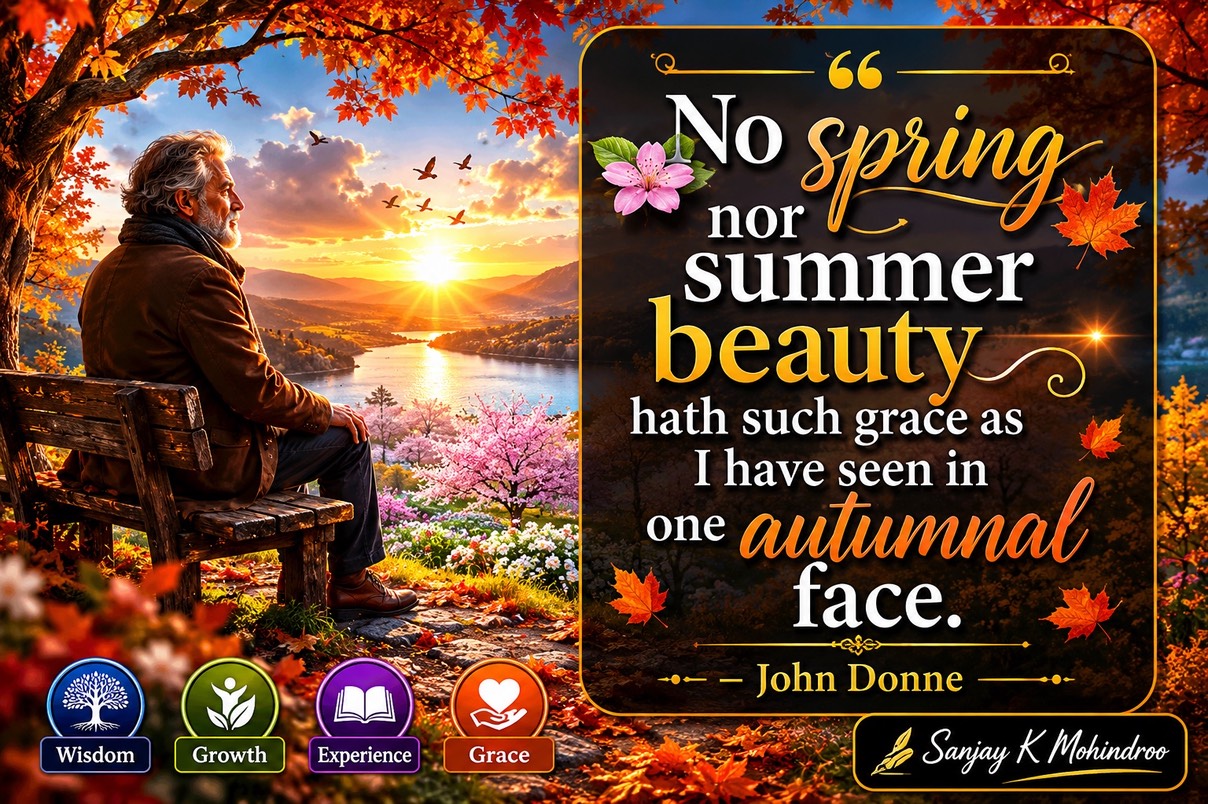
Sanjay K Mohindroo
True beauty often appears after experience, growth, and the passage of time.
True beauty deepens with experience, character, and wisdom. Time often reveals what youth cannot.
Most people spend their lives chasing spring.
They celebrate beginnings, youth, freshness, and the excitement of what is new. Yet the moments that stay with us longest often come much later. They arrive after life's victories and failures have left their mark. They appear in people who have lived, struggled, loved, lost, and grown.
As John Donne beautifully observed, "No spring nor summer beauty hath such grace as I have seen in one autumnal face."
This is not merely a reflection on age. It is a reflection on grace. It is an admiration for the kind of beauty that cannot be bought, copied, or manufactured. It speaks to the quiet power of experience, wisdom, and character. It reminds us that the most meaningful forms of beauty often emerge after life has done its work.
Beyond Appearance
Beauty That Tells a Story
Modern culture often rewards what is immediate. Youth dominates advertising. Freshness captures attention. Newness is treated as value itself.
Yet attention and admiration are not the same thing.
An attractive face may draw eyes. A face shaped by years of experience often captures hearts. There is something deeply compelling about a person whose presence reflects patience, kindness, courage, and understanding. Their expression carries stories. Their eyes reveal perspective. Their words carry weight because they have earned it.
This is where true #Wisdom and #Character begin to shine. Beauty stops being about perfection and starts becoming about meaning.
The Hidden Value of Autumn
Maturity Creates Depth
Nature offers an interesting lesson.
Spring is colorful and exciting. Summer is energetic and abundant. Yet autumn carries a different kind of power. It is calm, rich, and reflective. It represents completion rather than beginning.
People follow a similar path.
In youth, confidence often comes from potential. Later in life, confidence comes from proof. It comes from lessons learned, responsibilities carried, and challenges overcome. The person who has faced setbacks and remained kind possesses a depth that cannot be taught in classrooms or gained through appearances.
This is the essence of #PersonalGrowth. Every hardship, disappointment, and success contribute to a stronger and more complete version of ourselves.
The Faces We Remember
Presence Over Perfection
Think about the people who have left the strongest impression on your life.
Chances are, you do not remember them because they looked perfect. You remember them because of how they made people feel. Their warmth, calmness, generosity, and strength became their defining features.
Real influence works this way.
The leaders who inspire trust, the mentors who change careers, and the family members who hold generations together rarely rely on appearance. Their impact comes from presence. Their value comes from character.
In a society increasingly focused on external image, this perspective feels refreshing. It shifts the conversation from looking impressive to becoming impressive.
That shift lies at the heart of #Leadership and #HumanPotential.
A Challenge to Modern Thinking
Redefining Success and Beauty
Many people spend enormous energy trying to preserve youth.
There is nothing wrong with caring for ourselves. The problem begins when youth becomes the only standard of value. When that happens, we ignore the gifts that come with age and experience.
Wisdom improves judgment. Patience improves relationships. Perspective improves decisions. Compassion grows stronger through understanding.
These qualities make people more effective at work, stronger in families, and more valuable to society. They are also the qualities that create lasting admiration.
Perhaps the real goal is not to remain young forever. Perhaps the goal is to become someone whose character grows more attractive with every passing year.
That is a far more rewarding ambition.
The Grace That Endures
Time as a Sculptor
Time changes everyone.
The question is whether those changes reveal bitterness or grace.
Some people allow challenges to harden them. Others allow challenges to refine them. The difference becomes visible over the years. One creates walls. The other creates wisdom.
This is why grace is so powerful. It is not simply kindness or elegance. It is the ability to carry experience without losing humanity. It is strength without arrogance and confidence without ego.
That kind of beauty does not fade. It grows.
And because it grows, it becomes more valuable with every season of life.
Conclusion
The greatest beauty is rarely found in what is newest. It is found in what has been tested, shaped, and strengthened by time.
John Donne's observation remains powerful because it challenges a common assumption. It reminds us that life is not a race against age. It is an opportunity to gain depth, wisdom, and grace.
The people who leave the deepest mark on the world are not always the youngest or the most admired. They are often those whose experiences have transformed them into something far more compelling.
Their beauty is not measured by years avoided.
It is measured by years well lived.
#Wisdom #Character #PersonalGrowth #Leadership #HumanPotential #EmotionalIntelligence #LifeLessons #TimelessBeauty
John Donne was a renowned English poet, scholar, and cleric of the seventeenth century. He is widely regarded as one of the most influential voices in English literature, known for combining emotional depth with intellectual insight. His writings continue to resonate because they explore timeless themes of love, faith, mortality, and human nature.
The Quiet Power That Leaves the Deepest Mark.
Sanjay K Mohindroo
The deepest acts of generosity often happen when no one is watching.
Do good because it is right, not because it will be noticed. The most meaningful generosity often happens quietly and leaves the deepest impact.
The greatest acts of generosity often happen unseen. Their impact lasts far longer than recognition ever could.
Recognition feels good. Praise feels earned. Most people enjoy being noticed for the good they do. Yet some of the most meaningful actions in life happen without applause, acknowledgement, or reward.
As Anne Morrow Lindbergh once wrote, "To give without any reward or any notice has a special quality of its own."
At first glance, the idea seems simple. Give freely. Expect nothing. But beneath those few words lies a deeper truth about human character, purpose, and fulfillment. The quote points toward a form of generosity that is not driven by attention, status, or return. It speaks to a quiet strength that comes from acting because something is right, not because someone is watching.
In a culture where visibility often feels tied to value, that message deserves closer attention.
Giving Beyond the Spotlight
When the act matters more than the audience
Many acts of generosity today come with an audience. Social media rewards visibility. Public recognition rewards contribution. Organizations celebrate charitable efforts through announcements and campaigns. None of this is inherently wrong. Public examples can inspire others to act.
Yet something changes when giving becomes connected to approval.
When people begin measuring generosity through likes, praise, or reputation, the focus subtly shifts. The attention moves from the person receiving help to the person providing it.
True generosity asks a different question. It asks whether we would still do the same thing if nobody ever knew about it.
That question reveals motive. It separates generosity as performance from generosity as principle.
The spirit behind #Kindness and #GivingBack becomes far stronger when it survives without an audience.
The Hidden Character Test
Actions that reveal who we really are
Character is often described as what a person does when nobody is watching.
That idea sounds familiar because it is true.
Anyone can appear generous when recognition is guaranteed. The real test arrives when there is no reward attached. No promotion. No praise. No public appreciation. Only a choice between helping and walking away.
The people who consistently choose to help reveal something important. Their actions are rooted in values rather than outcomes.
These moments rarely make headlines. A mentor spends extra time guiding a struggling colleague. A neighbor quietly supports a family facing hardship. Someone offers encouragement to a person carrying invisible burdens.
The world may never hear those stories. Yet they shape lives in lasting ways.
That is the deeper promise of #Leadership and #HumanValues. Influence often grows from unseen acts rather than visible achievements.
The Freedom of Expecting Nothing
Releasing the burden of repayment
Many disappointments begin with expectations.
People give time, support, loyalty, or effort and secretly hope for appreciation in return. When appreciation never arrives, frustration follows.
Giving without expectation removes that burden.
The act becomes complete the moment it is offered. Its value no longer depends on another person's response.
This does not mean allowing exploitation or accepting unfair treatment. Healthy boundaries still matter. The point is different. It is about finding satisfaction in doing what is right, regardless of external recognition.
That mindset creates a remarkable sense of freedom.
People stop keeping score. They stop calculating returns. They focus on contribution rather than compensation.
The result is a stronger sense of purpose and inner peace.
Small Acts, Lasting Impact
The influence we rarely get to see
One of the most fascinating truths about generosity is that its effects often remain invisible.
A kind conversation may change someone's difficult day. Encouragement may restore confidence. A helping hand may prevent someone from giving up.
Most of the time, we never witness the full outcome.
Yet history repeatedly shows that small actions can produce consequences far beyond their original moment. A teacher's encouragement shapes a future leader. A stranger's kindness restores someone's faith in people. A quiet act of support creates a chain reaction that continues for years.
This is why #Purpose and #Compassion matter so much. Their impact cannot always be measured immediately, but their influence continues long after the moment has passed.
A Different Definition of Success
Contribution as a measure of significance
Modern success is often measured through visibility, wealth, influence, or achievement.
Those metrics have value. They reflect effort and accomplishment.
But they do not tell the whole story.
A meaningful life is also measured by contribution. It is measured by the number of people helped, encouraged, supported, or uplifted along the way.
Some of the most significant individuals in history were remembered not only for what they achieved but also for what they gave.
Their generosity became part of their legacy.
The most enduring influence rarely comes from attention. It comes from service.
That idea challenges us to think differently about success. It shifts focus from being noticed to being useful.
The quietest acts of generosity often carry the greatest weight.
When people give without seeking recognition, they express something powerful about their values. They show that kindness does not require an audience and that contribution does not need applause.
The world benefits from visible achievements, but it is sustained by invisible acts of care.
The next time an opportunity to help appears, there may be no reward waiting on the other side. No recognition. No public acknowledgement.
That may be precisely what gives the act its greatest value.
#Kindness #GivingBack #Leadership #HumanValues #Purpose #Compassion
Anne Morrow Lindbergh was an American author, aviator, and one of the most respected reflective writers of the twentieth century. Her work explored themes of purpose, relationships, simplicity, and personal growth. Her insights continue to resonate because they connect timeless human values with everyday life.
The Value of a Moment.
Sanjay K Mohindroo
Life moves faster than we realize. Every moment carries a value that cannot be reclaimed.
Most people live as though they have unlimited tomorrows.
We postpone conversations, delay dreams, and assume there will always be another chance. Then one day, a year has passed. A relationship has changed. An opportunity has vanished. Time, quietly and without warning, has moved on.
Samuel Butler captured this truth with remarkable simplicity: "Human life is as evanescent as the morning dew or a flash of lightning."
The image is striking because it feels familiar. Morning dew shines brilliantly before disappearing. Lightning lights the sky for a brief moment before darkness returns. Butler reminds us that human life follows the same pattern. It is beautiful, meaningful, and astonishingly brief.
His words are not a warning meant to create fear. They are an invitation to pay attention. They ask us to see life clearly and use our time with greater purpose.
The Illusion of Endless Time
Tomorrow Feels Guaranteed Until It Isn't
Youth creates a powerful illusion. It convinces us that life stretches endlessly ahead.
Many people spend years waiting for the perfect moment. They wait to start a business. They wait to write a book. They wait to tell someone they care. They wait to travel, to forgive, to create, and to contribute.
Yet life rarely announces its turning points.
The future arrives one ordinary day at a time. Small delays become years. Unspoken words become permanent silence. Opportunities disappear while people convince themselves they can act later.
This is why the quote remains powerful centuries after it was written. It challenges one of humanity's most common assumptions: that there will always be more time.
The reality is simpler. Time is not a resource we own. It is a gift we temporarily receive.
The Beauty Hidden in Impermanence
Fleeting Things Often Matter Most
At first glance, impermanence appears depressing.
Yet many of life's most meaningful experiences gain value because they do not last forever.
A sunset matters because it ends. Childhood feels precious because it passes. A family gathering becomes memorable because everyone knows it cannot be repeated exactly the same way again.
The temporary nature of life gives weight to ordinary moments.
When we understand this, we begin to notice more. We listen more carefully. We appreciate people more deeply. We become present instead of distracted.
This mindset sits at the heart of #Mindfulness and #PersonalGrowth. Awareness transforms routine experiences into meaningful memories.
Life's brevity is not merely a limitation. It is also the source of much of life's beauty.
Living Beyond Achievement
Success Means Little Without Presence
Modern culture celebrates productivity.
People chase promotions, wealth, recognition, and influence. These goals are valuable, but they can quietly become distractions when pursued without balance.
Many individuals spend decades preparing to live while forgetting to actually live.
A successful career cannot replace neglected relationships. Financial achievement cannot recreate lost years. Recognition cannot purchase another moment with someone who is gone.
This does not mean ambition is wrong.
It means ambition must serve a larger purpose.
The most fulfilled people often understand a simple truth. Success is not measured only by what we build. It is also measured by who we become and how we treat others while building it.
That perspective brings real meaning to #Leadership, #Purpose, and #LifeLessons.
The Courage to Act Now
A Brief Life Demands Deliberate Choices
Once we accept life's temporary nature, something powerful happens.
Fear loses some of its control.
Many people hesitate because they fear failure. Yet when viewed against the short span of a human life, most risks become smaller than they appear.
The conversation you have been avoiding matters more than the embarrassment you fear.
The dream you have delayed matters more than the possibility of rejection.
The contribution you can make matters more than the comfort of staying unchanged.
Recognizing life's brevity creates urgency, but not panic. It encourages action. It pushes us toward meaningful work, genuine relationships, and purposeful decisions.
Rather than asking whether we have enough time, we begin asking whether we are using our time well.
The morning dew does not apologize for disappearing. Lightning does not ask for more time in the sky.
Both simply exist with brilliance during the moments they are given.
Human life follows the same pattern.
The goal is not to live forever. The goal is to live fully. To pay attention. To appreciate people. To pursue meaningful work. To leave behind something valuable, whether it is an idea, a kindness, a lesson, or a legacy.
Life's greatest limitation is also one of its greatest gifts. Because our time is finite, every moment carries significance.
The question is not how long we will be remembered.
The question is whether we truly lived while we were here.
#Mindfulness #PersonalGrowth #Leadership #Purpose #LifeLessons #SelfReflection #MeaningfulLiving #GrowthMindset
Samuel Butlerwas a nineteenth-century English writer, essayist, and critic known for his thoughtful observations on human nature and society. His works often challenged conventional thinking and encouraged readers to question assumptions. Many of his reflections remain relevant because they address timeless aspects of human behavior and personal growth.
Forged in Fire, Proven Through Time.
Sanjay K Mohindroo
Growth is rarely comfortable. The greatest strength is often shaped by life's hardest tests.
“The finest steel has to go through the hottest fire.” — Richard M. Nixon
Most people admire strength when they see it. They admire confidence, success, leadership, and achievement. Yet few stop to consider the price often paid to build those qualities.
This quote captures a truth that appears throughout history, business, sport, and personal life. Real strength is rarely created in comfort. It is shaped in moments of pressure, uncertainty, failure, and struggle. The emotional message behind these words is not about suffering for its own sake. It is about transformation. Difficult experiences have the power to reveal character, sharpen judgment, and build capabilities that easier paths rarely produce.
The question is not whether challenges will come. The question is whether we allow them to break us or build us.
The Heat That Shapes Character
Growth Begins Where Comfort Ends
Every meaningful achievement carries a story that outsiders rarely see.
We often celebrate the successful entrepreneur but overlook the years of rejection. We admire great athletes without seeing the injuries, losses, and setbacks that tested their commitment. We praise effective leaders without knowing the difficult decisions they faced when outcomes were uncertain.
Pressure exposes weaknesses, but it also creates growth opportunities. Under demanding conditions, people are forced to think differently, adapt faster, and become stronger than they were before. This is where #PersonalGrowth begins to take shape.
Comfort can maintain existing abilities. Challenge expands them.
That is why many of life's most valuable lessons arrive during periods we would never voluntarily choose.
Resistance Creates Strength
The Hidden Value of Adversity
Nature offers a powerful example.
A muscle grows stronger only when it faces resistance. Remove the challenge, and growth slows. The same principle often applies to people.
When careers stall, relationships become difficult, businesses struggle, or plans collapse, individuals face a choice. They can view adversity as proof of failure, or they can treat it as training.
The difference lies in perspective.
Some of the most successful people speak openly about moments that looked like defeat at the time. Those experiences forced them to develop patience, discipline, emotional control, and strategic thinking. These qualities later became the foundation of their success.
This idea sits at the heart of #Leadership and #Success. Strong individuals are not people who avoid hardship. They are people who learn from it.
When Fire Becomes Too Much
Strength Also Requires Wisdom
There is another side to this conversation.
Many motivational messages suggest that every struggle automatically makes a person stronger. Reality is more complicated.
Pressure without support can damage people. Constant stress can lead to burnout. Difficult experiences do not always produce growth. Sometimes they create exhaustion, frustration, or fear.
This distinction matters.
The goal is not to glorify suffering. The goal is to understand that hardship can become valuable when paired with reflection, support, and purpose.
Steel becomes stronger because the process is controlled. Human growth follows a similar principle. Challenges are most productive when people have the tools, relationships, and mindset needed to process them.
This creates a more balanced understanding of #Mindset and personal development. Hardship alone is not the teacher. The lessons come from how we respond to it.
The Stories We Tell Ourselves
Meaning Changes Everything
Two people can experience the same setback and emerge with entirely different outcomes.
One person sees failure and concludes they are not capable. Another sees failure as feedback and adjusts their approach.
The event remains the same. The interpretation changes everything.
Human beings are meaning-making creatures. The stories we tell ourselves shape our future actions. When people believe challenges are preparing them for something greater, they often approach those challenges with greater determination and confidence.
This does not remove the pain. It changes the purpose.
Many breakthroughs begin when individuals stop asking, "Why is this happening to me?" and start asking, "What is this teaching me?"
That shift often marks the beginning of lasting #Resilience.
Excellence Carries a Cost
The Price of Becoming Exceptional
Every field rewards those willing to endure what others avoid.
Great companies survive difficult markets. Great leaders navigate criticism. Great creators face rejection. Great teams overcome setbacks.
Excellence demands patience. It requires persistence when results are not visible. It requires faith in a process that may feel uncomfortable for long periods.
This reality explains why exceptional people often share one common trait. They do not run from difficulty. They engage with it, learn from it, and emerge more capable because of it.
Their strength is not accidental.
It is earned.
Life rarely asks whether we are ready for its toughest moments. Challenges arrive without invitation and often without warning.
Yet those moments frequently become the turning points that shape who we become. They reveal strengths we did not know we possessed. They expose weaknesses we need to address. They transform experience into wisdom.
The strongest people are not those who have avoided hardship. They are those who have faced it, learned from it, and continued moving forward.
The fire is never the final story.
What emerges from it is.
#PersonalGrowth #Leadership #Success #Mindset #Resilience #CharacterDevelopment #SelfImprovement #MentalStrength #Growth #LeadershipLessons
Richard M. Nixon served as the 37th President of the United States from 1969 to 1974. Throughout his political career, he often spoke about perseverance, determination, and overcoming adversity. His observations on personal strength continue to spark discussion about leadership, character, and achievement.
The Strength Found Between Conversation and Solitude.
Sanjay K Mohindroo
True fulfilment comes from balancing deep human connection with meaningful solitude.
Human beings often assume that personality must fit neatly into a category. We are either social or solitary. We either seek crowds or avoid them. Yet life rarely works in such simple ways.
As Norman MacCaig once said, "I'm very gregarious, but I love being in the hills on my own."
At first glance, the statement feels contradictory. A social person enjoying complete solitude appears unusual. Yet the quote captures something deeply human. It reflects the tension many people feel between the need for connection and the need for space. It reminds us that enjoying people does not mean losing ourselves in them. It also suggests that solitude is not loneliness. It can be a source of clarity, strength, and renewal.
This idea matters more than ever. We live in a time where constant interaction is often celebrated, while time alone is misunderstood. MacCaig's words invite us to reconsider that assumption and explore the relationship between companionship and self-discovery.
The Human Need for Both Worlds
Connection Gives Energy, Solitude Gives Perspective
Most people gain something valuable from social interaction. Conversations spark ideas. Friendships provide comfort. Communities create a sense of belonging. Human connection remains one of the strongest influences on happiness and well-being.
Yet connection alone is not enough.
Many of life's most important insights emerge when there is nobody else around. Decisions become clearer. Emotions become easier to understand. Thoughts that are buried beneath noise finally rise to the surface.
This is where many people become confused. They assume solitude exists because social life is absent. In reality, healthy solitude serves a different purpose. It creates space for reflection. It allows the mind to settle and organize itself.
The strongest relationships often belong to people who are comfortable spending time alone. They do not depend on constant attention because they already possess a stable relationship with themselves.
In a culture driven by endless notifications and constant communication, choosing solitude can become an act of personal strength. It is a reminder that #SelfAwareness begins when external voices become quieter.
The Hills as a Symbol
Places That Allow the Mind to Breathe
MacCaig did not simply mention being alone. He mentioned being alone in the hills.
That detail matters.
For centuries, mountains, forests, and open landscapes have represented freedom, reflection, and perspective. When people stand before something larger than themselves, daily worries often shrink into proper proportion.
Nature strips away distractions. It removes deadlines, expectations, and social performances. It asks nothing except presence.
Many leaders, writers, artists, and thinkers have sought moments in nature for this exact reason. They understood that creativity often appears when pressure disappears. Answers arrive when the mind is no longer chasing them.
The hills become more than a location. They become a metaphor for stepping away from noise.
Everyone has their own version of the hills. For some, it is a quiet morning walk. For others, it is reading in silence, riding a motorcycle through open roads, or sitting beside a river without a schedule.
These moments create mental space. They remind us that #Mindfulness is not about escaping life. It is about seeing life more clearly.
The Hidden Cost of Constant Social Presence
When Connection Becomes Performance
Modern society rewards visibility.
People are encouraged to share opinions, document experiences, and remain constantly available. Social platforms make it easy to stay connected. Yet they also create pressure to remain connected all the time.
The result is subtle exhaustion.
Many people spend so much time responding to the world that they rarely pause to understand their own thoughts. They become experts at engagement but strangers to themselves.
This creates an important distinction.
Being surrounded by people does not automatically create fulfilment. In some cases, it creates distance from personal identity. The louder the environment becomes, the harder it can be to hear one's own voice.
Solitude acts as a reset button.
It allows individuals to reconnect with values, priorities, and aspirations that may have become buried beneath expectations. It helps separate personal truth from public performance.
That process strengthens #PersonalGrowth by creating alignment between who we are and how we live.
The Confidence to Enjoy One's Own Company
A Quiet Form of Freedom
Many people fear being alone because solitude forces honesty.
Without distractions, there is nowhere to hide from doubts, ambitions, regrets, or dreams. Yet this discomfort often becomes the starting point for growth.
People who enjoy their own company possess a unique form of freedom. They are less dependent on external validation. They make decisions based on conviction rather than approval. They are able to enter social situations because they want to, not because they need to.
This balance creates emotional independence.
Interestingly, those who value solitude often become better companions. Their conversations carry depth. Their attention becomes more genuine. Their relationships become more meaningful because they are built on choice rather than dependency.
The ability to stand comfortably in silence often produces stronger communication than endless conversation.
That is one reason #Leadership and personal influence frequently begin with self-understanding.
The Balance That Creates a Rich Life
Neither Isolation nor Constant Engagement
The deeper message behind MacCaig's observation is balance.
Life does not require choosing between people and solitude. It asks us to appreciate both.
Relationships enrich experience. Solitude deepens understanding.
One expands our perspective through others. The other expands our perspective through ourselves.
A meaningful life often emerges from moving between these worlds with intention. We engage fully when with others. We reflect deeply when alone. We contribute to communities while preserving space for personal growth.
This rhythm creates emotional stability. It prevents burnout. It encourages creativity. Most importantly, it allows individuals to remain connected without becoming consumed.
In a noisy world, the ability to move comfortably between conversation and quiet reflection may be one of the most valuable skills a person can develop.
Norman MacCaig's observation captures a truth that many people spend years discovering. Human connection and solitude are not opposing forces. They are partners.
The conversations we have with others shape our understanding of the world. The conversations we have with ourselves shape our understanding of who we are.
A life filled only with crowds can feel empty. A life filled only with isolation can feel incomplete. The richest path lies between them.
The goal is not to escape people. The goal is not to avoid solitude. The goal is to value both enough to know when each is needed.
That balance creates clarity, confidence, and a deeper appreciation for life itself.
#SelfAwareness #Mindfulness #PersonalGrowth #Leadership #Reflection #HumanConnection #EmotionalIntelligence #GrowthMindset
Norman MacCaig was a celebrated Scottish poet known for his vivid observations of people, landscapes, and everyday life. His writing often explored the relationship between human experience and the natural world. His reflections continue to resonate because they combine simplicity with profound insight.
Actions That Reveal the Mind.
Sanjay K Mohindroo
Thoughts shape intentions, but actions reveal truth—a reflection on character, integrity, and human behavior.
We often spend a great deal of time trying to understand what people think. We listen to their words, study their opinions, and pay attention to their promises. Yet, when uncertainty appears, one simple measure often tells us more than anything else.
"The actions of men are the best interpreters of their thoughts." — James Joyce
This observation carries remarkable weight because it speaks to a truth many of us have experienced. Words can be carefully chosen. Intentions can be hidden. Explanations can be crafted to sound convincing. Actions, however, leave evidence. They reveal priorities, values, fears, commitments, and beliefs.
At its heart, this idea is not about judging people harshly. It is about understanding human nature more clearly. It reminds us that behaviour often tells a deeper story than conversation ever can. When we pay attention to actions, we move closer to reality. We stop guessing and start seeing.
Character Written in Motion
The Story Beyond Words
Imagine a manager who constantly talks about supporting employees. During meetings, the language sounds perfect. The commitment appears genuine. Yet when team members need help, resources never arrive. Promotions are delayed. Concerns are ignored.
Now imagine another manager who rarely speaks about leadership. There are no grand speeches. There are no impressive slogans. Yet when challenges arise, this person shows up. Problems get solved. People feel supported.
Which manager truly values their team?
The answer becomes obvious because behavior exposes belief. The first manager may genuinely want to support employees, but their actions tell a different story. The second manager demonstrates their values through consistent behavior.
This pattern exists everywhere. In families. In friendships. In business. In public life. The gap between words and actions often becomes the gap between image and reality.
That is why #Leadership and #Integrity are measured through conduct, not declarations.
The Quiet Language Everyone Understands
Actions Speak Across Every Boundary
One fascinating aspect of human behavior is that actions communicate without requiring translation.
A person who keeps their promise sends a message. A friend who arrives during difficult times sends a message. A leader who accepts responsibility sends a message.
These signals travel further than words because they create trust.
Trust is rarely built through speeches. It grows through repeated experiences. Every fulfilled commitment becomes a small piece of evidence. Over time, those pieces form a reputation.
This explains why many people remember how someone behaved long after they forget what was said. The human mind is designed to observe patterns. Actions create patterns. Words create expectations.
When expectations and behavior align, credibility grows. When they clash, confidence begins to fade.
This principle sits at the center of #Trust and #PersonalGrowth.
The Mirror Turned Inward
Judging Ourselves by the Same Standard
It is easy to apply this quote to others. The harder task is applying it to ourselves.
Most people carry noble intentions. They want to exercise regularly. They want to spend more time with family. They want to read more books. They want to contribute positively to society.
Yet intentions alone do not shape reality.
Many of our strongest beliefs are revealed through where we invest our time, energy, and attention. If someone claims that health matters but never makes time for it, their actions reveal another priority. If someone says family comes first but consistently neglects relationships, behavior tells a different story.
This is not about guilt. It is about awareness.
Actions offer a mirror. They show us what we truly value, not what we wish we valued.
That insight can be uncomfortable. It can also be transformative.
When actions and values become aligned, people experience greater confidence because they no longer feel divided between intention and behavior.
The Difference Between Intent and Impact
Good Intentions Need Visible Expression
Many people are kind-hearted. Many have positive motives. Yet good intentions alone do not create positive outcomes.
A leader may intend to inspire. A parent may intend to support. A friend may intend to help.
The real question is whether those intentions become visible through action.
Impact enters the world through behavior. Thoughts remain private until they are expressed through choices.
This distinction matters because society experiences our actions, not our intentions.
A company may claim to value customers. Customers experience service quality. A government may claim to value citizens. Citizens experience delivery and outcomes. An individual may claim to value honesty. Others experience truthfulness through everyday interactions.
The connection between thought and action is where credibility lives.
That is why #Accountability remains one of the most respected qualities in any profession or relationship.
When Actions Contradict Beliefs
The Tension We All Recognize
Human beings are not perfect. Everyone occasionally behaves in ways that conflict with their stated beliefs.
Stress, fear, pressure, and uncertainty can influence decisions. In those moments, actions become especially revealing because they expose priorities under real conditions.
People often show their true values when circumstances become difficult.
Generosity matters more during scarcity. Courage matters more during risk. Honesty matters more when telling the truth carries a cost.
Easy situations rarely test character.
Difficult situations do.
That is why moments of pressure often reveal the deepest insights about individuals and organizations. They remove comfort and expose conviction.
The choices made during those moments become lasting reflections of character.
Building a Life That Matches Your Values
Consistency as a Source of Strength
The most respected individuals are rarely those with the most impressive words. They are often those whose behavior consistently reflects their principles.
Their actions reduce confusion.
People know where they stand.
People know what to expect.
People know their commitments will be honored.
This consistency creates influence. It creates trust. It creates credibility.
The same principle applies to organizations, institutions, and communities. Reputation is built through repeated action over time.
Every decision becomes part of a larger story.
Every behavior becomes evidence.
Every action contributes to a legacy.
The goal is not perfection. The goal is alignment.
When thoughts, values, and actions align, people become more authentic, more dependable, and more effective.
Human beings will always use words to explain themselves. That is natural. Communication matters. Intentions matter. Ideas matter.
Yet actions remain the strongest proof of what truly exists beneath the surface.
They reveal priorities when choices must be made. They expose values when pressure arrives. They build trust when promises are honored. They shape reputation long after conversations end.
If we want to understand others more clearly, we should watch what they repeatedly do. If we want to understand ourselves more honestly, we should do the same.
In the end, behavior leaves a trail that thoughts alone never can. That trail tells the story of who we are, what we value, and what we genuinely believe.
#Leadership #Integrity #Trust #PersonalGrowth #Accountability
James Joyce was an Irish novelist, literary critic, and poet widely regarded as one of the most influential writers of the twentieth century. His works explored human consciousness, identity, and the complexities of everyday life with remarkable depth. His observations continue to resonate because they capture timeless truths about human behavior and character.
When Breath Becomes Lightning: The Power Hidden Within Human Presence.
Sanjay K Mohindroo
A reflection on inner power, purpose, and the force that emerges when conviction meets action.
There are moments in life when a person enters a room, and everything changes. No title is announced. No credentials are displayed. Yet something powerful is felt immediately. It is presence. It is conviction. It is the rare energy that comes from complete alignment between thought, belief, and action.
Black Elk captured this feeling in a single unforgettable line: "And when I breathed, my breath was lightning."
The image is striking. Breath is ordinary. Lightning is extraordinary. One sustains life. The other commands attention. Together they create a picture of a human being whose very existence carries force and purpose.
The quote is not about physical power. It speaks to a deeper kind of strength. It points toward moments when people become so connected to their purpose that even their smallest actions carry impact. It is a reminder that true influence often begins within long before it appears in the outside world.
This idea matters today because many people spend years searching for power in places where it rarely exists. They chase recognition, status, and approval. Yet the most transformative force often comes from clarity, conviction, and self-belief. That is where lightning begins.
The Energy Behind Human Presence
When Conviction Creates Impact
Most people have encountered someone whose presence feels larger than the space they occupy.
They may not be the loudest person in the room. They may not seek attention. Yet people listen when they speak. Their words carry weight because they are backed by experience, integrity, and certainty.
This is the kind of energy the quote evokes.
Real influence is not created through volume. It is created through alignment. When a person's values, actions, and intentions move in the same direction, others feel it. There is no confusion. No contradiction. No performance.
In an age filled with constant noise, authentic presence has become increasingly valuable. People are drawn toward those who know who they are and what they stand for. That certainty creates trust. Trust creates influence.
The conversation around #Leadership often focuses on skills and strategies. Yet leadership begins with presence. Before people follow ideas, they respond to character.
Lightning Is Built Long Before It Appears
The Hidden Work Nobody Sees
Lightning seems sudden.
A flash appears across the sky and captures everyone's attention. Yet the conditions creating that moment have been forming long before anyone notices.
Human achievement works the same way.
The entrepreneur who builds a successful company spent years facing uncertainty. The athlete who wins a championship endured countless unseen hours of practice. The artist whose work moves millions invested years refining a craft.
People often celebrate the visible result while ignoring the invisible preparation.
The quote reminds us that powerful moments are rarely accidental. They emerge from commitment, discipline, and persistence. The breath became lightning because something meaningful was already happening beneath the surface.
This perspective changes how we view success. It shifts attention away from instant results and toward consistent effort. The strongest foundations are often built quietly.
That lesson remains relevant in conversations about #Success and #PersonalGrowth. Sustainable achievement is not created overnight. It is created one decision at a time.
The Difference Between Force and Power
Why Influence Lasts Longer Than Control
Many people confuse force with power.
Force demands compliance. Power inspires action.
Force relies on pressure. Power relies on belief.
Throughout history, the individuals who left lasting marks on society were rarely remembered for controlling others. They were remembered because they awakened something within others.
Their words encouraged courage. Their actions inspired confidence. Their example created momentum.
This distinction matters because modern culture often rewards visibility over substance. People are encouraged to appear powerful rather than become powerful.
Yet genuine influence cannot be manufactured. It emerges naturally when people live according to their principles.
The strongest leaders, teachers, and creators understand this truth. They do not spend their energy proving their worth. They focus on creating value. Over time, their actions speak louder than any self-promotion ever could.
That is the foundation of #Influence worth building.
The Courage to Own Your Voice
Moving Beyond Permission
Many people spend years waiting for permission.
Permission to start. Permission to speak. Permission to create. Permission to lead.
The problem is that permission often never arrives.
At some point, every meaningful achievement requires a person to trust their own voice.
The quote carries an important message about self-belief. Breath is something every human possesses. It is constant and natural. Lightning represents extraordinary expression.
The connection suggests that extraordinary impact often comes from ordinary people who choose to act with confidence.
History repeatedly supports this idea. Social movements began with individuals who refused to remain silent. Businesses started because someone believed an idea deserved a chance. Scientific advances happened because someone questioned accepted assumptions.
Progress often begins when people stop asking whether they are allowed to contribute and start asking how they can contribute meaningfully.
This is where #Mindset becomes action.
Living With Purpose Instead of Performance
The Freedom Found in Authenticity
Performance is exhausting.
When people spend their lives trying to meet expectations, they often lose touch with themselves. They become focused on appearances rather than purpose.
Purpose creates a different experience.
It provides direction during uncertainty. It creates stability during change. It helps people make decisions with confidence because they understand what matters most.
The quote points toward this deeper state of being. It reflects a person fully connected to something larger than ego or recognition.
That connection creates freedom.
People no longer need constant validation because their actions are guided by meaning. They stop measuring their worth through comparison. They begin measuring it through contribution.
This shift changes relationships, careers, and personal growth. It transforms effort into service and ambition into impact.
The result is a life that feels less fragmented and more intentional.
That is the heart of #Purpose.
The image of breath becoming lightning remains powerful because it captures a truth many people overlook.
The greatest force in human life does not come from external recognition. It comes from internal alignment. It emerges when conviction meets action, when purpose meets courage, and when belief becomes reality.
Every person possesses the breath. The question is whether they will develop the clarity, discipline, and confidence required to transform it into something greater.
The most influential people are not those who seek power for its own sake. They are those who become so committed to a meaningful purpose that their presence alone creates change.
That kind of power never goes out of style.
#Leadership #Success #PersonalGrowth #Influence #Mindset #Purpose
Black Elk was a respected holy man of the Oglala Lakota people and one of the most influential Indigenous spiritual voices in American history. His teachings combined personal experience, cultural wisdom, and deep spiritual insight. His words continue to inspire discussions about purpose, identity, leadership, and humanity's connection to something greater than itself.
Nature’s Masterpiece and Humanity’s Forgotten Responsibility.
Sanjay K Mohindroo
A reflection on nature, meaning, beauty, and humanity’s responsibility to protect the world around us.
Stand on a mountain at sunrise. Watch waves break against a silent shore. Look closely at a single leaf and its intricate design. In moments like these, many people feel something difficult to explain. They sense order without instruction, beauty without marketing, and meaning without words.
As Dante Alighieri once wrote, “Nature is the art of God.”
The statement carries more than admiration. It suggests that the natural world is not random decoration. It is expression. It is creativity on a scale beyond human imagination. Behind every forest, river, desert, and galaxy lies a level of complexity that no museum, architect, or artist can fully replicate.
Yet this idea also raises an uncomfortable question. If nature represents something sacred, why do so many people treat it as disposable? The answer reveals as much about humanity as it does about the environment itself.
Beyond Scenery
Beauty That Speaks Without Words
Many people experience nature as a backdrop. It is where holidays happen. It is where photographs are taken. It is scenery viewed through a car window.
But nature offers far more than visual pleasure.
A forest operates as a living network. Rivers create pathways for life. Oceans regulate climate systems across continents. Every ecosystem performs countless functions while maintaining remarkable balance.
The deeper we look, the harder it becomes to dismiss these systems as mere accidents. Patterns appear everywhere. The symmetry of flowers, the migration of birds, and the movement of planets all reveal structure and purpose.
This is why moments spent in nature often feel restorative. People are not simply looking at beauty. They are reconnecting with something larger than themselves.
In an age dominated by screens, notifications, and endless noise, that connection matters more than ever. #Nature reminds us that life is bigger than deadlines and digital distractions.
The Humility Hidden in Every Landscape
Lessons Modern Society Often Ignores
Human achievement deserves admiration. Cities rise into the sky. Technology connects billions. Medicine saves lives that once would have been lost.
Yet nature remains a powerful reminder that human control has limits.
A storm can shut down entire regions. A drought can affect economies. A virus can alter global behavior within months.
These events are not punishments. They are reminders.
Modern society often acts as if humanity stands above nature. In reality, humanity exists within it. Every building, business, government, and industry ultimately depends on natural systems functioning properly.
Recognizing this truth creates humility.
Humility is not weakness. It is clarity. It means understanding that progress and environmental stewardship are not competing goals. They are connected goals.
A future built without respect for nature will eventually face consequences. A future built with respect for nature creates stronger foundations for generations to come.
The Artist and the Audience
Appreciation Requires Responsibility
Imagine walking through a gallery filled with priceless artwork. Most people would never consider damaging the paintings.
Yet many of the same people think little about littering a beach, wasting water, or supporting practices that harm ecosystems.
This contradiction reveals an important truth.
Admiration without responsibility is incomplete.
When people describe nature as beautiful but fail to protect it, appreciation becomes passive. Real appreciation leads to action.
That action does not require dramatic gestures. It begins with everyday choices. It includes reducing waste, supporting sustainable practices, planting trees, conserving resources, and encouraging environmental awareness.
Small actions may seem insignificant. Yet history repeatedly shows that cultural change begins when individuals change their habits.
The conversation around #Sustainability often focuses on policies and regulations—those matter. But lasting change also depends on personal responsibility.
Every generation inherits a world shaped by the choices of those before it. The question is simple: What kind of inheritance will we leave behind?
Finding Meaning in Natural Order
A Source of Wisdom for Modern Life
Nature teaches lessons that extend far beyond environmental concerns.
Seasons remind us that change is natural. Trees demonstrate patience through steady growth. Rivers show persistence by carving through stone over time.
Many people spend years chasing speed. Nature celebrates consistency.
Many people fear change. Nature depends on it.
Many people seek perfection. Nature thrives through adaptation.
These lessons explain why philosophers, writers, scientists, and spiritual thinkers have long turned to the natural world for insight.
The answers they found were rarely technical. They were human.
Patience. Balance. Renewal. Interdependence.
These principles remain relevant whether someone leads a business, raises a family, studies science, or seeks personal growth.
The natural world continues to offer guidance because its patterns remain constant even when society changes.
That is one reason #Leadership, #Innovation, and #PersonalGrowth often draw inspiration from natural systems. Nature demonstrates effectiveness without unnecessary complexity.
A World Worth Seeing Clearly
Restoring Wonder in Everyday Life
One of the greatest losses in modern society is not just environmental damage. It is the loss of wonder.
People become so familiar with extraordinary things that they stop noticing them.
Sunsets become routine. Rain becomes an inconvenience. Trees become background objects.
Yet the ability to experience wonder is not childish. It is deeply human.
Wonder creates curiosity. Curiosity creates understanding. Understanding creates care.
When people stop feeling wonder, they stop paying attention.
Restoring that sense of attention changes perspective. Suddenly a walk becomes more than exercise. A garden becomes more than decoration. A landscape becomes more than real estate.
It becomes a reminder that beauty, complexity, and meaning still exist all around us.
In a culture that often values speed over reflection, wonder offers something rare: perspective.
And perspective is one of the most valuable resources any person can possess.
Nature remains one of humanity’s greatest teachers. It inspires artists, challenges scientists, humbles leaders, and comforts ordinary people during difficult times.
Seeing nature as a masterpiece changes the relationship between humanity and the environment. It shifts the conversation from ownership to stewardship. It replaces exploitation with responsibility. It encourages gratitude rather than entitlement.
The natural world does not ask for admiration alone. It asks for respect.
The forests, oceans, mountains, and skies that surround us are more than resources to consume. They are reminders of beauty, balance, and possibility.
When people begin to see nature through that lens, they do more than protect the environment. They rediscover a deeper understanding of their place within it.
#Nature #Sustainability #EnvironmentalAwareness #Leadership #Innovation #PersonalGrowth #ClimateResponsibility #NatureInspiration #EcologicalBalance
Dante Alighieri was an Italian poet, philosopher, and writer best known for The Divine Comedy, one of the most influential works in world literature. His writings explored faith, morality, human nature, and humanity’s relationship with the divine. Centuries later, his insights continue to inspire reflection on meaning, purpose, and the world around us.
Greatness That Endures Beyond Achievement.
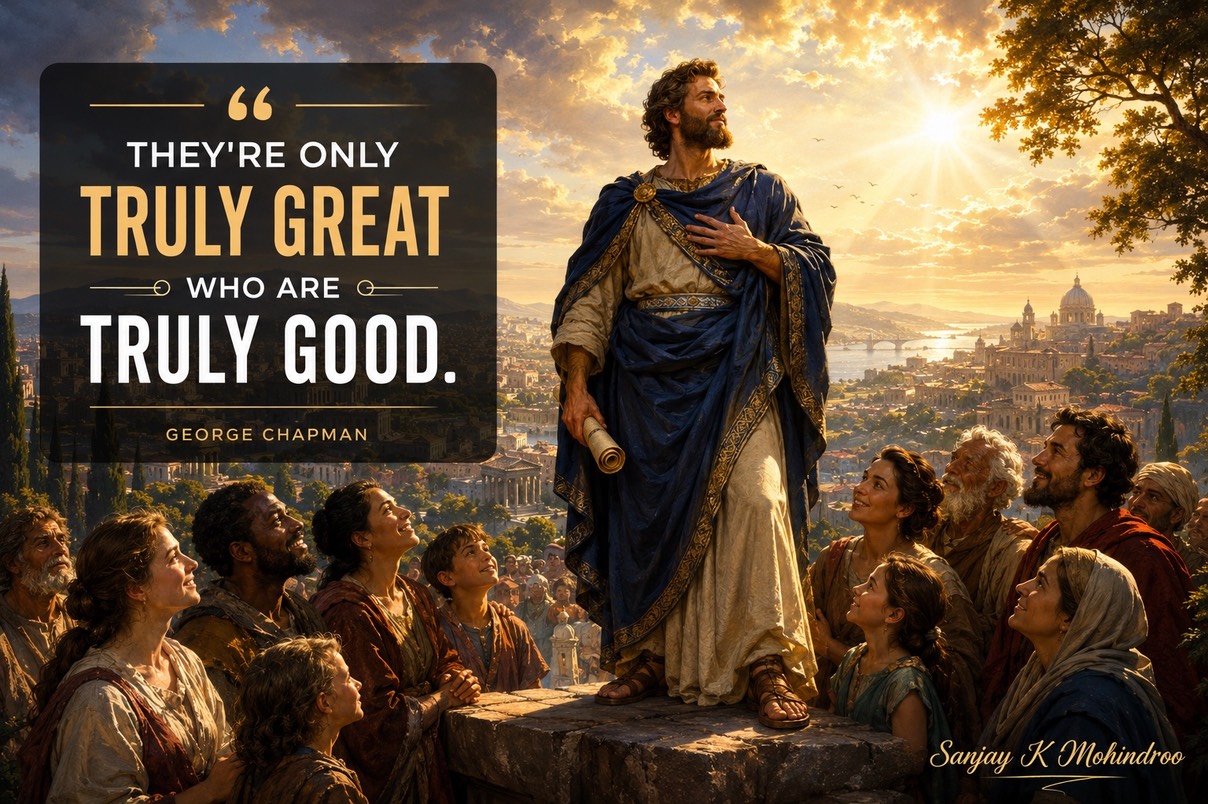
Sanjay K Mohindroo
True greatness is measured not by success alone, but by the goodness that shapes every action and decision.
Success attracts attention. Power commands respect. Achievement fills headlines. Yet history has a habit of separating those who merely accomplished much from those who genuinely mattered.
As George Chapman once said, "They're only truly great who are truly good. - George Chapman."
The statement carries a quiet strength. It challenges a belief many people accept without question: that greatness can be measured through influence, wealth, status, or achievement alone. Beneath the words lies a deeper message. Character is not separate from greatness. Character is the foundation of it.
The quote speaks to something people instinctively recognize. We admire success, but we trust goodness. We celebrate achievement, but we remember integrity. The people who leave the deepest mark are rarely those who reached the top. They are the ones who lifted others while climbing.
This idea becomes even more relevant at a time when visibility is often mistaken for value. Greatness that lasts is built on something stronger than recognition. It is built on goodness.
The Difference Between Success and Greatness
Achievement Wins Attention, Character Wins Respect
Many people spend years chasing success. There is nothing wrong with ambition. Progress drives innovation, creates opportunities, and pushes society forward. The problem begins when success becomes the only measure of worth.
History is filled with individuals who accumulated power, influence, and wealth. Some were feared. Others were admired for a season. Yet many faded from public memory because their achievements stood on weak moral foundations.
True greatness survives because it creates something larger than personal gain. It improves lives. It builds trust. It inspires others to become better versions of themselves.
A successful leader may build a large organization. A great leader builds people. A successful entrepreneur may create wealth. A great entrepreneur creates value that benefits communities, employees, and customers. The distinction is subtle but powerful.
When people discuss leadership under #Leadership or #PersonalGrowth, they often focus on skills, strategy, and execution. Those qualities matter. Yet without goodness, they become tools without direction.
The Hidden Power of Goodness
Strength Often Appears in Unexpected Forms
Many people associate goodness with softness. They assume kind individuals are less competitive, less ambitious, or less capable of making difficult decisions.
Reality suggests the opposite.
Goodness requires courage. It takes strength to remain honest when dishonesty offers an easier path. It takes discipline to act fairly when unfairness appears profitable. It takes conviction to treat people with dignity when circumstances encourage selfishness.
Every day, individuals face choices that reveal their character. Most of these moments never receive recognition. No audience applauds them. No newspaper reports them. Yet these decisions quietly shape reputations and relationships.
People remember who supported them during difficult times. They remember who acted with fairness under pressure. They remember who remained trustworthy when trust carried a cost.
That is why goodness carries influence far beyond a single action. It creates confidence. It creates loyalty. It creates credibility. These qualities cannot be purchased or manufactured.
The Legacy People Leave Behind
Reputation Lives Longer Than Results
Consider the people who continue to inspire generations after their deaths. Their influence often extends beyond their professional achievements.
People remember their values.
They remember generosity. They remember courage. They remember compassion. They remember integrity.
The reason is simple. Human beings connect with character more deeply than accomplishments. A person may admire someone's success, but they form emotional connections with someone's goodness.
Many achievements are eventually surpassed. Records are broken. Companies change. Technologies become outdated. Markets shift.
Character ages differently.
A person known for honesty remains respected long after specific accomplishments fade from memory. A person known for service continues to inspire long after titles disappear.
This is one reason conversations around #Character and #Integrity remain timeless. These qualities do not depend on economic conditions, political climates, or social trends. Their value remains constant.
Greatness in Everyday Life
Extraordinary Impact Often Comes from Ordinary Choices
When people hear the word greatness, they often imagine famous figures, influential leaders, or historic achievements.
Yet greatness frequently appears in quieter places.
A teacher who believes in struggling students changes lives. A manager who develops team members creates future leaders. A parent who consistently demonstrates patience and wisdom shapes generations.
These individuals may never receive awards or public recognition. Still, their influence spreads through every person they help.
Goodness multiplies.
One act of kindness encourages another. One display of integrity raises expectations for everyone around it. One example of courage permits others to act courageously.
This ripple effect explains why seemingly ordinary people can have extraordinary impact.
Their greatness is not measured by visibility. It is measured by influence.
The Challenge Modern Society Faces
Visibility Is Not the Same as Value
Modern culture rewards attention. Social media, news cycles, and public conversations often focus on visibility. The loudest voices receive the most exposure. The most dramatic stories attract the most engagement.
This creates a dangerous illusion.
People begin believing that being known is the same as being great.
It is not.
Recognition can be earned through talent, luck, timing, or circumstance. Greatness requires something deeper. It requires consistency between values and actions.
The individuals who truly shape organizations, communities, and societies often work quietly. They focus less on being noticed and more on being useful. Less on appearance and more on substance.
This mindset remains central to meaningful #LeadershipDevelopment and long-term success. People eventually see through appearances. Character becomes visible over time.
Goodness may move more slowly than popularity, but it lasts much longer.
The Standard Worth Pursuing
Becoming Better Before Becoming Bigger
The desire for achievement is natural. Growth, ambition, and excellence deserve encouragement. Yet they become most powerful when anchored to character.
The question is not whether people should seek success.
The question is what kind of person they become while pursuing it.
Every promotion, business opportunity, leadership role, or personal accomplishment presents the same choice. Will success strengthen character or weaken it?
The answer determines whether achievement becomes greatness.
People who focus only on outcomes often find success empty. People who focus on both excellence and goodness create something far more meaningful.
They build trust alongside results. They build respect alongside influence. They build legacies alongside accomplishments.
That combination creates greatness that endures.
The most admired people are rarely remembered only for what they achieved. They are remembered for who they were.
Goodness gives purpose to talent. It gives direction to ambition. It gives meaning to success.
Achievement can make someone important for a moment. Character can make someone significant for generations.
When success and goodness walk together, greatness stops being temporary. It becomes lasting. It becomes influential. It becomes the kind of greatness people continue talking about long after the applause fades.
#Leadership #PersonalGrowth #Character #Integrity #LeadershipDevelopment #EthicalLeadership #SuccessWithPurpose #Trust #Influence #Legacy
George Chapman was an English poet, playwright, and translator best known for his translations of Homer’s epic works. His writing often explored human nature, virtue, ambition, and moral responsibility. His words continue to resonate because they connect achievement with deeper questions of character and purpose.