

Cataloguing Strategic Innovations and Publications
Why Cloud Cost Optimization Fails in Large Enterprises.

Sanjay K Mohindroo
Most cloud cost optimization programs fail because they focus on technology instead of accountability, architecture, and business outcomes. Here's what leaders are missing.
The Cost Problem Isn't in the Cloud. It's in the Organization.
Why enterprises continue to spend more while believing they are optimizing
The uncomfortable truth behind rising cloud bills
Every year, enterprises invest millions in cloud optimization initiatives. They deploy FinOps teams. They purchase monitoring tools. They launch cost-reduction programs.
Yet cloud spending continues to climb.
The reason is simple. Most organizations treat cloud cost optimization as a technology problem, when it is actually a leadership, governance, and operating-model challenge.
After more than three decades leading technology organizations across global enterprises, I have seen the same pattern repeat itself. Teams focus on reducing costs at the infrastructure layer while ignoring the business behaviors creating those costs.
Cloud optimization succeeds when accountability, architecture, and business priorities work together. It fails when organizations chase dashboards instead of decisions.
This is not a cloud issue.
It is a management issue.
#CloudComputing #CIO #Leadership
When every executive meeting sounds the same
A few years ago, I sat in a quarterly review where cloud spending had exceeded forecasts for the third consecutive quarter.
The technology team had already presented detailed reports. Utilization charts looked impressive. Reserved instance savings had improved. Storage optimization initiatives were underway.
Everything appeared under control.
Except the bill.
As we dug deeper, the problem became obvious.
New applications were being launched without cost accountability. Development teams were overprovisioning environments. Business units were demanding faster delivery while nobody owned consumption decisions.
Everyone was optimizing.
Nobody was accountable.
That experience reinforced a lesson I have seen repeatedly across industries.
Cloud costs rarely become a problem because organizations lack visibility.
They become a problem because visibility rarely changes behavior.
Visibility Is Not Accountability
Dashboards do not make decisions
Most enterprises invest heavily in cloud monitoring platforms.
Executives receive detailed reports. Teams can see exactly where money is being spent. Cost anomalies are detected quickly.
Yet spending continues to rise.
Why?
Because information alone does not create ownership.
When every department consumes cloud resources but nobody feels responsible for the bill, costs become everyone's problem and nobody's priority.
The most successful organizations establish clear financial accountability for cloud consumption. Product owners understand the economic impact of their decisions. Business leaders see cloud spending as an operational expense they can influence.
When technology spending becomes part of business decision-making, behavior changes rapidly.
The dashboard was never the solution.
The conversation it enables is.
The Architecture Tax Nobody Talks About
Yesterday's design decisions create today's cloud bills
Many enterprises migrate legacy applications to the cloud expecting immediate savings.
What often follows is disappointment.
The application moves.
The costs increase.
The reason is straightforward.
Applications designed for traditional infrastructure often carry architectural assumptions that become expensive in cloud environments. Inefficient data movement, excessive storage, unnecessary processing, and duplicated services create hidden financial drag.
Cloud magnifies architectural choices.
Good architecture becomes more efficient.
Poor architecture becomes more expensive.
I have seen organizations spend months negotiating vendor discounts while ignoring application designs that were generating far greater costs.
The largest savings opportunities rarely sit in procurement contracts.
They sit inside the architecture itself.
#EnterpriseArchitecture #DigitalTransformation
Cloud-First Is Not Always Business-First
For years, "cloud-first" became one of the most popular technology strategies.
It sounded progressive. It signaled modernization. It reassured boards that the organization was moving forward.
But strategy should never become ideology.
The belief that every workload belongs in the cloud is incomplete.
Some workloads create extraordinary value in cloud environments. Others perform better economically in hybrid models. Some legacy systems may deliver greater business value when left untouched until a larger transformation occurs.
The goal is not maximizing cloud adoption.
The goal is maximizing business outcomes.
I have advised leadership teams where the smartest decision was moving workloads into the cloud.
I have also advised teams where the smartest decision was not moving them.
Technology choices should serve business strategy.
Business strategy should never become a hostage to technology trends.
That distinction separates mature leadership from fashionable leadership.
#BusinessStrategy #TechnologyLeadership
Speed Has a Cost
The hidden trade-off executives often overlook
One of the greatest benefits of cloud computing is speed.
Teams can deploy environments in minutes. New services can launch rapidly. Innovation accelerates.
That speed creates value.
It also creates risk.
When provisioning becomes effortless, consumption expands naturally. Development environments remain active longer than necessary. Test systems accumulate. Temporary workloads become permanent.
Cloud platforms make spending easy.
Governance must make spending intentional.
Organizations that achieve sustainable optimization balance agility with discipline. They empower teams to move quickly while maintaining clear financial guardrails.
The objective is not restricting innovation.
The objective is ensuring innovation produces value greater than the cost it creates.
FinOps Is a Leadership Discipline
Why finance and technology must operate as one team
Many organizations view FinOps as a technical function.
I believe that perspective is far too narrow.
At its best, FinOps creates a common language between technology, finance, and business leadership.
Technology teams understand performance.
Finance teams understand economics.
Business leaders understand priorities.
Cloud optimization happens when all three perspectives converge.
The organizations achieving exceptional results are not running better spreadsheets.
They are running better conversations.
Their leaders ask different questions.
Not "How do we reduce cloud costs?"
But "How do we maximize business value from every dollar we spend?"
That shift changes everything.
#FinOps #BusinessValue #ExecutiveLeadership
What leaders should focus on
Cloud cost optimization requires leadership attention beyond technology operations.
First, establish accountability for cloud spending at the business level, not just within IT.
Second, evaluate architecture alongside infrastructure. Long-term savings often come from design improvements rather than consumption reductions.
Third, challenge cloud assumptions. Every workload should justify its economic model.
Fourth, integrate finance, technology, and business leadership into a shared operating framework.
Finally, measure value, not simply cost reduction. The cheapest environment is not always the best environment.
The most successful organizations optimize for business outcomes, not infrastructure metrics.
Cloud economics reflect organizational behavior
After thirty years leading complex technology organizations across industries and regions, I have become convinced of one thing.
Technology rarely creates its biggest problems.
Organizations do.
Cloud platforms are remarkably powerful. They offer flexibility, scalability, and speed that previous generations of leaders could only imagine.
Yet cloud spending tells a story.
It reveals how decisions are made. It exposes accountability gaps. It highlights leadership strengths and weaknesses.
The enterprises that master cloud economics do not have better technology.
They have better alignment.
When strategy, architecture, governance, and accountability move in the same direction, cloud optimization becomes sustainable.
Until then, organizations will continue chasing savings while wondering why the bill keeps growing. #CloudComputing #CloudCostOptimization #FinOps #CIO #CEO #COO #Leadership #DigitalTransformation #TechnologyLeadership #EnterpriseArchitecture #BusinessStrategy #CloudGovernance #ITLeadership #ExecutiveLeadership #BusinessValue #Innovation #FutureOfWork #BoardLeadership
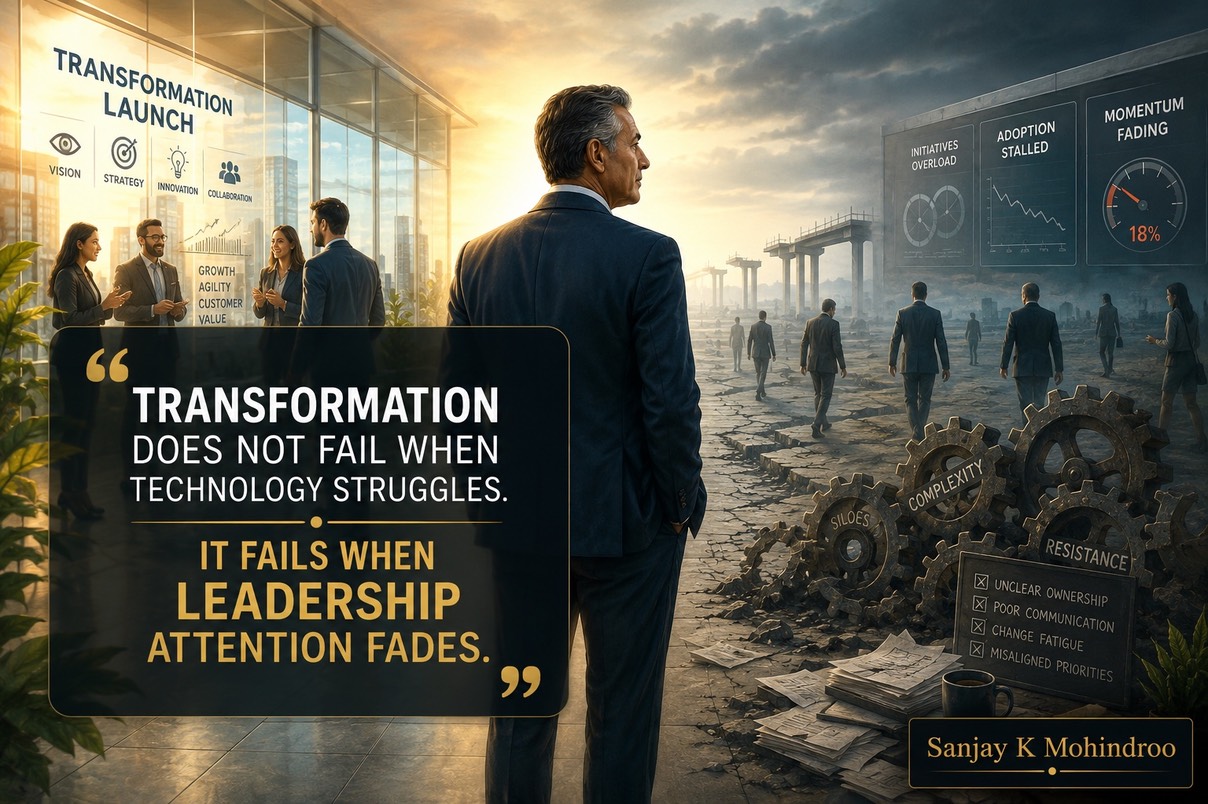
Why Most Transformation Programs Lose Momentum Within One Year.
Sanjay K Mohindroo
Most transformation programs do not fail because of technology, funding, or strategy. They lose momentum because leaders misunderstand what transformation actually requires. Here's what separates lasting change from temporary progress.
The Real Problem Is Not Execution. It Is Leadership Attention.
Most transformation programs begin with energy, urgency, and executive sponsorship.
Twelve months later, many are stalled.
The budgets are still there. The steering committees still exist. The presentations continue.
Yet momentum fades.
The common explanation is poor execution.
My experience suggests something different.
Most transformation programs lose momentum because leadership treats transformation as a project to manage rather than a business capability to build.
That distinction changes everything.
The First Year Creates a Dangerous Illusion
Early Progress Is Often Misread as Sustainable Change
The first twelve months of a transformation are usually the easiest.
Funding is available.
Executive attention is high.
Teams are motivated.
Consultants are engaged.
The organization is willing to tolerate disruption because the destination feels exciting.
This creates visible progress.
New systems are launched.
Processes are redesigned.
Dashboards show movement.
Board updates look positive.
Then reality arrives.
The transformation moves beyond planning and deployment into behavioral change.
That is where momentum begins to disappear.
Technology can be installed in months.
New habits can take years.
Most organizations underestimate this gap.
As a result, leaders celebrate implementation while the organization quietly resists adoption.
The transformation appears successful on paper while losing strength underneath.
The Hidden Cost of Competing Priorities
Transformation Rarely Loses to Resistance. It Loses to Distraction.
Organizations rarely wake up and decide to abandon transformation.
Something more subtle happens.
The business gets busy.
Revenue targets need attention.
Customer issues emerge.
Markets shift.
A competitor makes an unexpected move.
Leadership attention starts moving elsewhere.
Transformation becomes one priority among many.
That is the moment risk enters the system.
Every transformation competes for the same finite resource.
Executive attention.
When leadership attention becomes fragmented, organizational energy follows.
Teams receive mixed signals.
Employees begin prioritizing short-term operational demands.
Managers stop reinforcing new behaviors.
Momentum slows.
The program continues formally.
The transformation stops informally.
Many executives monitor budgets and milestones.
Few monitor the consistency of leadership attention.
That is often where momentum is won or lost.
Transformation Is a Leadership Discipline, Not a Program Office Function
Governance Cannot Replace Ownership
Organizations often respond to slowing momentum by adding governance.
More meetings.
More reporting.
More status reviews.
More escalation mechanisms.
None of these solve the real issue.
Transformation does not accelerate because there are more governance structures.
It accelerates when leaders make clear choices.
Employees pay attention to what leaders reward, measure, discuss, and tolerate.
Not what appears on project plans.
If transformation is discussed during quarterly reviews but ignored during weekly business discussions, people understand the message immediately.
Operations matter.
Transformation can wait.
The signal becomes stronger than the strategy.
Momentum is sustained when transformation becomes part of how the business is run, not something that sits alongside it.
That requires active leadership ownership long after the launch event is over.
The Measurement Trap
Many Organizations Track Activity Instead of Business Movement
One pattern appears repeatedly across transformation programs.
The wrong metrics survive the longest.
Leaders review project completion rates.
Training attendance.
Technology deployment percentages.
Budget utilization.
These indicators create comfort.
They rarely create insight.
The real question is simpler.
Has business behavior changed?
If decision-making remains the same, the transformation is not progressing.
If customer outcomes remain unchanged, the transformation is not progressing.
If managers continue operating through old processes, the transformation is not progressing.
Organizations often mistake activity for momentum.
The two are not the same.
Activity creates movement.
Momentum creates lasting change.
Only one of them survives executive presentations.
Executive Sponsorship Is Overrated
Executive Presence Does Not Create Transformation
One of the most accepted beliefs in business is that transformation succeeds with strong executive sponsorship.
I disagree.
Executive sponsorship is necessary.
It is rarely sufficient.
Many programs have visible sponsors who attend steering committees, approve budgets, and communicate support.
Yet momentum still disappears.
Why?
Because sponsorship and ownership are different things.
Sponsorship provides authorization.
Ownership provides sustained accountability.
Transformation succeeds when leaders treat outcomes as part of their operational responsibilities rather than delegated initiatives.
The most successful transformations I have seen were not driven by charismatic sponsors.
They were driven by leaders who consistently reinforced change through everyday decisions.
That difference is easy to miss.
It is also where lasting momentum comes from.
What Senior Leaders Should Focus On Instead
Five Questions Every Leadership Team Should Ask
1. Where has leadership attention shifted away from transformation during the last six months?
2. Which business behaviors have changed permanently because of the transformation?
3. Are we measuring outcomes or merely tracking activity?
4. Have operational leaders accepted ownership, or are they waiting for the program office to drive progress?
5. If executive sponsorship disappeared tomorrow, would the transformation continue moving forward?
The answers reveal more than any status report.
Momentum Is a Leadership Choice
The Organization Always Follows What Leaders Consistently Reinforce
Most transformation programs do not fail because the strategy was wrong.
They do not fail because the technology was inadequate.
They do not fail because employees resisted change.
They lose momentum because leadership attention moves on before organizational behavior changes.
Transformation is not an event.
It is not a launch.
It is not a technology deployment.
It is a sustained shift in how decisions are made, how work gets done, and how success is measured.
The organizations that sustain momentum understand a simple truth.
Transformation does not become real when systems go live.
It becomes real when leaders refuse to let the organization return to old habits.
That is the point where change stops being a program and starts becoming a capability.
#Leadership #CIO #DigitalTransformation #BusinessTransformation #ExecutiveLeadership
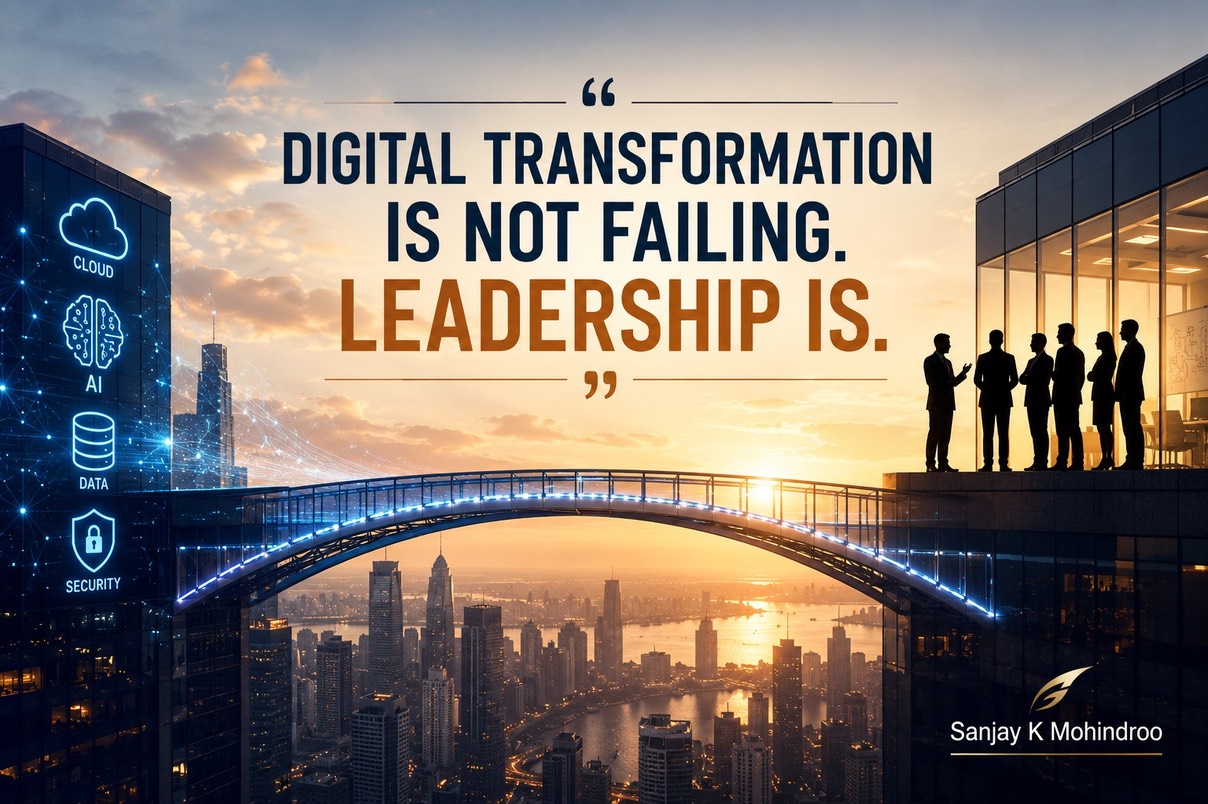
Digital Transformation Is Not Failing. Leadership Is.
Sanjay K Mohindroo
Most digital transformation initiatives do not fail because of technology. They fail because leadership treats transformation as an IT project instead of a business decision. Here is what senior leaders continue to miss.
The uncomfortable truth behind transformation failures
Organizations continue to invest billions in digital transformation. Cloud platforms are deployed. AI programs are launched. Data strategies are approved. Technology budgets continue to grow.
Yet many executives still describe transformation outcomes as disappointing.
The problem is rarely technology.
The problem is leadership behavior.
Transformation does not fail because systems cannot change. It fails because leaders refuse to change how decisions are made, how accountability is assigned, and how success is measured.
Until leadership transforms first, digital transformation remains little more than expensive modernization.
The Boardroom Story Nobody Wants to Tell
Technology is rarely the constraint
Over the last three decades, I have sat in countless executive meetings where transformation programs were reviewed.
The pattern is remarkably consistent.
When results fall short, the conversation immediately shifts toward technology.
The platform was not mature enough.
The implementation partner was weak.
The data quality was poor.
The users resisted change.
While these factors matter, they are usually symptoms rather than causes.
The deeper issue is that many leadership teams want the benefits of transformation without changing the way they operate.
They want faster decisions while maintaining layers of approvals.
They want innovation while punishing intelligent risk-taking.
They want agility while preserving structures designed for control.
Technology cannot compensate for leadership contradictions.
A modern platform running inside an outdated leadership culture simply digitizes inefficiency.
The Leadership Behaviors That Kill Transformation
Transformation dies long before technology fails
Most organizations underestimate how quickly leadership behavior shapes outcomes.
I often see four recurring patterns.
Delegating transformation downward
Leaders announce transformation and then hand responsibility to technology teams.
That is not transformation.
That is outsourcing accountability.
Digital transformation changes operating models, customer experiences, revenue streams, and competitive positioning.
Those are leadership responsibilities.
Measuring activity instead of outcomes
Many organizations celebrate project milestones.
Systems deployed.
Applications migrated.
Dashboards launched.
None of these measures business value.
Customers do not care how many applications moved to the cloud.
Shareholders do not reward successful migrations.
They reward growth, efficiency, resilience, and market advantage.
Protecting legacy power structures
Transformation often exposes inefficiencies.
Some leaders quietly resist because transparency threatens established influence.
The organization talks about change while rewarding preservation.
Transformation stalls.
Treating change management as a communications exercise
Sending emails and conducting town halls does not create change.
People follow incentives, leadership actions, and organizational priorities.
When leadership behavior remains unchanged, employees receive a clear message:
Transformation is optional.
More Technology Does Not Create More Transformation
One of the most widely accepted beliefs in business today is that transformation accelerates when organizations invest more aggressively in technology.
That belief is flawed.
Technology investment is often mistaken for transformation progress.
They are not the same thing.
Many organizations have accumulated impressive technology stacks while becoming more complex, slower, and harder to manage.
The real accelerator is leadership clarity.
When leadership aligns around outcomes, decision rights, accountability, and priorities, transformation moves rapidly.
When leadership lacks alignment, even the best technology becomes another layer of complexity.
The question is not:
"Do we have the right technology?"
The better question is:
"Have we created the leadership environment where technology can deliver value?"
That question is far less comfortable.
It is also far more important.
What Effective Leaders Do Differently
They transform the organization before transforming the technology
The strongest transformation leaders share several characteristics.
They establish business outcomes before selecting solutions.
They remove organizational barriers before launching programs.
They simplify decision-making before demanding speed.
They create accountability before approving budgets.
Most importantly, they remain personally involved.
Not in project management.
In leadership.
They continually reinforce priorities.
They resolve conflicts quickly.
They make difficult trade-offs visible.
They create alignment where complexity naturally emerges.
Transformation succeeds when leadership provides clarity faster than the organization creates confusion.
Questions every executive team should ask
Before approving another transformation initiative, leadership teams should challenge themselves with five questions:
1. What business outcome are we pursuing beyond technology modernization?
2. Which leadership behaviors must change for this initiative to succeed?
3. Who owns business accountability, not project accountability?
4. What decisions will become faster because of this transformation?
5. If the technology works perfectly, what leadership barriers could still cause failure?
The answers reveal far more than any project plan.
They expose whether transformation is truly strategic or merely technical.
The transformation mirror
Digital transformation has become one of the most analyzed topics in business.
Yet many organizations continue searching for technical explanations to leadership problems.
Technology is easier to blame.
Leadership is harder to examine.
The next time a transformation program struggles, resist the instinct to look first at systems, platforms, vendors, or budgets.
Look at the leadership team.
Look at decision-making.
Look at accountability.
Look at behavior.
Because transformation rarely fails when leadership is aligned.
And when leadership is not aligned, no technology in the world can save it.
The real question is not whether your organization is ready for digital transformation.
The real question is whether its leaders are.
#DigitalTransformation #Leadership #CIO #BusinessStrategy #ExecutiveLeadership
Biometric-Assured Identity: Why MFA Is No Longer Enough in the Age of AI.

Sanjay K Mohindroo
The next security battleground is no longer authentication. It is identity assurance.
AI has changed cyber risk. MFA alone is no longer enough; biometric-assured identity is becoming a board-level security priority.
The security conversation has moved beyond authentication
For nearly two decades, Multi-Factor Authentication (MFA) has been presented as the answer to identity security. It dramatically reduced password-based attacks and became the standard recommendation for every organization.
That recommendation no longer reflects today's threat landscape.
Artificial Intelligence has transformed cyberattacks from opportunistic to industrialized. Attackers no longer need to steal passwords. They manipulate identities, automate deception, bypass traditional authentication, and exploit human trust with alarming precision.
The leadership question is no longer:
"Do we have MFA?"
It is:
"How certain are we that the person accessing our systems is genuinely who they claim to be?"
That distinction changes everything.
#Leadership #CyberSecurity #AI #IdentitySecurity #BoardLeadership
The Illusion of Safety
When compliance becomes mistaken for security
Many executive dashboards proudly report MFA adoption rates above 95%.
Boards
see green indicators.
Audit committees feel reassured.
Risk registers show improvement.
Yet many successful breaches today begin inside accounts protected by MFA.
That should make every leadership team uncomfortable.
The problem is not that MFA has failed.
The problem is that the assumptions behind MFA have changed.
Traditional MFA verifies possession.
Do you have the phone?
Do you have the token?
Do you have access to the email?
It does not verify with high confidence that the individual holding those devices is the legitimate user.
AI has made impersonation dramatically easier.
Deepfake voice technology can convince service desks.
Synthetic identities pass manual verification.
Real-time phishing proxies capture authentication sessions.
Push fatigue attacks exploit human behavior rather than technical weaknesses.
The attacker is no longer trying to defeat technology.
The attacker is trying to become you.
That is a very different problem.
Identity Has Become the New Security Perimeter
Every digital transformation now depends on trusted identity
For years, organizations invested heavily in protecting networks.
Then cloud computing dissolved the network perimeter.
Security shifted toward applications.
Now AI is dissolving confidence in identity itself.
Every strategic initiative—cloud adoption, remote work, digital customer experience, automation, AI agents—depends upon one simple assumption:
The person requesting access is genuine.
If that assumption fails, every security control above it becomes less effective.
Encryption protects data.
Firewalls protect networks.
Monitoring detects activity.
Identity determines who receives permission in the first place.
Nothing is more foundational.
Boards increasingly ask whether cyber investments reduce measurable risk.
Identity assurance is one of the few investments that strengthens every other security control simultaneously.
It is not another layer.
It becomes the foundation.
Why Biometrics Change the Conversation
From authenticating devices to verifying people
Biometric authentication is often misunderstood as another convenience feature.
Fingerprint login.
Face recognition.
Voice authentication.
That thinking misses the larger opportunity.
Modern biometric assurance is not about replacing passwords.
It is about creating stronger confidence that a real, authorised human is present during every high-risk interaction.
When implemented correctly, biometric assurance combines multiple signals.
Facial recognition.
Liveness detection.
Behavioural patterns.
Device intelligence.
Contextual risk.
Continuous verification.
Rather than asking only:
"Did the correct device authenticate?"
The system asks:
"Is this the same trusted individual behaving consistently with previous interactions?"
That represents a significant improvement over static authentication.
No security solution is perfect.
Biometrics also introduce challenges around privacy, governance, regulatory compliance, bias, storage, and lifecycle management. These must be addressed deliberately through strong design and transparent governance.
Yet the direction is clear.
Identity assurance is becoming dynamic rather than transactional.
The Business Case Extends Beyond Cybersecurity
Trust creates measurable business value
Technology leaders sometimes struggle to justify identity investments because they frame them purely as security spending.
That is too narrow.
Trusted identity reduces fraud.
It improves customer experience.
It accelerates digital onboarding.
It simplifies regulatory compliance.
It reduces operational costs associated with account recovery.
It strengthens confidence in digital transactions.
It enables higher-value automation.
Most importantly, it builds trust.
Trust remains one of the few competitive advantages that cannot be replicated quickly.
Customers increasingly expect secure digital interactions without unnecessary friction.
Employees expect seamless access.
Partners expect confidence in every transaction.
Strong identity assurance supports all three.
The biggest mistake is believing stronger authentication automatically delivers stronger security
For years, security discussions focused on adding more authentication factors.
Password.
Token.
Mobile approval.
Hardware key.
More layers appeared to mean more protection.
That belief deserves re-examination.
Security does not improve because authentication becomes more complicated.
Security improves because identity becomes more certain.
Those are different objectives.
An organization can require five authentication factors and still approve access for the wrong individual.
Conversely, a well-designed biometric assurance framework combined with adaptive risk analysis may deliver higher confidence with less user friction.
The goal should never be more authentication.
The goal should always be better identity assurance.
That subtle shift changes technology investment priorities.
It also changes board conversations.
Questions worth asking before your competitors do
Leadership teams should challenge existing assumptions around digital identity.
Instead of asking whether MFA has been deployed, ask:
- Which identity attacks could still succeed despite MFA?
- How do we verify human presence during high-risk transactions?
- Can AI-generated impersonation bypass our current controls?
- Where does biometric assurance improve customer trust without creating unnecessary friction?
- Are identity risks discussed as business risks rather than technical issues?
These questions move security conversations from compliance toward resilience.
That is where executive attention belongs.
The next competitive advantage will be confidence, not convenience
Every major technology shift changes what organizations must protect.
Cloud changed infrastructure.
Remote work changed endpoints.
Artificial Intelligence is changing identity.
Organizations that continue to treat MFA as the finish line will eventually find themselves defending against yesterday's threat model.
The stronger position is to treat authentication as the starting point and identity assurance as the destination.
The future will belong to organizations that can answer one question with confidence:
"Are we certain this person is who they claim to be?"
Because in the AI era, certainty has become one of the most valuable assets an enterprise can possess.
The next board discussion may start here
If AI can imitate voices, generate realistic faces, automate phishing campaigns, and manipulate human trust, should boards continue measuring security maturity by MFA adoption alone?
Or is it time to redefine identity assurance as a strategic business capability rather than another cybersecurity control?
#Leadership #CyberSecurity #ArtificialIntelligence #IdentitySecurity #DigitalTrust
Alignment Is Not Meetings. It Is Shared Accountability.

Sanjay K Mohindroo
Most organizations confuse alignment with communication. Real alignment is not built through meetings, updates, or status reports. It is created when leaders share accountability for outcomes.
The Leadership Misconception That Slows Execution
Many organizations spend enormous amounts of time trying to improve alignment. More meetings are scheduled. More updates are requested. More governance layers are added.
Yet execution continues to struggle.
The reason is simple.
Alignment is not a communication problem.
It is an accountability problem.
Organizations move faster when teams share responsibility for outcomes, not when they share calendars.
The Most Aligned Teams Often Meet Less
Communication Creates Visibility. Accountability Creates Movement.
I have sat through thousands of executive meetings over the years.
Weekly
reviews.
Steering committees.
Transformation councils.
Executive updates.
Most were productive.
Many were necessary.
A surprising number achieved very little.
The assumption behind many of these meetings is that if everyone is informed, everyone is aligned.
That assumption is flawed.
People can have complete visibility and still pull in different directions.
They can agree during the meeting and compete afterward.
They can nod at the same presentation while optimizing different objectives.
Alignment does not happen because people hear the same message.
Alignment happens when people succeed or fail together.
That distinction changes everything.
The Cost of Functional Success
Why Organizations Struggle Despite Having Strong Leaders
One of the most common patterns in large organizations is functional optimization.
Sales hits revenue targets.
Operations improves efficiency.
Technology delivers projects.
Finance protects margins.
Each team performs well according to its own scorecard.
Yet enterprise outcomes fall short.
Why?
Because local success does not automatically create organizational success.
I have seen technology teams deliver every milestone on time while the business failed to adopt the solution.
I have seen operations achieve efficiency targets that damaged customer experience.
I have seen business units pursue growth initiatives that created unsustainable technology complexity.
Nobody failed.
Everyone succeeded.
The organization lost.
That is what happens when accountability ends at departmental boundaries.
Leaders often spend months trying to fix these situations through communication plans.
The real issue is incentive design.
When teams are measured separately, they behave separately.
When outcomes are shared, behavior changes quickly.
Accountability Is the Real Architecture of Alignment
Shared Outcomes Create Shared Decisions
The strongest transformations I have experienced had one common characteristic.
Ownership was collective.
Not symbolic.
Not verbal.
Real.
Business leaders and technology leaders shared the same outcome metrics.
Operations leaders and customer leaders carried the same targets.
Success belonged to everyone.
Failure belonged to everyone.
Once that happens, priorities become clearer.
Trade-offs become easier.
Decision-making accelerates.
The conversation changes from:
"Who owns this?"
to
"How do we make this successful?"
That shift removes enormous friction from execution.
The organization spends less time negotiating responsibilities and more time creating results.
More Alignment Meetings Often Signal Less Alignment
Many executives believe alignment problems should be solved with more coordination.
The opposite is often true.
When organizations become dependent on recurring meetings to stay aligned, it usually signals fragmented accountability.
The meeting becomes a substitute for ownership.
The update replaces commitment.
The governance process compensates for unclear responsibility.
Organizations with genuine alignment rarely need constant intervention.
People know what matters.
They understand how decisions affect adjacent teams.
They share responsibility for outcomes.
As a result, fewer issues require escalation.
More meetings are not evidence of alignment.
They are often evidence that alignment is missing.
The goal should not be to improve meeting effectiveness.
The goal should be to reduce the organizational need for meetings.
That is a far more valuable leadership metric.
What Boards and Executive Teams Should Ask
Questions That Reveal Whether Alignment Actually Exists
When discussing execution challenges, leaders should ask a different set of questions.
Instead of asking:
"Have all stakeholders been informed?"
Ask:
"Who shares accountability for the outcome?"
Instead of asking:
"How often are teams meeting?"
Ask:
"Would these teams still make the same decisions without the meeting?"
Instead of asking:
"Who owns this initiative?"
Ask:
"Who succeeds if it succeeds and who fails if it fails?"
The answers reveal more about organizational alignment than any governance dashboard.
Real alignment is visible in decisions, incentives, and behavior.
Not meeting schedules.
Not communication plans.
Not reporting structures.
Actions Senior Leaders Can Implement Immediately
1. Replace activity metrics with outcome metrics wherever possible.
2. Create shared targets across functions for strategic initiatives.
3. Reduce governance layers that exist only to coordinate disconnected incentives.
4. Evaluate leaders on enterprise outcomes, not just departmental performance.
5. Measure alignment by decision speed and execution quality, not meeting frequency.
These changes are harder than scheduling another committee.
They are also far more effective.
Alignment Is Proven When Nobody Needs Reminding
Organizations do not suffer from a lack of communication.
Most suffer from a lack of shared accountability.
The difference matters.
Communication creates awareness.
Accountability creates action.
The organizations that execute best are rarely the ones holding the most meetings.
They are the ones where leaders understand that success is interconnected.
When accountability is shared, alignment becomes natural.
When accountability is fragmented, no amount of communication can compensate.
The next time an organization struggles with alignment, the answer may not be another meeting.
It may be a harder question:
Have we created shared accountability for the outcome we claim to care about?
#Leadership #CIO #BusinessTransformation #ExecutiveLeadership #Strategy
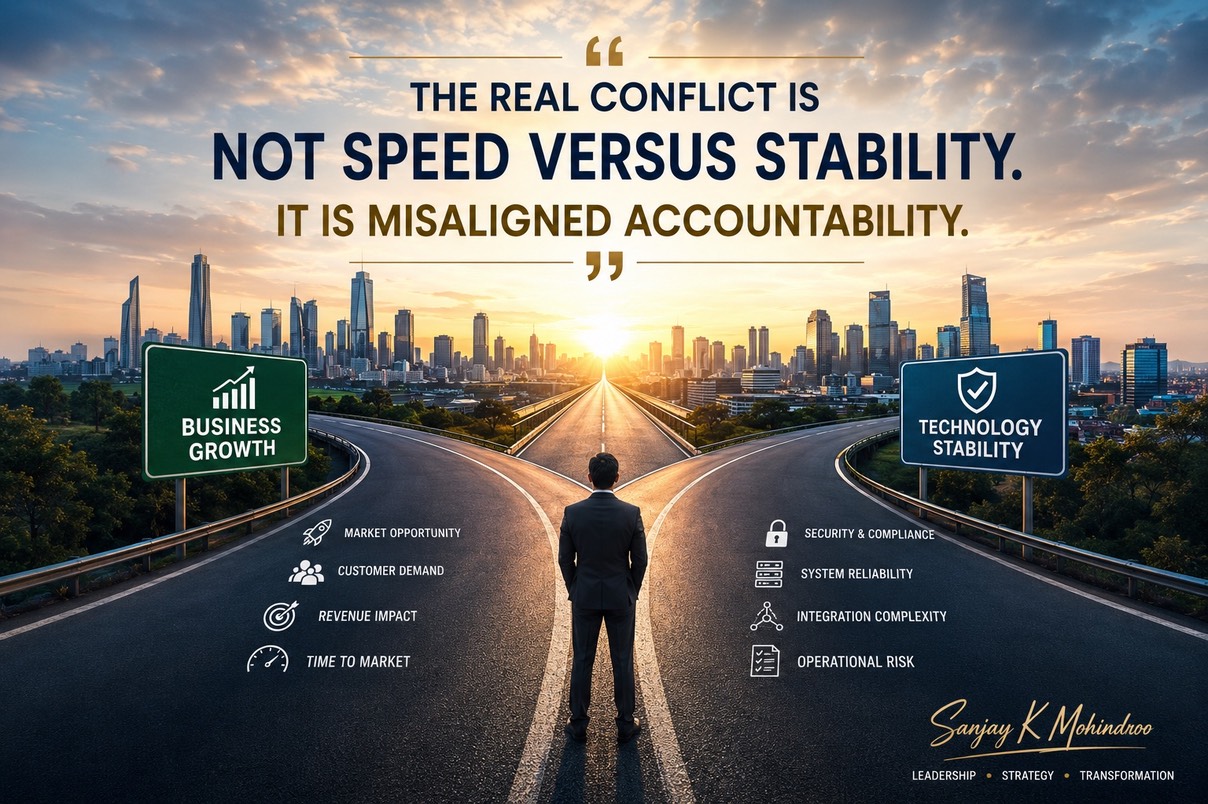
When the Business Wants Speed, and IT Wants Stability.
Sanjay K Mohindroo
The Leadership Decision That Defines Transformation
A real-world look at what happens when business urgency collides with IT discipline, and why the best leaders stop treating it as a conflict and start treating it as a design problem.
The Collision Most Organizations Misunderstand
Every major transformation eventually reaches the same moment.
The business wants results now.
IT wants to reduce risk.
Both believe they are protecting the organization.
Both are right.
The problem is that many leadership teams frame this as a battle between speed and control. In reality, it is a failure of alignment. The organizations that outperform their peers are not the ones that choose one side. They are the ones that redesign how decisions are made when priorities collide.
The Meeting Every Executive Has Seen
When Growth Targets Meet Technology Reality
A few years ago, I sat in a steering committee meeting that looked perfectly normal on the surface.
The business team wanted to launch a new digital offering before a major industry event. Revenue projections were strong. Competitive pressure was increasing. Delaying the launch meant losing market momentum.
The CIO's team pushed back.
The platform architecture was not ready.
Security testing was incomplete.
Integration risks remained unresolved.
The business viewed IT as a bottleneck.
IT viewed the business as reckless.
The discussion quickly became emotional.
Deadlines were defended.
Risks were amplified.
Trust began to erode.
What interested me was not the disagreement.
It was the assumption underneath it.
Everyone assumed the problem was technology.
It wasn't.
The problem was decision-making.
The organization had no shared framework for balancing opportunity against risk.
So, every discussion became a negotiation instead of a leadership decision.
The Real Issue Is Not Speed Versus Stability
It Is Accountability Versus Ownership
When business and IT priorities collide, leaders often frame the debate incorrectly.
The business asks:
"Why can't IT move faster?"
IT asks:
"Why is the business accepting so much risk?"
Neither question gets to the heart of the issue.
The better question is:
"Who owns the outcome?"
In many organizations, accountability is fragmented.
Business leaders own revenue.
IT leaders own systems.
Security leaders own compliance.
Operations leaders own execution.
Yet customers experience the company as one organization.
They do not care which department made the decision.
They only experience the result.
This is why siloed accountability creates organizational friction.
Everyone protects their domain.
Few optimize for the enterprise.
The most effective leadership teams establish shared accountability before major decisions are made.
The conversation changes immediately.
Instead of defending functions, leaders begin evaluating trade-offs.
That shift sounds simple.
In practice, it changes everything.
Why Most Escalations Are Symptoms of a Deeper Problem
Misaligned Incentives Create Predictable Conflict
In boardrooms around the world, I continue to see the same pattern.
The business rewards speed.
IT rewards reliability.
Operations rewards consistency.
Finance rewards efficiency.
Each function behaves rationally according to its incentives.
The conflict is predictable.
What leaders often miss is that no amount of governance fixes conflicting incentives.
You can create more committees.
You can add more reporting.
You can schedule more review meetings.
The friction remains.
The organizations that scale effectively align incentives around enterprise outcomes rather than functional success.
When leaders are measured against the same outcome, priorities become clearer.
Decisions become faster.
And the quality of execution improves.
Alignment is not a communication exercise.
It is a structural choice.
Speed Is Rarely the Problem
One of the most common beliefs in leadership circles is that IT slows down business growth.
I disagree.
In most organizations, speed is not the problem.
Unclear decisions are.
I have seen companies deploy technology rapidly and still fail.
I have also seen organizations move cautiously and outperform competitors.
The difference was not pace.
The difference was clarity.
When priorities are clear, teams move with confidence.
When priorities are unclear, organizations create the illusion of activity while decisions remain unresolved.
Many executives ask how to accelerate transformation.
A better question is:
"What decisions are we avoiding?"
That question usually reveals the real bottleneck.
And it is rarely technology.
What High-Performing Leadership Teams Do Differently
Turning Conflict into Competitive Advantage
The strongest leadership teams do not eliminate tension between business and IT.
They use it.
Constructive tension improves decisions.
It forces assumptions into the open.
It exposes blind spots.
It prevents costly mistakes.
The objective is not agreement.
The objective is clarity.
The best teams establish three principles.
First, every major initiative has a single business outcome that everyone understands.
Second, risks are quantified rather than debated emotionally.
Third, decisions are made at the appropriate level and documented clearly.
This creates trust.
And trust accelerates execution more than any technology investment ever will.
When people understand how decisions are made, they spend less time protecting themselves and more time delivering results.
Questions Every Leadership Team Should Ask
Before your next major transformation initiative, ask:
- Are business and IT measured against the same outcome?
- Have we defined acceptable risk levels?
- Are we debating facts or defending functions?
- Who ultimately owns the result?
- What decision are we avoiding because it is uncomfortable?
These questions often reveal more than months of status reports.
The Best Transformations Are Leadership Transformations
Technology rarely creates the biggest challenge.
People do.
More accurately, leadership choices do.
Every organization eventually faces a moment where business urgency collides with technology reality.
The outcome is rarely determined by the platform, the architecture, or the budget.
It is determined by how leaders think.
Organizations that treat business and IT as opposing forces create endless friction.
Organizations that align both around shared outcomes create momentum.
The difference is not strategy.
The difference is leadership.
And leadership becomes most visible when priorities collide.
#CIO #Leadership #DigitalTransformation #BusinessStrategy #TechnologyLeadership
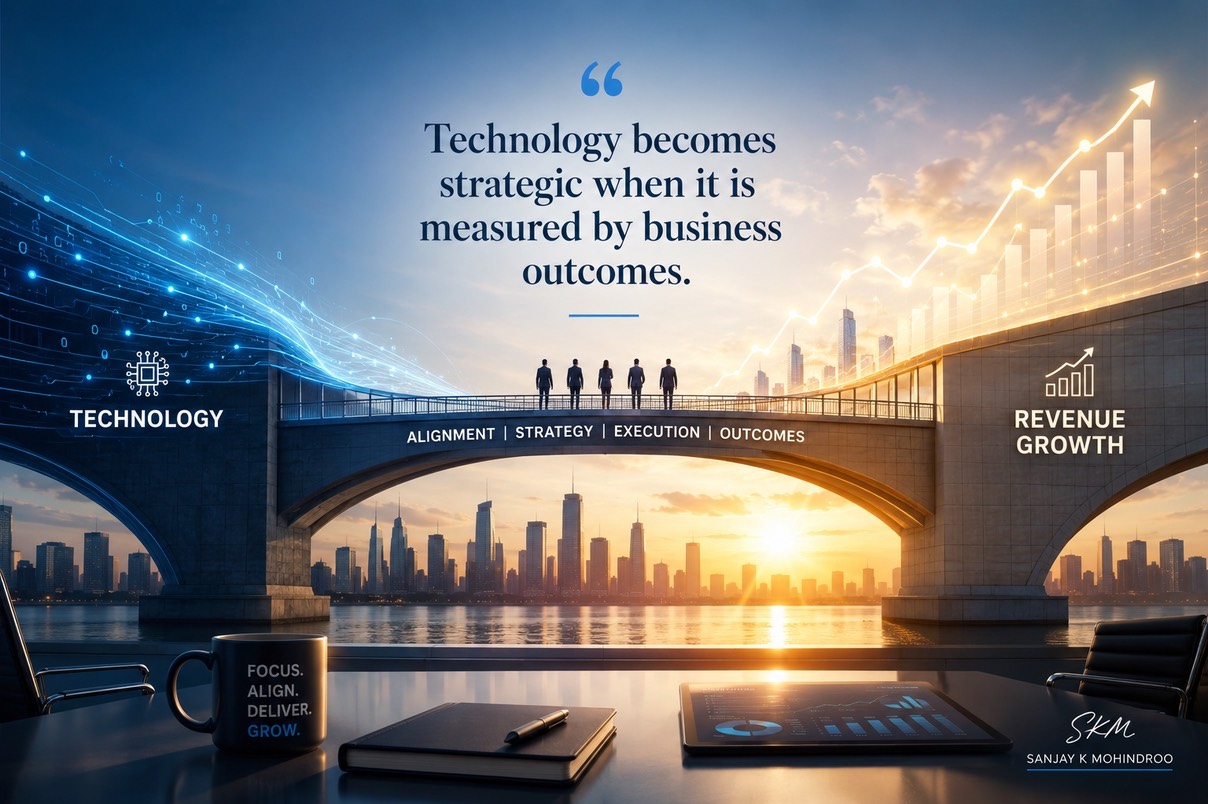
A Practical Model to Align IT with Revenue Outcomes.
Sanjay K Mohindroo
Most IT strategies fail to connect technology investments with measurable revenue outcomes. A practical model for CEOs, CIOs, and boards to align technology decisions with business growth.
Technology Does Not Create Value. Business Outcomes Do.
Many organizations spend millions on technology while struggling to explain how those investments contribute to revenue growth. The problem is rarely the technology itself. The problem is the operating model used to connect technology decisions with business outcomes.
The most effective CIOs do not manage projects. They manage revenue impact. This article outlines a practical framework that shifts IT from a cost center mindset to a growth engine mindset.
The Revenue Alignment Problem Most Companies Ignore
Why Good Technology Investments Still Fail
I have sat in countless boardrooms where technology leaders presented successful implementations.
The project was delivered on time.
The budget was under control.
The platform performed exactly as designed.
Yet six months later, nobody could explain what business value had actually been created.
This is one of the most expensive disconnects in modern business.
Organizations measure technology success through implementation metrics while executive teams evaluate success through revenue, growth, margin, and market share.
The result is predictable.
IT celebrates delivery.
The business asks where the results are.
Both sides believe they succeeded.
Both sides are frustrated.
The issue is not execution. The issue is alignment.
Technology teams often begin with systems, platforms, and architectures. Business leaders begin with growth objectives. When these conversations start from different places, alignment becomes impossible.
The most successful organizations reverse this sequence.
They start with revenue.
Then they work backward to technology.
The Revenue Chain Model
Connecting Every Technology Investment to Business Growth
Over the years, I have found that the simplest model is often the most effective.
Every technology initiative should be connected to a Revenue Chain.
The chain contains four questions:
What revenue outcome are we pursuing?
Increase customer acquisition?
Improve retention?
Expand wallet share?
Accelerate market entry?
Protect existing revenue?
The answer must be explicit.
What business capability influences that outcome?
Customer experience.
Sales productivity.
Supply chain responsiveness.
Pricing effectiveness.
Product innovation.
Technology should support a capability, not operate as a separate objective.
What operational metric proves improvement?
Lead conversion.
Customer churn.
Sales cycle duration.
Order fulfillment speed.
Product launch velocity.
These metrics create accountability.
What technology intervention enables the change?
Only after the first three questions are answered should technology enter the discussion.
Cloud migration.
AI implementation.
Data modernization.
Automation.
Cybersecurity enhancement.
The technology becomes a means rather than the objective.
This simple sequence changes the quality of investment decisions dramatically.
Stop Funding Projects. Start Funding Outcomes.
The Shift Boards and CEOs Need to Demand
Most organizations approve technology investments project by project.
This approach creates fragmented spending and fragmented accountability.
A better approach is to fund business outcomes.
For example:
Instead of funding a CRM upgrade, fund customer retention.
Instead of funding an analytics platform, fund revenue expansion.
Instead of funding automation, fund margin improvement.
The distinction matters.
Projects create activity.
Outcomes create value.
When funding is tied to outcomes, conversations change immediately.
Technology leaders begin discussing business impact.
Business leaders become active participants in technology decisions.
Accountability becomes shared.
The discussion moves away from features and toward measurable results.
That is where executive attention belongs.
The Missing Link: Shared Ownership
Revenue Is Not a Technology Metric. It Is a Business Metric.
One of the biggest mistakes organizations make is assigning revenue-related technology initiatives solely to IT.
Revenue belongs to the business.
Technology enables outcomes.
It does not own them.
When sales, operations, marketing, and technology leaders operate under separate scorecards, alignment breaks down.
Successful organizations create shared accountability.
A customer acquisition initiative should have joint ownership between business leadership and technology leadership.
The same applies to retention, operational efficiency, and digital growth initiatives.
Shared accountability reduces blame and increases execution quality.
Everyone wins or loses together.
That changes behavior faster than any transformation program.
More Technology Does Not Create More Revenue
One of the most persistent beliefs in executive circles is that digital maturity automatically leads to business growth.
It does not.
Many organizations are highly digitized and still struggle to grow.
Others operate with surprisingly simple technology environments and consistently outperform competitors.
The difference is not the amount of technology.
The difference is the quality of alignment.
A company running ten disconnected platforms can generate less value than a company running three tightly aligned ones.
Technology should never be measured by sophistication.
It should be measured by commercial impact.
The question is not whether your organization is digital.
The question is whether your technology investments are changing business outcomes.
That distinction is where many leadership teams lose focus.
Five Questions Every Executive Team Should Ask
Before approving the next technology investment, ask:
1. Which revenue outcome will this influence?
2. Which business capability will improve?
3. Which operational metric will change?
4. How will we measure commercial impact?
5. Who outside IT shares accountability for success?
If these questions cannot be answered clearly, the investment is not ready for approval.
Technology spending without outcome clarity is simply a more sophisticated form of guessing.
Technology Is Not the Strategy
For years, organizations have debated whether IT should have a seat at the executive table.
That debate misses the point.
The real question is whether technology leaders are helping shape revenue outcomes.
When technology conversations begin with platforms, costs, and architectures, they remain operational discussions.
When they begin with growth, customers, and revenue, they become strategic discussions.
The strongest CIOs understand this instinctively.
They do not ask how technology can support the business.
They ask how the business intends to create value and then determine what technology is required to make that outcome inevitable.
That is where alignment starts.
And that is where competitive advantage is built.
#CIO #Leadership #DigitalTransformation #BusinessStrategy #TechnologyLeadership
Digital Transformation Is Not a Technology Program.

Sanjay K Mohindroo
It Is a Business Reinvention Program
One of the most common mistakes I see is the assumption that digital transformation belongs to the technology organization.
It does not.
Digital transformation is the redesign of how an organization creates value.
Technology is simply the mechanism through which that redesign happens.
When leadership treats transformation as an IT initiative, three things typically occur:
First, business ownership disappears.
Second, technology teams become implementation partners rather than strategic contributors.
Third, transformation success is measured through project delivery metrics rather than business outcomes.
The conversation shifts toward systems, platforms, and timelines.
It should be focused on revenue growth, customer retention, productivity, risk reduction, and competitive advantage.
Organizations that outperform their peers understand a simple principle:
Technology decisions are business decisions.
Every major strategic decision now carries a technology component.
Ignoring that reality creates friction between strategy and execution.
When IT Sits Outside Strategy, Execution Slows Down
The Hidden Cost of Separation
Many executives assume organizational structure has little impact on transformation outcomes.
Experience suggests otherwise.
When technology leaders are excluded from strategic discussions, organizations create unnecessary delays and risks.
Business teams design future-state operating models without understanding technical constraints.
Technology teams inherit unrealistic expectations.
Projects require redesigns, budgets expand, and timelines slip.
Meanwhile, competitors move faster.
The strongest organizations integrate technology leadership into strategic planning from the beginning.
This changes the quality of decision-making.
Opportunities are identified earlier.
Risks become visible sooner.
Investments are prioritized more effectively.
Most importantly, strategy becomes executable.
A strategy that cannot be executed is not strategy.
It is aspiration.
The New Competitive Advantage Is Technology Fluency
Leadership Must Evolve
A decade ago, executives could delegate technology decisions.
Today, that approach creates blind spots.
Every industry is experiencing technology-driven disruption.
Healthcare.
Financial services.
Manufacturing.
Retail.
Energy.
Government.
The organizations pulling ahead are not necessarily spending the most on technology.
They are making better decisions about where technology creates business value.
This requires a new leadership capability.
Technology fluency.
Not technical expertise.
Technology fluency.
Senior leaders do not need to understand code.
They need to understand how technology changes customer expectations, operating models, risk profiles, and competitive dynamics.
The difference is significant.
One creates dependency.
The other creates strategic alignment.
The Problem Is Not That IT Lacks a Seat at the Table
The popular narrative is that CIOs need a seat at the executive table.
I disagree.
The real issue is that many organizations still believe there is a separate technology table.
That mindset belongs to another era.
Technology should not be represented in strategy discussions.
Technology should be embedded within strategy discussions.
There is a meaningful difference.
When technology is treated as a stakeholder, it becomes another voice competing for attention.
When technology is recognized as a business capability, it becomes part of every conversation.
The goal is not to elevate IT.
The goal is to eliminate the artificial boundary between business and technology.
Organizations that make this shift move faster, innovate more effectively, and generate stronger returns from transformation investments.
Questions Every Leadership Team Should Ask
If digital transformation remains a priority, leadership teams should challenge themselves with five questions:
1. Is technology represented in strategy creation or only in strategy execution?
2. Are transformation programs measured through business outcomes or project milestones?
3. Does the CIO influence growth discussions or primarily operational discussions?
4. Are technology investments evaluated as cost centers or value creators?
5. Can the organization execute its future strategy without technology leadership at the center of decision-making?
The answers often reveal why transformation momentum stalls.
The Future Does Not Separate Business and Technology
The organizations winning today have stopped debating whether technology is strategic.
They settled that question years ago.
What differentiates leaders now is how deeply technology is integrated into business thinking.
The companies that continue to treat IT as a support function will still invest in technology.
They will still launch transformation programs.
They will still talk about innovation.
But they will struggle to achieve the outcomes they expect.
Because digital transformation is not constrained by technology.
It is constrained by leadership assumptions.
And few assumptions are more dangerous than believing technology exists to support the business when it increasingly defines it.
#DigitalTransformation #CIO #Leadership #BusinessStrategy #TechnologyLeadership
Business–IT Alignment Is Not Broken. It Was Never Built.

Sanjay K Mohindroo
Most organizations do not have a Business–IT alignment problem. They have a leadership design problem. Technology and business were never built as one operating system. Here's what CEOs, CIOs, and boards need to change.
The Problem Leaders Keep Misdiagnosing
For decades, executives have talked about improving Business–IT alignment.
The assumption sounds reasonable: business and technology started aligned, drifted apart, and now need to be brought back together.
My experience suggests something different.
In many organizations, alignment was never truly built. Business and technology were designed as separate functions, measured differently, funded differently, and rewarded differently. What leaders call an alignment problem is often the natural outcome of a structure that was never intended to operate as one system.
The solution is not better communication between business and IT.
The solution is redesigning how decisions are made.
The Most Expensive Gap in the Enterprise
Why the Same Conversation Keeps Repeating
Walk into almost any boardroom and you will hear familiar concerns.
Technology is not moving fast enough.
Business stakeholders are frustrated.
Projects take longer than expected.
Investments fail to deliver anticipated outcomes.
The common response is predictable. More governance. More steering committees. More status meetings. More reporting.
Yet the problem remains.
The reason is simple.
Organizations continue treating technology as a service provider rather than a core component of business execution.
When technology sits on one side of the table and business sits on the other, alignment becomes a negotiation.
And negotiations create winners, losers, delays, and compromises.
That is not alignment.
That is institutionalized separation.
The Structural Flaw Nobody Wants to Address
Different Goals Create Different Behaviors
Most companies claim technology is strategic.
Very few operate that way.
Business leaders are measured on revenue growth, market share, customer outcomes, and profitability.
Technology leaders are measured on uptime, cost control, project delivery, and operational stability.
Both groups can perform exceptionally well against their objectives while collectively failing the enterprise.
I have seen organizations celebrate successful technology delivery while business performance declined.
I have also seen business leaders approve aggressive growth plans with little understanding of the technology capacity required to support them.
Neither side was wrong.
The system was.
Alignment cannot exist when success is defined differently across leadership teams.
If executives want different outcomes, they must start with shared accountability.
Not shared meetings.
Shared accountability.
Technology Is No Longer a Supporting Function
The Business Model Now Runs Through Technology
Many leadership models were built when technology supported the business.
That era is over.
Today, customer experience, operational efficiency, product innovation, supply chains, risk management, and growth all depend on technology decisions.
In many industries, technology is no longer enabling the business.
Technology is the business.
Yet organizational structures often reflect assumptions from twenty years ago.
Business leaders decide strategy.
Technology leaders execute it.
This model breaks under modern conditions.
Strategy decisions now contain technology decisions from the beginning.
Market expansion.
Pricing models.
Customer engagement.
Operational redesign.
Artificial intelligence.
Data monetization.
Every one of these decisions has technology embedded inside it.
The separation between business strategy and technology strategy exists mostly on organization charts.
The market does not recognize that separation.
Customers certainly do not.
Stop Trying to Align Business and IT
This may sound counterintuitive.
Many leadership teams spend years trying to improve alignment.
I would argue they are solving the wrong problem.
Business and IT should not be aligned.
They should be inseparable.
Alignment assumes two distinct entities attempting to coordinate.
That mindset creates permanent friction because it preserves the divide.
The better question is this:
Why are we still treating technology as a separate organization at all?
The highest-performing companies I have observed do not spend much time discussing alignment.
They focus on outcomes.
Cross-functional leaders own growth objectives together.
Technology decisions are business decisions.
Business decisions are technology decisions.
The conversation shifts from "What does IT need to do?" to "What outcome are we trying to create?"
That change sounds subtle.
It changes everything.
Building a Different Operating Model
Where Leadership Attention Should Move
If organizations want better outcomes, they need a different operating model.
Start with shared business metrics.
Technology leaders should have accountability for business outcomes.
Business leaders should have accountability for technology outcomes.
Second, fund outcomes instead of projects.
Projects create temporary activity.
Outcomes create sustained value.
Third, bring technology leaders into strategic decisions before priorities are finalized.
Not after.
Not during implementation.
Before.
Finally, evaluate major investments through a business lens first.
The question is not whether technology can deliver.
The question is whether the enterprise is organized to capture value from delivery.
Many transformation programs fail because leaders focus on implementation risk while ignoring adoption risk.
The second risk is usually larger.
What CEOs, CIOs, and Boards Should Ask
1. Are business and technology leaders measured against the same outcomes?
2. Do strategic decisions include technology leadership from the beginning?
3. Are we funding projects or funding business outcomes?
4. Do our governance structures accelerate decisions or protect organizational silos?
5. If technology disappeared from our organization chart tomorrow, would our operating model still work?
The answers reveal more about alignment than any maturity assessment ever will.
The Leadership Shift That Matters
The phrase "Business–IT alignment" has survived for decades because it sounds logical.
The problem is that it assumes separation is normal.
It is not.
In a digital economy, separating business and technology is like separating strategy from execution.
The distinction may exist on paper, but reality ignores it.
The organizations creating the most value are not building stronger bridges between business and technology.
They are eliminating the river.
That is the shift leadership teams should be discussing.
Not how to improve alignment.
But how to stop needing it.
#CIO #Leadership #DigitalTransformation #BusinessStrategy #BoardLeadership
IT Cost Reduction Often Destroys Long-Term Value.

Sanjay K Mohindroo
Many organizations celebrate IT cost reduction as a success. Yet aggressive cost cutting often weakens innovation, resilience, and growth. This article explains why smart technology investment creates more value than short-term savings.
When economic pressure rises, IT budgets are often among the first targets. The logic appears sound: reduce spending, improve margins, and show financial discipline.
Yet after more than three decades leading technology organizations across global enterprises, I have seen a recurring pattern.
The companies that cut technology costs aggressively often create larger business problems later. Innovation slows. Technical debt grows. Customer experience suffers. Talent leaves. Strategic options shrink.
The goal should never be to spend less on IT.
The goal should be to generate more business value from every technology dollar invested.
That distinction changes everything.
#Leadership #CIO #DigitalTransformation
The Most Expensive Cost Reduction Program I Ever Saw
When savings on paper become losses in reality
A board meeting once celebrated a major IT efficiency initiative.
Infrastructure costs were down.
Vendor spending was down.
Headcount was down.
The presentation looked impressive.
Twelve months later, the business faced delayed product launches, rising cybersecurity risks, growing operational outages, and a frustrated workforce struggling with outdated systems.
The savings were real.
The value destruction was even more real.
What appeared to be financial discipline had simply shifted costs into the future.
Technology is different from most business functions.
When you reduce investment in technology without understanding business dependencies, you are often reducing future capability rather than current expense.
That distinction rarely appears on quarterly reports.
It becomes visible years later.
The Hidden Tax Nobody Measures
Technical debt compounds faster than financial debt
Every executive understands financial debt.
Fewer understand technical debt.
When organizations postpone upgrades, delay modernization, reduce architecture investments, or minimize maintenance budgets, they are borrowing against the future.
The problem is that technical debt accumulates interest.
Systems become harder to maintain.
Integration becomes more complex.
Cybersecurity exposure increases.
Employee productivity declines.
Innovation cycles slow down.
Eventually, the organization spends significantly more simply to maintain existing operations.
I often tell leadership teams that technology debt behaves like rust.
You can ignore it for a while.
It never ignores you.
The most successful organizations treat technology health as a strategic asset, not a maintenance expense.
The Talent Equation Leaders Often Miss
Cost reduction can quietly remove your future advantage
Technology is built by people.
This sounds obvious.
Yet many cost reduction programs treat technology talent as a variable expense rather than a strategic capability.
The highest-performing engineers, architects, cybersecurity experts, and data professionals usually have options.
When organizations repeatedly signal that technology is viewed primarily as a cost center, those individuals begin evaluating alternatives.
The people who leave first are often the ones you most need to keep.
The remaining organization becomes less innovative, less agile, and more dependent on external providers.
The balance sheet may look healthier.
The capability base becomes weaker.
Over time, competitors gain ground.
I have watched organizations spend years rebuilding expertise that was lost during a single budget cycle.
Cost Efficiency Is Not the Same as Cost Reduction
Why the traditional IT savings mindset is outdated
One of the most common beliefs in corporate leadership is that strong CIOs reduce technology spending.
I disagree.
Strong CIOs improve technology economics.
Those are very different outcomes.
Reducing spending is easy.
Creating more value per dollar invested is difficult.
A technology leader should not be measured by budget reductions alone.
They should be measured by business outcomes.
Revenue growth.
Customer satisfaction.
Operational resilience.
Speed to market.
Productivity improvement.
Risk reduction.
Competitive advantage.
In many situations, increasing technology investment is the most financially responsible decision a leadership team can make.
The question is not:
"How much can we cut?"
The better question is:
"What capabilities create the greatest business value?"
That conversation changes technology from a budget discussion into a growth discussion.
#BusinessTransformation #TechnologyLeadership
Technology Is No Longer a Support Function
Every business strategy now has a technology strategy inside it
There was a time when IT existed primarily to support business operations.
That era is over.
Today, technology shapes customer experience, supply chains, product development, data intelligence, cybersecurity, and organizational agility.
In many industries, technology has become inseparable from business strategy.
This means traditional cost reduction approaches can unintentionally weaken strategic differentiation.
When organizations underinvest in technology platforms, data capabilities, automation, and cybersecurity, they are not merely reducing costs.
They are limiting future growth options.
The boardroom conversation must evolve.
Technology should be evaluated as a value creation engine.
Not simply as an operational expense category.
What High-Performing Organizations Do Differently
They optimize value before they optimize budgets
The strongest organizations I have worked with share several characteristics.
They simplify technology landscapes rather than applying broad budget cuts.
They eliminate complexity before eliminating capability.
They modernize core platforms.
They invest selectively but consistently.
They align technology decisions directly with business outcomes.
Most importantly, they maintain a long-term perspective.
They understand that sustainable competitiveness requires continuous investment in capabilities.
Short-term savings are important.
Long-term relevance is essential.
#FutureOfWork #Innovation #DigitalStrategy
Questions every board and executive team should ask
Before approving any major IT cost reduction initiative, leadership should ask:
- What future capability are we reducing?
- How will this decision affect innovation over the next three years?
- Are we removing waste or removing value?
- What technical debt will this create?
- How does this impact customer experience?
- How does this affect cybersecurity and resilience?
- Will this improve business outcomes or simply improve next quarter's numbers?
The quality of these questions often determines the quality of the results.
Cost reduction is a tactic. Value creation is a strategy.
After 30 years in technology leadership, one lesson continues to stand out.
Organizations rarely achieve lasting success by spending less.
They succeed by investing wisely.
Technology leaders have a responsibility to challenge simplistic cost-cutting narratives.
Boards and executive teams have a responsibility to look beyond immediate savings.
The objective is not a smaller IT budget.
The objective is a stronger business.
When technology investments are aligned with business outcomes, cost efficiency follows naturally.
When cost reduction becomes the objective itself, long-term value often becomes the casualty.
That is a price most organizations cannot afford to pay.
A Question for Senior Leaders
When reviewing technology investments, does your organization primarily evaluate cost—or business value?
What is one technology decision that generated measurable long-term advantage for your organization?
I would welcome your perspective.
#CIO #Leadership #DigitalTransformation #TechnologyLeadership #BusinessTransformation #ITStrategy #ExecutiveLeadership #BoardLeadership #Innovation #Technology #DigitalStrategy #FutureOfWork #BusinessValue #Cybersecurity #EnterpriseTechnology
The Most Important Budget Meeting in the Company.

Sanjay K Mohindroo
A CFO vs CIO Conversation on IT Spend
A practical executive perspective on how CFOs and CIOs can transform IT spending from a cost discussion into a business value conversation that drives growth, resilience, and competitive advantage.
Every budget cycle, the same conversation plays out.
The CFO asks, "Why are we spending more on technology?"
The CIO responds, "Because the business needs it."
Both are right. Both are often frustrated.
After more than three decades leading technology organizations across global enterprises, I have found that the tension rarely comes from the numbers. It comes from the language. CFOs speak in returns, risk, and cash flow. CIOs speak in platforms, architectures, and capabilities.
The organizations that outperform their peers bridge that gap. They stop debating IT costs and start discussing business outcomes.
The most effective CIOs do not defend technology budgets. They explain business value.
#Leadership #CIO #CFO #BusinessStrategy
The Annual Ritual Nobody Enjoys
When technology becomes a line item instead of a business enabler
I have sat through hundreds of budget reviews.
The setting changes. The countries change. The currencies change.
The conversation does not.
The CFO looks at rising technology costs and sees pressure on margins.
The CIO looks at the same numbers and sees cybersecurity investments, aging infrastructure, customer expectations, regulatory requirements, and growth initiatives.
Both perspectives are valid.
The challenge begins when technology spending is treated as an isolated cost rather than a business capability.
No CFO wakes up hoping to reduce innovation.
No CIO wakes up hoping to spend more money.
Yet many budget discussions position them on opposite sides of the table.
That is a leadership problem, not a financial one.
The best executive teams create alignment before budget season starts. They establish a shared understanding of how technology supports revenue growth, operational efficiency, customer experience, risk reduction, and organizational resilience.
When that happens, the conversation changes dramatically.
The Question Behind the Question
What CFOs are really asking
When a CFO challenges IT spending, the question is rarely about the invoice.
The real questions are:
What business problem are we solving?
What risk are we reducing?
What revenue opportunity are we enabling?
What happens if we do nothing?
These are reasonable questions.
Technology leaders sometimes respond with technical explanations that make perfect sense to engineers but create uncertainty for financial leaders.
Nobody approves a multimillion-dollar investment because a platform is modern.
They approve it because it improves productivity, reduces risk, accelerates growth, or strengthens customer relationships.
Over the years, I have found one simple rule useful.
Never present a technology initiative without first explaining the business outcome.
The technology should support the story, not become the story.
Cost Optimization Can Destroy Value
Why cutting IT budgets is often the most expensive decision
One of the most common executive assumptions is that reducing IT spend automatically improves financial performance.
In my experience, that belief is incomplete.
Cost reduction and value creation are not the same thing.
I have seen organizations celebrate large technology budget cuts only to face larger expenses later through operational failures, cyber incidents, talent attrition, customer dissatisfaction, and delayed market opportunities.
Technology spending should be evaluated the same way any strategic investment is evaluated.
Does it create measurable business value?
If the answer is yes, the conversation should not focus solely on cost.
It should focus on return.
A company would never shut down a profitable product line simply because it requires investment.
Yet many organizations apply that logic to technology.
The better question is not, "How much can we cut?"
The better question is, "Which investments create the highest business impact?"
That shift changes everything.
#DigitalTransformation #TechnologyLeadership
From Projects to Portfolios
How mature organizations evaluate technology investments
Strong CIOs think like investors.
Strong CFOs appreciate that mindset.
Instead of evaluating technology initiatives individually, leading organizations manage them as investment portfolios.
Some investments generate efficiency.
Some reduce risk.
Some support growth.
Some create future options.
Each category serves a different purpose.
A cybersecurity initiative may not generate direct revenue.
A customer experience platform may.
A data modernization effort may create long-term strategic flexibility.
Looking at all technology investments through a single financial lens creates poor decisions.
Portfolio thinking creates balance.
It helps executives allocate capital where it generates the greatest enterprise value.
That is where meaningful business conversations begin.
The Language of Trust
Why executive alignment matters more than budget accuracy
The most successful CFO-CIO relationships I have witnessed share one characteristic.
Trust.
Not agreement on every decision.
Trust.
The CFO trusts that the CIO understands business priorities.
The CIO trusts that the CFO understands strategic technology needs.
Trust reduces friction.
Trust accelerates decisions.
Trust creates room for intelligent risk-taking.
When trust is absent, every investment becomes a negotiation.
When trust exists, investments become strategic choices.
Building that trust requires transparency, simplicity, and consistency.
Technology leaders must communicate in business language.
Financial leaders must remain open to emerging opportunities that traditional financial models may struggle to quantify.
The future belongs to organizations that can do both.
Turning budget discussions into business conversations
Senior leaders can strengthen CFO-CIO alignment by focusing on a few practical principles.
Start every technology discussion with business outcomes.
Measure value, not activity.
Separate operational spending from strategic investments.
Evaluate technology initiatives as portfolios rather than isolated projects.
Balance cost efficiency with long-term competitiveness.
Create shared accountability between business and technology leaders.
Most importantly, stop asking whether technology is expensive.
Start asking whether the business can afford to operate without the capabilities technology provides.
That is a very different conversation.
The best technology investments rarely look like technology investments
After more than thirty years in leadership roles, one lesson remains constant.
Technology does not create value on its own.
Business outcomes create value.
The role of the CIO is not to manage systems.
The role of the CIO is to help the enterprise grow, adapt, compete, and thrive.
The role of the CFO is not to limit investment.
The role of the CFO is to allocate capital wisely.
When those two perspectives come together, technology spending stops being a budget discussion.
It becomes a strategic advantage.
And in today's environment, strategic advantage is one of the few assets that cannot be easily copied.
#BusinessTransformation #ExecutiveLeadership #Innovation
#CIO #CFO #TechnologyLeadership #DigitalTransformation #BusinessStrategy #ExecutiveLeadership #ITSpend #TechnologyROI #Innovation #BusinessTransformation #Leadership #EnterpriseTechnology #BoardLeadership #FutureOfWork #StrategicLeadership
Cost Efficiency Without Clarity Creates Hidden Risks.

Sanjay K Mohindroo
Cost efficiency is a business imperative, but cost reduction without strategic clarity creates hidden operational, security, and innovation risks. Senior leaders must balance efficiency with visibility, accountability, and long-term business value.
Every executive wants efficiency. Every board expects discipline. Every IT leader is under pressure to do more with less.
Yet many organizations make a critical mistake: they pursue cost efficiency before establishing clarity.
Budgets shrink. Vendors consolidate. Teams become leaner. Technology stacks are simplified.
On paper, everything looks better.
In reality, risk often grows in places leadership can no longer see.
After more than three decades leading global technology organizations, I have observed a consistent pattern. Cost reduction creates value only when leaders fully understand what they are reducing, why it matters, and what business capability might be affected.
Efficiency without clarity is not optimization.
It is uncertainty disguised as progress.
#Leadership #CIO #BusinessStrategy
The Number That Made Everyone Happy
A few years ago, I sat in an executive review where a major cost-reduction program was being celebrated.
The numbers looked impressive.
Infrastructure spending had dropped significantly. Vendor contracts had been renegotiated. Support teams had been consolidated across regions.
The board was pleased.
The CFO was pleased.
The headlines inside the organization were positive.
Then an uncomfortable question surfaced.
"Can anyone explain which business risks increased because of these reductions?"
The room became very quiet.
Nobody had a clear answer.
That moment stayed with me because it revealed a leadership challenge that appears in organizations of every size.
Reducing cost is easy to measure.
Understanding the impact is much harder.
And that is where hidden risks begin.
The Visibility Gap
What Leaders Cannot See Often Hurts Them Later
Most organizations have sophisticated financial reporting.
Far fewer have sophisticated visibility into operational dependencies.
Technology environments have become incredibly interconnected. Applications depend on cloud platforms. Cloud platforms depend on vendors. Vendors depend on third parties. Cybersecurity controls depend on people, processes, and technologies working together.
When leaders remove cost from one area, the effects often appear somewhere else.
A smaller support team may increase incident response time.
A cheaper vendor may introduce reliability concerns.
A delayed upgrade may create cybersecurity exposure.
None of these impacts appear immediately in a quarterly savings report.
They surface months later when systems fail, customers become frustrated, or regulators start asking difficult questions.
This is why clarity matters.
Good leaders do not simply ask, "What will we save?"
They ask, "What capability are we changing?"
Those are very different conversations.
The Hidden Tax of Uncertainty
Cheap Decisions Often Become Expensive Problems
Many executives view cost reduction as a financial exercise.
In reality, it is a risk-management exercise.
Every technology investment exists for a reason.
Some generate revenue.
Some protect operations.
Some reduce exposure.
Some preserve future flexibility.
When organizations cut costs without understanding those purposes, they often create what I call the hidden tax of uncertainty.
The organization saves money today but spends significantly more tomorrow.
I have seen companies reduce testing budgets only to face production failures.
I have seen cybersecurity investments delayed because the risk appeared theoretical.
I have seen critical skills leave the organization because workforce reductions were measured only through payroll savings.
The irony is simple.
The original savings looked successful.
The recovery costs were never connected back to the decision.
Leadership should never evaluate cost reduction in isolation.
Every savings initiative should be assessed against resilience, customer experience, operational continuity, and strategic growth.
Lower IT Spending Does Not Automatically Mean Better Leadership
One belief continues to circulate in boardrooms.
"If IT spending decreases, leadership is becoming more efficient."
I disagree.
Lower spending is not a leadership metric.
Business value is.
Some organizations proudly reduce technology budgets while quietly increasing technical debt.
Others cut innovation funding while competitors invest in future capabilities.
Some reduce cybersecurity spending and then wonder why resilience declines.
Cost reduction becomes dangerous when it becomes the goal instead of the outcome.
The best leaders I have worked with rarely begin discussions with budgets.
They begin with business objectives.
They ask:
What are we trying to achieve?
What capabilities matter most?
What risks are acceptable?
What risks are not?
Only then do they discuss spending.
A business-first strategy often produces cost efficiency naturally.
A cost-first strategy often creates business limitations.
That distinction matters more than many organizations realize.
#DigitalTransformation #BusinessValue #ExecutiveLeadership
Clarity Creates Better Decisions
Context Is the Most Valuable Asset in Leadership
Technology leaders often focus on architecture, systems, platforms, and tools.
Business leaders focus on growth, customers, operations, and profitability.
The strongest organizations connect these perspectives.
Clarity emerges when leaders understand how technology decisions influence business outcomes.
A server is not just infrastructure.
It supports a customer process.
A security investment is not just protection.
It preserves trust.
A cloud migration is not just modernization.
It changes operational flexibility.
When leaders create this visibility, discussions become more productive.
The conversation shifts from cost versus technology.
It becomes value versus risk.
That is where better decisions happen.
And that is where leadership earns credibility.
Practical Questions Every Executive Team Should Ask
Before approving any major efficiency initiative, leadership teams should challenge themselves with five questions:
1. What business capability could be affected?
2. Which risks increase if this investment is reduced?
3. How will customer experience change?
4. What assumptions are we making that may prove incorrect?
5. Can we clearly explain the decision to the board, employees, customers, and regulators?
If these questions cannot be answered confidently, the organization may be reducing visibility rather than reducing cost.
Real efficiency strengthens the business.
It does not weaken foundations that are difficult to replace.
Clarity Is the Real Competitive Advantage
Technology spending will always be scrutinized.
Economic cycles will continue.
Pressure for efficiency will never disappear.
That is normal.
What separates strong organizations from vulnerable ones is not how aggressively they reduce cost.
It is how clearly, they understand the consequences of every decision.
Over the years, I have found that the most effective leaders share a common trait.
They resist the temptation to celebrate savings before understanding impact.
They seek clarity before action.
They recognize that sustainable efficiency is built on visibility, accountability, and business alignment.
Cost efficiency is valuable.
Cost efficiency without clarity is expensive.
The difference often determines whether an organization becomes more resilient—or simply more exposed.
#Leadership #CIO #COO #CEO #BoardLeadership #DigitalTransformation #BusinessStrategy #TechnologyLeadership #ITLeadership #RiskManagement #OperationalExcellence #EnterpriseTechnology #BusinessValue #Innovation #CyberSecurity #Governance #ExecutiveLeadership #FutureOfWork #Consulting #StrategicLeadership
Prioritizing Transformation Initiatives.

Sanjay K Mohindroo
Why Most Organizations Start with the Wrong Question.
Most transformation portfolios fail because leaders prioritize projects instead of outcomes. A practical framework for CEOs, CIOs, and boards to prioritize transformation initiatives that create measurable business impact.
Transformation is not a funding problem. It is a prioritization problem.
Most organizations do not struggle with ideas. They struggle with choices.
Every leadership team has a growing list of transformation initiatives. AI programs. ERP modernization. Customer experience improvements. Automation projects. Data platforms. Cybersecurity investments.
The challenge is not deciding what is valuable.
The challenge is deciding what deserves attention now.
The organizations that consistently outperform their peers use a structured approach to prioritization. They focus less on project enthusiasm and more on business impact, strategic relevance, execution capacity, and timing.
That shift changes everything.
The Hidden Cost of Poor Prioritization
Why transformation portfolios become overcrowded
In most executive discussions, transformation initiatives enter the portfolio one at a time.
A business leader proposes an initiative.
The case sounds reasonable.
The benefits appear attractive.
The investment seems manageable.
The project gets approved.
Then another follows.
And another.
Over time, organizations accumulate dozens of transformation efforts competing for the same talent, budget, leadership attention, and operational capacity.
The result is predictable.
Projects move slower.
Dependencies increase.
Teams become stretched.
Business value arrives later than expected.
What appears to be a transformation problem is often a prioritization failure.
The question leaders should ask is not:
"Is this initiative valuable?"
The real question is:
"Is this initiative more valuable than everything else we could be doing right now?"
Those are very different conversations.
A Four-Lens Framework for Prioritization
Looking beyond ROI
Many organizations rely heavily on financial returns when prioritizing transformation initiatives.
That is necessary.
It is also incomplete.
The most effective leadership teams evaluate initiatives through four lenses.
1. Strategic Impact
Does this initiative strengthen a critical business objective?
Does it improve market position?
Does it create competitive advantage?
Does it support future growth?
An initiative with strong strategic impact often deserves attention even when immediate financial returns are difficult to quantify.
2. Business Value
What measurable outcomes will be achieved?
Revenue growth.
Cost reduction.
Risk mitigation.
Customer retention.
Operational resilience.
Every initiative should have a clearly defined value hypothesis.
If value cannot be articulated clearly, prioritization becomes opinion-driven.
3. Execution Readiness
Can the organization realistically execute this initiative today?
This is where many portfolios become disconnected from reality.
A high-value initiative with low organizational readiness often produces delays, cost overruns, and leadership frustration.
Capability matters as much as ambition.
4. Time Sensitivity
What happens if we wait?
Some initiatives become more valuable over time.
Others become less valuable.
Regulatory requirements, competitive pressures, market shifts, and customer expectations all influence timing.
Urgency should be evaluated deliberately, not emotionally.
The Portfolio View Leaders Often Miss
Individual projects rarely fail alone
One mistake I see repeatedly is evaluating initiatives in isolation.
Boards approve projects one at a time.
Executives sponsor programs one at a time.
Business units advocate for their own priorities.
Yet transformation does not occur one project at a time.
It occurs through a portfolio.
A project that looks attractive individually may create significant strain when viewed alongside ten other active initiatives.
Leadership teams must evaluate cumulative impact.
How many major programs are already underway?
How much change can the organization absorb?
How much executive attention is available?
How many critical teams are shared across initiatives?
The strongest portfolios are not the largest.
They are the most focused.
More Transformation Is Not Better Transformation
A belief persists in many boardrooms.
If transformation is important, doing more transformation must be better.
That assumption creates enormous waste.
The organizations that generate the greatest value are rarely pursuing the highest number of initiatives.
They are pursuing the smallest number of initiatives that matter most.
Transformation is not a volume game.
It is a focus game.
Every new initiative introduces complexity.
Every new initiative creates dependencies.
Every new initiative consumes leadership capacity.
When leaders continuously add projects without removing others, they create the illusion of progress while slowing actual execution.
The most disciplined organizations are willing to say no.
Not because an initiative lacks value.
Because something else creates greater value.
That distinction separates effective transformation from transformation theater.
A practical approach for senior leaders
When evaluating transformation initiatives, consider five questions:
1. Does this initiative directly support a strategic business priority?
2. Can the expected business value be clearly measured?
3. Does the organization have the capacity to execute successfully?
4. Is the timing critical, or can it wait?
5. What initiative should be deprioritized if this one moves forward?
The fifth question is often the most important.
Prioritization is not choosing what to do.
It is choosing what not to do.
Without that discipline, transformation portfolios become collections of good ideas rather than engines of business value.
The quality of transformation depends on the quality of choices
Technology has never been more powerful.
Capital has never been more available.
Ideas have never been more abundant.
Yet many organizations still struggle to convert transformation investments into business outcomes.
The difference is rarely strategy.
The difference is prioritization.
Leaders who establish a structured approach to evaluating transformation initiatives create clarity where others create congestion.
They focus resources where they matter most.
They move faster because they do less.
And in transformation, the organizations that win are often not the ones doing the most.
They are the ones choosing the best.
#DigitalTransformation #CIO #Leadership #BusinessStrategy #ExecutiveLeadership
Inside a Transformation Meeting That Goes Off Track.

Sanjay K Mohindroo
Most transformation initiatives do not fail because of technology. They fail because leadership conversations drift away from decisions and toward activity. Here is what senior leaders should watch for before momentum disappears.
Transformation meetings rarely collapse dramatically. They lose value gradually.
The agenda gets longer. The updates become more detailed. More people speak. Fewer decisions get made.
What appears to be progress is often motion without direction.
After years of sitting in transformation reviews, steering committees, and board discussions, I have noticed a pattern. The moment a transformation meeting shifts from decision-making to information-sharing, the transformation itself starts slowing down.
The problem is not poor execution.
The problem is leadership attention.
The Meeting Looks Productive. The Transformation Isn't.
Activity Is Easy to Mistake for Progress
Most transformation meetings begin with the right intentions.
The program team shares status updates.
Workstreams present achievements.
Project timelines are reviewed.
Risk registers are discussed.
Everything appears under control.
Then something subtle happens.
The meeting becomes a reporting session rather than a decision forum.
People spend twenty minutes discussing a milestone that was completed last week.
Another fifteen minutes reviewing metrics nobody will act on.
An hour passes.
No major decision is made.
No obstacle is removed.
No accountability changes hands.
Everyone leaves feeling busy.
The transformation leaves unchanged.
This is how momentum quietly disappears.
Not through failure.
Through distraction.
The Real Job of Leadership During Transformation
Remove Friction Faster Than It Appears
Transformation creates uncertainty.
Uncertainty creates questions.
Questions require decisions.
That is where leadership matters.
The most effective transformation meetings I have attended were surprisingly short.
Not because leaders cared less.
Because they focused on one thing.
Removing barriers.
When a transformation reaches senior leadership, the discussion should revolve around decisions that cannot be made elsewhere.
Funding trade-offs.
Operating model choices.
Talent allocation.
Vendor commitments.
Strategic priorities.
These are leadership decisions.
Everything else is operational reporting.
The moment executives become consumers of information instead of owners of decisions, transformation slows.
The organization starts waiting instead of moving.
Why Smart Leaders Still Fall Into This Trap
Visibility Feels Like Control
Many executives believe that more information creates better oversight.
It feels responsible.
It feels prudent.
It often creates the opposite outcome.
As reporting expands, attention fragments.
Leaders become buried under detail.
Critical signals become harder to identify.
Teams spend more time preparing updates than solving problems.
The organization begins optimizing for presentation rather than progress.
I have seen transformation teams spend weeks producing executive decks that generated no meaningful decision.
The deck was excellent.
The transformation was stuck.
Leadership attention is a scarce asset.
Treat it that way.
More Governance Does Not Improve Transformation Outcomes
The Popular Assumption
When a transformation struggles, many organizations respond by adding more governance.
More reviews.
More committees.
More checkpoints.
More reporting layers.
The assumption is simple.
More control will create better execution.
The Reality
In practice, excessive governance often creates slower execution.
Every additional review cycle introduces delay.
Every new approval step creates hesitation.
Every extra committee increases ambiguity around ownership.
Transformation succeeds when accountability is clear.
Not when oversight is endless.
Strong governance is valuable.
Governance inflation is not.
The better question is not:
"How many reviews should we add?"
It is:
"What decisions are being delayed because too many people are involved?"
The organizations that move fastest are rarely the ones with the most governance.
They are the ones with the clearest decision rights.
The Three Signals That a Meeting Has Gone Off Track
1: The Majority of Time Is Spent Looking Back
Transformation is about changing the future.
Yet many meetings spend most of their time reviewing the past.
Status updates matter.
Decision-making matters more.
If 80% of the meeting focuses on what happened last month, leadership is operating through a rearview mirror.
2: Nobody Leaves with a Different Responsibility
A good transformation meeting changes something.
A decision.
A priority.
An owner.
A deadline.
If everyone leaves with the same responsibilities they had before entering the room, the meeting created little value.
3: The Hard Conversations Never Happen
Every transformation contains uncomfortable trade-offs.
Budget versus speed.
Standardization versus flexibility.
Short-term performance versus long-term capability.
When meetings repeatedly avoid these discussions, leaders are choosing comfort over progress.
Transformation eventually forces those decisions anyway.
The only difference is the cost of waiting.
What Senior Leaders Should Change Immediately
Make Decision Velocity the Primary Metric
Track how quickly critical decisions move through the organization.
Slow decisions create hidden costs.
Reduce Reporting and Increase Accountability
Ask for fewer slides.
Ask for clearer ownership.
The quality of decisions matters more than the quantity of updates.
Reserve Executive Time for Strategic Obstacles
If an issue can be solved below the executive level, it should be.
Leadership attention belongs where organizational friction is highest.
End Every Meeting with Explicit Decisions
Before the meeting closes, answer three questions:
What was decided?
Who owns the next action?
By when?
If those answers are unclear, the meeting probably failed.
Transformation Does Not Need More Meetings. It Needs Better Decisions.
The biggest threat to transformation is rarely technology.
It is leadership drift.
The gradual shift from making decisions to consuming information.
The shift is easy to miss because the room remains busy.
Slides are presented.
Updates are shared.
Calendars stay full.
Yet momentum fades.
The organizations that transform successfully understand something simple.
Meetings are not the work.
Decisions are the work.
And every transformation ultimately moves at the speed of leadership decisions.
#Leadership #CIO #DigitalTransformation #BusinessTransformation #ExecutiveLeadership
Transformation Slows Down When Clarity Is Missing.
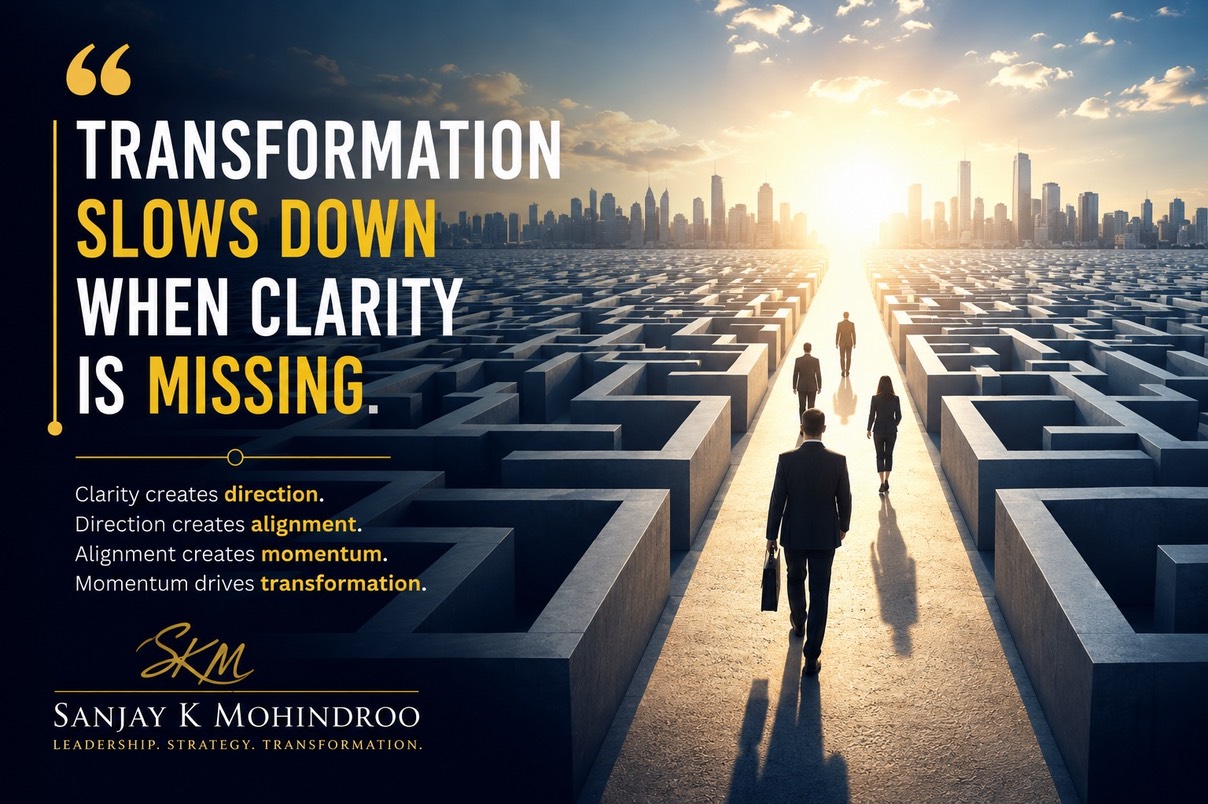
Sanjay K Mohindroo
Most transformation programs do not fail because of technology, budgets, or talent. They slow down because leaders mistake activity for clarity. Here's why clarity is the most underrated leadership capability in transformation.
Organizations spend millions on transformation initiatives yet struggle to achieve the expected outcomes. The common explanation is resistance to change, lack of resources, or execution challenges.
In my experience, those are rarely the root cause.
Transformation slows down when clarity is missing.
When people do not understand what matters, why it matters, and what success looks like, organizations create motion without progress. Teams become busy, decisions become slower, and alignment becomes harder.
The leadership challenge is not generating more activity.
It is creating more clarity.
The Cost of Ambiguity Is Higher Than Most Leaders Realize
Every transformation begins with optimism.
A strategy is approved. Funding is allocated. Teams are mobilized.
Then something subtle happens.
Priorities multiply.
Interpretations diverge.
Different leaders begin defining success differently.
At that point, transformation starts consuming energy rather than creating momentum.
I have seen organizations launch major digital programs with hundreds of people involved and significant executive sponsorship. Yet six months later, leaders could not answer a simple question consistently:
"What problem are we actually solving?"
When that happens, every meeting becomes longer. Every decision becomes harder. Every dependency becomes more complex.
The organization appears busy.
The transformation appears stalled.
These are not execution problems.
They are clarity problems.
Why Smart Organizations Create Confusion
Complexity Is Often Mistaken for Sophistication
Many leaders assume complex environments require complex communication.
The opposite is usually true.
The more complex the business challenge, the simpler the message must become.
Board members do not need twenty strategic priorities.
Employees do not need forty transformation initiatives.
Customers do not care about internal program structures.
People move faster when they understand exactly what matters.
The strongest transformation leaders simplify without oversimplifying.
They reduce noise.
They eliminate competing narratives.
They create a common understanding across the organization.
That is not a communication exercise.
It is a leadership discipline.
The Contrarian Insight: More Alignment Meetings Do Not Create Alignment
One of the most accepted beliefs in large organizations is that alignment comes from more discussion.
I disagree.
Most organizations already have enough meetings.
What they lack is decision clarity.
When leaders sense confusion, the default response is often another workshop, another steering committee, or another review session.
The assumption is that more conversation will create more alignment.
In reality, excessive discussion often signals that decisions have not been made clearly enough.
People do not align around conversations.
They align around decisions.
The fastest transformations I have seen were not driven by constant consensus-building.
They were driven by leadership teams willing to make clear choices, communicate them consistently, and reinforce them relentlessly.
Alignment is not created through participation alone.
It is created through clarity.
What Clarity Looks Like in Practice
Clarity of Purpose
Every transformation should answer one question in a single sentence:
"What are we trying to achieve?"
If leadership teams cannot articulate that consistently, the organization will struggle to execute it.
Clarity of Priorities
Everything cannot be important.
Yet many organizations attempt transformation by pursuing dozens of priorities simultaneously.
The result is predictable.
Resources become fragmented.
Focus disappears.
Progress slows.
High-performing organizations identify the few priorities that create the greatest business impact and direct energy toward them relentlessly.
Clarity of Accountability
Transformation often fails in the space between responsibilities.
Everyone supports the initiative.
Nobody owns the outcome.
Clear accountability removes ambiguity.
People know who decides.
People know who executes.
People know who is responsible for results.
Speed follows naturally.
Clarity of Success
Many transformation programs operate without a shared definition of success.
Different stakeholders measure different outcomes.
Some focus on technology delivery.
Others focus on cost savings.
Others focus on customer experience.
Success becomes subjective.
Effective leaders define success early and make it visible to everyone.
When success is clear, decision-making accelerates.
The Leadership Test Few Organizations Pass
The ultimate test of transformation clarity is surprisingly simple.
Ask ten leaders involved in the initiative three questions:
What are we trying to achieve?
What are the top three priorities?
How will we know we succeeded?
If you receive ten different answers, your transformation has a clarity problem.
The issue is not capability.
The issue is leadership focus.
Most organizations do not suffer from a shortage of talent.
They suffer from competing interpretations.
And competing interpretations create friction.
Friction slows transformation.
Takeaways
· Simplicity creates speed.
· Clarity is more valuable than additional activity.
· Alignment follows decisions, not endless discussion.
· Fewer priorities often produce better outcomes.
· Accountability accelerates execution.
· Transformation momentum depends on a shared definition of success.
· Leaders must eliminate ambiguity before they attempt to accelerate delivery.
Transformation does not slow down because organizations lack intelligence.
It slows down because intelligence gets scattered across too many priorities, too many interpretations, and too many conversations.
Technology can scale.
Processes can scale.
Investment can scale.
Confusion scales even faster.
The organizations that move fastest are rarely the ones with the biggest budgets or the most advanced technology.
They are the ones where everyone understands what matters, why it matters, and what happens next.
Clarity is not a soft skill.
It is a competitive advantage.
And in transformation, it is often the difference between motion and progress.
#Leadership #DigitalTransformation #CIO #BusinessStrategy #ExecutiveLeadership
Reliability Is a Business Decision: Rethinking SRE from the Boardroom.
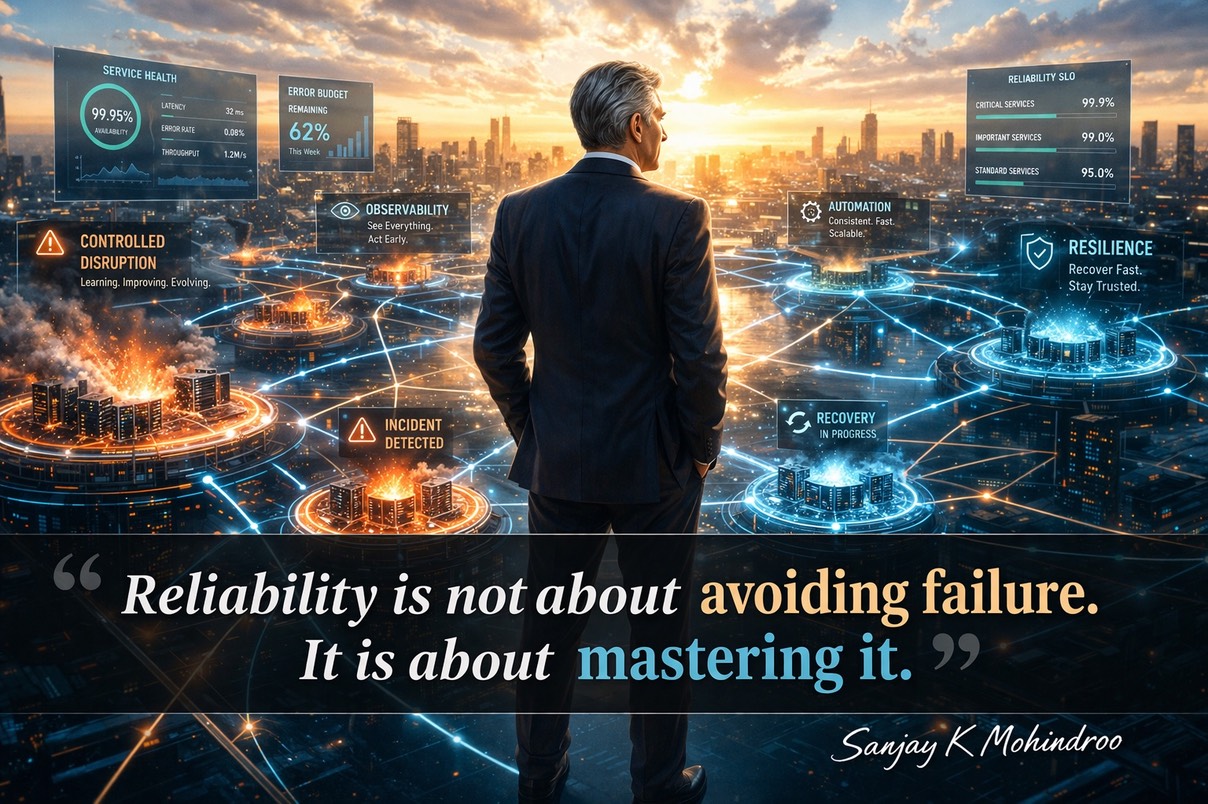
Sanjay K Mohindroo
A senior IT leader’s perspective on SRE, balancing reliability, speed, and cost, and why reliability is a strategic business decision.
Site Reliability Engineering has moved from engineering practice to business priority. Yet many organizations still treat it as a technical discipline.
That is where the gap begins.
SRE is not about uptime alone. It is about balancing reliability, speed, and cost in a way that supports business outcomes.
In my experience, organizations that get SRE right do not chase perfection. They define acceptable risk, align it with business priorities, and build systems that operate within those boundaries.
This piece explores what SRE really means for leadership, why common approaches fall short, and how to embed reliability into decision-making at scale. #SRE #CIO #Leadership
The outage that cost more than downtime
A few years ago, I was reviewing a major production incident with a global team. The system was down for less than an hour.
Technically, it was resolved quickly.
Commercially, the damage was far greater—lost transactions, customer frustration, reputational impact.
What stood out was not the failure itself. It was the absence of clarity.
No one could answer a simple question.
“How much reliability do we actually need?”
That is the conversation most organizations avoid.
What SRE Really Means
Reliability is not an engineering metric. It is a business choice
SRE is often reduced to metrics. Availability percentages, latency thresholds, error rates.
These matter. But they are not the starting point.
The starting point is business impact.
Different systems require different levels of reliability. A customer-facing payment platform demands near-perfect availability. An internal reporting tool does not.
Yet many organizations apply uniform standards across all systems.
This leads to over-engineering in some areas and under-investment in others.
In one organization, we categorized services based on business criticality. Reliability targets were aligned accordingly.
This brought clarity to investment decisions. It also reduced unnecessary effort.
Because not everything needs to be perfect.
The Balance Between Speed and Stability
You cannot optimize for both without trade-offs
There is a natural tension between speed and reliability.
Business wants faster releases. Engineering wants stability.
SRE provides a framework to manage this tension.
Error budgets are a powerful concept. They define how much failure is acceptable within a given period.
When error budgets are consumed, focus shifts to stability. When they are healthy, teams can move faster.
In practice, this creates a disciplined approach to trade-offs.
In one transformation, introducing error budgets changed behaviour across teams. Conversations became more grounded. Decisions became more balanced.
It moved the discussion from opinion to structure. #DigitalTransformation
The Contrarian View
Zero downtime is not the goal. Controlled failure is
There is a strong belief that systems should aim for zero downtime.
It sounds logical. It is also unrealistic.
Chasing zero downtime leads to higher costs, greater complexity, and slower innovation.
Every additional layer of redundancy adds overhead. Every safeguard introduces latency.
The goal is not to eliminate failure. It is to manage it.
I have seen organizations spend millions chasing marginal improvements in uptime while neglecting recovery capabilities.
The better approach is resilience.
Systems should fail gracefully. Recover quickly. Minimize impact.
In one case, we shifted focus from preventing every incident to improving recovery time.
The result was a more robust system and a more confident organization.
Because failure, when managed well, becomes part of the system rather than a threat to it. #Resilience
Designing SRE into the Organization
Reliability must be built, not inspected
SRE cannot be an afterthought. It must be embedded into how systems are designed and operated.
This starts with architecture. Systems should be modular, scalable, and fault-tolerant.
It continues with automation. Manual processes introduce variability and delay.
And it requires observability. Without visibility, reliability cannot be managed.
In one global rollout, we introduced standard observability practices across all services.
It did not just improve monitoring. It improved understanding.
Teams could see how systems behaved under load, where risks existed, and how failures propagated.
That visibility changed decision-making.
The Role of Culture
SRE works when blame is removed, and learning is prioritized
Technology alone does not deliver reliability. Culture does.
In high-performing organizations, incidents are treated as learning opportunities, not failures to be punished.
Blameless post-incident reviews are critical. They focus on what happened, why it happened, and how to improve.
Not who made the mistake.
I have seen teams transform when this mindset is adopted.
Engineers become more open. Issues surface earlier. Improvements happen faster.
Without this cultural shift, SRE becomes a compliance exercise.
The Leadership Imperative
Why SRE is a board-level concern
Reliability impacts revenue, customer trust, and brand reputation.
It is not just an operational issue. It is a strategic one.
For CEOs and boards, this means asking different questions.
What is our acceptable level of risk
How does reliability impact customer experience
Are we investing in resilience or just prevention
For CIOs, the role is to translate technical realities into business language.
To make trade-offs visible. To align reliability with business priorities.
This is where leadership creates value.
What Gets in the Way
The quiet challenges that derail SRE
SRE implementation often faces subtle barriers.
Lack of clarity on service criticality
Misaligned incentives between teams
Over-reliance on tools without process discipline
Resistance to cultural change
These issues are rarely discussed openly. Yet they are the primary reasons SRE efforts stall.
Addressing them requires leadership attention, not just technical expertise.
What senior leaders should act on
Define reliability in business terms, not just technical metrics
Align service levels with business criticality
Introduce structured trade-offs between speed and stability
Invest in resilience and recovery capabilities
Embed observability and automation into core systems
Foster a culture of learning and accountability
Ensure leadership understands and supports reliability decisions
Reliability is a leadership decision
SRE is not about engineering perfection. It is about disciplined decision-making.
The organizations that succeed are not the ones that avoid failure.
They are the ones that understand it, manage it, and recover from it effectively.
Reliability, at its core, is a reflection of how an organization thinks and operates.
And that makes it a leadership responsibility.
#SRE #SiteReliabilityEngineering #Leadership #CIO #DigitalTransformation #Resilience #ITStrategy #EnterpriseIT #TechnologyLeadership #OperationalExcellence
The Fundamentals Didn’t Change. Your Strategy Should.

Sanjay K Mohindroo
A veteran global CIO breaks down ninety years of computing history to expose the flawed assumption driving today’s AI capital decisions — and what senior leaders should actually be watching before the next correction.
30 years of computing history says more about your AI roadmap than any vendor deck will
Every board I sit in front of this year asks some version of the same question: Is AI a new era of computing, or the same era moving faster? The honest answer is both, and most leadership teams are making expensive decisions because they haven’t separated the two. The mathematics underlying computing has not changed in ninety years. The economics of deploying it have changed every decade. Confuse those two layers, and you will either underinvest in something durable or overpay for something that was never going to last. This article is about telling the difference, before your balance sheet does.
The Pattern Nobody in the Boardroom Is Naming
I have sat through five distinct technology cycles as a CIO. Mainframes to client-server. Client-server to web. Web to mobile and cloud. Cloud to data platforms. Now this. Each one arrived with the same promise: this changes everything. Each one was, underneath the noise, the same logic running on cheaper, faster infrastructure.
Binary representation. Stored-program execution. Information theory. These ideas are from 1936 to 1948. Turing, Shannon, von Neumann. Nobody has replaced them. Nobody is close to replacing them. What changes every decade is not the logic — it is whether the economics finally make that logic cheap enough to deploy at scale.
That distinction sounds academic. It is not. It is the single most useful filter I have for separating a real capital decision from a fashionable one.
When the transistor matured, it did not invent new logic. It made existing logic absurdly cheap. When the internet matured, it did not invent new computation. It made existing computation reachable from anywhere. AI is no different. The architecture behind today’s models has existed in pieces since the 1980s. What changed between 2012 and 2017 was not the mathematics. It was GPUs, internet-scale data, and one paper solving a parallelization bottleneck. Old logic. New economics. None of this implies AI is merely another infrastructure cycle. Transformer architectures, reinforcement learning, and agentic systems represent genuine advances in how software is built and deployed. The lesson from history is not that AI is unimportant. It is that transformative technologies still obey economic realities. That is the entire pattern of computing history in one sentence, and it is the lens every leader in this room should be applying to their AI budget right now.
Every Major Technology Shift Arrives as a Burst, not a Slope
Boards love a smooth growth chart. Technology does not deliver smooth growth charts. It delivers long, quiet plateaus, then sudden jumps, then plateaus again.
The reason is simple once you see it: progress runs on multiple independent curves at once — compute cost, data availability, algorithmic technique — and nothing visible happens until two or three of those curves cross a usability threshold together. Computers got cheaper for fifteen years before anyone noticed. Data accumulated for two decades before anyone monetized it. The moment they converged; the world called it sudden. It was not sudden. It was finally legible.
This matters for how you plan capital, not just how you understand history. If you wait for the visible jump before you act, you have already missed the window where the smart money is positioned. If you chase every visible jump as if it is permanent, you will overbuild the way telecom overbuilt fiber in 1999 — real infrastructure, real capital, a decade ahead of real demand.
Your job is not to predict the jump. Your job is to know which curve you are actually betting on, and whether that curve is close to its threshold or nowhere near it.
Unprecedented Adoption Is Not the Same as Durable Demand
Here is the belief I want to challenge directly, because almost every leadership team I talk to is quietly operating on it: massive AI user growth proves massive AI value.
The more useful signal is enterprise value creation. Across software development, customer operations, compliance, and knowledge work, organizations are already reporting measurable gains in productivity, cycle-time reduction, and automation. The question is no longer whether AI can create value. The question is where value is durable enough to justify long-term capital allocation.
It does not. It proves a massive AI trial. Those are different things, and the gap between them is where capital gets destroyed.
The overwhelming majority of consumer AI usage today is unpaid. Free tier usage dominates the headline numbers you see quoted in every strategy deck. Free-to-paid conversion across the industry sits roughly where freemium software has always sat — a single-digit percentage. One of the largest AI consumer companies in the world is already projecting an 80% decline in its primary paid subscription tier this year, planning to replace that revenue with cheaper, ad-supported access instead. Read that again. The company itself does not believe most of its current paying users will keep paying at today’s price.
That is not a company in crisis. That is a company being honest about freemium economics — the same economics every SaaS category has lived with for twenty years. But it should stop every CIO in this room from citing "a billion weekly users" as evidence of enterprise-grade demand. Consumer curiosity and enterprise willingness-to-pay are not the same signal, and treating them as the same signal is how strategy decks get the multiplier wrong.
The more reliable signal sits one layer down, in enterprise retention and contracted usage, where the willingness to pay is tied to a measured cost reduction or productivity case, not discretionary spend. If you want to know whether AI is durable in your organization, stop watching the user-growth chart. Start watching whether the business case survives a renewal conversation.
What This Means for Capital Allocation, Not Just Curiosity
Three decisions follow directly from separating the logic layer from the economics layer.
1. Distinguish infrastructure bets from application bets.
The current AI buildout has two very different risk profiles stacked on top of each other. Physical infrastructure — compute, data center capacity, power — behaves like the telecom fiber cycle of the early 2000s: real capital, financed partly through debt and circular vendor arrangements, betting on a demand curve that has to keep compounding to justify the spend. Application-layer software sitting on top of that infrastructure behaves more like the dot-com era: thin, fast-moving, and far more exposed to being replaced the moment the underlying platform adds the same feature natively. Know which one you are funding. Underwrite them differently.
2. Stop pricing vendor promises against an extrapolated trend.
Every overbuild in computing history shares one fingerprint: capital expenditure justified by assuming today’s growth rate continues indefinitely, rather than by today’s actual unit economics. Ask your own organization the uncomfortable question directly: Does this initiative work if adoption merely plateaus rather than keeps compounding? If the business case only survives under the optimistic curve, you do not have a business case. You have a bet on someone else’s forecast.
3. Watch the architecture layer, not just the capability layer.
The deepest principles of computing — what is computable, what information theory permits — are not moving. But the engineering default that has held since the 1940s, an explicit human-written instruction executed deterministically, is genuinely being challenged for the first time by systems that learn their own internal logic rather than having it specified. That shift changes where your governance, audit, and accountability structures need to sit. It does not change whether the underlying computer is still a computer.
What to Do Monday Morning
Separate what is permanent from what is merely current
Before approving the next AI initiative, ask which layer it depends on: the ninety-year-old mathematics, which is not going anywhere, or this decade’s economics, which has reversed before and will again. Capital deployed against the first is infrastructure. Capital deployed against the second is a trade, and should be sized and governed like one.
The Discipline Boards Actually Need
History does not ask you to predict the cycle. It asks you to know which part of it you are standing in.
I have never once seen a technology cycle that rewarded the leader who got the timing exactly right. I have seen many who punished the leader who could not tell a durable capability from a fashionable one. That is the discipline this moment demands — not prophecy, just clarity about what you are actually betting on, and whether your organization survives if the optimistic curve does not show up on schedule.
The fundamentals have outlasted every cycle I have led through. Your strategy should be built on the part that outlasts the cycle, not the part that is merely loud this year.
AI will likely become embedded in every major business process over the next decade. The risk is not investing in AI. The risk is confusing durable capability with temporary enthusiasm. History suggests the winners are rarely the organizations that adopted first. They are the organizations that understood where value would ultimately accrue and allocated capital accordingly.
Where is your organization placing its bet — on the mathematics, or on the moment?
I would like to hear how your board is drawing that line.
#Leadership #CIO #DigitalTransformation #ArtificialIntelligence #BoardroomStrategy