
Sanjay K Mohindroo
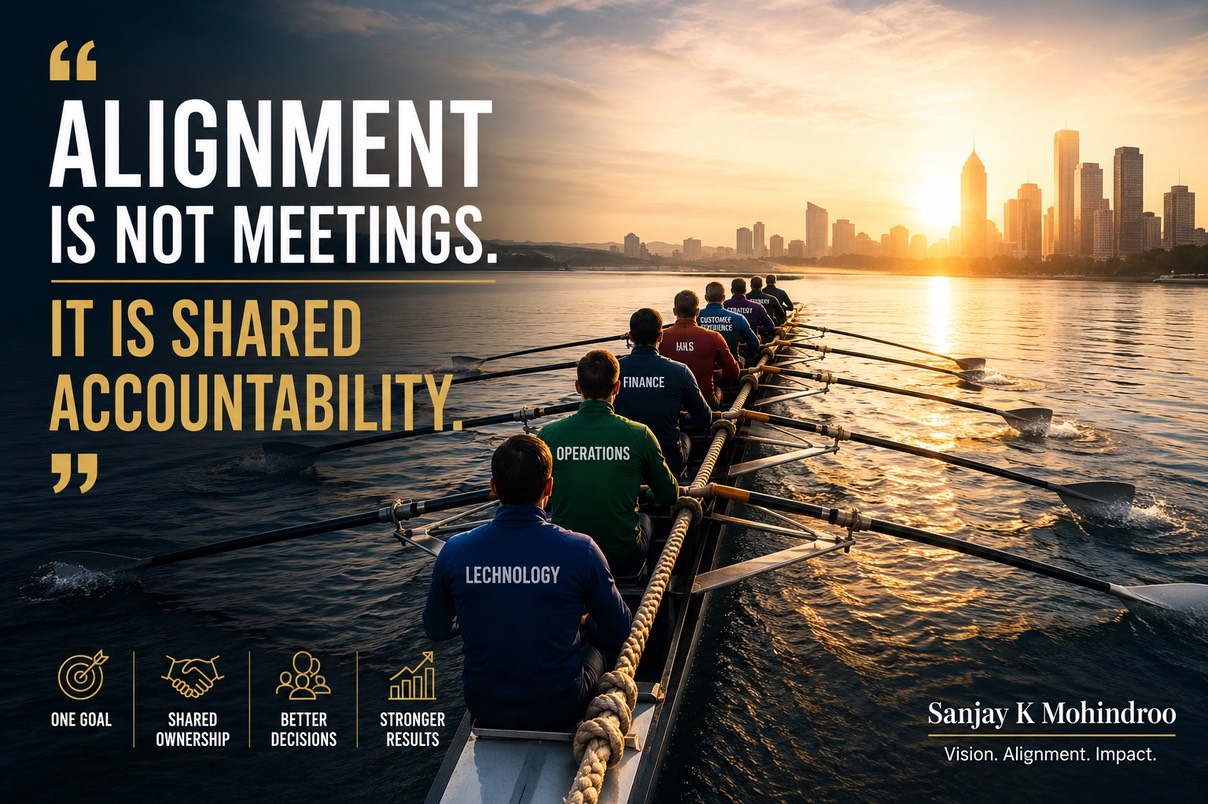
Most organizations confuse alignment with communication. Real alignment is not built through meetings, updates, or status reports. It is created when leaders share accountability for outcomes.
The Leadership Misconception That Slows Execution
Many organizations spend enormous amounts of time trying to improve alignment. More meetings are scheduled. More updates are requested. More governance layers are added.
Yet execution continues to struggle.
The reason is simple.
Alignment is not a communication problem.
It is an accountability problem.
Organizations move faster when teams share responsibility for outcomes, not when they share calendars.
The Most Aligned Teams Often Meet Less
Communication Creates Visibility. Accountability Creates Movement.
I have sat through thousands of executive meetings over the years.
Weekly
reviews.
Steering committees.
Transformation councils.
Executive updates.
Most were productive.
Many were necessary.
A surprising number achieved very little.
The assumption behind many of these meetings is that if everyone is informed, everyone is aligned.
That assumption is flawed.
People can have complete visibility and still pull in different directions.
They can agree during the meeting and compete afterward.
They can nod at the same presentation while optimizing different objectives.
Alignment does not happen because people hear the same message.
Alignment happens when people succeed or fail together.
That distinction changes everything.
The Cost of Functional Success
Why Organizations Struggle Despite Having Strong Leaders
One of the most common patterns in large organizations is functional optimization.
Sales hits revenue targets.
Operations improves efficiency.
Technology delivers projects.
Finance protects margins.
Each team performs well according to its own scorecard.
Yet enterprise outcomes fall short.
Why?
Because local success does not automatically create organizational success.
I have seen technology teams deliver every milestone on time while the business failed to adopt the solution.
I have seen operations achieve efficiency targets that damaged customer experience.
I have seen business units pursue growth initiatives that created unsustainable technology complexity.
Nobody failed.
Everyone succeeded.
The organization lost.
That is what happens when accountability ends at departmental boundaries.
Leaders often spend months trying to fix these situations through communication plans.
The real issue is incentive design.
When teams are measured separately, they behave separately.
When outcomes are shared, behavior changes quickly.
Accountability Is the Real Architecture of Alignment
Shared Outcomes Create Shared Decisions
The strongest transformations I have experienced had one common characteristic.
Ownership was collective.
Not symbolic.
Not verbal.
Real.
Business leaders and technology leaders shared the same outcome metrics.
Operations leaders and customer leaders carried the same targets.
Success belonged to everyone.
Failure belonged to everyone.
Once that happens, priorities become clearer.
Trade-offs become easier.
Decision-making accelerates.
The conversation changes from:
"Who owns this?"
to
"How do we make this successful?"
That shift removes enormous friction from execution.
The organization spends less time negotiating responsibilities and more time creating results.
More Alignment Meetings Often Signal Less Alignment
Many executives believe alignment problems should be solved with more coordination.
The opposite is often true.
When organizations become dependent on recurring meetings to stay aligned, it usually signals fragmented accountability.
The meeting becomes a substitute for ownership.
The update replaces commitment.
The governance process compensates for unclear responsibility.
Organizations with genuine alignment rarely need constant intervention.
People know what matters.
They understand how decisions affect adjacent teams.
They share responsibility for outcomes.
As a result, fewer issues require escalation.
More meetings are not evidence of alignment.
They are often evidence that alignment is missing.
The goal should not be to improve meeting effectiveness.
The goal should be to reduce the organizational need for meetings.
That is a far more valuable leadership metric.
What Boards and Executive Teams Should Ask
Questions That Reveal Whether Alignment Actually Exists
When discussing execution challenges, leaders should ask a different set of questions.
Instead of asking:
"Have all stakeholders been informed?"
Ask:
"Who shares accountability for the outcome?"
Instead of asking:
"How often are teams meeting?"
Ask:
"Would these teams still make the same decisions without the meeting?"
Instead of asking:
"Who owns this initiative?"
Ask:
"Who succeeds if it succeeds and who fails if it fails?"
The answers reveal more about organizational alignment than any governance dashboard.
Real alignment is visible in decisions, incentives, and behavior.
Not meeting schedules.
Not communication plans.
Not reporting structures.
Actions Senior Leaders Can Implement Immediately
1. Replace activity metrics with outcome metrics wherever possible.
2. Create shared targets across functions for strategic initiatives.
3. Reduce governance layers that exist only to coordinate disconnected incentives.
4. Evaluate leaders on enterprise outcomes, not just departmental performance.
5. Measure alignment by decision speed and execution quality, not meeting frequency.
These changes are harder than scheduling another committee.
They are also far more effective.
Alignment Is Proven When Nobody Needs Reminding
Organizations do not suffer from a lack of communication.
Most suffer from a lack of shared accountability.
The difference matters.
Communication creates awareness.
Accountability creates action.
The organizations that execute best are rarely the ones holding the most meetings.
They are the ones where leaders understand that success is interconnected.
When accountability is shared, alignment becomes natural.
When accountability is fragmented, no amount of communication can compensate.
The next time an organization struggles with alignment, the answer may not be another meeting.
It may be a harder question:
Have we created shared accountability for the outcome we claim to care about?
#Leadership #CIO #BusinessTransformation #ExecutiveLeadership #Strategy