

Cataloguing Strategic Innovations and Publications
Defining Your Leadership Signature in Technology Management.
Sanjay K Mohindroo
A thought-provoking leadership article on how CIOs and senior technology executives can define a lasting leadership signature through clarity, business alignment, and transformation discipline.
Every technology leader delivers projects. Far fewer leave a leadership signature.
A leadership signature is the consistent impact people associate with your presence. It is the difference between a CIO who manages systems and one who shapes direction. In today’s environment, where AI, cloud, cybersecurity, and digital transformation dominate boardroom discussions, technical competence alone no longer creates executive influence.
The leaders who stand out are those who bring clarity during uncertainty, discipline during chaos, and business alignment when organizations drift into technology theatre.
This article explores what defines a lasting leadership signature in technology management, why many IT leaders struggle to build one, and what senior executives must rethink if they want their influence to endure beyond projects, titles, or trends.
#Leadership #CIO #TechnologyLeadership
The Boardroom Question No One Asks Directly
After three decades in technology leadership, I have noticed something fascinating.
Most organizations can explain what their CIO manages. Very few can explain what that leader stands for.
That distinction matters more than ever.
I have sat in boardrooms during cyber crises, failed ERP programs, aggressive mergers, and ambitious AI discussions where enthusiasm exceeded practical understanding by several light-years. In those moments, nobody cared about buzzwords. Nobody asked who attended the latest innovation summit.
They looked for one thing.
Judgment.
Can this leader simplify complexity? Can they align technology with business reality? Can they make difficult decisions without creating panic?
That is where leadership signatures are formed.
Not during keynote speeches. During pressure.
Technology management has entered a phase where visibility is high, expectations are brutal, and patience is low. Many executives still approach leadership as a collection of certifications, frameworks, and transformation slogans.
The strongest leaders approach it differently.
They become known for something unmistakable.
The Shift from Technology Operator to Business Architect
Why Modern CIOs Must Think Beyond Systems
There was a time when IT leaders were measured by uptime, infrastructure stability, and cost control.
Those responsibilities still matter. Ignore them and your career becomes very short very quickly.
But modern enterprises expect far more.
Technology leaders are now expected to influence revenue growth, customer experience, operating efficiency, risk posture, workforce productivity, and strategic direction. That changes the nature of leadership entirely.
A leadership signature begins to emerge when technology decisions consistently reflect business understanding.
I have worked with leaders who could explain cloud architecture beautifully but struggled to explain how the business actually made money. Boards notice that gap immediately.
Strong technology leadership requires commercial awareness.
It requires understanding supply chains, customer behavior, operating margins, regulatory pressure, and competitive positioning. The CIO who understands these dimensions becomes part of strategic conversations. The one who does not remains trapped in operational reviews.
This is where #DigitalTransformation often succeeds or fails.
Not because of technology quality.
Because of leadership depth.
Clarity Is the Most Underrated Leadership Skill
Smart Leaders Simplify. Weak Leaders Complicate.
One of the biggest myths in technology management is that intelligence must sound complicated.
It does not.
In fact, complexity is often camouflage.
I have seen presentations with 60-slide architectures, endless capability maps, and enough acronyms to qualify as a new language. At the end of the meeting, nobody understood the business impact.
That is not leadership.
That is performance art.
The most respected technology leaders I have worked with possessed a rare ability to reduce complexity into clear business choices. They could explain cybersecurity risk to a finance committee. They could explain AI investment logic to operations leaders. They could explain cloud economics without turning the room into a hostage situation.
Clarity builds trust.
And trust creates influence.
A leadership signature is often built through communication discipline more than technical brilliance.
#Leadership #BusinessTransformation
Digital Transformation Is Not Failing. Leadership Is.
Technology Is Rarely the Core Problem
For years, organizations have claimed that digital transformation programs fail because technology moves too fast.
I disagree.
Most transformation efforts fail because leadership teams treat transformation as a technology deployment exercise instead of an organizational behavior challenge.
Installing platforms is easy compared to changing decision-making habits.
I have seen companies spend hundreds of millions on transformation programs while preserving the same fragmented governance, political silos, and slow approval structures that created inefficiency in the first place.
The result is predictable.
Modern systems running inside outdated leadership cultures.
Transformation succeeds when leaders create operational alignment, accountability, and decision clarity. Technology simply accelerates whatever culture already exists.
A dysfunctional organization with advanced AI still produces dysfunctional outcomes faster.
That may sound harsh. It also happens to be true.
The strongest CIOs understand this instinctively. They spend as much time influencing people, incentives, and operating models as they do evaluating platforms.
That is why some leaders consistently deliver results across industries while others struggle despite having larger budgets.
Their signature is not tied to tools.
It is tied to execution discipline.
#CIO #ChangeManagement #DigitalTransformation
The Leadership Signature People Remember
Consistency Creates Reputation
Many executives underestimate how reputations form inside organizations.
People remember patterns.
Does the leader remain calm during crisis?
Do they create accountability or confusion?
Do they protect teams while demanding performance?
Do they speak honestly in difficult moments?
Do they align technology with business priorities instead of chasing trends?
Over time, these patterns become your signature.
Some leaders become known for operational precision. Others for innovation. Others for strategic turnaround capability. The best leaders balance all three without becoming prisoners of corporate fashion.
In my experience, leadership signatures become strongest when they are built around principles rather than personality.
Personality attracts attention.
Principles sustain trust.
And trust remains the single most valuable currency in enterprise leadership.
What Senior Leaders Should Prioritize
1. Build business fluency alongside technical expertise. Technology leadership without commercial understanding has limited influence.
2. Simplify communication relentlessly. Boards reward clarity, not complexity.
3. Focus transformation efforts on operating behavior, not just systems implementation.
4. Create consistency under pressure. Leadership reputations are built during difficult moments.
5. Develop a recognizable leadership standard. People should know what improves when you lead.
6. Resist trend-driven decision-making. Business-first thinking outlasts technology hype cycles.
7. Invest in people leadership as seriously as technical capability. Enterprise transformation remains deeply human work.
#ExecutiveLeadership #TechnologyManagement
Technology management is entering a decisive era.
AI will reshape operating models. Cybersecurity risk will intensify. Digital ecosystems will become more interconnected and more fragile at the same time.
In that environment, organizations will not simply need technology executives.
They will need trusted leadership.
The leaders who stand apart will not be those with the loudest innovation language or the largest transformation vocabulary. They will be the ones who create clarity, stability, alignment, and measurable business value when complexity rises.
That is the real leadership signature.
And unlike technology trends, it does not expire every three years.
#Leadership #TechnologyLeadership #CIO #DigitalTransformation #ExecutiveLeadership #BusinessTransformation #TechnologyManagement #AILeadership #ITStrategy #EnterpriseTransformation #BoardLeadership #Innovation #CyberSecurity #ChangeManagement #BusinessAlignment
Business–IT Alignment Is Not Broken. It Was Never Built.

Sanjay K Mohindfroo
A senior IT leader’s perspective on why business–IT alignment is not failing but was never structurally built inside most organizations. A strategic leadership view on digital transformation, CIO evolution, and enterprise execution.
For decades, organizations have spoken about “aligning IT with the business” as if technology and business were separate worlds trying to cooperate through diplomacy.
That framing is the problem.
Technology is no longer a support function. It shapes customer experience, operating models, revenue velocity, risk exposure, and competitive advantage. Yet many companies still operate with structures, incentives, and leadership behaviors built for a time when IT existed to maintain systems, not drive growth.
The result is predictable. Boards complain that IT moves too slowly. CIOs complain they are brought in too late. Business leaders complain that technology teams “do not understand the business.”
After leading transformations across global enterprises for more than three decades, I have come to a simple conclusion:
Business–IT alignment is not failing. In many organizations, it was never structurally built in the first place.
And until leadership accepts that reality, digital transformation will continue to produce expensive activity instead of measurable business impact.
The Meeting That Told Me Everything
Years ago, I sat in an executive meeting reviewing a delayed transformation program. The room was full of smart people. The CFO blamed delivery delays. Operations blamed system complexity. IT blamed changing requirements.
Then the CEO asked a simple question:
“Who owns the business outcome?”
Silence.
Not because people were unprepared. Because the organization had spent years separating “technology decisions” from “business decisions” until nobody could clearly connect the two.
That moment has repeated itself in different forms across industries, countries, and leadership teams.
We keep talking about alignment as though it is a communication problem. It is not.
It is a structural leadership problem.
#Leadership #CIO #DigitalTransformation
The Great Illusion of Alignment
Why Most Organizations Still Treat IT Like a Service Desk
Many companies claim technology is strategic. Then they measure IT almost entirely through cost control, ticket resolution, uptime, and project delivery timelines.
You cannot ask technology leaders to drive innovation while evaluating them like utility managers.
Real alignment begins when leadership stops viewing IT as a department and starts treating it as an operating capability embedded into the business itself.
In high-performing organizations, technology leaders participate in market discussions, pricing conversations, acquisition planning, customer strategy, and operational redesign. They are not waiting for requirements documents after decisions are already made.
The difference is massive.
When IT joins after the strategy is defined, technology becomes reactive.
When IT shapes strategy from the beginning, technology becomes a growth multiplier.
That distinction separates companies that digitize processes from companies that reinvent industries.
The Contrarian Truth
Digital Transformation Is Not Failing. Leadership Design Is.
This may sound blunt, but after years of hearing organizations blame “legacy systems,” “technical debt,” or “resistance to change,” I believe many transformation programs collapse for a far simpler reason:
Leadership structures were never redesigned for a digital operating environment.
Companies still organize themselves around industrial-era silos while expecting digital-era agility.
Marketing buys platforms without enterprise architecture involvement.
Operations redesign workflows without data governance participation.
Technology teams deploy systems without understanding commercial priorities.
Then executives wonder why transformation becomes slow, political, and expensive.
The issue is not technology maturity.
The issue is fragmented accountability.
One of the most dangerous phrases in business today is:
“That’s an IT problem.”
No. If technology impacts customer experience, revenue, productivity, compliance, or resilience, it is a business problem.
And if leadership teams still separate those conversations, alignment does not exist.
#BusinessTransformation #EnterpriseTechnology
Strategy Without Technology Is Fiction
Every Business Decision Is Now a Technology Decision
A pricing model depends on analytics.
A customer experience depends on data architecture.
Supply chain resilience depends on system visibility.
AI adoption depends on governance maturity.
Cybersecurity impacts brand trust.
Cloud strategy impacts operating economics.
At this stage, there are very few major business decisions that do not carry technology implications.
Yet many executive teams still invite technology leadership into discussions after budgets are approved and timelines are announced.
That approach belongs to another era.
The best CEOs I have worked with understood something important early:
Technology leaders should not just explain systems. They should influence direction.
A mature CIO does not walk into a boardroom talking about servers, integrations, or platforms first.
They talk about growth velocity, operating margin, customer retention, business risk, scalability, and execution capability.
Because that is the language of leadership.
And that is where credibility is built.
Alignment Is Built Through Shared Accountability
Incentives Shape Behavior Faster Than Vision Statements
Organizations love talking about collaboration. Few redesign incentives to support it.
If sales is rewarded only for revenue growth, operations only for efficiency, and IT only for cost reduction, alignment will remain performative.
Real alignment happens when leadership teams share outcomes.
Customer onboarding time.
Revenue realization speed.
Operational resilience.
Digital adoption rates.
Customer retention.
Decision-making velocity.
These are enterprise outcomes, not departmental metrics.
One global transformation I led succeeded because we stopped discussing “business requirements” and started measuring cross-functional outcomes instead. Conversations changed immediately. So did behavior.
People align quickly when incentives align.
Funny how that works.
#FutureOfWork #EnterpriseLeadership
The CIO Role Has Changed Permanently
From Technology Custodian to Enterprise Architect
The modern CIO cannot survive as a passive operator.
The role now requires commercial awareness, organizational influence, communication precision, geopolitical awareness, cybersecurity understanding, talent leadership, and operational depth.
Technology leadership today sits at the intersection of business strategy and execution reality.
That is why boards are increasingly looking for CIOs and transformation leaders who can simplify complexity instead of adding more noise to it.
The organizations winning today are not necessarily the ones spending the most on technology.
They are the ones creating the clearest connection between technology investment and business value.
That clarity is rare.
And rare capabilities become strategic advantages.
What Leadership Teams Must Do Next
1. Stop treating IT as a downstream execution function. Include technology leadership in strategic planning from day one.
2. Redesign accountability structures. Shared business outcomes create faster alignment than cultural slogans.
3. Evaluate technology investments through business capability impact, not only implementation timelines.
4. Build leadership teams that understand both operational realities and digital execution.
5. Shift CIO conversations from systems to business value creation.
6. Remove the phrase “business versus IT” from organizational language entirely. It reflects an outdated mental model.
Alignment Was Never About Technology
The organizations that thrive over the next decade will not be separated by software alone.
They will be separated by leadership maturity.
The companies that win will build operating models where technology, business strategy, data, customer experience, and execution exist as one integrated system.
Everything else will feel increasingly slow, fragmented, and reactive.
Business–IT alignment is not a workshop. It is not a steering committee. It is not a quarterly presentation.
It is a leadership philosophy.
And for many organizations, that philosophy was never truly built.
#Leadership #CIO #DigitalTransformation #BusinessTransformation #EnterpriseTechnology #TechnologyLeadership #ExecutiveLeadership #BusinessStrategy #Innovation #DigitalLeadership #FutureOfWork #EnterpriseArchitecture #Transformation #BoardLeadership #ITStrategy
Alignment Is Not Meetings. It Is Shared Accountability.

Sanjay K Mohindroo
A thought-provoking leadership article on why true organizational alignment comes from shared accountability, not endless meetings. Insights for CEOs, CIOs, COOs, boards, and transformation leaders.
Most organizations do not suffer from a lack of meetings. They suffer from a lack of ownership.
Leadership teams sit through hours of alignment calls, steering committees, status reviews, and transformation workshops. Yet execution still breaks down. Projects slow. Priorities drift. Business and IT blame each other quietly, then publicly.
The reason is simple.
Alignment is not communication volume. It is shared accountability for outcomes.
After three decades leading enterprise technology across global organizations, I have seen one pattern repeat itself across industries, geographies, and leadership styles: when accountability is fragmented, alignment becomes theatre.
Real alignment begins when technology, operations, finance, and business leadership commit to the same business result and accept collective responsibility for achieving it.
That changes everything.
The Most Expensive Word in Business Is “They”
The silent language of misalignment
“They did not give us requirements.”
“They changed priorities.”
“They delayed approvals.”
“They built the wrong solution.”
The moment leadership conversations start with “they,” alignment is already broken.
One of the clearest warning signs in large organizations is the invisible wall between functions. IT talks about delivery timelines. Business teams talk about revenue pressure. Finance talks about cost discipline. Operations talks about execution risk.
Everyone is technically correct.
No one is collectively accountable.
I once worked on a major transformation involving multiple business units across three continents. Weekly meetings were flawless. Governance was polished. Dashboards were beautiful. Every workstream showed “green.”
The program was still failing.
Why?
Because every team was optimizing for its own success metrics instead of the enterprise outcome. Technology wants system stability. Sales wanted faster customization. Procurement wanted lower vendor costs. Legal wanted reduced exposure.
No shared accountability existed across the leadership structure.
Meetings increased. Trust declined.
That pattern is far more common than most executives admit.
#Leadership #BusinessTransformation #CIO
Alignment is a Decision, not a Calendar Invite
Shared outcomes change behavior
Organizations often treat alignment as a communication exercise.
It is not.
Alignment is a leadership design choice.
The strongest leadership teams I have seen do one thing exceptionally well: they create shared success metrics across functions.
Not parallel metrics. Shared metrics.
That distinction matters.
If the CIO is measured on uptime, the COO on efficiency, and the business unit leader on quarterly growth, friction becomes inevitable. Everyone protects their own scorecard.
But when leaders share accountability for customer experience, operating margin, delivery speed, or product adoption, conversations change immediately.
The discussion stops being:
“Who owns this problem?”
It becomes:
“How do we solve this together?”
That shift sounds simple. It is not.
It requires maturity. Transparency. Ego control. It also requires leaders willing to accept discomfort without retreating into functional silos.
Real alignment is rarely comfortable in the beginning.
The Contrarian Truth: More Collaboration Can Reduce Accountability
Why excessive alignment rituals often slow execution
Modern enterprises are addicted to collaboration.
Cross-functional syncs.
Daily standups.
Transformation councils.
Executive steering forums.
Alignment workshops.
At some point, collaboration becomes corporate camouflage.
The uncomfortable reality is this: many organizations use meetings to compensate for unclear accountability structures.
When nobody truly owns the outcome, everyone attends meetings about the outcome.
That is not alignment. That is organizational insurance.
I have seen teams spend six weeks aligning on decisions that should have taken six hours. By the time consensus was reached, the business opportunity had already moved on.
Speed matters.
High-performing organizations do not eliminate collaboration. They reduce unnecessary dependency.
Strong leaders clarify decision rights early. They define escalation paths clearly. They remove ambiguity fast.
The result is not less communication. It is cleaner communication.
One executive once told me:
“We mistake visibility for control.”
He was right.
A packed meeting calendar often signals the opposite of organizational confidence.
#Leadership #Execution #DigitalTransformation
Technology Alignment Starts with Business Language
CIOs must stop translating technology too late
One of the biggest mistakes technology leaders make is waiting too long to connect IT decisions to business impact.
Boards do not care about architectures.
CEOs do not wake up thinking about cloud migration sequencing.
COOs do not measure success through infrastructure modernization.
They care about growth, resilience, speed, margin, customer trust, risk exposure, and operational continuity.
Technology leaders who understand this become strategic advisors.
The rest remain service providers.
Over the years, I have noticed that the most respected CIOs are not always the most technical people in the room. They are the clearest thinkers in the room.
They simplify complexity.
They explain tradeoffs without jargon.
They connect technology investment directly to enterprise priorities.
And most importantly, they make accountability visible.
That last point is critical.
If transformation accountability lives only inside the IT organization, business alignment will always remain fragile.
Transformation succeeds when business leaders co-own operational change, adoption, process redesign, and customer outcomes.
Technology enables transformation.
Business leadership operationalizes it.
Both sides must carry the weight.
Culture Reveals Alignment Faster Than Strategy Decks
Watch how leaders react under pressure
Every organization claims alignment during planning cycles.
The real test comes during disruption.
Budget cuts.
Cyber incidents.
Supply chain shocks.
Failed releases.
Market pressure.
Executive turnover.
That is when organizational culture reveals itself.
Do leaders protect the enterprise or their territory?
Do they share accountability or redirect blame?
In strong organizations, pressure sharpens collaboration.
In weak ones, pressure exposes fragmentation.
One reason I remain optimistic about the future of enterprise leadership is that younger leaders are increasingly rejecting silo-driven operating models. They expect transparency—faster decisions. Shared responsibility. Clear purpose.
That shift is healthy.
But it also demands stronger leadership discipline.
Because alignment without accountability quickly becomes chaos disguised as empowerment.
What executive teams should focus on now?
1. Build shared business metrics across functions. Alignment improves when incentives align.
2. Reduce unnecessary governance layers. More meetings rarely fix weak accountability.
3. Clarify decision ownership early. Ambiguity slows execution faster than technology limitations.
4. Measure transformation by business outcomes, not project milestones alone.
5. Encourage leaders to speak the language of enterprise value, not departmental success.
6. Treat accountability as a cultural expectation, not a reporting structure.
Organizations that master these principles move faster with less friction. They also build stronger trust across leadership teams.
That trust becomes a competitive advantage.
Alignment is not about attendance.
It is not about presentation decks, steering committees, or collaboration slogans.
It is about whether leaders are willing to stand behind outcomes together.
That is the difference between organizations that execute consistently and organizations that remain trapped in perpetual transformation cycles.
Technology will continue to evolve.
Markets will continue to shift.
AI will continue to reshape operating models.
But one leadership principle will remain constant:
Organizations move at the speed of shared accountability.
And no number of meetings can replace that.
#Leadership #CIO #CEO #BusinessTransformation
#DigitalTransformation #ExecutiveLeadership #OrganizationalCulture #EnterpriseTransformation
#StrategyExecution #TechnologyLeadership #BusinessAlignment
#COO #BoardLeadership #FutureOfWork #SharedAccountability
Prioritizing Transformation.

Sanjay K Mohindroo
A senior IT leadership perspective on how CEOs, CIOs, and boards can prioritize transformation initiatives with clarity, discipline, and measurable business impact.
Why Smart Leaders Stop Chasing Every Good Idea
Most transformation programmes do not fail because of poor technology. They fail because leadership teams try to do too much at once.
In boardrooms across industries, transformation portfolios are becoming crowded with AI pilots, cloud migrations, automation programmes, data initiatives, cybersecurity upgrades, and operating model redesigns. Every initiative sounds urgent. Every sponsor believes their project matters most.
The result is predictable. Fatigue. Fragmentation. Slow execution. Rising costs. Weak adoption.
The strongest IT leaders do something differently. They create a disciplined structure for prioritization. They separate motion from progress. They align transformation investments to measurable business outcomes rather than internal excitement.
After three decades leading global technology organizations, I have seen one pattern repeatedly: transformation succeeds when leadership dares to say “no” more often than “yes”.
That is where real transformation begins.
#Leadership #DigitalTransformation #CIO
The Real Problem Is Not Technology
Most organizations are overloaded, not underpowered
A few years ago, I sat in an executive review with a leadership team managing more than 140 active transformation initiatives across regions.
Every project had a steering committee. Every programme had consultants, dashboards, milestones, and status reports. Yet revenue growth was flat. Customer experience scores were declining. Employees were exhausted.
One executive proudly said, “We are transforming every part of the business.”
My response was simple.
“That may be the problem.”
Transformation has become addicted to activity. Many organizations mistake volume for ambition. They launch initiatives faster than they can absorb change.
The issue is rarely capability. Most enterprises already have enough technology, enough data, and enough vendors. What they lack is prioritization discipline.
A structured transformation model forces leadership teams to ask difficult questions early:
Which initiatives directly improve business performance?
Which programmes create strategic differentiation?
Which projects exist because of executive politics rather than customer value?
That conversation is uncomfortable. It is also necessary.
A Practical Framework for Prioritization
Four questions every leadership team should ask
Over time, I developed a simple structure that consistently brought clarity to complex transformation portfolios. It works because it connects technology decisions to operational reality.
1. Does this initiative solve a business problem people actually feel?
This sounds obvious. Yet many projects begin because technology has become available rather than because the business demanded change.
The strongest initiatives remove the friction that customers, employees, or operations teams experience every day.
Pain creates urgency. Urgency creates adoption.
When transformation efforts are detached from operational pain points, they become presentation material instead of business value.
2. Can the organization absorb the change right now?
This question is ignored far too often.
An organization may technically support ten simultaneous initiatives. Humanly, it may only absorb three.
Transformation capacity is not measured by budget alone. It is measured by leadership bandwidth, operational resilience, employee trust, and execution maturity.
I have seen excellent programmes fail because leaders underestimated organizational fatigue.
Sometimes the smartest decision is sequencing, not acceleration.
3. Will this initiative create measurable business movement within 12 to 18 months?
Long-term transformation matters. But executives also need visible progress.
A balanced portfolio should include both foundational investments and measurable near-term wins.
Momentum matters. Boards gain confidence from tangible results. Employees gain confidence from visible improvements. Customers gain confidence from consistency.
Transformation without momentum quickly turns into corporate theatre.
4. Does leadership have the courage to sustain the decision?
This may be the most important question of all.
Many initiatives collapse not because the strategy was flawed, but because leadership attention moved elsewhere.
Prioritization is not a workshop exercise. It is an ongoing leadership commitment.
#BusinessTransformation #Strategy #ExecutiveLeadership
The Contrarian Reality
Digital transformation is not failing. Leadership discipline is.
For years, the industry narrative has been that digital transformation has a poor success rate.
I disagree with that framing.
Technology has never been more capable. Cloud platforms are mature. AI tools are accelerating rapidly. Data infrastructure is stronger than ever.
The problem is not technology failure.
The problem is leadership behavior.
Too many organizations pursue transformation without operational focus. They announce large-scale programmes before defining execution accountability. They celebrate innovation while ignoring process complexity. They buy platforms without redesigning decision-making structures.
One company I advised invested heavily in AI-driven analytics while frontline teams still relied on manual spreadsheet approvals for core operations. The organization wanted advanced intelligence layered on top of broken workflows.
That is not a transformation. That is an expensive decoration.
Real transformation starts with operational clarity. Technology amplifies discipline. It does not replace it.
This is where experienced leadership matters. Mature leaders understand that transformation is less about technology excitement and more about organizational alignment.
That may sound less glamorous. It also happens to work.
Why Prioritization Has Become Harder
The modern enterprise is drowning in urgency
The current environment creates constant pressure.
Cybersecurity threats are rising. AI expectations are accelerating. Customers expect seamless experiences. Boards want faster returns. Regulators demand stronger governance.
Every issue feels critical.
This creates a dangerous executive habit: reactive transformation.
Leaders move from trend to trend without creating strategic coherence. One quarter focuses on automation. The next focuses on AI copilots. Then sustainability reporting. Then, platform consolidation.
The organization becomes directionally confused.
Strong CIOs and transformation leaders act as stabilizers in this environment. They bring structure where others bring noise.
That requires confidence. It also requires restraint.
In leadership, maturity often reveals itself through what you choose not to pursue.
#CIO #OperationalExcellence #EnterpriseTransformation
Clarity creates execution power
Senior leadership teams should challenge transformation portfolios using a few direct principles:
1. Fewer initiatives executed well outperform large, fragmented portfolios.
2. Business alignment matters more than technology sophistication.
3. Organizational readiness should influence transformation timing.
4. Short-term wins and long-term capability building must coexist.
5. Leadership attention is a finite strategic asset.
6. Transformation metrics should measure business outcomes, not project activity.
The best transformation leaders are not the loudest voices in the room. They are the clearest thinkers.
Transformation is a leadership discipline before it becomes a technology strategy
After thirty years in global IT leadership, I have become increasingly convinced of one thing:
Successful transformation is not built on ambition alone. It is built on focus.
Every organization has more opportunities than capacity. The leaders who create lasting impact are the ones who prioritize with discipline, communicate with clarity, and execute with consistency.
Technology will continue to evolve at an extraordinary speed. That part is guaranteed.
What will continue to separate successful enterprises from struggling ones is leadership judgment.
Because in the end, transformation is not about doing more.
It is about choosing better.
#Leadership #DigitalTransformation #CIO #BusinessTransformation #TechnologyLeadership #EnterpriseTransformation #ExecutiveLeadership #OperationalExcellence #Strategy #DigitalStrategy #Innovation #BusinessStrategy #TransformationLeadership #BoardroomLeadership #ChangeManagement
When the CFO Says “Stop Spending” and the CIO Says “We Can’t Slow Down”.

Sanjay K Mohindroo
A senior IT leader’s perspective on the real tension between business priorities and technology strategy, and why alignment matters more than transformation slogans.
Every senior leader eventually faces the same collision point: the business wants faster growth, lower cost, and predictable outcomes, while IT pushes for modernization, resilience, and long-term capability. Both sides are right. Both sides are frustrated.
The real problem is not budget tension. It is a language tension.
Business leaders often see technology investments as delayed value. Technology leaders often see business decisions as short-term thinking. That gap creates stalled transformations, weak execution, and silent resentment across leadership teams.
After three decades leading large-scale technology transformations across global enterprises, I have seen one pattern repeat itself across industries, cultures, and boardrooms: the organizations that win are not the ones with the biggest technology budgets. They are the ones where business and IT operate with shared commercial clarity.
#Leadership #CIO #BusinessTransformation
The Collision Nobody Talks About Enough
When strategic priorities look rational in isolation — and destructive together
A few years ago, I sat in a board review where the CEO wanted aggressive expansion into new markets. The COO wanted operational stability after a difficult quarter. The CFO wanted a spending freeze. Meanwhile, cybersecurity risks were rising, legacy systems were reaching the breaking point, and customer expectations had changed faster than the operating model.
Every leader around the table had valid concerns.
The problem was timing.
The business wanted acceleration. IT needed repair work before acceleration became safe. Neither side believed the other fully understood the consequences.
This is where many organizations start making dangerous decisions.
The business delays infrastructure upgrades because revenue pressure feels immediate. IT delays simplification because transformation programmes are politically safer than operational honesty. Consultants produce elegant slides while delivery teams quietly absorb the chaos.
Everyone stays busy. Very little becomes simpler.
I have seen billion-dollar organizations run critical operations on systems held together by tribal knowledge and late-night heroics. I have also seen companies overspend on fashionable platforms that delivered little measurable business impact.
Technology problems are rarely technology problems alone. They are leadership alignment problems wearing technical clothing.
The Myth of “Business vs IT”
Strong companies stop treating technology as a support function
One of the most outdated beliefs in corporate leadership is the idea that “the business” and “IT” are separate entities with separate agendas.
That language alone creates failure.
Technology is no longer a back-office utility. It shapes customer experience, operating speed, risk posture, workforce productivity, supply chain visibility, and revenue scalability.
Yet many executive teams still engage IT only after strategic decisions are already made.
That approach worked twenty years ago. It does not work now.
I once asked a business leader why his transformation programme kept missing targets. His answer was immediate: “The technology team moves too slowly.”
The technology team had a different answer: “The business changes priorities every six weeks.”
Both were correct.
No architecture can stabilize around executive inconsistency. No growth strategy survives operational fragility for long.
The best CIOs I have worked with were never “technology-first” leaders. They were business operators with deep technical judgment. They understood margin pressure, customer churn, regulatory exposure, and investor expectations just as clearly as they understood infrastructure, security, and data strategy.
That distinction matters.
#DigitalTransformation #ExecutiveLeadership
Cloud-First Is Not Always Business-First
Sometimes the smartest move is restraint
For years, “cloud-first” became almost unquestionable executive doctrine. Boards heard it. Analysts reinforced it. Vendors marketed it relentlessly.
And many organizations moved far too quickly.
Cloud can create tremendous agility. It can improve scalability and accelerate deployment cycles. But I have also seen organizations increase operating costs dramatically because they migrated without financial discipline, governance maturity, or workload clarity.
One global enterprise reduced data center costs by moving aggressively to the cloud. Twelve months later, their cloud spending exceeded the original operating model by a significant margin.
Why?
Because no one redesigned the operating behavior.
Poorly governed cloud environments become very expensive very quickly. Teams provision endlessly. Redundant workloads multiply. Visibility drops. Accountability weakens.
Technology strategy without operational discipline becomes corporate theatre.
The right question is not “Should we move to the cloud?”
The right question is: “Which business capabilities genuinely benefit from cloud economics, cloud speed, and cloud flexibility?”
That is a very different conversation.
Experienced leadership teams understand this instinctively. Mature transformation is selective, disciplined, and commercially grounded.
Not every legacy system is a problem. Not every modern platform is progress.
The Leadership Skill That Matters Most
Translating complexity into business consequences
The most valuable leaders in modern enterprises are translators.
Not presenters. Not slogan creators. Translators.
A strong technology leader can explain cyber risk in terms of operational downtime, legal exposure, and reputational damage. A strong business leader can explain revenue pressure without dismissing technical debt as “an IT issue.”
This capability becomes critical during moments of pressure.
Economic uncertainty exposes weak alignment quickly. Budgets tighten. Priorities compress. Patience disappears.
That is when leadership maturity matters most.
I have watched executive teams’ fracture during downturns because every function defended its own agenda. I have also watched leadership teams emerge stronger because they focused relentlessly on enterprise outcomes rather than departmental victories.
The difference was rarely intelligence.
It was trust.
And trust grows when leaders communicate clearly, make trade-offs honestly, and avoid hiding behind jargon.
One of the simplest rules I followed throughout my career was this:
If a technology initiative cannot be explained clearly in business terms, it is probably not ready for investment approval.
That rule prevented more mistakes than any framework ever did.
#BusinessAlignment #TechnologyLeadership #CIO
What Boards and CEOs Should Be Asking More Often
The questions that expose real transformation readiness
Many board discussions still focus heavily on project status updates. Green indicators. Delivery milestones. Budget adherence.
Those metrics matter, however they are not enough.
The more important questions are harder.
Are we simplifying the business or adding complexity?
Are our operating teams becoming more capable or more dependent on external vendors?
Can our leaders explain technology investments in commercial language?
Are we building resilience or just expanding systems?
Does our culture reward transparency when projects struggle?
Real transformation is operational. Cultural. Financial. Human.
The technology itself is often the easiest part.
What leadership teams should focus on now?
1. Align business and IT planning cycles. Strategy without operational integration creates friction.
2. Stop measuring transformation only through deployment milestones. Measure business behavior change.
3. Treat technical debt as a financial risk, not a technical inconvenience.
4. Build executive teams that can discuss technology in business language and business strategy in operational language.
5. Push for clarity, not complexity. Simpler operating models outperform impressive architecture diagrams.
6. Challenge fashionable narratives. Market trends are not strategy.
The tension between business priorities and technology priorities will never disappear. Nor should it.
Healthy friction creates stronger decisions.
But the organizations that succeed are the ones where leadership teams stop treating technology as a separate conversation. Technology is now embedded in every commercial decision, customer interaction, operational process, and growth strategy.
That reality demands a different kind of leadership.
Calmer. Sharper. More commercially aware.
The future will not belong to companies with the loudest transformation messaging. It will belong to organizations that execute with clarity while others chase noise.
And in my experience, clarity is still one of the rarest leadership capabilities in business.
#Leadership #CIO #DigitalTransformation #BusinessTransformation #TechnologyLeadership #ExecutiveLeadership #BoardroomStrategy #CloudStrategy #BusinessAlignment #EnterpriseTechnology #OperationalExcellence #InnovationLeadership #ITStrategy #FutureOfWork #CEO #COO #BusinessStrategy #DigitalLeadership
From Cost Centre to Growth Engine.
Sanjay K Mohindroo
A practical leadership model for aligning IT with revenue outcomes. Insights for CIOs, CEOs, and senior executives on turning technology into measurable business value.
A Practical Model to Align IT With Revenue Outcomes
Many organizations still treat IT as a support function measured by uptime, ticket closures, and budget control. That model no longer works.
Modern enterprises compete through technology. Revenue growth, customer retention, operational speed, and market responsiveness now depend on how well IT aligns with business outcomes. Yet many leadership teams still struggle to connect technology investments to measurable commercial impact.
This article presents a practical model that shifts IT from a reactive delivery unit to a business growth engine. It is based on decades of experience leading enterprise transformation across global organizations, where the real challenge was rarely technology. It was alignment, accountability, and clarity.
The companies creating sustainable advantage are not spending more on technology. They are connecting technology decisions directly to revenue movement, customer value, and strategic execution.
#Leadership #CIO #BusinessTransformation
The Boardroom Question Every CIO Eventually Faces
At some point, every CIO hears the same question.
“We invested millions in technology. So where is the business impact?”
It usually arrives after a major transformation program. A cloud migration. A data platform initiative. An ERP modernization effort. Sometimes, after a painful year of cost pressure.
The room goes quiet because everyone knows the uncomfortable truth.
The systems may be modernized. Dashboards may look impressive. Yet revenue growth has barely moved.
I have seen this pattern repeatedly across industries. Retail. Manufacturing. Financial services. Healthcare. Telecommunications.
The problem is rarely weak technology.
The problem is that many IT organizations still operate without a commercial operating model.
Technology teams optimize systems. Business leaders optimize growth. Those objectives should never be separate. Yet in many enterprises, they still are.
That gap is where transformation programs lose credibility.
And it is also where strong IT leadership creates enormous value.
Stop Measuring IT Like a Utility
Availability Is Expected. Business Impact Is What Matters.
For years, IT success was measured through operational metrics.
System uptime. Incident response. Infrastructure stability. Delivery timelines.
Those metrics still matter. Nobody celebrates a stable network because stability is the minimum expectation now. It is like applauding electricity for working.
What leadership teams care about is different.
Did technology reduce customer acquisition cost?
Did it increase cross-sell opportunities?
Did it improve pricing intelligence?
Did it accelerate product launch cycles?
Did it improve conversion rates?
These are business conversations, not technical conversations.
One global organization I worked with had an excellent infrastructure team. Service levels were among the best I had seen. Yet the sales organization viewed IT as slow and disconnected.
Why?
Because every technology discussion began with architecture. Never with revenue.
That changed only when IT leaders began attending commercial reviews rather than limiting themselves to operational reviews. The shift was subtle but powerful. Technology priorities began aligning with growth priorities.
Within eighteen months, product launch timelines dropped sharply, sales forecasting improved, and digital channels started generating measurable revenue lift.
The technology stack barely changed.
The conversation did.
#DigitalTransformation #RevenueGrowth
The Revenue Alignment Model
Four Questions Every IT Initiative Must Answer
Over the years, I began using a very simple framework with leadership teams. Before approving any major IT initiative, we asked four questions.
First, how does this initiative increase revenue?
Second, how does it protect existing revenue?
Third, how does it improve speed to market?
Fourth, how does it improve customer experience in measurable terms?
If an initiative could not clearly answer at least one of these questions, it was usually a technology activity disguised as a strategy.
That may sound harsh. It is meant to be.
Organizations waste enormous resources funding projects with weak business linkage. Many transformation portfolios become collections of disconnected technical upgrades with no commercial narrative.
Strong CIOs change that dynamic.
They connect architecture discussions to market outcomes.
They explain technology in terms the CFO understands.
They force accountability around business value realization.
Most importantly, they build joint ownership between IT and business leaders.
One of the most effective changes I introduced in a multinational environment was simple. Every major technology initiative had both a business sponsor and an IT sponsor. Shared accountability changed behavior overnight.
Suddenly, business teams became more engaged in adoption.
Technology teams became more commercially aware.
Projects stopped becoming “IT programs.”
They became technology-powered business programs.
The Contrarian Truth
Digital Transformation Is Not Failing. Leadership Alignment Is.
There is a popular narrative that digital transformation has failed.
I disagree.
Technology has never been more capable.
The real failure sits elsewhere.
Leadership teams often approve transformation without changing decision-making structures, incentives, or operating culture.
That is why many organizations modernize technology while keeping outdated management habits.
Cloud platforms are installed. Yet approval chains remain painfully slow.
Advanced analytics capabilities are built. Yet leaders continue making decisions based on instinct and hierarchy.
AI pilots are launched. Yet frontline workflows remain fragmented.
The issue is not digital maturity.
It is leadership maturity.
I have seen organizations spend years debating platforms while ignoring process friction that frontline employees could identify in thirty minutes.
Technology cannot compensate for organizational indecision.
And no amount of AI will repair weak accountability structures.
This is where experienced IT leadership matters most.
The strongest technology leaders are not the people speaking the most technical language in the room. They are the people creating operational clarity across business functions.
That distinction matters.
#Leadership #CIO #EnterpriseTransformation
Why Revenue Alignment Requires Human Leadership
Technology Strategy Is Still About People
There is another mistake many organizations make.
They assume alignment is a systems problem.
It is not.
It is a leadership behavior problem.
Revenue alignment improves when IT leaders spend time understanding customer pain points, sales friction, operational bottlenecks, and employee realities.
Some of the best strategic insights I received over the years did not come from dashboards.
They came from warehouse managers.
Call center supervisors.
Regional sales leaders.
Plant operators.
Frontline employees often understand business inefficiencies long before leadership dashboards detect them.
Strong CIOs stay close to those realities.
They translate operational friction into scalable enterprise solutions.
And they build credibility because people feel heard.
Technology leadership without human connection becomes administration.
Technology leadership with business empathy becomes transformation.
What Senior Leaders Should Focus on Next
1. Measure IT using business outcomes, not only operational metrics.
2. Tie every major technology initiative to revenue, retention, speed, or customer value.
3. Build shared accountability between business and IT leadership.
4. Reduce transformation complexity. Simplicity scales faster.
5. Treat frontline operational insight as a strategic asset.
6. Shift CIO conversations from systems to growth strategy.
7. Build leadership alignment before launching large transformation programs.
Organizations that execute these principles consistently create faster decision cycles, stronger customer responsiveness, and more resilient operating models.
The Future CIO Will Be Measured Differently
The role of IT leadership is changing permanently.
The future CIO will not be evaluated only on operational stability or technology modernization.
They will be evaluated on business acceleration.
Revenue impact.
Market responsiveness.
Execution clarity.
The organizations that understand this early will move faster than competitors who still treat IT as a back-office function.
Technology is now part of business strategy itself.
That reality changes everything.
And it demands a different kind of leadership.
One grounded in commercial thinking, operational discipline, and the ability to bring clarity where organizations often create noise.
#Leadership #CIO #DigitalTransformation #BusinessTransformation #EnterpriseTechnology #RevenueGrowth #TechnologyStrategy #ExecutiveLeadership #Innovation #EnterpriseTransformation #COO #CEO #BoardLeadership #ITLeadership #BusinessValue
Why CIOs Struggle to Get Alignment on Priorities.
Sanjay K Mohindroo
Why CIOs struggle to align priorities and what leaders must change to drive real execution across the organization.
Most CIOs do not struggle with strategy. They struggle with alignment.
Not because the business lacks clarity, but because every function believes its priority is the business’s priority. Finance wants cost control. Sales wants speed. Operations wants stability. The board wants risk minimized. The CEO wants growth.
The CIO sits at the center of this tension and is expected to translate it into a coherent technology agenda.
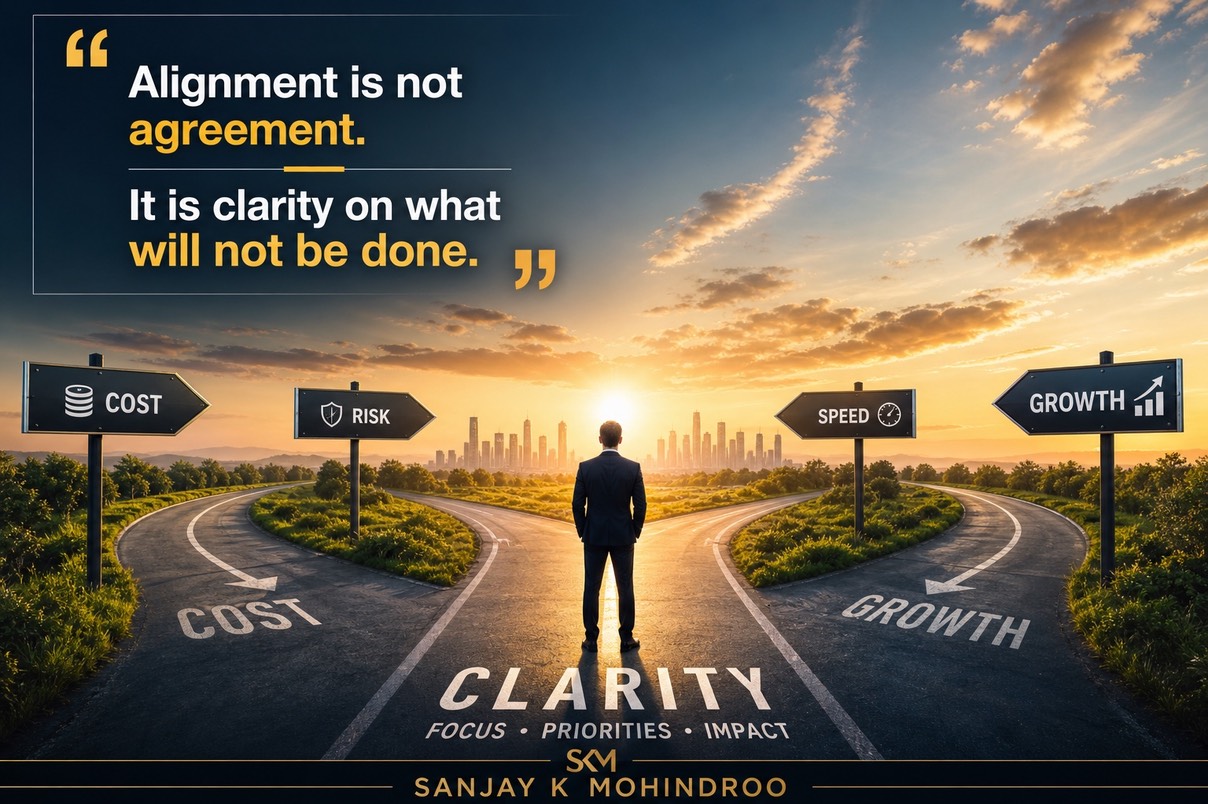
This article reframes the problem. Alignment is not about agreement. It is about enforced trade-offs. CIOs who succeed do not seek consensus. They create clarity on what will not be done.
The Real Tension in the Room
I have sat in hundreds of executive meetings where alignment was declared. Slides were approved. Budgets were signed off. Everyone nodded.
Six months later, the same priorities were under debate again.
Nothing had changed in the market. Nothing had changed in the strategy. What changed was pressure.
A regulatory deadline appeared. A competitor launched a new feature. A quarter missed expectations. Suddenly, every leader wanted their initiative to move to the top.
This is where alignment breaks.
Not because leaders disagree on strategy, but because they are accountable for different outcomes. And when pressure rises, those accountabilities take over.
The CIO becomes the referee. Or worse, the bottleneck.
Alignment Is Not Consensus
There is a flawed assumption that alignment means agreement.
It does not.
In most organizations, if everyone agrees, it means the conversation was too shallow.
Real alignment comes from clarity on three things:
1. What are the top three priorities that will receive disproportionate attention and investment?
2. What will be delayed, even if it is important?
3. What will not be done at all?
Most CIOs get the first part right. They define priorities.
They avoid the second and third.
That is where alignment collapses.
Without explicit trade-offs, every leader assumes their initiative still has a chance. And they continue to push for it.
This creates a silent conflict that surfaces later as missed deadlines, stretched teams, and shifting commitments.
More Alignment Conversations Do Not Create Alignment
The common response to misalignment is to hold more meetings.
More steering committees. More governance forums. More reviews.
This makes the problem worse.
Each additional conversation reopens decisions that were already made. It creates room for negotiation. It signals that priorities are flexible.
In my experience, alignment is not built through repeated discussion. It is built through finality.
At some point, the CIO must say:
This is the direction. These are the trade-offs. This is what we are not doing.
And then hold that line.
Leaders respect clarity. They exploit ambiguity.
The Fragmented View of Value
Another reason alignment fails is that each function defines value differently.
Sales sees value in revenue acceleration.
Finance sees value in cost efficiency.
Operations sees value in reliability.
Risk sees value in control.
Technology cuts across all of them.
This creates a structural problem.
When a CIO presents a priority, it is interpreted through different lenses. The same initiative can be seen as critical by one function and secondary by another.
For example, a cloud migration.
Sales sees faster deployment cycles.
Finance sees rising costs.
Operations sees disruption risk.
Risk sees exposure to new vulnerabilities.
The CIO sees long-term flexibility.
No amount of discussion will align these views unless they are anchored to a single business outcome.
That is where most CIOs miss a step.
They present technology priorities. They do not translate them into business consequences.
The Missing Link Between Strategy and Execution
Many organizations have a clear business strategy.
Fewer have a clear execution model.
This gap shows up in technology.
The CIO is asked to support growth, improve efficiency, and manage risk at the same time.
These are not compatible goals in the short term.
Growth requires speed and investment.
Efficiency requires discipline and constraint.
Risk management requires control and caution.
Without a clear hierarchy among these, technology becomes reactive.
Teams are pulled in different directions. Roadmaps change. Delivery slows down.
Alignment is not possible when the organization itself has not prioritized its objectives.
The CIO cannot solve this alone.
But the CIO can force the conversation.
Why Prioritization Frameworks Fail
Most CIOs rely on frameworks to prioritize initiatives.
Scoring models. Business cases. ROI calculations.
They look structured. They feel objective.
They rarely work in practice.
Because priorities are not decided by numbers. They are decided by power, timing, and narrative.
A high-scoring initiative can still be deprioritized if it lacks executive sponsorship. A lower-scoring initiative can move forward if it is tied to a critical moment.
Frameworks create the illusion of objectivity. They do not remove subjectivity.
Strong CIOs understand this.
They use frameworks to inform decisions, not to make them.
And they spend more time shaping the narrative than refining the model.
The Leadership Gap Behind the Alignment Problem
At its core, this is not a technology problem.
It is a leadership problem.
Alignment requires someone to make a call that not everyone will like.
Many CIOs hesitate here.
They try to accommodate.
They try to balance.
They try to keep all stakeholders satisfied.
That approach works in stable environments.
It fails in dynamic ones.
The role of the CIO has shifted. It is no longer about enabling every request. It is about deciding which requests matter.
That requires a different posture.
Less consensus building. More decision ownership.
What Effective CIOs Do Differently
Over the years, I have seen a clear pattern.
CIOs who consistently achieve alignment do five things differently.
First, they anchor every priority to a business outcome that the CEO cares about. Not a technical benefit.
Second, they make trade-offs explicit. They say what will not be done and why.
Third, they limit the number of active priorities. Three to five at most.
Fourth, they align incentives. If leaders are measured on conflicting outcomes, alignment will not hold.
Fifth, they revisit priorities at defined intervals, not continuously.
This creates stability. It builds trust. It allows teams to execute.
Takeaways
1. Alignment is not about agreement. It is about enforced trade-offs
2. More conversations do not solve misalignment. Clear decisions do
3. Technology priorities must be framed as business consequences
4. Conflicting organizational goals make alignment impossible
5. Leadership clarity matters more than prioritization frameworks
CIOs are often judged on execution.
But execution is a downstream outcome.
The real test is whether the organization is aligned enough to execute at all.
If priorities keep shifting, if teams are stretched across too many initiatives, if decisions are constantly revisited, the issue is not capability.
It is clarity.
And clarity is a leadership choice.
#Leadership #CIO #DigitalTransformation #ExecutiveLeadership
What Actually Happens in Boardrooms When IT Asks for Budget.
Sanjay K Mohindroo
A CIO explains what really happens when IT asks for budget in boardrooms and how leaders can reframe the conversation to secure strategic investment.
Most IT budget discussions fail before they begin. Not because the technology is weak, but because the conversation is misframed. Boards do not fund technology. They fund outcomes, risk decisions, and competitive positioning. When CIOs walk in with cost structures, architectures, and roadmaps, they lose the room. When they walk in with clarity on revenue impact, risk exposure, and strategic leverage, they gain alignment. The difference is not presentation. It is a mindset. This article breaks down what really happens in boardrooms, why many IT asks fall short, and how leaders can reframe the conversation to get decisions made.
The Room Does Not See Technology. It Sees Trade-offs.
I have sat in enough boardrooms to know this: when IT asks for budget, no one is thinking about servers, platforms, or tools.
They are thinking about trade-offs.
Every rupee allocated to IT is a rupee not spent on market expansion, acquisitions, talent, or shareholder returns. That is the lens. Not innovation. Not transformation. Trade-offs.
The CFO is asking, “What am I giving up?”
The CEO is asking, “Does this move the business?”
The board is asking, “What happens if we do not do this?”
If your proposal does not answer these three questions within minutes, the discussion moves away from you. Quietly. Decisively.
This is where most IT leaders lose ground. They assume the merit of the technology will carry the decision. It does not. The board is not evaluating your solution. It is evaluating your judgment.
The Unspoken Filters Every IT Budget Faces
No board will say this directly, but every IT proposal is filtered through three silent tests.
1. Is this defensive or offensive?
Defensive spending
protects the business. Security, compliance, resilience.
Offensive spending grows the business. New revenue streams, customer
experience, market advantage.
Defensive spending is necessary but rarely exciting. It gets approved when the risk is clear. It gets cut when pressure builds.
Offensive spending competes with core business investments. It must show impact, not promise it.
If your proposal sits in the middle, it becomes vulnerable. It is neither urgent nor compelling.
2. Is this a one-time cost or a recurring dependency?
Boards are cautious about commitments that lock them into long-term cost structures.
Cloud migrations, platform shifts, and large vendor contracts. These are not just investments. They are future obligations.
If you cannot articulate how costs evolve, the default assumption is escalation. And escalation creates resistance.
3. Is the value measurable or assumed?
“Improved efficiency” is not a metric.
“Better user experience” is not a metric.
Boards fund what they can track. If the benefit cannot be measured, it is treated as optional.
This is not a failure of the board. It is a failure of framing.
The Real Reason IT Budget Requests Fail
Let me be direct. Most IT budget requests fail because they are presented as technology problems.
They should be presented as business decisions.
I have seen detailed architecture diagrams, vendor comparisons, and implementation plans presented with precision. None of it matters if the board cannot connect it to business impact.
A common example.
An IT team asks for a budget to modernize infrastructure. The argument is built around scalability, performance, and future readiness.
The board hears cost, complexity, and uncertainty.
Now reframe the same ask.
“We are losing X percent of transactions during peak load. That is Y crore in lost revenue annually. This investment removes that ceiling and supports projected growth for the next five years.”
Same investment. Different outcome.
The first is a technology upgrade.
The second is a revenue decision.
Boards fund the second.
Alignment Does Not Win Budget. Tension Does.
There is a widely held belief that IT must “align with the business” to secure budget.
It sounds reasonable. It is also incomplete.
Alignment creates agreement. It does not create urgency.
In boardrooms, decisions are driven by tension. The gap between where the business is and where it needs to be.
If there is no tension, there is no decision.
When IT presents a well-aligned, risk-free, carefully balanced proposal, it often gets deferred. Not rejected. Deferred. Which is worse.
The board thinks, “This makes sense. We can do it later.”
Later rarely comes.
What drives action is clarity on what happens if we do not act.
Revenue loss. Competitive disadvantage. Regulatory exposure. Customer churn.
These are not scare tactics. They are realities.
The role of the CIO is not just to align with the business. It is to surface the consequences of inaction.
That is what moves decisions.
The Budget Conversation Is Really About Trust
At senior levels, budget decisions are less about numbers and more about trust.
Does the board trust that IT understands the business?
Does the board trust that IT can execute at scale?
Does the board trust that the investment will deliver outcomes?
If the answer to any of these is uncertain, the budget becomes harder to secure.
Trust is built over time, but it is tested in moments.
One missed delivery. One overrun. One vague benefit statement. These stay in memory.
This is why consistency matters. Not just in delivery, but in communication.
Every interaction with the board shapes how your next proposal is received.
You are not just asking for a budget. You are reinforcing or weakening your credibility.
What High-Performing CIOs Do Differently
After decades in this role, I have seen a clear pattern among CIOs who consistently secure strategic investment.
They do three things differently.
1. They lead with outcomes, not solutions
They do not start with
what they want to build.
They start with what the business needs to achieve.
Growth targets. Cost pressures. Risk exposure. Market shifts.
Technology comes later in the conversation, as a means to an end.
2. They quantify impact with precision
They translate technical benefits into financial or operational terms.
Reduced downtime becomes revenue protection.
Automation becomes cost reduction with timelines.
Data capability becomes faster decision cycles tied to measurable outcomes.
There is no ambiguity.
3. They frame decisions, not requests
They do not ask, “Can we get a budget for this?”
They present options.
“Option A maintains the current state with X risk.”
“Option B requires investment of Y and delivers Z outcome.”
“Option C accelerates impact with a higher upfront cost.”
This shifts the conversation. The board is no longer evaluating IT. It is choosing a path for the business.
The Hidden Risk of Underfunding IT
There is one more reality that rarely gets discussed openly.
Underfunding IT does not reduce cost. It shifts it.
Delayed upgrades lead to higher maintenance costs.
Weak security leads to incident costs.
Poor systems lead to productivity loss.
These costs are less visible, but they are real.
Boards that consistently underinvest in IT often end up paying more. Just not in ways that are easy to track.
The role of the CIO is to make these hidden costs visible.
Not through fear, but through clarity.
Takeaways
1. IT budget discussions are business decisions. Frame them as such.
2. Answer trade-offs early. What is gained and what is at risk.
3. Separate defensive and offensive investments clearly.
4. Quantify impact. If it cannot be measured, it will be challenged.
5. Create tension. Show the cost of inaction.
6. Build trust through consistent delivery and clear communication.
7. Present choices, not requests.
When IT walks into a boardroom, it is not asking for money. It is asking for belief.
Belief that technology can move the business.
Belief that the team can execute.
Belief that the investment will deliver.
Most CIOs focus on proving the first. The best focus on earning the second and third.
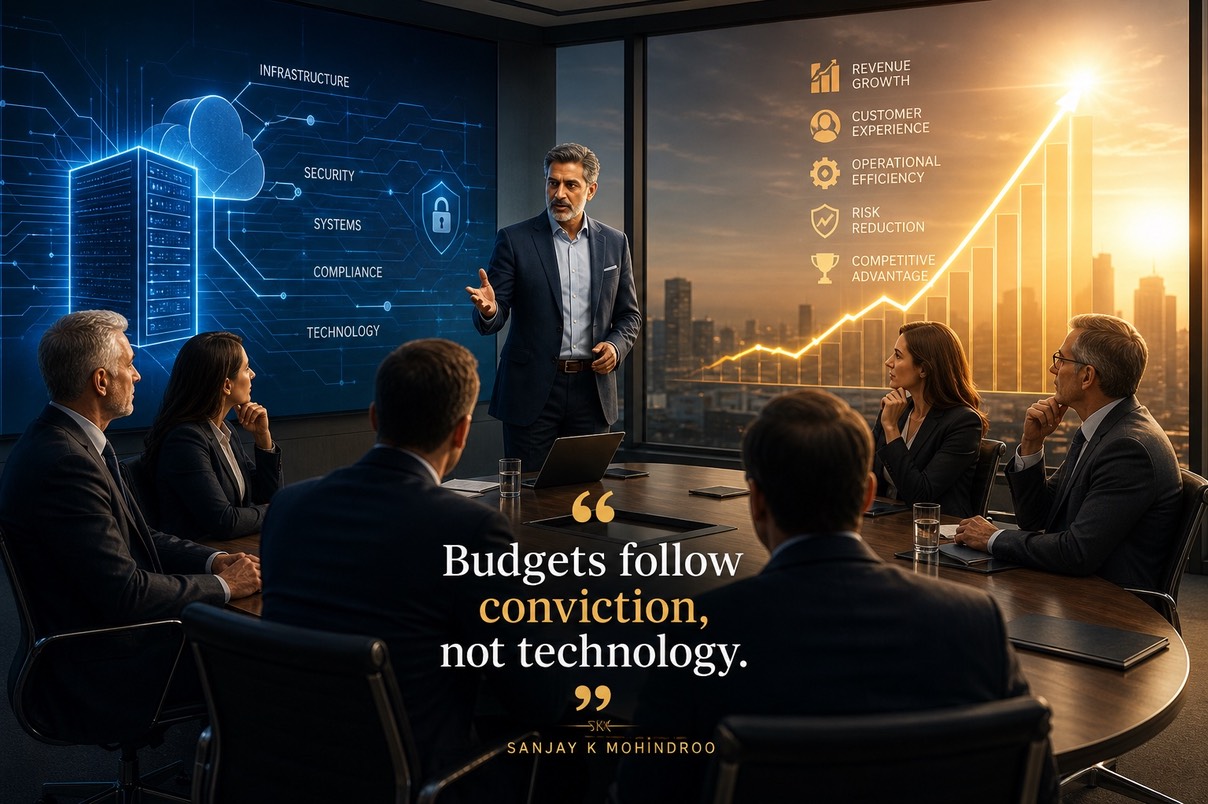
Because in the end, budgets do not follow technology.
They follow conviction.
#Leadership #CIO #Boardroom #DigitalTransformation #Strategy
The Real Reason Decisions Get Delayed in IT.
Sanjay K Mohindroo
A CIO’s perspective on why IT decisions get delayed and how leadership behavior, not data, is the real bottleneck.
Decision delays in IT are rarely about a lack of data, weak teams, or slow processes. They are symptoms. The real cause sits higher. It is a leadership issue shaped by risk posture, unclear ownership, and the quiet habit of deferring accountability. In most organizations, decisions stall not because leaders cannot decide, but because the system allows them not to. This article reframes decision delays as a design flaw in how organizations think about risk, control, and responsibility. It challenges the belief that more information leads to better decisions and offers a sharper perspective. Clarity, not data, drives speed. Ownership, not consensus, drives action.
The Moment Where Everything Slows Down
Every leadership team recognizes this moment.
A proposal is on the table. The analysis is sound. The numbers are credible. The risks are known. Yet the room hesitates.
Someone asks for more data. Another suggests waiting for market signals. A third recommends alignment with a parallel initiative.
The decision moves to the next meeting.
Nothing appears broken. No one is visibly obstructing progress. Yet weeks pass.
From the outside, it looks like caution. From the inside, it feels responsible. In reality, it is something else entirely.
It is a system that has learned how to delay without saying no.
It Is Not About Data. It Is About Exposure
Most leaders will tell you that decisions get delayed because there is not enough information.
That explanation is convenient. It is also wrong.
In my experience, decisions slow down when the cost of being wrong feels higher than the cost of waiting.
The issue is not data. It is exposure.
A decision commits the organization. It creates a point of accountability. It makes outcomes visible. It ties a leader’s credibility to a result.
Waiting does the opposite. It spreads responsibility. It dilutes ownership. It reduces personal risk.
So, leaders wait.
Not because they lack insight. But because the system rewards delay over decisive action.
Until those changes are made, no amount of dashboards, analytics platforms, or AI models will fix the problem.
More Data Does Not Improve Decisions
There is a persistent belief in modern IT organizations.
If we have more data, we will make better decisions.
It sounds logical. It is widely accepted. It is also flawed.
More data rarely improves decisions. It often delays them.
Here is why.
Data expands the range of possible interpretations. It introduces nuance where clarity is needed. It creates room for debate when alignment is required.
Leaders start asking new questions. They seek additional validation. They want one more data point to remove uncertainty.
The decision horizon moves further away.
In large organizations, I have seen teams spend months refining analysis that was already sufficient to act.
The outcome did not improve. The timing did.
And timing, in many cases, is the decision.
The sharper perspective is simple.
Good decisions require enough data, not complete data.
The discipline is knowing when you have crossed that threshold.
That judgment cannot be outsourced to systems. It sits with leadership.
Consensus Is Not Alignment
Another source of delay is the pursuit of consensus.
On the surface, consensus feels like alignment. It signals collaboration. It creates a sense of collective ownership.
In practice, it often leads to the opposite.
Consensus is slow. It requires every stakeholder to agree. It encourages compromise. It avoids clear trade-offs.
Alignment is different.
Alignment is clarity on direction, even if not everyone fully agrees.
It requires a decision-maker. It requires a clear call. It requires the organization to move forward with intent.
When leaders confuse consensus with alignment, decisions stall.
Everyone has a voice. No one has authority.
The room becomes active. The organization becomes passive.
The fix is not better facilitation. It is clearer ownership.
The Hidden Cost of “One More Review”
In many IT organizations, there is a quiet habit.
Before committing, teams seek one more review.
Another architecture validation. Another risk assessment. Another financial check.
Each step appears prudent. Each step adds comfort.
Collectively, they create friction.
Over time, this becomes institutional behavior. Reviews multiply. Decision paths lengthen. Accountability becomes distributed across layers.
No single review is the problem.
The accumulation is.
Leaders rarely challenge this because each review has a rationale. It is hard to argue against caution in isolation.
But the system effect is clear.
Decisions lose momentum. Opportunities pass. Execution weakens.
The organization becomes efficient at analyzing and slow at acting.
The question leaders need to ask is simple.
What is the minimum number of reviews required to make a responsible decision?
Not the maximum that can be justified.
Risk Is Being Misunderstood
Most organizations claim to be risk-aware.
Few are truly risk literate.
Risk is often treated as something to avoid. Decisions are evaluated on how much uncertainty they remove.
This leads to a predictable outcome.
Leaders wait for clarity that rarely comes.
In reality, risk is something to be managed, not eliminated.
Every meaningful decision carries uncertainty. Waiting does not remove it. It shifts it.
When leaders delay, they are still making a decision. They are choosing inaction.
That choice has consequences.
Markets move. Competitors act. Costs rise. Teams lose energy.
The risk does not disappear. It changes form.
High-performing organizations understand this.
They define acceptable risk. They act within that boundary. They adjust as outcomes emerge.
They do not wait for perfect visibility.
Technology Is Not the Bottleneck
There is another assumption that needs to be challenged.
When decisions slow down in IT, the instinct is to improve systems.
Better tools. Faster data pipelines. More integrated platforms.
These investments have value. They improve efficiency. They enhance visibility.
They do not solve decision paralysis.
The bottleneck is not technology. It is leadership behavior.
If leaders are hesitant, no system will make them decisive.
If ownership is unclear, no dashboard will create accountability.
If risk is misunderstood, no model will provide certainty.
Technology can support decisions. It cannot replace judgment.
That distinction matters.
Designing for Decisiveness
If decision delays are a system issue, they require a system response.
This is not about pushing leaders to move faster. It is about creating conditions where decisiveness is natural.
There are a few principles that have worked consistently.
First, define clear decision ownership. Every critical decision should have a single accountable owner. Not a committee. Not a shared group. One person.
Second, set explicit decision timelines. Not open-ended discussions. Time-bound calls. This creates urgency and focus.
Third, agree on decision criteria upfront. What defines a good decision in this context? Cost. Speed. Risk. Strategic fit. Make it visible.
Fourth, limit the number of inputs. Not every stakeholder needs to be involved in every decision. Involvement should be intentional.
Fifth, normalize reversibility. Not all decisions are permanent. When leaders know they can adjust, they act faster.
These are not theoretical constructs. They are practical levers.
When applied consistently, they change behavior.
Takeaways
Decision delays are rarely about capability. They are about structure and incentives.
More data will not fix hesitation. Clarity will.
Consensus is not a requirement for action. Ownership is.
Risk cannot be eliminated. It must be understood and managed.
Technology enables decisions. It does not drive them.
Decisiveness is not a personality trait. It is a system outcome.
Leaders shape that system.
In every organization I have worked with, the pattern is the same.
When decisions slow down, performance follows.
Not immediately. Not dramatically. But steadily.
Opportunities narrow. Execution weakens. Talent disengages.
Over time, the organization becomes cautious by default.
Reversing this is not about pushing teams harder or demanding speed.
It is about confronting a simple truth.
Delays are designed into the system.
Leaders have more control over this than they think.
The question is whether they are willing to use it.
#Leadership #CIO #DecisionMaking #DigitalTransformation #ExecutiveLeadership
Most IT Decisions Fail Before Execution Even Begins.
Sanjay K Mohindroo
Most IT initiatives fail before execution begins. This article reveals why decision-making, not delivery, is the real problem — and how leaders can fix it.
Most technology initiatives do not fail in execution. They fail long before a line of code is written or a vendor is selected. The failure happens at the decision stage. It happens when leaders approve direction without clarity, align without conviction, and commit resources without confronting trade-offs.
The uncomfortable truth is this: poor decisions, not poor delivery, are the primary cause of failed IT outcomes.
This article reframes how leaders should approach technology decisions. It challenges the belief that execution is the problem and shows why decision quality is the real constraint. It outlines where decisions break down, what leaders miss, and how to correct course before failure becomes inevitable.
The Real Problem Is Not Execution
I have sat in enough boardrooms to recognize a pattern.
A major program is approved. The intent is strong. The funding is secured. The leadership team is aligned on the surface. Months later, the initiative is labelled as delayed, over budget, or underwhelming.
The post-mortem usually points to execution gaps. Delivery teams. Vendors. Change management. Communication.
This is convenient. It is also wrong.
Execution teams rarely fail in isolation. They inherit ambiguity. They inherit conflicting priorities. They inherit decisions that were never fully made.
By the time execution begins, the outcome is already constrained.
You cannot clearly execute to a decision that never existed.
Where IT Decisions Break Down
The failure is not dramatic. It is quiet. It hides in early conversations and passes through approval gates without resistance.
1. Alignment Without Agreement
Leaders often confuse alignment with agreement.
In many meetings, heads nod. No one challenges the direction. The initiative moves forward.
But underneath, each executive holds a different interpretation of success.
The CFO sees cost optimization.
The COO sees process efficiency.
The CIO sees modernization.
The business unit sees growth.
No one resolves the tension. The initiative carries all expectations at once.
Execution then becomes a compromise machine.
You do not get failure at the start. You get slow erosion.
2. Decisions Without Trade-offs
Every meaningful IT decision involves trade-offs. Speed versus control. Cost versus flexibility. Standardization versus customization.
Yet most proposals are presented as if trade-offs do not exist.
The language is polished. The risks are softened. The benefits are stretched.
Leaders approve a version of reality that cannot exist.
The team is then forced to choose trade-offs during execution, without authority, and under pressure.
That is when friction begins.
3. Strategy Without Operational Depth
Many strategies sound right at a high level.
“Move to the cloud.”
“Adopt AI.”
“Integrate platforms.”
These are directions, not decisions.
A decision answers hard questions.
Which workloads move first?
What gets shut down?
Which processes change?
Who loses control?
What risk is accepted?
Without this depth, execution teams spend months trying to interpret intent.
That delay is not inefficiency. It is the cost of an incomplete decision.
4. Overconfidence in Consensus
Consensus feels safe. It reduces visible conflict.
But in complex IT decisions, consensus often dilutes accountability.
When everyone agrees, no one owns the consequence.
Difficult questions are avoided to maintain momentum.
Critical risks remain unaddressed because raising them disrupts alignment.
Execution then becomes the stage where unresolved tensions surface.
And by then, they are expensive.
Better Data Does Not Lead to Better Decisions
There is a widely accepted belief that more data leads to better decisions.
It sounds logical. It is also misleading.
I have seen teams spend months gathering data, building models, benchmarking peers, and still arrive at weak decisions.
Data does not resolve ambiguity. It amplifies it.
For every dataset, there is a counter dataset. For every insight, there is a competing interpretation.
Leaders then defer decisions, waiting for clarity that never comes.
What actually improves decisions is not more data. It is a sharper judgement.
Judgement comes from experience, context, and the willingness to take a position.
Data should inform decisions, not delay them.
The leaders who make effective IT decisions do not wait for perfect information. They define what matters, accept uncertainty, and move with intent.
The Cost of Poor Decision-Making
When decisions fail early, the cost is not immediate. It compounds.
Time Is Lost First
Teams spend months clarifying scope, revisiting assumptions, and renegotiating priorities.
What appears as slow execution is often delayed decision-making.
Talent Gets Misused
Strong teams are forced into reactive roles. They solve problems that should not exist.
Energy shifts from building to correcting.
Over time, even high-performing teams lose momentum.
Trust Erodes Quietly
Business stakeholders begin to question IT’s ability to deliver.
IT teams begin to question leadership clarity.
The gap widens without open acknowledgement.
By the time failure is visible, trust is already weakened.
What Strong Decision-Making Looks Like
Strong IT decisions are not complex. They are precise.
1. Define Success in One Sentence
If success cannot be stated clearly, the decision is not ready.
“Improve customer experience” is not a decision.
“Reduce onboarding time from five days to one day across all channels within twelve months.”
Clarity at this level removes interpretation.
2. Make Trade-offs Explicit
Every proposal should answer one question clearly.
What are we willing to give up to achieve this?
If that question is not addressed, the decision is incomplete.
Leaders must confront trade-offs before execution, not during it.
3. Assign Real Ownership
Ownership is not a title. It is accountability for outcomes.
One leader must own the decision. Not the committee. Not the steering group.
This creates clarity when decisions need to evolve.
4. Decide at the Right Level
Many IT decisions are escalated unnecessarily.
Senior leaders should decide the direction and constraints.
Execution teams should decide how to deliver within those boundaries.
When this balance is wrong, decisions either stall or become disconnected from reality.
5. Lock Decisions Before Scaling
Too many organizations scale before stabilizing.
They roll out initiatives across regions, functions, or products before proving the model.
This multiplies complexity.
A strong decision includes a clear point of validation before expansion.
Strategic Takeaways
1. Most IT failures are decision failures, not execution failures.
2. Alignment without true agreement creates hidden risk.
3. Trade-offs must be made early and explicitly.
4. Data informs decisions but does not replace judgment.
5. Clear ownership is non-negotiable.
6. Execution speed improves when decision clarity improves.
The next time an IT initiative struggles, resist the instinct to look at execution first.
Go back to the decision.
Ask what was assumed, what was avoided, and what was never fully resolved.
In my experience, the answers are always there.
Execution does not fix weak decisions. It exposes them.
Leaders who understand this shift in how organizations operate.
They spend less time managing failure and more time enabling success.
And they recognize that the most important work in any IT initiative happens before it begins.
#Leadership #CIO #DigitalTransformation #DecisionMaking #ExecutiveLeadership
When the Pressure Mounts.
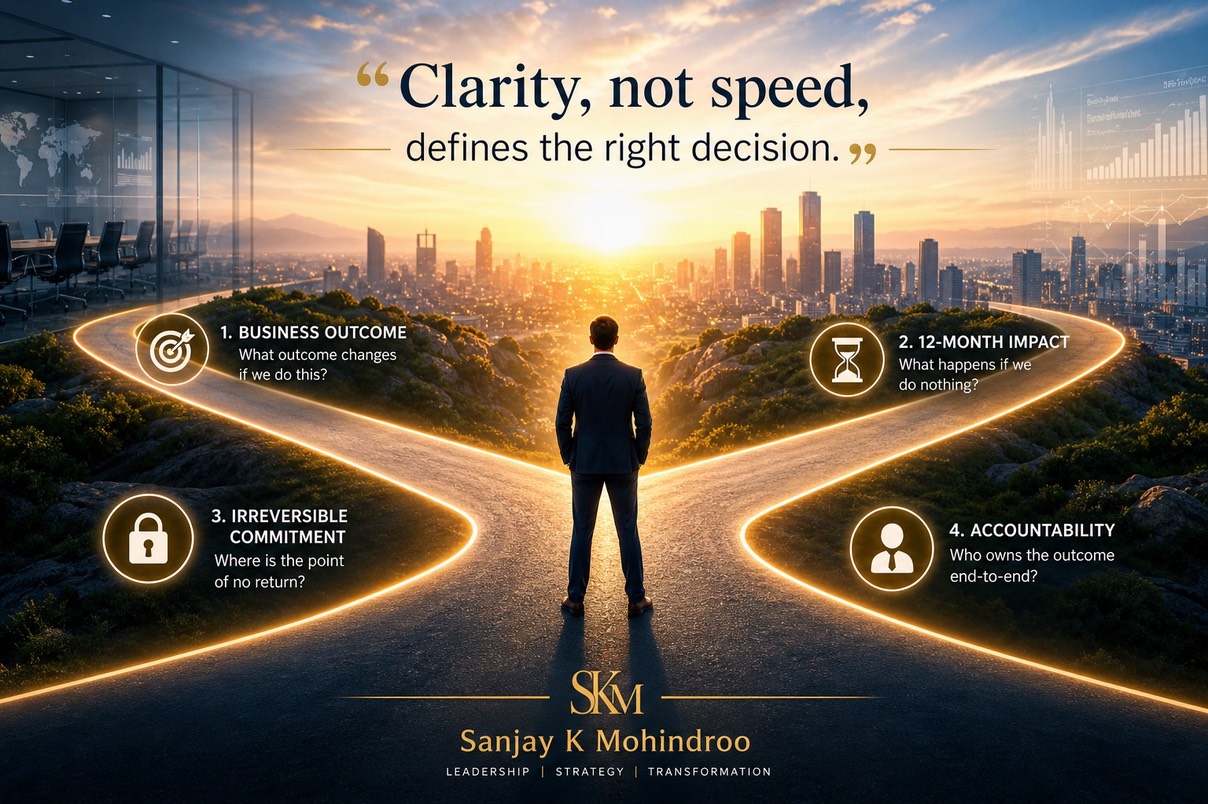
Sanjay K Mohindroo
A senior CIO shares a simple four-question framework to evaluate IT investments under pressure, helping leaders make sharper, high-stakes decisions.
A Simple Framework to Evaluate IT Investments
Under pressure, most IT investment decisions deteriorate. Urgency replaces clarity. Noise replaces judgment. Leaders approve projects they would normally challenge, or delay decisions that demand speed.
After three decades in global boardrooms, I have seen one pattern repeat: the problem is not the investment. It is the way it is evaluated.
This article lays out a simple framework built for pressure situations. It strips away complexity and forces decisions back to first principles. It also challenges a widely held belief that speed and scale should dominate investment thinking.
If you are making high-stakes technology decisions with incomplete information, this is the discipline that protects both capital and credibility.
The Real Problem Is Not the Technology
In calm conditions, investment discussions are measured. Teams present options. Risks are debated. Financials are scrutinized.
Pressure changes everything.
A competitor makes a bold move. A regulator signals change. A board member asks why progress is slow. Suddenly, the question is no longer “Should we invest?” It becomes “How fast can we move?”
At this point, most organizations make one of two mistakes.
They either
rush into large commitments without clarity.
Or they freeze, waiting for perfect information that will never arrive.
Neither approach survives scrutiny over time.
The issue is not a lack of intelligence. It is a lack of structure.
When pressure rises, leaders need fewer variables, not more. They need a way to reduce the decision to what truly matters.
The Framework: Four Questions That Cut Through Noise
Over time, I have reduced IT investment evaluation to four questions. Not twenty. Not ten. Four.
If a proposal cannot stand up to these, it does not deserve capital.
1. What business outcome changes if we do this?
Not features. Not capabilities. Outcomes.
Will revenue shift? Will cost structures change? Will risk exposure be reduced? If the answer is vague, the investment is not ready.
I have seen multi-million-dollar programmes approved on the strength of technical elegance.
They delivered systems, not outcomes.
Technology does not justify itself. The business must.
2. What happens if we do nothing for 12 months?
Every proposal looks urgent when presented. Few are.
If delaying the decision causes no meaningful impact, it is not a priority. If the consequences are severe, the urgency is real.
This single question filters out a surprising amount of noise.
3. Where is the irreversible commitment?
Not all investments are equal. Some can be reversed. Others lock you in.
A cloud contract with exit flexibility is different from a multi-year platform migration tied to a single vendor. A pilot is different from a global rollout.
Leaders often underestimate how quickly optionality disappears.
Once you commit, your future choices narrow. That is where most long-term costs are hidden.
4. Who is accountable for the outcome?
This is where many decisions quietly fail.
If accountability sits with a function, rather than a person, the outcome becomes negotiable.
Every investment must have a single accountable leader. Not for delivery. For the business result.
Without that, execution becomes activity, not impact.
Speed Is Not the Advantage You Think It Is
There is a widely accepted belief in technology circles: speed wins.
Move faster than competitors. Deploy quicker. Scale earlier.
This belief has driven many organizations to adopt “accelerate at all costs” as a default posture.
It sounds compelling. It is often wrong.
Speed amplifies both good decisions and bad ones. Under pressure, most decisions are not at their best.
I have seen organizations move quickly into cloud architectures they did not fully understand. They achieved speed. They also locked in costs that took years to unwind.
I have seen rapid AI deployments create operational confusion because the underlying processes were not ready.
Speed without clarity is expensive.
The real advantage is not speed. It is direction.
A well-judged decision executed at a measured pace will outperform a fast decision made on weak assumptions.
Leaders do not lose because they moved more slowly. They lost because they moved without discipline.
Why Financial Models Fail Under Pressure
In theory, every investment is supported by a business case.
In reality, under pressure, these models become optimistic narratives.
Costs are underestimated. Benefits are front-loaded. Risks are softened.
The problem is structural.
Financial models are built on assumptions. Pressure reduces the time available to challenge those assumptions.
This is why I rarely rely on detailed financial projections in early-stage decisions.
Instead, I look for asymmetry.
If the downside is limited and the upside is meaningful, the investment has merit. If the downside is large and uncertain, even attractive projections do not justify the risk.
This is not about ignoring numbers. It is about recognizing their limitations under pressure.
The Hidden Risk: Alignment Drift
One of the most overlooked risks in IT investments is alignment drift.
At the start, everyone agrees on the objective. As execution progresses, priorities shift.
The business wants speed. Technology wants stability. Finance wants cost control.
Each is rational. Together, they create friction.
Without constant alignment, the original outcome gets diluted.
I have seen programmes that technically succeeded but failed commercially because the objective changed midway.
This is why the first question in the framework matters so much.
If the outcome is not clear, alignment will not hold.
Applying the Framework in the Real World
This framework is not theoretical. It is built for boardroom use.
When a proposal comes in, I do not ask for more slides. I ask these four questions.
If the answers are clear, the decision becomes easier.
If they are not, the proposal goes back.
There is often resistance at first.
Teams want to explain complexity. They want to defend their work. That is natural.
But complexity is not a virtue. It is often a sign that thinking is incomplete.
Strong ideas survive simplification.
Weak ideas hide behind detail.
Takeaways
1. Pressure does not justify poor decisions. It demands better structure.
2. Most IT investments fail at the evaluation stage, not execution.
3. Outcomes matter more than capabilities. Always anchor decisions in business impact.
4. Optionality is a strategic asset. Protect it.
5. Accountability must be personal, not distributed.
6. Speed is overrated. Direction is not.
7. Financial models are useful, but only within the limits of their assumptions.
8. Alignment is fragile. It must be actively maintained.
Technology decisions are rarely about technology.
They are about judgment under uncertainty.
Pressure will always exist. Markets move. Boards ask questions. Competitors act.
What separates strong organizations is not access to better tools. It is the discipline of decision-making.
A simple framework does not reduce complexity. It exposes what matters within it.
That is where clarity lives.
And clarity, in high-stakes environments, is a competitive advantage few truly have.
#Leadership #CIO #DigitalTransformation #Strategy #DecisionMaking
Hyperconverged Infrastructure.

Sanjay K Mohindroo
The Quiet Reinvention of Enterprise IT
A strategic deep dive into Hyperconverged Infrastructure (HCI), covering use cases, deployment models, licensing, costs, and ROI for enterprise leaders.
Hyperconverged Infrastructure (HCI) has moved from a niche architectural choice to a strategic lever for modern enterprises. It simplifies IT operations by integrating compute, storage, and networking into a unified software-defined system. For leadership, this is not just a technology upgrade. It is a shift in how infrastructure aligns with speed, scale, and business resilience.
Yet, the narrative around HCI is often incomplete. While it promises agility and cost efficiency, the real value lies in how it is deployed, governed, and monetized over time. Poorly planned HCI adoption can lock organizations into rigid cost structures and vendor dependencies. Well-executed HCI, on the other hand, becomes a foundation for innovation.
This piece breaks down HCI from a leadership lens. What it is. Where it works. Where it fails. And how to approach it with clarity to drive real return on investment.
When Infrastructure Becomes a Bottleneck
In boardrooms across industries, I hear a familiar frustration.
“We invested heavily in infrastructure. Why are we still slow?”
The answer is rarely about hardware. It is about architecture.
Traditional infrastructure was built for stability. Business today demands adaptability. The gap between the two is where most organizations lose momentum. IT teams spend more time managing complexity than enabling growth.
This is where Hyperconverged Infrastructure enters the conversation. Not as a silver bullet, but as a response to a deeper problem.
The question is not whether HCI works. It does. The real question is whether it works for your business.
What Is Hyperconverged Infrastructure
A Software-Led Approach to Infrastructure Simplicity
At its core, Hyperconverged Infrastructure collapses compute, storage, and networking into a single software-defined platform running on commodity hardware.
Instead of managing separate silos, organizations operate a unified system through a central interface. Resources are pooled, scaled, and orchestrated dynamically.
In simple terms, HCI turns infrastructure into software.
That shift matters. Because software scales differently from hardware. It adapts faster. It integrates more easily. It aligns closer with business cycles.
Platforms such as Nutanix, VMware, and Dell Technologies have shaped this space with mature offerings that power enterprises globally.
Where HCI Delivers Real Value
Use Cases That Justify the Investment
HCI is not meant for every scenario. Its strength lies in specific use cases where simplicity and scalability outweigh raw customization.
1. Virtual Desktop Infrastructure (VDI)
HCI excels in VDI environments where workloads are predictable yet require flexibility. Scaling desktops becomes a matter of adding nodes rather than redesigning architecture.
2. Remote and Branch Offices
Distributed environments benefit from HCI’s compact footprint and centralized management. It reduces the need for specialized IT staff at every location.
3. Private Cloud and Hybrid Cloud Foundations
HCI provides a strong base for organizations building private clouds or integrating with public cloud environments. It supports workload portability and policy-based management.
4. Disaster Recovery and Business Continuity
Replication and failover capabilities are built into most HCI platforms. Recovery becomes faster and more reliable.
5. Edge Computing
As enterprises push compute closer to data sources, HCI offers a manageable and scalable solution for edge deployments.
In each of these cases, the value is not just technical. It is operational. Reduced complexity leads to faster execution. And that translates directly into business advantage.
Deployment Scenarios: One Size Does Not Fit All
Choosing the Right Model
HCI can be deployed in multiple ways. Each has implications for cost, control, and flexibility.
On-Premise HCI
Best suited for organizations with regulatory constraints or predictable workloads. Offers control but requires upfront investment.
Hybrid HCI
Combines on-premise infrastructure with cloud integration. This model balances control with scalability. It is increasingly the default choice for large enterprises.
HCI as a Service
Delivered through subscription models. Reduces capital expenditure but shifts focus to operational spending.
Edge HCI Deployments
Designed for low-latency environments such as manufacturing or retail. Compact and resilient.
The mistake many organizations make is choosing a deployment model based on trend rather than need. Architecture decisions must follow business strategy, not the other way around.
Advantages: Why Leaders Are Paying Attention
Operational Clarity Over Technical Complexity
HCI brings several advantages that resonate at the leadership level.
Simplicity
A single
interface replaces multiple management tools. This reduces operational
friction.
Scalability
Adding
capacity is straightforward. New nodes can be integrated without disrupting
existing systems.
Faster Deployment
Infrastructure can be provisioned in hours instead of weeks.
Improved Resource Utilization
Pooling resources reduces wastage and improves efficiency.
Built-In Resilience
High availability and fault tolerance are part of the architecture.
From a CIO perspective, this means fewer firefights and more focus on strategic initiatives.
Disadvantages: The Trade-Offs Few Talk About
Complexity Does Not Disappear. It Shifts
No technology eliminates complexity. It redistributes it.
Vendor Lock-In
HCI solutions often tie organizations to specific ecosystems. Switching becomes expensive.
Cost at Scale
While initial deployment may appear cost-effective, large-scale expansion can become expensive due to licensing models.
Performance Limitations
For highly specialized workloads, traditional architectures may still outperform HCI.
Skill Gap
Teams need to adapt to software-defined environments. This requires training and a mindset change.
Ignoring these factors leads to disappointment. Addressing them early leads to better outcomes.
“HCI Reduces Costs” Is an Incomplete Truth
The Real Question Is Not Cost. It Is Value Density
One of the most common narratives around HCI is cost reduction.
In my experience, this is misleading.
HCI does not always reduce costs. In many cases, it increases them. Licensing fees, node-based scaling, and vendor dependencies can drive expenses higher than traditional setups.
So why do leading organizations still adopt it?
Because the real metric is not cost. It is value density.
How much business value can you generate per unit of infrastructure?
If HCI enables faster product launches, reduces downtime, and improves customer experience, the return justifies the spend.
This is where leadership judgment matters. Technology decisions cannot be evaluated in isolation. They must be tied to business outcomes.
#DigitalTransformation is not about saving money. It is about creating leverage.
Licensing Models: Where ROI Is Won or Lost
Understanding the Financial Architecture
HCI licensing is often more complex than the technology itself.
Per Node Licensing
Charges based on the number of nodes. Simple, but it can become expensive as you scale.
Per Core Licensing
Tied to CPU cores. Suitable for compute-intensive workloads.
Subscription-Based Models
Flexible and aligns with operational expenditure. Increasingly popular.
Enterprise Licensing Agreements (ELA)
Provides cost predictability for large organizations but requires long-term commitment.
The key is alignment.
Licensing should match workload patterns. Not the other way around.
A common mistake is overprovisioning to “future-proof” infrastructure. This locks capital into unused capacity.
A better approach is incremental scaling with clear utilization benchmarks.
Cost Implications: The Hidden Layers
Beyond the Purchase Price
The cost of HCI extends beyond hardware and software.
Initial Investment
Hardware, software, and implementation costs.
Operational Costs
Power, cooling, maintenance, and support.
Licensing Renewals
Recurring costs that can escalate over time.
Migration Costs
Data transfer, downtime, and integration efforts.
Training and Change Management
Upskilling teams to manage the new environment.
Leaders must evaluate the total cost of ownership over a 5 - 7 year horizon. Short-term savings often mask long-term commitments.
Migration Between HCI Platforms
A Strategic Decision, not a Technical One
Switching from one HCI platform to another is not trivial.
Data migration, application compatibility, and operational disruption must be carefully managed.
Costs include:
- Data transfer and validation
- Downtime risks
- Reconfiguration of workloads
- Retraining teams
The decision to migrate should be driven by clear business value. Not dissatisfaction with a vendor or market hype.
In most cases, optimization within the existing platform delivers better returns than switching.
What Matters at the Executive Level
1. Align infrastructure decisions with business strategy. Not technology trends.
2. Evaluate HCI based on value creation, not cost reduction.
3. Choose deployment models that match operational realities.
4. Treat licensing as a strategic lever, not a procurement detail.
5. Plan for long-term scalability and cost implications.
6. Invest in people as much as technology.
#CIO #Leadership decisions in infrastructure shape organizational agility for years.
Infrastructure as a Business Enabler
Hyperconverged Infrastructure is not the future. It is the present.
But its impact depends on how it is used.
Organizations that treat HCI as a cost-saving tool will see limited gains. Those who see it as a platform for speed, resilience, and innovation will unlock its full potential.
The role of leadership is to bring clarity.
To cut through the noise.
To ask the right questions.
To make decisions that stand the test of time.
Technology evolves. Principles endure.
#Leadership #CIO #DigitalTransformation #ITStrategy #HyperconvergedInfrastructure #EnterpriseIT #CloudComputing #BusinessTransformation #TechnologyLeadership #Innovation
Reliability Is a Business Decision.
Sanjay K Mohindroo
Rethinking SRE from the Boardroom.
A senior IT leader’s perspective on SRE, balancing reliability, speed, and cost, and why reliability is a strategic business decision.
Site Reliability Engineering has moved from an engineering practice to a business priority. Yet many organizations still treat it as a technical discipline.
That is where the gap begins.
SRE is not about uptime alone. It is about balancing reliability, speed, and cost to support business outcomes.
In my experience, organizations that get SRE right do not chase perfection. They define acceptable risk, align it with business priorities, and build systems that operate within those boundaries.
This piece explores what SRE really means for leadership, why common approaches fall short, and how to embed reliability into decision-making at scale. #SRE #CIO #Leadership
The outage that cost more than downtime
A few years ago, I was reviewing a major production incident with a global team. The system was down for less than an hour.
Technically, it was resolved quickly.
Commercially, the damage was far greater. Lost transactions, customer frustration, and reputational impact.
What stood out was not the failure itself. It was the absence of clarity.
No one could answer a simple question.
“How much reliability do we actually need?”
That is the conversation most organizations avoid.
What SRE Really Means
Reliability is not an engineering metric. It is a business choice
SRE is often reduced to metrics. Availability percentages, latency thresholds, and error rates.
These matter. But they are not the starting point.
The starting point is business impact.
Different systems require different levels of reliability. A customer-facing payment platform demands near-perfect availability. An internal reporting tool does not.
Yet many organizations apply uniform standards across all systems.
This leads to over-engineering in some areas and under-investment in others.
In one organization, we categorized services based on business criticality. Reliability targets were aligned accordingly.
This brought clarity to investment decisions. It also reduced unnecessary effort.
Because not everything needs to be perfect.
The Balance Between Speed and Stability
You cannot optimize for both without trade-offs
There is a natural tension between speed and reliability.
Business wants faster releases. Engineering wants stability.
SRE provides a framework to manage this tension.
Error budgets are a powerful concept. They define how much failure is acceptable within a given period.
When error budgets are consumed, focus shifts to stability. When they are healthy, teams can move faster.
In practice, this creates a disciplined approach to trade-offs.
In one transformation, introducing error budgets changed behavior across teams. Conversations became more grounded. Decisions became more balanced.
It moved the discussion from opinion to structure. #DigitalTransformation
The Contrarian View
Zero downtime is not the goal. Controlled failure is
There is a strong belief that systems should aim for zero downtime.
It sounds logical. It is also unrealistic.
Chasing zero downtime leads to high cost, complexity, and slower innovation.
Every additional layer of redundancy adds overhead. Every safeguard introduces latency.
The goal is not to eliminate failure. It is to manage it.
I have seen organizations spend millions chasing marginal improvements in uptime while neglecting recovery capabilities.
The better approach is resilience.
Systems should fail gracefully. Recover quickly. Minimize impact.
In one case, we shifted focus from preventing every incident to improving recovery time.
The result was a more robust system and a more confident organization.
Because failure, when managed well, becomes part of the system rather than a threat to it. #Resilience
Designing SRE into the Organization
Reliability must be built, not inspected
SRE cannot be an afterthought. It must be embedded into how systems are designed and operated.
This starts with architecture. Systems should be modular, scalable, and fault-tolerant.
It continues with automation. Manual processes introduce variability and delay.
And it requires observability. Without visibility, reliability cannot be managed.
In one global rollout, we introduced standard observability practices across all services.
It did not just improve monitoring. It improved understanding.
Teams could see how systems behaved under load, where risks existed, and how failures propagated.
That visibility changed decision-making.
The Role of Culture
SRE works when blame is removed, and learning is prioritized
Technology alone does not deliver reliability. Culture does.
In high-performing organizations, incidents are treated as learning opportunities, not failures to be punished.
Blameless post-incident reviews are critical. They focus on what happened, why it happened, and how to improve.
Not who made the mistake.
I have seen teams transform when this mindset is adopted.
Engineers become more open. Issues surface earlier. Improvements happen faster.
Without this cultural shift, SRE becomes a compliance exercise.
The Leadership Imperative
Why SRE is a board-level concern
Reliability impacts revenue, customer trust, and brand reputation.
It is not just an operational issue. It is a strategic one.
For CEOs and boards, this means asking different questions.
What is our acceptable level of risk
How does reliability impact customer experience
Are we investing in resilience or just prevention
For CIOs, the role is to translate technical realities into business language.
To make trade-offs visible. To align reliability with business priorities.
This is where leadership creates value.
What Gets in the Way
The quiet challenges that derail SRE
SRE implementation often faces subtle barriers.
Lack of clarity on service criticality
Misaligned incentives between teams
Over-reliance on tools without process discipline
Resistance to cultural change
These issues are rarely discussed openly. Yet they are the primary reasons SRE efforts stall.
Addressing them requires leadership attention, not just technical expertise.
What senior leaders should act on
Define reliability in business terms, not just technical metrics
Align service levels with business criticality
Introduce structured trade-offs between speed and stability
Invest in resilience and recovery capabilities
Embed observability and automation into core systems
Foster a culture of learning and accountability
Ensure leadership understands and supports reliability decisions
Reliability is a leadership decision
SRE is not about engineering perfection. It is about disciplined decision-making.
The organizations that succeed are not the ones that avoid failure.
They are the ones who understand it, manage it, and recover from it effectively.
Reliability, at its core, is a reflection of how an organization thinks and operates.
And that makes it a leadership responsibility.
#SRE #SiteReliabilityEngineering #Leadership #CIO #DigitalTransformation #Resilience #ITStrategy #EnterpriseIT #TechnologyLeadership #OperationalExcellence