
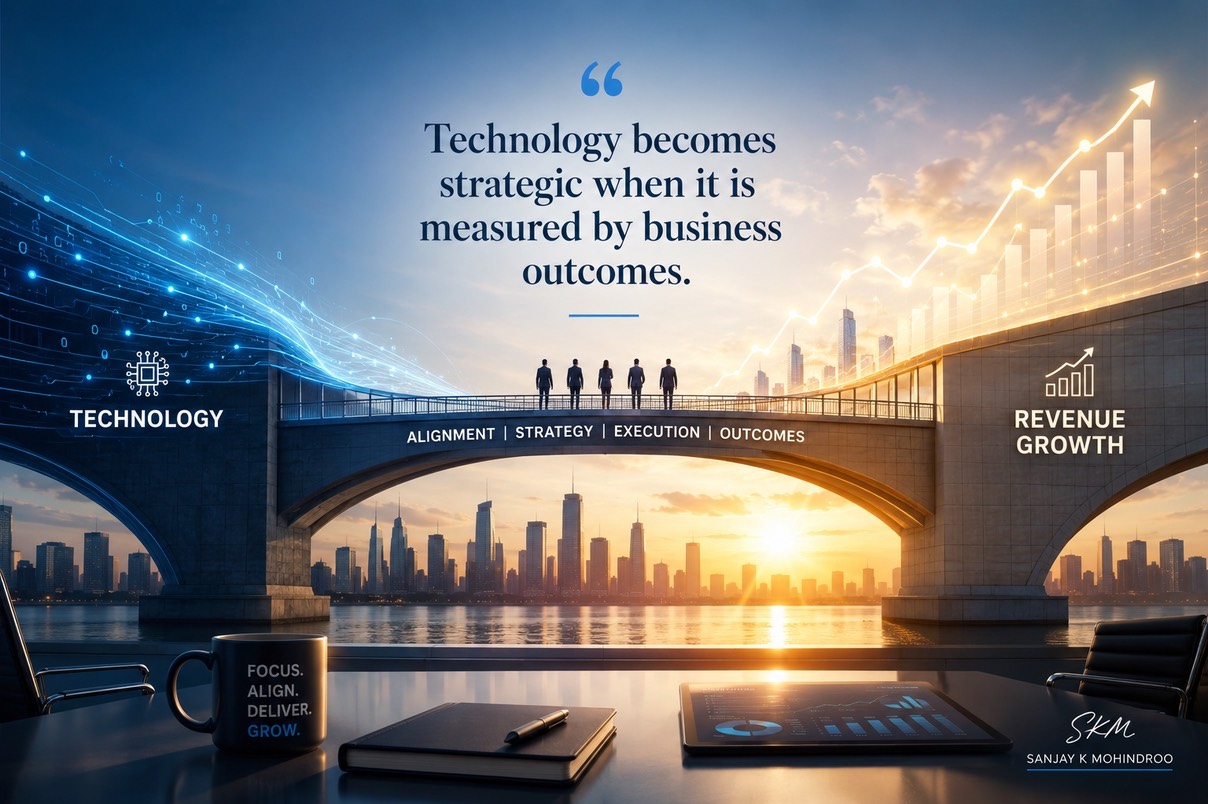
Sanjay K Mohindroo
Most IT strategies fail to connect technology investments with measurable revenue outcomes. A practical model for CEOs, CIOs, and boards to align technology decisions with business growth.
Technology Does Not Create Value. Business Outcomes Do.
Many organizations spend millions on technology while struggling to explain how those investments contribute to revenue growth. The problem is rarely the technology itself. The problem is the operating model used to connect technology decisions with business outcomes.
The most effective CIOs do not manage projects. They manage revenue impact. This article outlines a practical framework that shifts IT from a cost center mindset to a growth engine mindset.
The Revenue Alignment Problem Most Companies Ignore
Why Good Technology Investments Still Fail
I have sat in countless boardrooms where technology leaders presented successful implementations.
The project was delivered on time.
The budget was under control.
The platform performed exactly as designed.
Yet six months later, nobody could explain what business value had actually been created.
This is one of the most expensive disconnects in modern business.
Organizations measure technology success through implementation metrics while executive teams evaluate success through revenue, growth, margin, and market share.
The result is predictable.
IT celebrates delivery.
The business asks where the results are.
Both sides believe they succeeded.
Both sides are frustrated.
The issue is not execution. The issue is alignment.
Technology teams often begin with systems, platforms, and architectures. Business leaders begin with growth objectives. When these conversations start from different places, alignment becomes impossible.
The most successful organizations reverse this sequence.
They start with revenue.
Then they work backward to technology.
The Revenue Chain Model
Connecting Every Technology Investment to Business Growth
Over the years, I have found that the simplest model is often the most effective.
Every technology initiative should be connected to a Revenue Chain.
The chain contains four questions:
What revenue outcome are we pursuing?
Increase customer acquisition?
Improve retention?
Expand wallet share?
Accelerate market entry?
Protect existing revenue?
The answer must be explicit.
What business capability influences that outcome?
Customer experience.
Sales productivity.
Supply chain responsiveness.
Pricing effectiveness.
Product innovation.
Technology should support a capability, not operate as a separate objective.
What operational metric proves improvement?
Lead conversion.
Customer churn.
Sales cycle duration.
Order fulfillment speed.
Product launch velocity.
These metrics create accountability.
What technology intervention enables the change?
Only after the first three questions are answered should technology enter the discussion.
Cloud migration.
AI implementation.
Data modernization.
Automation.
Cybersecurity enhancement.
The technology becomes a means rather than the objective.
This simple sequence changes the quality of investment decisions dramatically.
Stop Funding Projects. Start Funding Outcomes.
The Shift Boards and CEOs Need to Demand
Most organizations approve technology investments project by project.
This approach creates fragmented spending and fragmented accountability.
A better approach is to fund business outcomes.
For example:
Instead of funding a CRM upgrade, fund customer retention.
Instead of funding an analytics platform, fund revenue expansion.
Instead of funding automation, fund margin improvement.
The distinction matters.
Projects create activity.
Outcomes create value.
When funding is tied to outcomes, conversations change immediately.
Technology leaders begin discussing business impact.
Business leaders become active participants in technology decisions.
Accountability becomes shared.
The discussion moves away from features and toward measurable results.
That is where executive attention belongs.
The Missing Link: Shared Ownership
Revenue Is Not a Technology Metric. It Is a Business Metric.
One of the biggest mistakes organizations make is assigning revenue-related technology initiatives solely to IT.
Revenue belongs to the business.
Technology enables outcomes.
It does not own them.
When sales, operations, marketing, and technology leaders operate under separate scorecards, alignment breaks down.
Successful organizations create shared accountability.
A customer acquisition initiative should have joint ownership between business leadership and technology leadership.
The same applies to retention, operational efficiency, and digital growth initiatives.
Shared accountability reduces blame and increases execution quality.
Everyone wins or loses together.
That changes behavior faster than any transformation program.
More Technology Does Not Create More Revenue
One of the most persistent beliefs in executive circles is that digital maturity automatically leads to business growth.
It does not.
Many organizations are highly digitized and still struggle to grow.
Others operate with surprisingly simple technology environments and consistently outperform competitors.
The difference is not the amount of technology.
The difference is the quality of alignment.
A company running ten disconnected platforms can generate less value than a company running three tightly aligned ones.
Technology should never be measured by sophistication.
It should be measured by commercial impact.
The question is not whether your organization is digital.
The question is whether your technology investments are changing business outcomes.
That distinction is where many leadership teams lose focus.
Five Questions Every Executive Team Should Ask
Before approving the next technology investment, ask:
1. Which revenue outcome will this influence?
2. Which business capability will improve?
3. Which operational metric will change?
4. How will we measure commercial impact?
5. Who outside IT shares accountability for success?
If these questions cannot be answered clearly, the investment is not ready for approval.
Technology spending without outcome clarity is simply a more sophisticated form of guessing.
Technology Is Not the Strategy
For years, organizations have debated whether IT should have a seat at the executive table.
That debate misses the point.
The real question is whether technology leaders are helping shape revenue outcomes.
When technology conversations begin with platforms, costs, and architectures, they remain operational discussions.
When they begin with growth, customers, and revenue, they become strategic discussions.
The strongest CIOs understand this instinctively.
They do not ask how technology can support the business.
They ask how the business intends to create value and then determine what technology is required to make that outcome inevitable.
That is where alignment starts.
And that is where competitive advantage is built.
#CIO #Leadership #DigitalTransformation #BusinessStrategy #TechnologyLeadership