

Cataloguing Strategic Innovations and Publications
Relevance Is a Moving Target: Why Most Leaders Are Already Behind on AI.
Sanjay K Mohindroo
A sharp, executive-level perspective on staying relevant in the AI era. Practical insights for CIOs, CEOs, and business leaders navigating workforce and strategy shifts.
AI is not just changing how work gets done—it is redefining what makes a role valuable. The shift is subtle but decisive. Execution is losing value. Judgment, system thinking, and adaptability are gaining it.
Leaders who treat AI as a tool will fall behind. Those who treat it as a structural shift in value creation will move ahead.
The path forward is clear: evolve from doing work to shaping how work happens.
The Quiet Shift Most Leaders Are Missing
In boardrooms, I still hear a familiar question:
“How will AI impact our business?”
It sounds reasonable. It’s also the wrong question.
Because AI is not waiting to “impact” anything. It is already reshaping how value flows inside organizations.
The real issue is not adoption. It’s relevance.
I’ve seen this pattern before—during large ERP rollouts, during cloud transitions, during global outsourcing waves. But this time feels different.
Those shifts changed how work was done.
This one is changing who remains valuable while work is being done.
And that’s where most leadership conversations are still lagging.
The Relevance Curve Is Rewriting Roles
From Execution to Strategic Leverage
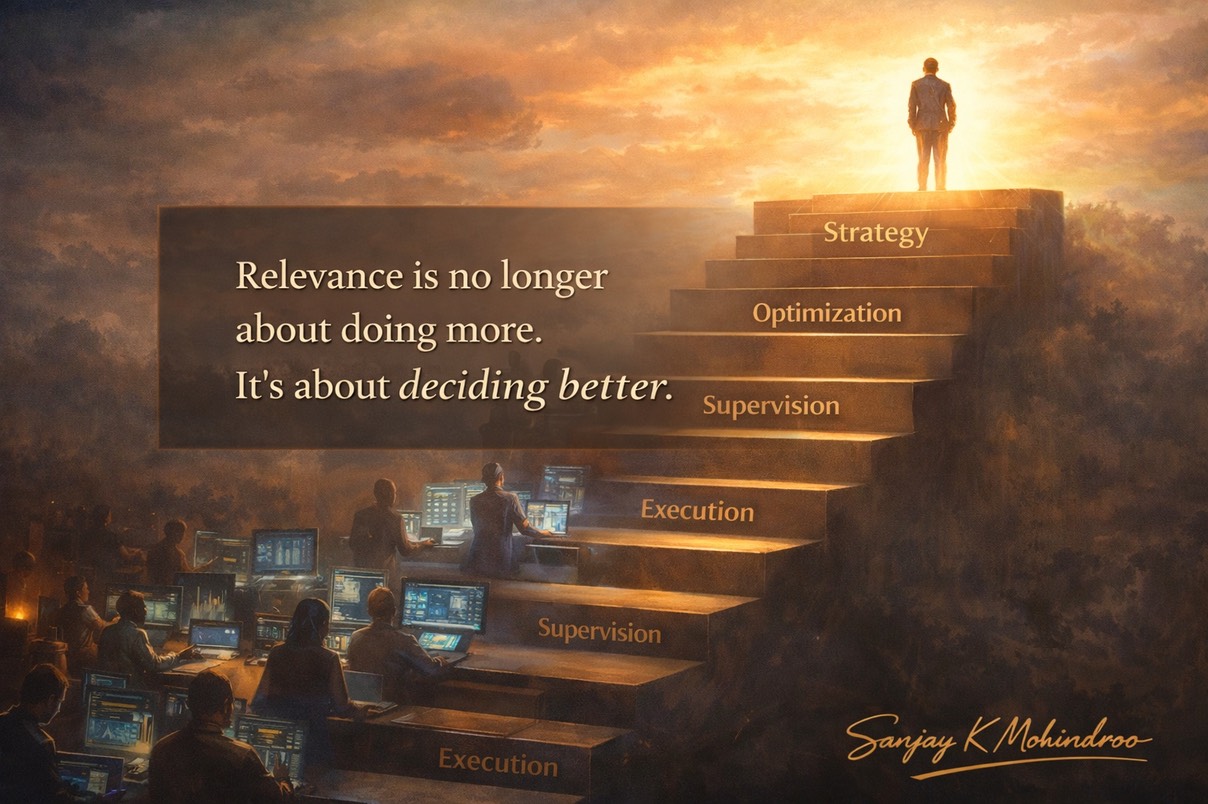
Every role today is moving along a simple but powerful progression:
Execution → Supervision → Optimization → Strategy
This is not a theory. It is visible across industries.
Execution is the process of performing tasks manually. It is predictable. Repeatable. And now, increasingly automated.
Supervision is the process of humans overseeing systems and AI outputs. It requires awareness, but not deep control.
Optimization is where real leverage begins. This is where people improve systems, refine outputs, and increase efficiency.
Strategy sits at the top. This is where direction is defined. Trade-offs are made. Value is created.
The problem is straightforward.
Most organizations are still structured—and rewarded—around execution.
And that is precisely where AI is accelerating fastest.
The Illusion of Productivity
Why Working Faster Is No Longer Enough
There is a common belief that using AI to work faster increases value.
It doesn’t. Not in a meaningful way.
Speed without direction only amplifies inefficiency.
I’ve seen teams generate more reports, more dashboards, more analysis than ever before—yet decision quality remains unchanged.
Why?
Because productivity is not the constraint anymore. Clarity is.
AI removes friction from execution. But it does not decide what matters.
That responsibility remains human.
And that is where the real shift in relevance is happening.
AI Is Not a Technology Problem
It’s a Leadership and Value Allocation Problem
Let’s challenge a popular narrative.
“Organizations need better AI strategies.”
In my experience, most don’t have a strategy problem. They have a value perception problem.
They are still assigning importance based on effort, not impact.
They reward:
- Hours spent
- Tasks completed
- Activity levels
While AI is quietly shifting value toward:
- Decision quality
- System thinking
- Outcome ownership
This mismatch creates friction.
Leaders invest in AI tools but expect traditional behaviors to deliver results.
That will not work.
AI does not transform organizations.
Leadership clarity does.
What Staying Relevant Actually Looks Like
A Practical Shift in How You Operate
Relevance today is not about mastering AI tools. It is about repositioning how you contribute.
At early career levels, the shift is from doing tasks to understanding why those tasks exist.
The moment someone starts questioning the purpose behind work, they begin moving up the value chain.
At mid-level roles, the shift is from managing people to designing systems.
The best managers I’ve worked with are not the ones chasing updates. They are the ones who remove the need for updates.
They build clarity into the system.
At senior levels, the shift is more demanding.
AI is no longer a support function. It is a business lever.
Revenue models are changing. Cost structures are compressing. Risk surfaces are expanding.
Leaders who see AI only as efficiency are missing its real potential—and its real threat.
The Three Non-Negotiables
Where Leaders Must Double Down
Across all roles, three capabilities are becoming essential.
AI Fluency
Not technical depth, but a working understanding. Enough to ask the right questions and challenge assumptions.
Domain Depth
AI can generate answers. It cannot replace context built over years of experience.
Learning Speed
This is the multiplier. The faster you adapt, the longer you stay relevant.
Miss one, and your growth slows.
Miss all three, and your relevance erodes quietly.
The 90-Day Reality Reset
What Leaders Should Do Now, Not Later
Transformation does not require a multi-year roadmap to begin. It requires a shift in behavior.
In the first month, exposure matters. Use AI in daily work. Not as an experiment, but as a habit.
In the second month, application matters. Integrate it into real workflows. Replace parts of your process.
In the third month, integration matters. Redesign how work gets done. Remove steps. Simplify decisions.
This is where most leaders stop short.
They experiment. They pilot. They discuss.
Very few redesigns.
And that is where the real advantage lies.
Strategic Takeaways for Leadership
- AI is compressing execution. Value is moving upward
- Productivity gains without decision clarity create noise
- Middle layers will shrink unless they evolve into system roles
- Leadership must redefine how value is measured and rewarded
- Speed of adaptation will outperform depth of experience alone
This is not a future scenario. It is already unfolding.
The Shift Is Quiet, But It Is Decisive
AI will not replace leadership.
But it will expose weak leadership.
Because when execution becomes easy, what remains is judgment.
Clarity. Direction. Accountability.
That is where relevance now lives.
And that is where leaders must operate.
#AI #Leadership #CIO #DigitalTransformation #FutureOfWork #EnterpriseStrategy #Innovation #BusinessTransformation #TechnologyLeadership #ExecutiveLeadership
AI Is Reallocating Value—Not Jobs: Who Wins, Who Struggles, and Why.
Sanjay K Mohindroo
AI is not eliminating jobs—it is shifting value across roles. A strategic perspective on who wins, who struggles, and what leaders must do now.
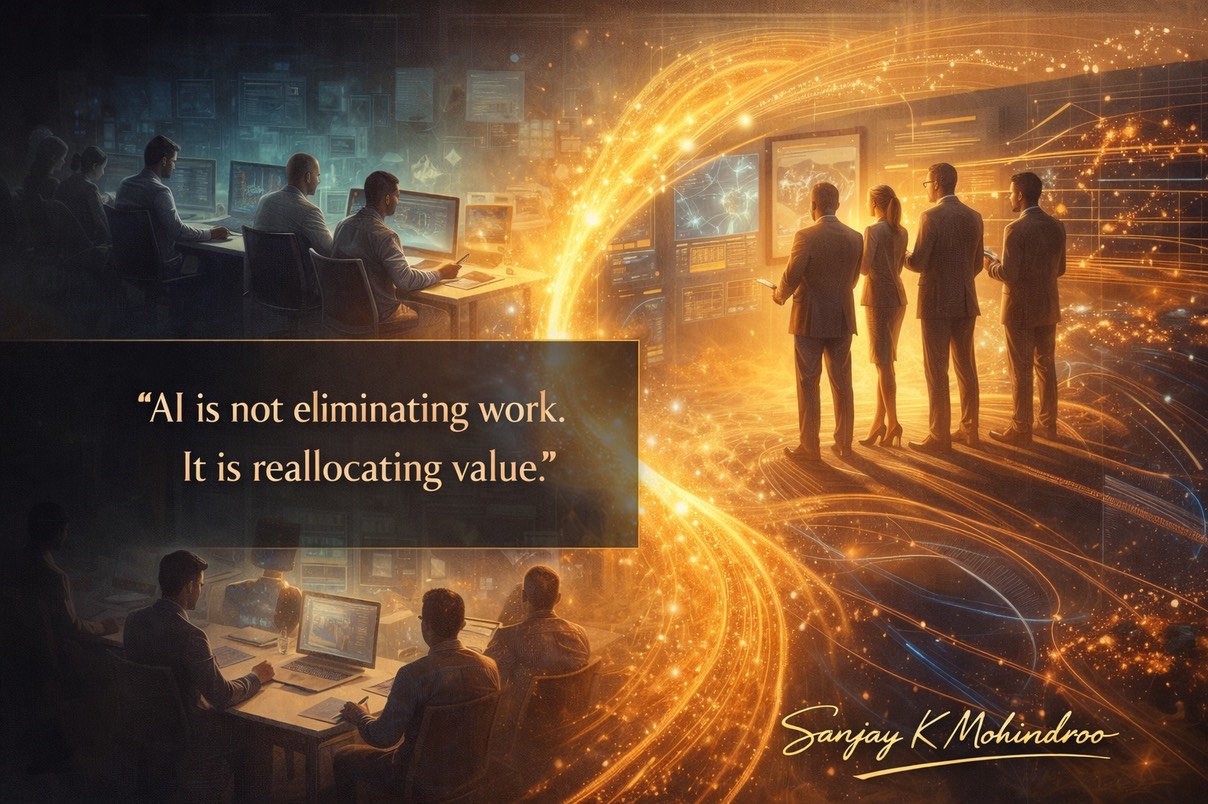
AI is not eliminating work. It is shifting
where value sits inside organizations.
Execution is becoming cheaper. Judgment, context, and systems thinking are becoming
scarce.
The winners will not be those who work harder. They will be those who move closer to decision-making and value creation.
This shift is already underway. Most organizations just haven’t labeled it yet.
The Quiet Shift Leaders Are Missing
In boardrooms, the conversation still circles a
familiar concern:
“Which jobs will AI replace?”
It’s the wrong question.
After three decades of leading technology transformations across industries, I’ve learned that disruption rarely announces itself clearly. It shows up as small shifts in relevance. A role loses a bit of influence. A team becomes slightly less central. Decisions move elsewhere.
And then one day, the structure looks completely different.
That’s what AI is doing right now.
Not with noise. With precision.
The real shift is not job loss.
It is value migration.
And if you don’t track where value is moving, you will miss where your organization is weakening. #Leadership #AI #CIO
Blue Collar Work Is Not Disappearing. It Is Being Elevated
From effort to oversight
On the ground, the change is visible but often misunderstood.
Machines are taking over repetitive execution. That part is clear. What is less discussed is what replaces it.
The role is not vanishing. It is being reshaped.
Work is moving from:
- Doing tasks
- To manage machines that perform those tasks
This sounds incremental. It is not.
The skill set shifts from physical execution to:
- Interpreting machine output
- Diagnosing issues
- Adjusting processes in real time
The gap between those who adapt and those who don’t will widen quickly.
I’ve seen this pattern before in manufacturing transformations. The highest performers were not the fastest operators. They were the ones who understood the system behind the machine.
That principle now applies across sectors.
White Collar Work Is Facing Its First Real Compression
Execution is no longer a differentiator
For years, white-collar roles were protected by complexity.
Writing reports, analyzing data, and creating presentations—these were considered skilled tasks.
AI has changed that equation almost overnight.
Execution is becoming:
- Faster
- Cheaper
- Widely accessible
Which means it is losing value.
The real shift is subtle but powerful:
From:
- Completing tasks
To:
- Defining the right problems
That distinction separates relevance from redundancy.
AI can generate answers at scale.
It cannot determine which questions matter in a business context.
That requires:
- Judgment
- Context
- Experience applied with clarity
This is where leaders must recalibrate expectations.
High output is no longer impressive.
High-quality thinking is.
#FutureOfWork #DigitalTransformation
Middle Management Is at an Inflection Point
Coordination is being automated out of existence
If there is one layer where the impact will be most visible, it is middle management.
For decades, organizations relied on managers to:
- Track progress
- Coordinate teams
- Escalate issues
- Consolidate reporting
AI is quietly absorbing much of this.
Dashboards replace status meetings.
Automation replaces follow-ups.
Real-time data replaces summaries.
This creates an uncomfortable reality.
Managers who rely on coordination as their core value will find themselves squeezed.
The role is not disappearing. It is evolving.
The new expectation is clear:
- Design systems
- Enable flow of work
- Remove friction at scale
In simple terms, managers must shift from controlling work to architecting work.
That is a very different capability.
Leadership Is Entering a Continuous Strategy Cycle
Planning is no longer periodic
At the executive level, the shift is more strategic—and more demanding.
AI is accelerating:
- Market signals
- Competitive moves
- Customer expectations
The traditional planning cycle is under pressure.
Annual strategy reviews are starting to look outdated in fast-moving environments.
The new reality is continuous adaptation.
Leaders must now:
- Reassess assumptions more frequently
- Make decisions with incomplete data
- Act faster without losing direction
This is not about reacting. It is about staying aligned while the ground moves.
In my experience, the leaders who succeed here are not the most technical. They are the ones who maintain clarity under pressure.
AI amplifies complexity. Leadership must simplify it.
#CIO #BusinessStrategy #AILeadership
AI Is Not Eliminating Jobs. It Is Exposing Mediocrity
The real disruption is not where most people are looking
There is a widely accepted narrative:
AI will replace jobs, and new jobs will emerge.
That framing is incomplete.
What AI is actually doing is exposing the difference between:
- Value creators
- Task performers
Average performance used to be sustainable. Organizations had enough inefficiency to absorb it.
That buffer is shrinking.
AI does not tolerate mediocrity well. It replaces it quietly.
This is uncomfortable but necessary to acknowledge.
Experience alone is losing weight.
Effort alone is not enough.
Titles do not guarantee relevance.
What matters now is:
- Clarity of thinking
- Ability to adapt
- Ownership of outcomes
This is not a technology shift. It is a performance shift.
And most organizations are not ready to address it openly.
Strategic Takeaways for Leadership
The implications are direct and actionable:
- Reevaluate role design
Focus on where value is created, not just where work happens
- Invest in thinking capabilities
Problem framing and decision-making must be developed deliberately
- Redefine management expectations
Move from coordination metrics to system effectiveness
- Shorten strategy cycles
Build mechanisms for continuous alignment, not periodic reviews
- Address performance honestly
AI will expose gaps. Leadership must respond with clarity, not avoidance
Direction Will Decide Outcomes
AI is not a future concern. It is a present force.
The shift is already underway. It is just uneven.
Some roles are evolving rapidly. Others appear stable—for now.
But the direction is clear.
Value is moving:
- Away from execution
- Toward judgment and system thinking
Organizations that align early will gain a disproportionate advantage.
Those who delay will not fail immediately. They will drift.
And drift is far more dangerous than disruption.
Because by the time it is visible, it is already late.
#AI #Leadership #CIO #FutureOfWork #DigitalTransformation #BusinessStrategy #WorkforceTransformation #EnterpriseAI #ExecutiveLeadership #TechnologyLeadership
AI Didn’t Evolve Linearly. It Advanced in Bursts—and That Pattern Will Decide Who Wins by 2040.

Sanjay K Mohindroo
A strategic, decade-by-decade analysis of AI evolution from 1940 to 2040, highlighting acceleration cycles, slowdowns, and what senior leaders must do next.
AI has never been a steady climb. It has moved in waves of hype, silence, and sudden acceleration—from early computing in the 1940s to the generative AI surge of today.
Each decade tells a different story:
· Long periods of quiet groundwork
· Sharp bursts of visible progress
· Strategic missteps that slowed adoption
We are now in the fastest acceleration phase in history.
But speed alone is not the story.
The real shift is this:
AI is moving from a technology layer to a decision layer.
For leaders, the question is no longer
“Should we adopt AI?”
It is:
“Where does AI change how we think, decide, and compete?”
The Pattern Most Leaders Miss
Every few years, I hear the same statement in boardrooms:
“AI is finally here.”
It was said in the 1980s.
It was said again in the early 2000s.
And now, it’s said with more urgency than ever.
The problem is not the statement.
The problem is the assumption behind it.
AI didn’t arrive once.
It has been arriving in waves for 80 years.
And unless you understand those waves, you will misread what comes next.
1940s–1950s — The Foundation Era
When computation was born, but intelligence was theoretical
The invention of programmable computers changed everything. Machines could now process instructions at scale.
In 1956, the term “Artificial Intelligence” was formally introduced. Expectations were high. Some believed human-level intelligence was just a few years away.
Reality was different.
Progress was conceptual, not practical.
The computing power was limited.
Data was scarce.
👉 Momentum: Slow, foundational
👉 Signal: High ambition, low execution
1960s–1970s — Early Optimism, Then Reality
The first surge—and the first slowdown
Governments invested heavily. Early models showed promise in problem-solving and symbolic reasoning.
Then came the gap.
Systems worked in controlled environments but failed in real-world complexity.
Funding dropped. Confidence faded.
This became the first AI winter.
👉 Momentum: Early acceleration → sharp slowdown
👉 Signal: Overpromise met under delivery
1980s — The Expert Systems Boom
AI enters the enterprise—briefly
AI made its first serious move into business through expert systems.
Organizations tried to codify human expertise into rule-based systems.
It worked—within limits.
Maintenance was painful. Systems were rigid. Scale was difficult.
By the late 1980s, the enthusiasm faded again.
👉 Momentum: Fast enterprise adoption → quick plateau
👉 Signal: Practical use, but fragile foundations
1990s — Quiet Progress Behind the Scenes
Less noise, more substance
This decade rarely gets attention, but it mattered.
Machine learning started gaining traction.
Statistical models improved.
Data began to grow.
In 1997, IBM’s Deep Blue defeated Garry Kasparov. A symbolic moment.
Still, AI remained niche.
👉 Momentum: Slow, steady progress
👉 Signal: Silent buildup of capability
2000s — The Data Era Begins
AI finds its fuel
The internet changed everything.
Data exploded. Storage improved. Computers became more accessible.
AI started solving narrow, high-value problems:
· Search
· Recommendations
· Fraud detection
Still, it stayed in the background.
👉 Momentum: Gradual acceleration
👉 Signal: Invisible integration into daily systems
2010s — The Breakthrough Decade
From possibility to inevitability
Deep learning changed the trajectory.
Speech recognition, image processing, and natural language took major leaps.
Companies like Google and Amazon embedded AI into their core business models.
AI moved from experimentation to competitive advantage.
👉 Momentum: Rapid acceleration
👉 Signal: AI becomes business-critical
2020s — The Explosion Phase
AI becomes visible to everyone
Generative AI changed the conversation.
Platforms like OpenAI brought AI into everyday workflows.
For the first time:
· Non-technical users engaged directly with AI
· Productivity gains became personal
· Adoption cycles collapsed from years to months
This is not just acceleration.
This is a compression of time.
👉 Momentum: Hyper-acceleration
👉 Signal: AI becomes universal
2030–2040 — The Decision Economy
Where AI stops assisting—and starts shaping outcomes
Looking ahead, AI will shift from:
· Supporting decisions
· To influence and shape them
We will see:
· Autonomous enterprise processes
· AI-driven strategy simulations
· Real-time business model adaptation
The organizations that win will not be the ones with the most AI.
They will be the ones where:
AI is embedded in how decisions are made.
👉 Momentum: Sustained acceleration, with localized slowdowns
👉 Signal: AI becomes infrastructure for thinking
Contrarian Insight — AI Winters Didn’t Kill Progress. They Built It.
Silence is not failure. It is preparation.
There is a common belief:
“Slow periods in AI mean the technology is failing.”
That’s incorrect.
Every so-called slowdown created the next breakthrough.
· The 1970s forced realism
· The 1990s built statistical foundations
· The 2000s created data ecosystems
What looked like stagnation was actually deep infrastructure building
The real risk is not the slowdown.
The real risk is:
👉 Mistaking silence for irrelevance
Many organizations reduced investment during quiet phases.
They paid the price when acceleration returned.
Leadership lesson:
Stay engaged when the noise drops. That’s where advantage is built.
Strategic Takeaways for Leaders
AI evolution offers very clear signals:
1. Speed will not be consistent
· Plan for bursts, not linear growth
2. Competitive advantage shifts quickly
· What differentiates today becomes baseline tomorrow
3. Capability builds during quiet phases
· Invest when others pause
4. AI is moving up the value chain
· From execution → to decision-making
5. Leadership readiness matters more than technology
· Most failures are not technical. They are strategic
This Time, It’s Structural
AI is no longer an emerging capability.
It is becoming part of how organizations:
· Think
· Decide
· Compete
The past shows us something important:
· The winners are not those who react fastest during hype cycles.
They are the ones who:
· Stay consistent during slow phases
· Move decisively during acceleration
We are now entering a phase where AI is not optional.
It is structural.
And structure, once formed, does not reverse easily.
#AILeadership #DigitalTransformation #CIO #FutureOfWork #EnterpriseStrategy #Innovation #TechnologyLeadership #BusinessTransformation #ExecutiveLeadership
Twenty Years Forward: Quiet Truths from the Long Road of IT Leadership.

Sanjay K Mohindroo
Hard truths, calm lessons, and lived wisdom I wish I had at the start of my IT leadership path.
Early IT leadership often feels like a race. Faster systems. Bigger teams. Louder wins. With time, a calmer truth emerges. Impact grows from judgment, trust, and restraint far more than from speed or tools. This post reflects on lessons that only show up after years of tough calls, failed bets, late nights, and silent wins. It speaks to leaders who want a durable impact, not short applause. It shares case studies, clear views, and firm opinions. It invites debate. And it asks one honest question. What would you tell your younger self if you cared less about praise and more about results that last?
Twenty years of IT leadership compress into quiet lessons on judgment, trust, and choices that last.
The First Promotion Feels Like Arrival
The real work starts after
The first big role in IT leadership feels final. You manage teams. You approve budgets. You sit in rooms where choices shape years. At that point, most leaders think skill and drive will carry them. That belief fades fast.
The job stops being about what you know. It becomes about how you decide under doubt, how you treat people when stress peaks. How you act when data is thin, and pressure is high. These lessons rarely show up in books or talks. They arrive through cost.
If I could speak to myself twenty years back, I would not hand over tools or trends. I would share a mindset. One that saves time, trust, and energy. One that turns IT from a service unit into a source of strength.
This post is written for those who sit between code and consequence. It is written with respect. It is written without polish. It is written to spark comments.
Early Confidence Meets Reality
Skill wins entry. Judgment wins trust
At the start, technical skill opens doors. You fix outages. You ship systems. You impress peers. That phase ends fast.
Leadership tests a different muscle. Judgment.
I once pushed a large system change because the design felt clean. The data looked sound. The team was ready. What I missed was timing. A sales cycle was at risk. A partner was not ready. The launch hurt trust. Not because the system failed, but because the call ignored context.
Case Study
A global bank rolled out a risk platform upgrade mid-quarter. The tech passed every test. The business lost two weeks of deal flow. The CIO owned the call. After that, the release boards added one new rule. Business rhythm matters as much as code quality. The rule stayed.
Judgment grows when leaders pause. When they ask one extra question. When they weigh impact beyond the screen. #ITLeadership #DecisionMaking
Technology Is Rarely the Core Problem
People and incentives shape outcomes
Most failed IT efforts are blamed on tools. That story comforts teams. It is often wrong.
Systems reflect structure. If teams pull in different directions, no platform fixes that. If goals clash, dashboards lie.
I once inherited a data program that burned millions. Each group had clear targets. None aligned. The fix was not new tech. It was a shared goal and one owner with teeth.
Case Study
A retail firm invested in a cloud data stack. Reports stayed slow. Teams blamed vendors. A review showed six owners, each measured on local goals. The CEO reset incentives. One leader took charge. Output improved in one quarter. The stack stayed the same.
IT leaders who see this early save years. #OrgDesign #TechAndPeople
Visibility Is Not the Same as Value
Quiet systems beat loud launches
Early leaders chase visibility. Big decks. Bold claims. Stage moments. That habit fades with scars.
The most valuable systems often run silently. Identity layers. Payment rails. Core data pipes. When they work, no one claps. When they fail, everyone shouts.
I once delayed a flashy launch to harden a core service. The delay drew heat. Six months later, a peer team faced a breach. Our system held. Silence felt better than praise.
Case Study
A health network skipped a public AI rollout. Funds went to data hygiene and access control. Two years later, they scaled models with speed and trust. Others paused due to risk gaps.
Strong leaders pick boring wins. #DigitalTrust #ResilientSystems
Speed Without Direction Burns Teams
Pace needs a point
Fast teams look good. Until they break.
In my early years, I pushed pace as proof of drive. Burnout followed. Errors rose. Good people left.
Speed matters. Direction matters more.
Leaders set the tempo. Not with slogans. With tradeoffs. With what they say no to.
Case Study
A product firm doubled sprint goals to match rivals. Output rose for one cycle. Quality dipped. Attrition climbed. A reset, cut scope, and raised focus. Velocity fell on paper. Value rose.
Teams last when leaders protect energy. #SustainableTech #TeamHealth
Data Never Speaks Alone
Context gives numbers meaning
Dashboards seduce leaders. They look sharp. They feel solid. They hide gaps.
Data shows patterns. It never shows motive. It never shows fear. It never shows skill.
I once backed a cost cut based on clean charts. The numbers hid a truth. A small team held deep system knowledge. Cuts saved money. They cost months later.
Case Study
A telecom firm cut ops staff after uptime gains. Metrics looked strong. Recovery times worsened. Hidden expertise walked out. Rehires cost more.
Leaders read data. They also read rooms. #DataWisdom #LeadershipJudgment
Security Is a Leadership Choice
Risk grows in silence
Security is framed as tech work. It is a values test.
Shortcuts happen when leaders reward speed alone. Breaches follow when no one wants to slow the train.
I once stopped a release hours before launch due to a weak access flow. The backlash was loud. The risk was real. Weeks later, a similar flaw hit a peer firm. The pause paid off.
Case Study
A SaaS firm tied exec pay to uptime and growth. Security lagged. A breach forced a reset. Incentives changed. Posture improved.
Leaders signal risk tolerance every day. #CyberRisk #LeadershipSignals
Influence Beats Authority Over Time
Titles open doors. Trust keeps them open
Early leaders lean on role power. It works once. Then fades.
Long-term impact comes from influence. From listening. From calm pushback. From showing you care about shared wins.
I learned this after losing a strong architect. The exit note was clear. Decisions felt forced. Voice felt small. I changed how I led. Outcomes changed, too.
Case Study
A CIO faced shadow IT growth. Bans failed. Forums worked. By listening first, the CIO shaped the standards the teams wanted to follow.
Authority fades. Influence compounds. #TechCulture #ModernLeadership
Strategy Lives in Tradeoffs
Every yes hides a no
Young leaders chase full plates. Mature leaders choose.
Strategy is not vision text. It is what you stop.
I once joined every request to please all. Roadmaps broke. Focus died. A mentor said one line. Pick pain now or chaos later.
I picked pain.
Case Study
A global firm cut project count by a third. Leaders faced heat. Delivery improved. Staff morale rose. The cut stayed.
Clear tradeoffs earn respect. #TechStrategy #Focus
Careers Are Long Games
Reputation outlasts roles
Early wins feel final. They are not.
Your name travels. How you act in stress stays. How you treat people echoes.
I have hired peers I once worked with. I have lost chances due to past calls. Both felt fair.
Case Study
A CTO known for calm crisis handling kept roles through shifts. Peers trusted his style. Others with louder wins faded after missteps.
Think long. #CareerCapital #LeadershipLegacy
The Real Promotion Is Perspective
Twenty years reshape ambition. The goal shifts from being right to being useful. From speed to strength. From noise to trust.
If I could share one truth with my younger self, it would be this. Leadership is less about pushing and more about choosing. Choosing when to act. When to wait. When to protect people. When to say no.
The best IT leaders do not chase the spotlight. They build systems, teams, and norms that hold when things go wrong.
If you disagree, say so. If you see gaps, point them out. If your path taught you other truths, share them below. That is where real insight lives.
#ITLeadership #CIOPerspective #TechStrategy #DigitalTrust #LeadershipJudgment #EnterpriseIT #TechCulture
Crisis Communication When Code Breaks and Trust Holds.

Sanjay K Mohindroo
When systems fail, trust is on the line. This post explores how IT shapes calm, clarity, and credibility during major technology incidents.
Technology incidents no longer stay in server rooms. They surface in board meetings, news feeds, investor calls, and public memory. In these moments, IT does far more than restore systems. IT sets tone, pace, and truth. Crisis communication is no longer a side task handled after recovery. It is a core technical skill, as vital as uptime, security, and scale.
When outages hit, words matter as much as fixes. This post explores how IT leaders shape trust during technology crises.
This post argues a clear position. Crisis communication belongs inside IT leadership, not outside it. The teams closest to the systems must also be closest to the story. When IT owns the narrative with clarity and speed, trust holds even when systems fail. When IT stays silent or vague, damage spreads faster than any outage.
Through real case studies, strategic insight, and blunt lessons, this piece shows how IT teams can shape confidence during chaos. It invites senior leaders to rethink incident response as both a technical and human discipline. It also invites debate. Strong views deserve strong replies. #CrisisCommunication #ITLeadership #IncidentResponse
When silence costs more than downtime
Every outage creates two problems. One is technical. The other is human. The technical problem has logs, metrics, and a root cause. The human problem has fear, doubt, and anger. Most firms solve the first and underestimate the second.
Customers forgive failure. They do not forgive confusion. They accept risk. They reject silence.
Crisis communication is not public relations paint. It is a system of truth delivery under stress. IT teams already work under stress. They understand systems, limits, and tradeoffs. That makes them the right owners of the message.
This is not about spin. It is about clarity. It is about speaking early, staying factual, and showing control. In every major technology incident, communication speed rivals recovery speed. Sometimes it matters more. #TechIncidents #TrustInTech
Communication is part of system design
Most IT leaders treat communication as a layer added after failure. That thinking is outdated. Communication is part of the system itself. It shapes user behavior, market response, and internal focus.
When a system fails without clear updates, users flood support lines. Executives panic. Teams lose focus. Recovery slows.
When a system fails with steady updates, users wait. Leaders back the team. Engineers work with fewer distractions.
This is not a theory. It is a pattern. Crisis communication reduces the load on the system. It preserves decision space. It buys time.
IT leaders who plan messaging with the same rigor as backups and failover outperform peers in every public incident. #SystemDesign #DigitalTrust
Case study: Cloud outage and the power of radical clarity
A major cloud provider faced a regional outage that took down thousands of services. The technical fault was complex. The response was simple. The status page is updated every ten minutes. Each update named affected services, current actions, and honest limits.
No promises. No vague phrases. No marketing tone.
Customers shared the updates themselves. Social channels stayed calm. Enterprise clients held calls but did not threaten exit. Trust held.
Contrast this with other outages where updates lagged or used soft language. Those incidents led to headlines, churn, and executive apologies.
The lesson is sharp. Accuracy beats optimism. Frequency beats polish. #CloudReliability #Transparency
The leadership shift: IT as the voice of truth
During incidents, many firms push communication upward to legal or brand teams. This adds delay and dilution. Each filter strips technical meaning.
IT leaders must claim a different role. They must become the voice of truth. Not the final approver of words, but the source of facts.
This requires skill. Engineers do not always enjoy writing for public view. That can be trained. Silence cannot.
The best IT teams prepare message templates during calm periods. They rehearse incident updates like fire drills. They define who speaks, where, and how often.
This is not soft work. It is operational readiness. #ITStrategy #OperationalExcellence
Case study: Financial platform breach and trust recovery
A global payment firm suffered a data breach that exposed user data. The breach was serious. The response was faster than expected.
Within hours, the firm issued a clear statement written with input from senior IT security staff. It explained what was known, what was not, and what users should do next.
Daily updates followed. Each update stayed factual. Each admitted limit.
The market reaction surprised analysts. Share price dipped but recovered within weeks. Customer churn stayed low.
Post-event analysis showed a key factor. Users felt respected. They felt informed. They felt the firm stayed in control even while under attack.
This was not luck. It was disciplined crisis communication led by IT. #CyberSecurity #BreachResponse
The human factor: Calm language shapes calm behavior
Language matters during stress. Words shape emotion. Emotion shapes action.
When IT messages sound defensive, users become hostile. When messages sound calm, users mirror that calm.
Short sentences help. Clear verbs help. Avoid jargon unless needed. Avoid blame at all costs. Focus on the present action.
Do not say teams are working hard. Say what teams are doing. Do not say the service will return soon. Say what must happen before it returns.
These choices feel small. They change outcomes. #UserExperience #IncidentManagement
Case study: Internal outage and employee trust
A large enterprise suffered an internal system failure that blocked payroll access. The outage did not hit customers, but it hit staff trust.
The IT team sent an internal update within thirty minutes. It explained the issue, the risk window, and the expected next update time. Leaders echoed the message without edits.
Employees stayed patient. Managers stayed aligned. No rumors spread.
In a similar firm, a similar outage caused anger and confusion due to delayed and vague internal messages.
Crisis communication applies inside the firewall as much as outside it. #InternalComms #WorkplaceTrust
The technical discipline
Building communication into incident response
Crisis communication must sit inside incident response playbooks. Not as a footnote. As a core track.
Every incident plan should answer simple questions. Who writes the first update? Where it goes. How often do updates repeat? Who approves facts, not tone.
Metrics should include communication lag. Track time from detection to first message. Track update cadence.
Teams that measure this improve fast. Teams that ignore it repeat mistakes.
Communication is a system. Measure it like one. #SRE #ResilienceEngineering
Risk and truth
Saying less hurts more
Many leaders fear saying the wrong thing. That fear leads to silence. Silence creates speculation. Speculation multiplies risk.
The safer path is narrow and clear. Say what is known. Say what is unknown. Say when the next update will arrive.
Do not guess. Do not promise. Do not hide.
Truth told, early reduces legal risk more than delayed polish. This is proven across sectors. #RiskManagement #CorporateTrust
The cultural signal
Incidents reveal leadership values
Every crisis acts as a mirror. It shows how a firm treats users, staff, and truth.
When IT leads with openness, it signals confidence. It tells teams that facts matter more than fear.
This builds long-term credibility. Not through slogans, but through repeated behavior under stress.
Technology changes fast. Trust changes slowly. Protect it with intent. #LeadershipCulture #DigitalResilience
The challenge to leaders
Stop outsourcing the narrative
If you lead IT, this message is direct. Own the narrative during incidents. Not the blame. The facts.
Build communication skills in your teams. Practice them. Measure them.
If you lead the business, let IT speak. Do not slow truth with layers.
Crisis communication is not an add-on. It is a core capability in modern technology leadership. #CIO #CTO
When systems fail, leadership speaks
Failures will happen. Complexity guarantees it. What defines strong firms is not failure rate alone. It is response quality.
IT holds a rare position. It sees the system and shapes the message. When those align, trust survives stress.
The next incident will test more than code. It will test clarity, courage, and control. Prepare now. Speak early. Stay honest.
The conversation does not end here. It begins here. Share your view. Disagree if you must. Strong systems are built on strong debate. #CrisisLeadership #TechTrust
#CrisisCommunication #ITLeadership #IncidentResponse #DigitalTrust #TechIncidents #CyberSecurity #OperationalResilience #CIO #CTO
When Great Tech Falls, Leaders Rise.

Sanjay K Mohindroo
Leadership lessons carved from iconic technology failures
When big tech breaks, leaders reveal their truth. Sharp lessons on judgment, culture, and courage from famous failures.
Technology failure is not rare. Poor leadership is. This piece explores iconic tech collapses to surface the real lesson. Systems fail, markets shift, and code breaks. Leadership choices decide the outcome. From missed signals to rigid cultures, each case shows patterns that repeat across eras and sectors. These lessons matter for senior leaders who build teams, shape culture, and steer risk. Failure is not the villain. Silence, delay, and ego are.
Great tech failed. Leaders shaped the fall. The lessons still matter.
Every leader enjoys growth stories. Few studies collapse with the same care. That is a mistake.
Failure is the sharpest mirror a leader will face. It strips away slides, titles, and noise. It shows how decisions were made when signals were weak, when fear crept in, and when pride spoke louder than facts.
Technology fails in public. Code breaks fast. Markets respond faster. The story that follows is not about bad tools. It is about human choice under pressure.
The leaders who study failure gain an edge. They spot risk early. They build cultures that speak up. They act before charts turn red. This is not about blame. It is about clarity.
Let’s walk through the lessons written in the wreckage of famous tech falls. #Leadership #TechStrategy
A Pattern Behind the Collapse
Comfort breeds blind spots
Most iconic failures share a calm before the fall. Revenue looks solid. Brand trust feels earned. Leaders relax.
This calm is dangerous. It rewards past wins, not future truth. Signals that challenge the core story get brushed aside. Teams stop arguing. Meetings get quiet.
Leadership sets this tone. When leaders prize comfort over debate, the system drifts. The market never waits.
Failure starts long before headlines. It begins when leaders stop asking hard questions. #LeadershipMindset
Case Study: Nokia
Speed lost to pride
Nokia once ruled mobile phones. Its scale was unmatched. Its supply chain was world-class. Its fall was not due to a lack of skill.
The threat was clear. Touch screens. App stores. New user habits. Engineers saw it. Middle leaders flagged it. Senior leaders stalled.
Internal fear slowed action. Teams protected turf. Leaders doubted outside ideas. The firm had technical skills but a weak belief in change.
The lesson is direct. Market shifts demand fast trust in teams closest to reality. Leaders who wait for full proof arrive late.
Speed is a leadership choice. #DecisionMaking #TechLeadership
Case Study: Kodak
Vision blocked by profit comfort
Kodak built the digital camera. It still failed to lead digital photos. This was not irony. It was fear.
Film margins were rich. Digital felt thin. Leaders chose to protect the old cash engine. They delayed a future they already saw.
The deeper flaw was not tech. It was an incentive design. Leaders tied rewards to legacy profit. Teams learned what not to push.
The lesson is blunt. If leaders tie rewards to yesterday’s win, tomorrow’s work dies. #Strategy #Innovation
Case Study: BlackBerry
Users ignored; culture locked
BlackBerry defined secure mobile work. Leaders believed that the edge was enough. Users disagreed.
People wanted ease. They wanted to touch. They wanted fun mixed with work. Feedback was clear. Leaders dismissed it as noise.
Culture blocked truth. The firm prized control over change. Leaders trusted past buyers more than future users.
The leadership lesson here is sharp. When leaders stop listening to users, decline is certain. Products serve people, not plans. #CustomerFocus
Case Study: Boeing and the 737 MAX
Pressure beats judgment
This failure was not about tech skills. It was about trade-offs. Speed to market beats safety margin. Cost beats caution.
Engineers raised alarms. Process moved on. Leaders trusted systems over signals. The result was tragic.
The lesson is heavy but clear. Leadership must set red lines that profit cannot cross. When leaders blur those lines, risk turns real.
Trust once lost is hard to earn back. #Risk #Governance
Case Study: Theranos
Silence sold as vision
Theranos promised magic. Leaders enforced silence. Dissent was punished. Data was hidden.
This was not a tech failure alone. It was a leadership failure rooted in fear and control. Vision became shield. Facts became a threat.
The lesson is stark. Leaders who crush doubt also crush truth. Without truth, systems rot fast. #Ethics #Culture
Signals Leaders Miss
Weak signs speak first
Failure sends whispers before it shouts. Small bugs. Missed dates. Rising staff exits. User churn.
Leaders often dismiss these signs. They wait for big proof. By then, options shrink.
Strong leaders act on weak signals. They ask teams to stress the plan. They reward early warning. They listen without anger.
The skill is not genius. It is discipline. #LeadershipSkills
Culture Is the Real Stack
Tools follow trust
Every failed firm above had talent. What they lacked was safe truth flow.
Culture decides which facts travel up. Leaders shape culture with every reaction. Praise curiosity, and it grows. Punish doubt, and silence spreads.
No dashboard saves a culture that fears truth. Leadership behavior sets the real system design. #OrgCulture
Speed Versus Care
Balance beats bravado
Leaders often frame speed and care as rivals. That is false. True speed comes from clear rules and trust.
Slow firms fear error. Fast firms study it. Leaders who punish mistakes create delay. Leaders who study mistakes gain pace.
Failure punishes slow truth more than bold action. #Execution
Power and Proximity
Distance clouds judgment
As firms grow, leaders drift from users and engineers. Filters rise. Language smooths. Pain fades.
Smart leaders fight this drift. They sit with teams. They read raw feedback. They hear the bad news first.
Proximity sharpens judgment. Distance dulls it. #LeadershipPractice
Failure is a leadership mirror
Technology failure is rarely sudden. It is layered. It is human. It reflects how leaders listen, reward, decide, and react.
The leaders who grow from failure share traits. They stay curious. They prize truth. They act early. They protect ethics. They invite debate.
This is not soft thinking. It is hard-edge leadership. Markets reward it. Teams trust it.
Failure does not end careers. Poor leadership does. #LeadershipLessons
Great leaders do not chase flawless runs. They chase clear sight.
Every firm here had talent. Each fall came from leadership choices made under comfort or fear. The lesson is timeless.
If you lead teams, products, or systems, ask this now. Where are we silent? Where are we slow? Where are we proud?
Answering those questions early is leadership at its best.
Your turn. Which failure taught you the most? And what lesson did it carve into your style?
#Leadership #Technology #FailureLessons #TechLeadership #Strategy #Innovation #Culture #Risk #Governance #ExecutiveLeadership

When Teams Click: Building Cross-Functional Alliances for Digital Success.

Sanjay K Mohindroo
Digital wins happen when teams align with trust, speed, and shared goals. Cross-functional alliances turn tools into impact.
Digital change fails less because of tech gaps and more because of human gaps. Systems ship on time. Teams drift apart. The fix is not a new tool or a new org chart. The fix is alliance. Cross-functional alliances bring together IT, product, data, security, finance, and business teams into a single motion. They turn tension into pace. They turn goals into results. This post takes a clear stand. Digital success demands active, lived alliances across teams. Not slogans. Not workshops. Daily practice. Real trade-offs. Shared wins.
You will see why most firms stall, how strong alliances work in real cases, and what senior leaders must do now. Expect direct views, sharp examples, and a clear call to act. This is an open invitation to debate.
Digital wins come from teams that move as one. Cross-functional alliances turn strategy into real results.
Digital work moves fast. People move more slowly. That gap kills value.
Most firms invest in cloud stacks, data lakes, and AI pilots. Many still miss targets. The root cause sits in plain sight. Teams act in silos. Each group guards its turf. Each group optimizes for its own scorecard.
This is not a cultural flaw. It is a design flaw. Firms design work by function, yet expect results by flow. That mismatch creates drag.
Cross-functional alliances fix this drag. They align goals, pace, and trust across teams that must ship together. They cut waste. They raise speed. They lower risk.
This post lays out a clear view. Alliances are not soft skills. They are hard levers for digital results. #DigitalLeadership #CrossFunctional
The Real Friction Inside Digital Work
Where value leaks in plain sight
Every digital effort crosses lines. Product needs IT. IT needs security. Security needs legal. Data needs ops. Ops needs finance.
Yet most firms reward each team in isolation. IT tracks uptime. Security tracks risk events. Product tracks releases. Finance tracks cost. No track shared value flow.
This creates three frictions.
First, delay. Work waits in queues for sign-off. Each handoff adds time.
Second, rework. Late input from one team forces redo by another.
Third, silent conflict. Teams push back through slow responses, long reviews, or strict rules.
These frictions look normal. They feel safe. They are costly.
Alliances attack these frictions at the source. They shift focus from task handoffs to shared outcomes. #DigitalTransformation
Alliance as a Strategic Asset
Trust, clarity, and shared pace
An alliance is not a committee. It is not a meeting. It is a working bond across roles.
Strong alliances rest on three pillars.
Shared aim. Teams align on one outcome, not many metrics.
Clear trade-offs. Teams agree where to bend and where to hold firm.
Fast trust. Teams speak early, not late.
This sounds basic. It is rare in practice.
Most firms talk about alignment. Few design for it. Alliances need structure. They need time. They need leadership cover.
When done right, alliances become a moat. They are hard to copy. Tools age fast. Trust compounds. #EnterpriseIT
Case Study – Retail at Speed
Product, IT, and supply chain in one rhythm
A global retail brand faced slow digital launches. Online features took months. Stock data lagged. Customers left.
The root issue was not skill. It was split control. Product set roadmaps. IT ran systems. Supply chain ran data. Each worked well alone. Together, they stalled.
The firm formed a standing alliance. Product leads, IT architects, and supply leads shared one backlog. They met weekly. They owned one goal: live stock accuracy at checkout.
Rules changed. No feature shipped without data sign-off. No data rule shipped without IT input.
Results followed fast. Checkout errors fell. Release cycles shrank. Revenue rose.
No new tool drove this gain. Alliance did. #RetailTech #ProductOps
Leadership’s Silent Role
Power, cover, and clear calls
Alliances rise or fall on leadership action.
Leaders often say the right words. They still reward the wrong acts.
If a CIO praises speed but punishes risk, teams freeze.
If a CISO demands zero gaps, teams hide work.
If a CFO cuts spend mid-stream, trust erodes.
Leaders must make trade-offs explicit. They must back alliance calls even when they sting.
This is not about harmony. It is about clarity. Teams move fast when lines are clear.
The strongest signal is shared reward. When leaders tie bonuses to joint outcomes, behavior shifts fast. #CIO #CISO
Case Study – Bank Grade Security Without Drag
Security and dev moving as one
A regional bank rolled out a digital lending app. Early pilots failed audits. Security flagged gaps late. Dev teams felt blocked.
The bank reset its model. Security joined the sprint planning. Dev joined threat reviews. Both owned one risk score tied to release speed.
Language changed. Security stopped saying no. They said here is the safe path. Dev stopped rushing late fixes. They built security by default.
Audit pass rates rose. Release pace held. Stress dropped.
This is an alliance at work. Risk stayed real. Speed stayed high. #CyberSecurity #FinTech
Design Beats Intent
Structuring work for an alliance
Good intent fades under load. Design holds.
Firms that scale alliances design for them.
They form small, stable teams around value streams.
They cut approval layers.
They set shared dashboards.
They fix time blocks for joint work.
Most importantly, they keep teams together long enough to build trust.
Rotating people too fast kills alliance memory. Keeping teams stuck kills fresh thought. Balance matters.
Design is not theory. It is a daily choice. #AgileEnterprise
Case Study – Data as a Shared Language
Marketing, data, and IT in one frame
A media firm invested in analytics. Dashboards grew. Impact stayed flat.
Marketing asked for insight. Data teams-built models. IT managed pipes. Each blamed the other.
The firm set a data alliance. Marketers sat with analysts. Analysts joined campaign reviews. IT joined design talks.
They picked one question: which channel drives repeat spend.
One question. One dataset. One view.
Spend shifted. Returns rose. Trust followed.
Data did not change. Alliance did. #DataStrategy
The Hard Truths
Where alliances break
Alliances fail for clear reasons.
Vague goals.
Hidden power games.
Reward mismatch.
Lack of time.
They also fail when leaders expect magic. Alliances need effort. They need conflict. They need to resolve.
Avoiding tension kills value. Working through it builds strength.
This is not soft work. It is disciplined work. #Leadership
Digital success is a team sport
Digital tools matter. Talent matters. Culture matters.
None beat alliance.
Cross-functional alliances turn parts into systems. They turn plans into motion. They turn spend into return.
Firms that build them win quietly and often. Firms that ignore them keep buying tools.
The choice is clear. #DigitalStrategy
Digital success is not blocked by code or cloud. It is blocked by gaps between teams.
Cross-functional alliances close those gaps. They align pace, trust, and intent. They demand leadership courage. They reward clarity.
This is not a trend. It is a shift in how work gets done.
If you lead digital
work, ask one hard question today.
Where does the value stall between teams?
Fix that gap. Build the alliance. Watch the results follow.
Now your turn. Where have alliances helped or failed in your work? Speak up. Let’s compare notes.
#DigitalLeadership #CrossFunctional #DigitalTransformation #EnterpriseIT #RetailTech #ProductOps #CyberSecurity #FinTech #AgileEnterprise #DataStrategy #Leadership #DigitalStrategy
Defining Success as a Modern Technology Executive.

Sanjay K Mohindroo
Success for tech leaders is shifting from speed and scale to trust, clarity, and long-term value.
From metrics and momentum to meaning and trust
Success in technology leadership has changed shape. Revenue, uptime, and speed still matter, but they no longer tell the full story. Modern technology executives are judged by how well they align systems with human judgment, growth with trust, and ambition with restraint. This piece argues that success today sits at the intersection of business impact, decision quality, and institutional confidence. It draws on real case studies to show how leaders are redefining performance, not by louder claims, but by quieter results. This is a call to rethink what winning looks like when technology runs everything.
Modern tech success is no longer about speed alone. It is about trust, judgment, and strength that lasts.
When the scoreboard stops telling the truth
For years, success in tech leadership felt clear. Ship faster. Scale harder. Cut cost. Raise output. The scoreboard lit up with charts, dashboards, and growth curves. Boards nodded. Markets cheered.
Then something shifted.
Systems grew complex. Risk moved faster than control. AI stopped being a tool and started acting like a decision partner. Cloud spending grew even as value felt thin. Teams ran more pilots than outcomes. Leaders spoke more about vision and less about results.
Many executives sensed the gap but could not name it.
The old markers still mattered, yet they failed to answer the real question. Are we building strength or just motion?
Defining success today means facing that question head-on.
#TechnologyLeadership #DigitalStrategy #ExecutiveMindset
The quiet reset
From motion to meaning
Modern technology leadership lives in a world where action is cheap and judgment is rare. Tools promise speed. Vendors sell ease. Teams chase proof of progress.
Success now depends on restraint.
Strong leaders pause where others rush. They cut projects that look clever but change nothing. They focus on fewer bets with clear value. They trade noise for signal.
This is not about caution. It is about clarity.
A modern executive defines success by asking three hard questions. Does this system change how decisions are made? Does it reduce risk at scale? Does it earn trust over time?
If the answer is no, speed does not save it.
#DecisionMaking #TechStrategy
Case study
Microsoft and the long view of trust
When Satya Nadella took charge at Microsoft, the firm was not broken. It was profitable, vast, and skilled. Yet it had lost trust in developers and partners.
The shift was not driven by a single product. It came from a reset in how success was framed.
Cloud mattered, but culture mattered more. Open source once felt like a threat. It became a bridge. AI was framed as a tool that augments people, not replaces them.
Success showed up slowly. Developer trust rose. Ecosystems grew. Enterprise buyers felt safer betting long term.
Revenue followed, but it followed trust.
This case shows a key truth. Sustainable impact flows from values that shape daily choices, not from slogans.
#Leadership #TrustInTech
Metrics that mislead
When numbers hide risk
Many boards still ask for counts. Number of pilots. Number of models. Number of tools in use. These metrics feel safe. They fit slides. They show motion.
They also hide risk.
Modern success metrics look different. They ask how often AI output is challenged by humans. They track how many decisions changed because of data. They measure how fast errors are caught, not how fast code ships.
A system that never raises questions is not smart. It is dangerous.
Executives who redefine success push for fewer metrics with deeper meaning. They prefer outcome measures over activity counts. They accept slower starts in exchange for durable gains.
#AILeadership #ResponsibleTech
Case study
A global bank learns restraint
A large global bank rolled out AI tools across compliance and risk review. Early results looked strong. Reviews moved faster. Costs dropped. Teams celebrated.
Then the leaders looked closer.
Errors clustered in edge cases. Staff deferred too much to system output. Accountability blurred. Who was responsible when the model passed a flawed case?
The bank paused expansion. It rewired success criteria. AI output required sign-off. Escalation paths were clear. Review quality mattered more than speed.
Short-term gains slowed. Long-term confidence rose.
This is modern success in practice. Knowing when to stop is a leadership skill.
#RiskManagement #AIinFinance
People remain in the system
Talent as judgment, not headcount
Technology leaders often speak about talent. Fewer speak about judgment.
Hiring more engineers does not raise decision quality. Tools do not fix weak thinking. Culture sets the ceiling.
Modern success shows up in teams that question models, challenge defaults, and raise concerns early. Leaders reward this behavior. They protect dissent. They build space for pause.
This runs against old habits. Many firms still praise speed over sense. Modern executives flip that order.
They know systems reflect the people who design and govern them.
#TechCulture #LeadershipValues
Case study
A product firm cuts features to gain loyalty
A consumer tech firm faced churn. Usage was high. Satisfaction was flat. Teams kept adding features.
Leadership changed the scorecard.
Success became about clarity. They cut tools. They reduced settings. They listened to how users felt, not just what they clicked.
The product grew quieter. Trust rose. Retention followed.
This case proves a hard point. More tech does not mean better tech.
#ProductLeadership #UserTrust
Governance as strategy
Control that enables growth
Governance often gets framed as drag. Rules slow teams. Review gates block flow.
This view is shallow.
Modern governance defines safe speed. It sets clear lines on data use, model limits, and risk ownership. It frees teams from fear by making expectations clear.
Executives who define success well treat governance as core strategy. They align it with business goals. They measure its impact on confidence and resilience.
Firms without this discipline move fast until they cannot.
#TechGovernance #EnterpriseAI
The boardroom shift
Fewer promises, stronger proof
Boards have grown wary of tech theater. They want proof that systems work under stress. They ask who is accountable when tools fail.
Modern executives succeed by changing the conversation. They speak plainly. They show tradeoffs. They explain risk without drama.
They do not sell certainty. They show readiness.
This builds credibility. Credibility is the currency of long-term leadership.
#BoardLeadership #CIOPerspective
Success, redefined
Strength that holds under pressure
Success today is not about being first. It is about being sound.
It is seen in systems that fail safely. In teams that speak up early. In leaders who cut hype and stand by results.
Technology executives who embrace this view stand out. They attract trust. They shape firms that last.
This is not softer leadership. It is harder. It demands judgment, courage, and clarity.
The question is simple. When pressure rises, does your tech hold or does it crack?
That answer defines success.
The mark that remains
Years from now, few will recall which tools you shipped first. They will recall whether your systems helped people decide better, work safer, and move with confidence.
Modern technology leadership leaves a mark through trust earned over time. That is the success worth chasing.
If this resonates, share your view. Where do you think success in tech leadership is headed next?
#TechnologyExecutive #DigitalTrust #Leadership
#TechnologyLeadership #ModernExecutive #AITrust #DigitalStrategy #CIO #TechGovernance #EnterpriseAI #LeadershipMindset
Bridging the IT–Business Divide.

Sanjay K Mohindroo
Clear talk builds strong tech moves. Close the IT–business gap with shared goals, plain language, and trust that scales.
Clear talk. Shared goals. Real results.
The gap between IT and business does not come from skill. It comes from talk. Each side uses words that make sense to them and noise to others. This post makes a firm claim. Clear talk is a core skill, not a soft add-on. Teams that align on goals, values, and timing move faster, waste less, and build trust. The piece lays out practical moves that senior leaders can use now. It shares real case stories. It names the habits that block progress. It shows how shared language turns roadmaps into revenue, risk into control, and data into action. The aim is simple. Help leaders spark better talks that lead to better calls.
Great tech wins when IT and business speak the same language. This piece shows how clear talk turns plans into results.
Two rooms. One goal. No shared map.
In one room, business heads talk about growth, margin, and risk. In the next room, IT leaders talk about uptime, debt, and scale. Both want the same win. Both feel unheard. The work slows. Trust thins. Costs rise. This is not a culture issue. It is a talk issue.
When teams fix talk, work flows. Plans gain pace. People feel seen. This post takes a direct stance. The divide closes when leaders shape shared meaning. Not slides. Not slogans. Meaning.
Clear talk is a leadership act
Strong leaders set the tone. They choose words with care. They link tech work to business value in plain terms. They ask for the same in return. Clear talk does not water down rigor. It sharpens it. It makes tradeoffs visible. It puts time, cost, and risk on the table early. It turns debate into choice.
The hidden cost of the divide
Missed value hides in plain sight
The gap shows up as delays, rework, and blame. Projects drift. Scope grows. Budgets strain. The real loss is trust. When trust drops, teams hedge. They add layers. They avoid bold calls. That cost compounds.
This is where strategy stalls. Not due to weak tech or weak markets. Due to weak alignment. #ITLeadership #BusinessStrategy
Shared language as a system
Words that travel across roles
Shared language does not mean less tech depth. It means shared anchors. Value. Time. Risk. Outcome. When IT frames work in these anchors, the business listens. When business frames needs with these anchors, IT plans better.
Start with outcomes, not tools. Name the metric. Set the time box. State the risk. Agree on the trade. Repeat this rhythm in every forum. Over time, it becomes muscle memory. #DigitalTransformation
Case study
Retail scale through plain talk
A retail group faced slow rollouts across stores. IT spoke of cloud shifts and data pipes. Business spoke of footfall and stock turns. The fix was not a new tool. It was a new forum. Each project pitch had to open with one page. The page showed the store metric, the gain target, the time to value, and the risk band.
Once that page became the entry pass, debate changed. Choices became clear. Low-value work dropped fast. High-value work moved first. Rollouts sped up. Store teams trusted IT plans because they saw their numbers in the story. #RetailTech #ValueFocus
Decision frames that stick
One-page beats ten decks
Leaders win when they reduce noise. A one-page frame forces clarity. It also forces honesty. If the value is vague, it shows. If risk is real, it shows. This frame respects time and builds trust.
Adopt a single page for all tech asks. Keep it strict. No jargon. No buzz. Plain words. Clear math. #Leadership
Case study
Bank risk cuts through shared metrics
A mid-sized bank faced audit heat. IT spoke of patch cycles. Risk teams spoke of exposure. Talks went in circles. The shift came when both sides agreed on one shared score. Exposure hours.
Every change is linked to how many hours of risk it cuts. Boards grasped it fast. Funding followed. Teams aligned. Audits eased. The score did the work that words could not. #FinTech #Risk
Data moves minds when tied to purpose
Data alone does not lead. Story does. A good story links fact to purpose. IT leaders who tell clear stories gain space to act. They show why a trade matters now. They show who wins and who waits.
Keep stories short. Start with the stake. End with the choice. Invite challenge. #TechStorytelling
Case study
Health system gains pace
A public health system struggled with long waits. IT planned system upgrades. Care leaders wanted faster triage. Talks clashed. A joint team mapped the patient path. Each tech step is tied to the wait time cut.
The shared map broke silos. Teams saw the same pain. Funds shifted to the steps with the biggest wait cut. Results are shown in weeks. Trust grew. #HealthIT
Habits that block progress
Talk traps to drop now
Jargon walls shut doors. Long decks hide weak logic. Late risk talk kills trust. Blame drains energy. These habits feel safe but cost more over time.
Leaders must call them out. Replace them with plain words, early risk talk, and clear calls. #Change
Forums that work
Where the right talk happens
Pick forums with clear roles. Strategy forums set outcomes. Delivery forums track pace and risk. Review the forums test value. Do not mix them. Mixing blurred talk and slow action.
Set rules for each forum. Time box. Outcome first. Decisions logged. This discipline keeps talk sharp. #Governance
Skills that scale
Translate, listen, decide
The best leaders translate both ways. They listen without defense. They decide with facts and purpose. These are learnable skills. They scale teams faster than any tool.
Invest in these skills. Coach them. Reward them. #PeopleFirst
Measuring quality
Signals that show progress
Look for signs. Fewer reworks. Faster calls. Shorter meetings. Clearer asks. If these rise, talk is working. If not, reset the frame.
Measure what matters. #Execution
Clear talk is the edge
The IT–business divide is not fate. It is a choice. Leaders who shape clear talk win trust, speed, and value. They turn tech into results. They turn plans into action.
The next move is yours. Change the words. Change the work.
#ITLeadership #BusinessStrategy #DigitalTransformation #Leadership #RetailTech #ValueFocus #FinTech #Risk #TechStorytelling #HealthIT #Change #Governance #PeopleFirst #Execution
IT Leadership in 2026: The Skills That Separate the Relevant from the Remembered.

Sanjay K Mohindroo
IT leadership in 2026 will reward clarity, courage, and judgment. This piece explores the skills leaders must build before the window closes.
IT leadership has entered a decisive phase. The past decade rewarded scale, speed, and technical depth. The years ahead will reward judgment, restraint, and the ability to turn noise into signal. By 2026, the most respected IT leaders will not be those who chase every new tool, but those who choose carefully, communicate clearly, and anchor technology to outcomes people can feel.
This post explores the skills that now define effective IT leadership. These are not buzzwords or trends. They are patterns already visible across high-performing firms. They shape how leaders think, decide, and act under pressure. Through real cases and grounded analysis, this piece argues that IT leadership is no longer about systems alone. It is about trust, focus, and the courage to say no.
If you lead teams, budgets, platforms, or policy, this is your moment to pause and reflect. The next two years will not forgive drift.
IT leadership is shifting fast. By 2026, judgment and trust will matter more than tools. This piece explores the skills that decide relevance.
Something subtle has changed in IT leadership. The shift did not arrive with a headline. It crept in through board meetings, post mortems, and quiet doubts after bold pilots failed to scale.
Leaders now face a strange paradox. Tools grow stronger each quarter, yet clarity feels harder to reach. Teams move faster, yet outcomes feel thin. Dashboards glow with promise, yet trust feels fragile.
By 2026, the gap between leaders who adapt and those who stall will widen fast. This gap will not be technical. It will be human.
The question is no longer about keeping up. It is about choosing well.
Judgment Over Volume
Discernment as a leadership edge
The era of loud adoption is ending. Boards no longer reward activity alone. They ask a sharper question. Does this change improve decisions, reduce risk, or save time at scale?
Strong IT leaders now show taste. They cut more than they add. They reduce tool sprawl. They kill pilots that cannot defend their cost. This restraint builds trust.
A global retail firm offers a clear case. Between 2022 and 2024, it launched over forty digital pilots across data, cloud, and AI. Only seven reached scale. In 2025, the CIO froze new pilots for six months. The team focused only on reuse, integration, and clarity of ownership. Operating costs fell. System uptime rose. Most telling, board confidence returned.
Judgment is not caution. It is direction.
Fluency Across Power Lines
Speaking tech where decisions live
By 2026, IT leaders must move with ease across rooms that speak different languages. Finance wants risk and return. Legal wants accountability. Operations wants calm. Teams want purpose.
The strongest leaders translate without distortion. They do not hide behind jargon. They do not oversimplify risk. They frame trade offs in plain terms.
A public sector CIO in Asia faced pushback on a national data platform. Instead of selling features, she reframed the effort around trust, audit, and service quality. Each group heard its own stakes clearly. Approval followed.
Fluency is not charm. It is respect for how power listens.
Trust As Architecture
Designing for belief, not blind faith
Trust is now a system feature. It must be built in, not patched later.
Leaders in 2026 will be judged on how well they embed accountability into systems. This includes audit trails, clear ownership, human review points, and visible controls. Teams must know who decides and who answers when things break.
A payments firm learned this the hard way. A fully automated credit check system blocked thousands of valid users after a data drift. No one owned the final call. Recovery took weeks. The reputational cost lasted longer.
In the rebuild, the firm added clear review gates and named owners for each decision layer. Speed dipped slightly. Trust soared.
Strong systems explain themselves.
Outcome First Thinking
Measuring value where it matters
Activity is easy to count. Impact is harder. By 2026, leaders who still track success by the number of launches will lose credibility.
The shift is toward outcome metrics. Time saved. Errors reduced. Decisions improved. Risk avoided.
A logistics company reset its AI program around three board metrics. Route accuracy, claim disputes, and staff hours freed. Half the projects died. The rest scaled fast.
Outcome focus sharpens teams. It also protects leaders.
Human Presence at Scale
Leadership that does not vanish behind tools
As systems grow more capable, leaders must grow more visible. People want to know who stands behind decisions.
This does not mean micromanagement. It means presence. Clear messages. Honest post-mortems. Calm during failure.
In a health tech firm, the CIO held short monthly open forums. No slides. No scripts. Staff could ask anything. Trust grew. Attrition fell.
Leadership presence creates psychological safety. Systems then work better.
Patterns already shaping 2026
Across sectors, the same traits repeat.
A bank reduced fraud losses not by adding models, but by clarifying decision rights. A manufacturing firm cut downtime by halving dashboards and doubling owner clarity. A public agency restored citizen trust by slowing rollouts and explaining limits upfront.
None of these wins came from novelty. They came from leadership maturity.
Focus As Strategy
Choosing fewer bets with more care
The leaders who stand out now protect their focus fiercely. They understand that every new system taxes attention.
By 2026, focus will define credibility. Leaders who spread teams thin will struggle. Those who align around a small set of goals will move faster.
Focus is not scarcity. It is alignment.
The Quiet Skill
Saying no with clarity
The hardest skill remains refusal. Strong leaders say no early and explain why. Weak leaders delay and let projects die slowly.
Clear refusal saves time and morale. It also signals leadership strength.
A telecom CIO blocked a flashy platform that lacked clear data ownership. The vendor was strong. The pressure was real. The risk was higher. Six months later, a rival firm faced a major breach using the same tool.
No is a full sentence when backed by reason.
IT leadership in 2026 will not be defined by tools, titles, or trend awareness. It will be defined by judgment, clarity, and trust.
The leaders who thrive will cut through noise. They will build systems people believe in. They will measure value honestly. They will show up when it matters.
This is a hopeful moment. The bar is rising, but so is the chance to lead with meaning.
The real question is simple. Which skills are you building now, and which habits are you willing to leave behind?
The comment section is open.
#ITLeadership #DigitalTrust #TechnologyStrategy #CIOPerspective #EnterpriseIT #Leadership2026 #AIResponsibility #TechGovernance #Leadership2026 #DigitalTrust #ResponsibleAI
IT Storytelling That Moves the Boardroom.

Sanjay K Mohindroo
IT leaders win trust when they tell clear, human stories. This post shows how narrative turns tech into boardroom impact.
When Technology Speaks in Human Terms
Strong IT leaders shape strategy through story. This post explores how narrative turns tech insight into boardroom action.
Senior IT leaders sit on vast insight. They see risk before it hits. They sense value before it shows on a chart. Yet many of these insights stall in the boardroom. Not due to weak ideas. Not due to poor data. They stall because the story falls flat.
The C-suite does not reject technology. It rejects noise. It rejects long decks with no pulse. It rejects facts with no frame. This post argues that IT storytelling is not soft skill theatre. It is a core leadership act. A sharp story turns systems into strategy. It turns spending into value. It turns caution into action.
This piece explores how strong IT narratives earn trust, shape choices, and lift IT from a service role to a strategic peer. It shares real cases, clear patterns, and direct lessons. It invites debate. It asks you to reflect on how you speak about your work. It ends with a challenge: tell fewer facts, tell better stories. #ITLeadership #CIO #CISO #DigitalStrategy
The Quiet Gap Between Insight and Influence
Most boards do not lack data. They lack clarity.
An IT leader walks into a meeting with breach stats, uptime charts, and cost lines. The room listens. The room nods. The room moves on. No shift in plan. No budget change. No urgency. The story never landed.
This gap frustrates many CIOs and CISOs. They sense that the board cares, yet acts distant. The truth is simple. The board hears a report. It needs a narrative.
Stories shape memory. Stories shape trust. Stories frame risk and reward in ways numbers alone cannot when IT leaders master storytelling, their voice changes. Their role changes. Their seat at the table becomes firm.
This is not about drama. This is about direction. #Boardroom #ExecutiveCommunication #TechLeadership
Narrative Is a Strategic Tool
Storytelling in IT is not about charm. It is about choice.
Every board decision answers three silent questions. What is at stake? Why now. What happens if we act or wait? A good story answers all three with calm force.
A patch backlog is not a list. It is a rising exposure curve. A cloud shift is not an upgrade. It is a speed play against rivals. A data platform is not a cost. It is leverage.
When IT leaders frame work in this way, the board stops asking for proof. It starts asking for pace.
This is where trust forms. Trust grows when leaders show they see the whole field, not just their lane. #Strategy #Risk #ValueCreation
From Systems to Stakes
Many IT updates fail because they stay inside the machine.
Leaders talk about tools, versions, and tickets. The board thinks about growth, safety, and brand. The two views never meet.
Strong stories start with stakes—a system upgrade links to revenue protection. A delay leads to loss of trust. A weak control links to public risk. This framing shifts the room.
Case Study: The Retail CIO Who Reframed Downtime
A global retailer faced rising outages during peak sales. The CIO stopped sharing uptime charts. Instead, she opened with a single line. “Each minute offline costs us one store’s daily profit.” The room changed.
She showed a short arc. Peak load. System strain. Customer drop. Social buzz. The fix followed. So did funding. The board acted in one meeting.
The data never changed. The story did. #RetailTech #CIOPerspective
Risk That Feels Real
Cyber risk often sounds abstract. Threat counts. Severity scores. Heat maps. Boards struggle to feel it.
Stories turn risk into consequence.
A breach is not an event. It is a chain. Entry. Lateral move. Data loss. Public glare. Regulator call. Stock dip. Each step builds weight.
Case Study: The CISO Who Spoke in Scenarios
A financial firm faced pushback on security spend. The CISO stopped asking for tools. He told a short scenario.
He named a likely attack path. He named the data touched. He named the first headline. He named the first call from the regulator. He paused.
Then he said, “This plan cuts that path in half.”
The board approved the spend. No debate. #CyberSecurity #CISO #RiskManagement
Change Told as a Journey
Digital change often triggers fear. Jobs shift. Skills fade. Culture strains. Many boards sense this but hear no plan.
A story of change needs a path. Start. Strain. Shift. Gain.
Case Study: ERP Renewal as Renewal of Trust
A manufacturing firm faced a painful ERP swap. Past projects had burned cash and morale. The CIO framed the work as a journey.
He spoke of pain points staff faced each day. He showed how the new flow cut waste. He showed how teams would train and adapt. He spoke of pride, not tools.
Union leaders backed the plan. The board stayed calm. The project landed on time.
The system mattered. The story carried it. #DigitalTransformation #ChangeLeadership
Time, Not Tech, as the Hero
Speed wins markets. Many IT plans chase speed but fail to say so.
Boards care about time. Time to market. Time to recover. Time to adapt.
Stories that place time at the center gain instant pull.
A data lake becomes a decision engine. Automation becomes a time-release valve. Resilience becomes a promise of calm during shock.
When IT leaders frame tech as time saved or time gained, ears open. #Speed #Agility #Resilience
Language That Builds Trust
Words shape tone. Tone shapes belief.
Clear stories avoid buzz. They avoid hype. They avoid long terms unless needed. They speak in plain terms. They respect the room.
Short sentences help. Strong verbs help. Calm pace helps.
Boards trust leaders who sound sure, not loud. Stories should feel grounded, not staged.
This is where many fail. They oversell. They overexplain. They dilute the core.
Say less. Mean more. #ExecutivePresence #LeadershipVoice
Data as Proof, Not the Plot
Data still matters. It just plays a new role.
In strong stories, data confirms the arc. It does not drive it. Charts follow the point. They do not lead it.
A single number, well placed, beats ten slides. A trend beats a table. A contrast beats detail.
The board remembers shape, not scale. #DataStrategy #DecisionMaking
The Ethical Edge
Stories also carry values.
Boards now ask hard questions. Privacy. Bias. Energy use. Trust. IT sits at the center of these issues.
Stories that show care earn respect. Stories that dodge impact lose it.
An IT leader who speaks about ethics with clarity sets the tone for the firm. This builds long trust, not just budget wins. #TechEthics #ResponsibleIT
When IT Speaks, Strategy Listens
IT storytelling is leadership in action. It is not flair. It is a focus.
The C-suite does not need more detail. It needs meaning. It needs to see how today’s system choice shapes tomorrow’s firm.
When IT leaders tell better stories, they shift from support to strategy. They stop chasing approval. They shape direction.
This is a skill worth effort. It sharpens with practice. It pays in trust.
Your next board update is a chance. Choose facts with care. Frame them with intent. Tell a story that moves the room.
Then listen to the response. #Leadership #BoardroomImpact #ITStrategy
#ITStorytelling #CIO #CISO #ITLeadership #DigitalStrategy #Boardroom #ExecutiveCommunication #CyberSecurity #ChangeLeadership #TechEthics
Leading Multi-Generational IT Teams.

Sanjay K Mohindroo
Lead multi-generational IT teams with clarity and conviction. Discover practical strategies to align Boomers, Gen X, Millennials, and Gen Z for inclusion, speed, and resilient performance—without hype. Build trust, cut risk, and turn age diversity into a true competitive edge.
Inclusion That Scales, Productivity That Lasts
Most IT teams today span four age groups. Each group brings strong skills, clear habits, and great pride in its craft. Trouble starts when leaders treat age as a problem to manage rather than energy to align. The result shows up fast. Slow delivery. Silent conflict. Burnout. Missed ideas.
High-performing leaders take a firmer path. They set shared standards, clear goals, and fair rules. They invite debate but not chaos. They build teams where wisdom and speed sit at the same table. This post takes a direct look at that work. It shows where leaders slip, where they win, and what makes mixed-age teams a real edge in modern IT.
You will see real cases, clear patterns, and strong views. The aim is not comfort. The aim is results.
Four generations sit in today’s IT teams. The leaders who align them build speed, trust, and teams that last.
Walk into any IT floor today. You will see fresh hires who move fast and ask hard questions. You will see mid-career leaders who know systems, risk, and trade-offs. You will see senior hands who built the core platforms that still run the firm.
This mix should be a gift. Too often it turns into friction.
Younger staff feel blocked. Senior staff feel rushed aside. Middle leaders feel squeezed from both ends. When this plays out, the team loses pace and trust.
Strong leaders do not fix this with perks or slogans. They fix it with design. They shape roles, work, feedback, and growth so each group plays to strength. They stay fair and plain-spoken. They refute myths about age.
This is a leadership test. It decides who builds teams that last.
The real shape of today’s IT workforce
Four generations, one delivery line
Modern IT teams often include Boomers, Gen X, Millennials, and Gen Z. The labels matter less than the traits that come with time in the field.
Senior staff carry system memory. They know why rules exist. They spot risk early. Mid-career leaders balance building speed with service duty. Younger staff push tools, test limits, and spot waste no one else sees.
When leaders fail, they let these traits clash. When leaders win, they make them interlock.
The truth is blunt. Age gaps do not break teams. Vague goals and weak norms do.
Clear work design beats age-talk every time. Teams thrive when everyone knows the goal, the quality bar, and the rules of play.
Inclusion without theatre
Respect as a working system
Inclusion is not about being nice. It is about making sure talent can work at full output.
Many firms confuse inclusion with silence. They avoid hard calls to keep the peace. This slows work and breeds quiet anger.
Real inclusion looks sharper. It sets one bar for code, uptime, and ethics. It invites challenge from any seat. It shuts down bias fast.
In strong teams, a junior dev can question an old design. A senior lead can flag risk without being tagged as slow. The debate stays about work, not age.
This takes nerve. It also takes practice. Leaders must model it in every review, stand-up, and post-mortem.
Productivity beyond speed
Output that holds under stress
Speed alone is a poor goal. Real output holds when load spikes, rules shift, or a breach hits.
Mixed-age teams shine here when led well. Younger staff bring fresh tools that cut waste. Senior staff keep systems safe under strain.
Leaders must stop praising speed without context. They must reward clean fixes, clear notes, and strong hand-offs. This protects the team and the firm.
Productivity grows when teams trust each other’s calls. That trust grows from clear roles and shared wins.
Case study: IBM
Skill markets over age ranks
IBM faced a wide age span across core tech teams. The risk was clear. Fast tools meet deep legacy systems.
The firm shifted focus from age to skill markets. Teams formed around skills, not years served. Senior staff led system safety. Younger staff led tool trials. Each role held equal weight.
Mentors flowed both ways. New hires shared tool craft. Senior staff shared risk sense and client duty. The firm saw better reuse of code and fewer late fixes.
The lesson stands. When leaders design work around skill, age fades from view.
Case study: Microsoft
Growth paths that cross, not climb
Microsoft pushed a culture where growth did not mean one narrow climb. Staff could move across roles, not just up titles.
This helped mixed-age teams in two ways. First, it cut fear. Senior staff did not feel forced to make room. Younger staff did not feel stuck waiting years.
Second, it raised skill depth. Teams gained people who knew more than one slice of the stack. This lifted the build quality and cut hand-off loss.
The key move was simple. Leaders backed skill growth as much as rank.
Case study: Infosys
Shared standards in a large system
Infosys runs teams at a massive scale. Age mix is a given. The firm leans on shared standards to keep work tight.
Clear playbooks guide code, review, and client work. These rules apply to all. This removes guesswork and bias.
Senior staff focus on judgment and client trust. Younger staff drive tool use and speed. The rules hold the line.
The result shows in stable delivery across teams with a wide age spread. The firm proves that scale and inclusion can live together.
The leader’s daily choices
Small acts that set the tone
Leadership shows up in small moves. Who speaks first in a meeting? Who gets credit in a review? Whose risk call gets heard?
Leaders who win watch these moments. They rotate voices. They name good work fast. They stop age jokes on the spot.
They also give clear feedback. Praise stays sharp. Critique stays about work. These build trust across age lines.
There is no trick here. Just steady care and courage.
Tools are not the fix
Design beats software
Many firms buy tools to bridge age gaps. Chat apps. Dashboards. Portals. These help, but they do not lead.
The real fix sits in work design. Clear goals. Clear roles. Clear rules.
When these stand firm, tools serve the team. When they do not, tools turn into noise.
Leaders must start with design. Tech follows.
Breaking common myths
Truths leaders must face
Myth one says older staff resist change. The truth says most resist chaos. Give clear goals and fair rules, and change flows.
Myth two says younger staff lack loyalty. The truth says they avoid dead ends. Show growth and purpose, and they stay.
Myth three says age mix slows teams. The truth says poor leadership does.
Calling out these myths matters. They shape how leaders act, hire, and reward.
Inclusion as risk control
A view boards respect
Mixed-age teams reduce risk when led well. Senior staff spot weak signals early. Younger staff stress test ideas fast.
This blend cuts blind spots. It improves audit trails. It raises trust with clients and boards.
Leaders who frame inclusion as risk control gain backing at the top. This is not soft work. It is a core duty.
The cultural edge
Teams people want to stay in
Teams that respect all ages keep talent longer. They save hire cost. They keep system memory alive.
They also attract strong hires. Word travels fast in tech. People know where they can speak and grow.
Culture is not a poster. It is a pattern of acts seen daily.
A clear stance
Leading multi-generational IT teams is not optional work. It is central to delivery, safety, and trust.
Leaders who dodge it lose pace and people. Leaders who face it gain an edge that tools cannot copy.
This work asks for clarity, fairness, and nerve. It pays back in teams that ship, adapt, and endure.
The future of IT will not belong to one age group. It will belong to teams that blend speed with sense.
Leaders set that future now. Through how they design work. Through how they speak. Through what they reward.
Inclusion is not a favor. Productivity is not luck. Both come from choice.
If this view stirs a reaction, good. Strong teams grow from honest talk. Share your take. Push back. Add your story. That is where progress starts.
#ITLeadership #InclusiveTeams #TechCulture #FutureOfWork #DigitalLeadership #TeamPerformance #EnterpriseIT
Benefits Realization Management: Turning IT Spend into Business Proof.

Sanjay K Mohindroo
Benefits Realization Management turns IT spend into proof. This piece challenges leaders to measure value, not motion.
Benefits Realization Management, or BRM, separates busy IT from valuable IT. Many firms ship projects on time and on budget, yet fail to show real business gain. Leaders feel the gap. Boards ask sharp questions. Finance wants proof. Business heads want impact, not dashboards.
This post takes a clear stand. IT value must be shown in outcomes that matter to the firm: cost, speed, risk, trust, and growth. BRM gives structure to that task. It links tech work to business change. It tracks value from idea to result. It holds leaders to account.
We explore core ideas behind BRM, common traps, and what strong practice looks like. We draw on real cases across banking, retail, and public-sector IT. The aim is simple. Shift the talk from delivery to value. Spark debate. Push leaders to ask harder questions. Invite readers to share how they prove IT value today. #ITLeadership #DigitalValue #BenefitsRealization
IT value fades without proof. This post challenges leaders to track benefits, not just delivery.
IT teams ship more than ever. Cloud moves fast. Data flows widely. Budgets rise. Still, doubt lingers. Many firms cannot say which systems paid off and which did not. This gap hurts trust. It weakens the CIO’s voice. It fuels cost cuts that miss the point.
BRM enters at this fault line. It is not a tool. It is not a scorecard. It is a way of thinking and acting. One that treats value as planned, tracked, and owned. When done well, BRM lifts IT from a cost center to a growth engine.
This is not a theory. Firms that use BRM well gain speed and focus. They kill weak ideas early. They scale strong ones with pride. Those who skip it drown in reports yet starve for truth.
Let’s be direct. Shipping code is not successful. Uptime is not a value. Adoption is not an impact. Value lives where tech shifts how work gets done and how money moves.
The Core Shift
From delivery pride to value discipline
Most IT shops still celebrate delivery. Green status. Milestones hit. Scope closed. This feels safe. It is also shallow.
BRM flips the lens. It starts with a blunt ask. What business change will this enable? Less time per task. Fewer errors. Higher sales per rep. Lower churn. Clear risk drop.
This shift feels small. It is not. It changes who speaks first. Business leads set value aims. IT shapes options. Both share the score.
Strong BRM ties each tech move to a benefit owner. Not IT. A business leader with skin in the game. The owner tracks progress after go-live. Not for a month. Until the value shows or the idea dies. #BusinessValue #ITStrategy
The Value Chain
Ideas, change, and results
BRM rests on a clean chain. Idea leads to change. Change leads to results. Break any link, and value fades.
Many firms stop at output. A new app. A new tool. A new report. BRM pushes past that. It asks how people will work in new ways. Who must act? What habits must shift? Which rules must bend?
Change is the hard part. Training, process edits, and role shifts drive value more than code. BRM makes this visible. It forces spending where impact lives.
A value map helps. It links tech features to business moves and then to hard results. This map stays live. It guides trade-offs when scope fights back.
Case Study: Retail banking and the myth of speed
A large retail bank rolled out a new loan platform. Delivery hit every mark. The board praised speed. Six months later, loan volume stayed flat. Staff still used old paths.
A BRM review changed the story. The team traced the gap. Credit rules stayed complex. Branch staff feared errors. Incentives stayed old.
The fix was not more tech. It was rule cuts, role tweaks, and a new reward plan. The IT cost rose by ten percent. Loan volume jumped by thirty.
The lesson was clear. Speed without change means little. BRM gave the bank a way to see that early. #BankingIT #DigitalChange
Metrics that Matter
Fewer numbers, sharper truth
BRM hates metric clutter. It seeks a few sharp measures. One’s leaders trust and act on.
Benefit metrics share traits. They link to money, time, risk, or trust. They have a clear owner. They can move within a year.
Avoid proxy traps. Logins do not equal value. Page views do not equal sales. Use them with care.
Balance hard and soft gains. Cost cuts and sales lifts matter. So does risk drop and staff morale. Name both. Track both. Treat soft gains with rigor, not fluff. #ITMetrics #ValueTracking
The Governance Angle
Value as a leadership habit
BRM works only when leaders back it. Half steps fail. Teams game numbers. Reviews turn soft.
Strong firms bake BRM into funding gates. No clear value path, no cash. No owner, no green light. Weak value trend, rethink fast.
This feels harsh. It is fair. It protects scarce funds. It rewards clarity.
CIOs gain from this stance. It sharpens their voice. It aligns them with finance and the board. It shifts talks from cost to return.
Case Study: A retail chain finds its focus
A global retail chain ran over fifty IT projects at once. Leaders felt proud and lost. Costs rose. Impact blurred.
A BRM push forced a reset. Each project had to show a value map and an owner. Half failed the test. They stopped.
The rest got deeper support. Store ops led change. IT stayed close. Within a year, stock turns rose, and waste fell.
The chain did not do more. It did less, better. BRM made that choice clear.
#RetailTech #PortfolioFocus
Common Traps
Where BRM breaks
Many BRM efforts fail for simple reasons.
First, teams treat it as paperwork. They fill forms, then move on. Value dies in silence.
Second, IT owns benefits. This kills truth. Business leaders must own value.
Third, firms wait too long to review. Early signals matter. Delay hides’ waste.
Last, culture resists bad news. BRM surfaces weak bets fast. Leaders must welcome that.
Call these out early. Fix them fast.
Case Study: Public sector realism
A public agency launched a citizen portal. Goals were broad. Use rose, yet complaints stayed high.
BRM reframed the aim. Reduce visit time. Cut repeat calls. Raise trust scores.
Data showed the truth. Forms were dense. Language was cold. Back-end rules clashed.
Fixes followed. Simpler flows. Clear words. Aligned rules. Costs stayed flat. Trust rose.
BRM proved value where budgets were tight and stakes were high. #GovTech #PublicValue
The Human Side
Pride, trust, and courage
BRM is not cold math. It shapes behavior. Teams feel pride when value is shown. They feel trust when leaders ask fair questions. They feel safe to stop weak work.
This takes courage. Leaders must drop pet projects. They must face sunk cost bias. They must reward truth over noise.
When this happens, energy shifts. Teams aim for impact, not applause.
Benefits Realization Management is not optional. It is the price of trust in a digital firm. It turns IT spend into business proof. It replaces hope with clarity.
Leaders who avoid it lose ground. Those who embrace it gain voice and focus. They prove worth in terms that the business respects.
This is my take. BRM is the line between motion and meaning. Between cost and value. Between talk and proof.
Where does your firm stand? How do you show IT value today? Share your view. Push back. Add your case. The debate matters. #BenefitsRealization #ITValue #DigitalLeadership #CIOAgenda
#BenefitsRealizationManagement #ITValue #DigitalValue #BusinessValue #ITLeadership #DigitalLeadership #ITStrategy #CIOAgenda #ITGovernance #ValueManagement #ValueTracking #ITMetrics #BusinessOutcomes #PortfolioFocus #RetailTech #BankingIT #GovTech #PublicValue
Innovation Accounting: When Experiments Start Paying Rent.

Sanjay K Mohindroo
Innovation accounting gives IT leaders a sharp lens to judge experiments by learning speed, signal strength, and real business lift.
Innovation lives on bets. IT teams test ideas in cloud stacks, data labs, and product sprints. Yet many firms still judge these bets with tools built for stable work. Budget burn, uptime, and headcount miss the point of trials. Innovation accounting fills this gap. It tracks learning, traction, and risk reduction while the work is still young. It replaces gut feel with clear signals. It does not kill bold ideas. It keeps them honest. This post lays out the logic, the metrics, and the hard trade-offs. It shows how leaders can tell promise from noise without choking speed. It also shares real cases where teams moved from hype to proof and from proof to scale. #InnovationAccounting is not soft math. It is sharp thinking for leaders who want progress that shows up on the scorecard.
Bold IT bets need fair measures. Innovation accounting shows which experiments deserve to scale and which should stop.
Most IT experiments fail. That is normal. The real failure is not knowing which ones earned the right to keep going. When leaders ask for ROI on day one, teams fake certainty. When leaders ask for nothing, teams drift. Innovation accounting sets a fair bar. It asks for evidence that grows with time. It respects risk. It demands truth. This balance is rare and vital. #ITLeadership needs it now.
A New Lens for Early Work
From Output to Signal
Early experiments do not exist to ship features. They exist to test beliefs. A cloud pilot tests cost curves. A data model tests lift. A security control tests the blast radius. Counting tickets closed or hours billed tells us little. Innovation accounting shifts focus to signals that show learning. These signals are small, fast, and tied to a claim. A claim like “users will adopt this flow” or “this model cuts fraud by five points.” The lens is narrow on purpose. It blocks noise. It lets leaders see if the work earns the next round of time and cash. #DigitalTransformation thrives when signals guide spend.
Metrics That Respect Uncertainty
Precision Without Pretence
Traditional metrics crave certainty. Experiments live on doubt. Innovation accounting bridges this gap with staged metrics. Early stages track learning speed and risk burn-down. Middle stages track traction and unit tests. Late stages track scale and cash. This avoids fake math. It also avoids blind faith. Leaders agree upfront which metric matters now. Teams stop gaming the system. The work stays real. This discipline builds trust between the board and the lab. #ProductStrategy gains teeth when metrics match the moment.
The Three Buckets That Matter
Learning, Traction, Economics
First bucket: learning. Measure the cycle time between question and answer. Track decision clarity. Count invalidated assumptions. This is not vanity. It shows whether a team can think fast. Second bucket: traction. Measure active use, repeat use, or model lift against a baseline. Choose one. Keep it clean. Third bucket: economics. Track unit cost, marginal gain, and risk exposure. Do not forecast ten years out. Show the curve direction. Together, these buckets tell a clear story. They let leaders cut or double down with calm. #InnovationMetrics work when they stay simple.
Case Study: Streaming at Scale
Signals Over Subscriptions
A global media firm ran A-B tests on a new content feed. The old scorecard watched sign-ups. Results looked flat. Innovation accounting changed the view. The team tracked watch time per session within the first week. They also tracked churn intent via exit clicks. The signals showed deeper engagement for a smaller group. Leaders green-lit a focused rollout. Subscriptions rose later. The early signal saved months. The firm learned faster and spent less. #DataDriven works when leaders pick the right early signal.
Case Study: Cloud Cost Reality
From Sticker Shock to Proof
A bank moved batch jobs to the cloud. Early bills scared finance. The team used innovation accounting to test cost drivers. They tracked cost per job and variance by time window. They also tracked failure rates. Tuning schedules cut cost by a third. Reliability rose. Leaders approved the move. Without staged metrics, the project would have died on day thirty. #CloudStrategy needs truth before scale.
Case Study: AI in the Call Centre
Lift Before Lore
A telecom piloted an AI agent for support calls. The hype was loud. The team set two metrics only. First call resolution change. Agent handoff rate. In four weeks, the model lifted resolution by six points for billing calls only. It failed elsewhere. Leaders scoped the rollout to one use case. Costs stayed low. Value showed up fast. This is innovation accounting at work. #AIinIT grows when leaders demand proof, not promises.
Governance That Backs Speed
Control Without Drag
Innovation accounting needs governance that fits. Small bets get light gates. Big bets earn heavy review. The gates are clear and known. Each gate asks for the next right metric. No one asks for a five-year NPV on a two-week test. This is not loose control. It is smart control. It keeps speed high and waste low. Boards gain line of sight. Teams gain room to think. #TechGovernance can be firm and fast at once.
The Role of the CFO and CIO
A Shared Scorecard
This model works when finance and tech agree. The CFO protects capital. The CIO protects learning. Innovation accounting gives them a shared language. It turns debate into data. It also forces tough calls. Some ideas die early. That is success, not loss. The saved funds for the next bet. Over time, trust builds. The firm gets better at choosing. #CIO #CFO alignment shows up in the numbers.
Common Traps to Avoid
Where Good Intent Fails
First trap: too many metrics. Focus wins. Second trap: changing metrics mid-test. Decide first. Third trap: rewarding activity. Reward insight. Fourth trap: hiding bad news. Kill that habit fast. Innovation accounting fails when leaders punish truth. It shines when leaders prize it. Culture matters more than tools here. #Leadership sets the tone.
Tools Are Secondary
Thinking Comes First
Dashboards help. Platforms help. None replace judgment. Start with clear claims. Map metrics to claims. Review often. Write decisions down. This cadence matters more than any tool stack. Firms that win keep the loop tight. They do not chase shiny charts. #Analytics earns value when paired with clear thought.
Progress Deserves Proof
Innovation without accounting is faith. Accounting without innovation is fear. Leaders need both. Innovation accounting is not soft. It is strict in the right way. It protects bold work by asking it to speak in evidence. It protects capital by cutting noise early. In a world of fast tech shifts, this balance is a moat. Firms that master it move with calm speed. They argue less. They decide better. They win more often. #InnovationLeadership is about choices that stand up to daylight.
Innovation accounting turns experiments into adults. It asks them to pay rent with learning first, then traction, then cash. This order matters. It keeps teams honest and leaders confident. The result is not fewer ideas. It is a better one. If your IT lab feels busy but unclear, the fix is not more vision. It is a better measure. Adopt this lens. Debate it. Improve it. Then watch your experiments start to earn their place. #EnterpriseIT #ProductManagement
#InnovationAccounting #ITLeadership #DigitalTransformation #ProductStrategy #InnovationMetrics #DataDriven #CloudStrategy #AIinIT #TechGovernance #EnterpriseIT #ProductManagement #InnovationLeadership
From Systems to Strategy.

Sanjay K Mohindroo
The CIO role is shifting from systems control to growth, trust, and strategy. This piece explores the real change shaping modern enterprises.
The CIO’s quiet rise as a core business leader
The CIO role has shifted from system care to business strategy. This piece explores what that change really means.
The role of the Chief Information Officer has changed at a deep level. The CIO is no longer judged by uptime alone. Boards now expect judgment, business sense, and a clear view of risk and value. Digital tools sit inside every product, process, and promise a firm makes. That reality pulls the CIO into the heart of growth, trust, and long-term choice.
This shift did not happen by title change or job design. It happened because tech now shapes revenue, cost, speed, and public trust at the same time. Cloud, data, AI, cyber risk, and platforms do not live at the edge of the firm. They define how the firm works.
This post takes a clear view. The CIO who stays focused only on tools becomes a support role. The CIO who reads the business, sets digital direction, and speaks in plain terms becomes a strategist. The gap between these two paths is widening.
For years, the CIO was the calm voice in the server room. When systems ran, silence followed. When they broke, alarms rang. Success meant nothing happened.
That logic no longer holds.
Today, the same systems shape customer trust, pricing power, and brand value. A cloud choice can lock or free a firm for a decade. A data choice can raise growth or risk fines and loss of faith. AI choices can lift teams or break them at scale.
The CIO now stands at the center of these calls. Not as a caretaker. As a shaper of direction.
This is not a soft change. It is structural. It changes power, language, and duty. It also creates tension, since many firms still treat tech as a cost line while asking it to drive growth.
That tension defines the modern CIO role.
The old frame no longer fits
From control and care to shared outcomes
The classic CIO role grew in a world where tech was rare and costly. Central teams ran systems. Business teams asked for support. Value came from order and control.
That world has faded.
Cloud and SaaS spread power across teams. Data flows beyond IT walls. Security threats move faster than rulebooks. Business units can buy tools with a card swipe.
Control alone fails in this setting.
The CIO who insists on strict gatekeeping slows the firm. The CIO who steps back fully invites chaos. The role now sits between these extremes.
Modern CIOs focus on outcomes. Speed with guardrails. Choice with clear limits. Trust is built into the design. This mindset shift matters more than any tool choice.
Across industries, boards now ask CIOs about growth plans, margin impact, and risk posture. Uptime is assumed. Insight is demanded. This is where #CIOLeadership and #DigitalStrategy now meet.
Strategy enters the tech room
Digital choices as business choices
Every major business plan now has a digital spine. Market entry depends on platforms. Cost plans depend on automation. Trust depends on data care and cyber strength.
This pulls the CIO into strategy rooms early.
A CIO who joins late reacts to plans already fixed. A CIO who joins early shapes options before they harden. Timing defines influence.
Strong CIOs frame choices in business terms. They talk about trade-offs. They show paths, not just risks. They state what tech can and cannot do within time and cost limits.
This is not about hype. It is about clarity.
When CIOs speak this way, peers listen. They become partners to the CEO, CFO, and heads of product. The role shifts from service to leadership. This is the heart of #TechnologyLeadership.
Case study
Retail scale through shared platforms
A global retail group faced rising costs and slow store rollouts. Each region ran its own systems. Data sat in silos. Decisions lagged.
The CIO proposed a shared cloud and data platform. Not as an IT cleanup, but as a growth lever. The pitch focused on faster launches, better stock use, and clear sales views.
The board backed the plan because the case tied tech spend to store growth and margin lift. Within two years, rollout time dropped. Inventory waste fell. Regional teams gained freedom within a common frame.
The CIO did not sell tools. They sold outcomes.
This pattern repeats across #DigitalTransformation stories that succeed.
Data and AI reshape trust
Insight with duty, speed with care
Data once served reports. Today, it drives live choices. Prices, offers, and risk calls now change in real time.
AI raises the stakes.
A weak database turns AI into noise. A strong one turns it into leverage. The CIO owns this base, even when teams run models outside IT.
Trust now sits at the core of the role. Privacy, bias, and misuse risks grow with scale. A single error can hit millions at once.
CIOs who treat trust as a side issue fail. Those who build it into systems earn room to move faster. This balance defines modern #DataStrategy.
Case study
Banking trust in the age of speed
A mid-size bank pushed digital channels to cut branch load. Usage rose fast. Complaints did too.
The CIO paused feature growth and reset the data core. Clear data rules. Simple model checks. Human review on edge cases.
The move slowed releases for a quarter. Then stability followed. Complaints fell. Usage climbed again. Regulators praised the approach.
The CIO framed trust as a growth asset, not a brake. That stance won long-term support.
Cyber risk moves to the board
Security as business survival
Cyber risk no longer sits in the tech lane. It hits share price, public faith, and legal duty.
Boards now ask direct questions. What breaks first? What costs the most? What we can absorb.
The CIO must answer in plain terms. Not in tool lists. Not in fear language. Clear impact statements matter.
This shifts power. Security leaders work with CIOs who speak business. The rest are sidelined.
Cyber choices now shape market trust. This makes #CyberSecurity a strategic field, not a support task.
The CIO as a bridge
Culture, skill, and pace
Tools change fast. People change slowly.
CIOs now spend more time on skill, culture, and team mix. They hire translators who speak tech and business. They reward learning speed, not tool loyalty.
They also act as bridges. Between legacy teams and new hires. Between caution and push. Between cost and value.
This human role often goes unseen. It decides success more than architecture diagrams.
Firms that ignore this side burn out teams or stall change. Those who invest here build a durable edge. This is where #FutureOfWork meets tech leadership.
Case study
Manufacturing moves with digital twins
An industrial firm struggled with plant downtime. Data lived in logs that few read. Fixes came late.
The CIO worked with ops leaders to build simple digital twins. Not complex models. Clear views of stress points.
Teams saw issues early. Downtime fell. Trust in data rose.
The key move was not the model. It was a shared language. Tech served real work. This shift changed how teams saw IT.
Clear truths worth stating
No comfort, no hype
Not every CIO will make this shift. Some firms still treat the role as cost control. Some leaders prefer safe lanes.
But the market does not pause.
Firms that keep CIOs boxed lose speed and insight. Firms that elevate them gain clarity.
This is not about title inflation. It is about fitting with reality.
The CIO who acts as a digital strategist shapes growth, trust, and resilience. The one who does not fade into noise.
This is the choice in front of the role today.
The CIO role has crossed a line. There is no return to the old frame. Tech now shapes the firm from core to edge.
This creates pressure. It also creates a chance.
CIOs who step into strategy, speak plain truth, and link tech to outcomes will lead. Others will manage decline.
The question for every firm is simple. Do you want your CIO guarding systems or shaping the future?
Share your view. Challenge this take. The role is still being written, and your voice belongs in that debate.
#CIOLeadership #DigitalStrategy #TechnologyLeadership #DigitalTransformation #DataStrategy #CyberSecurity #FutureOfWork
Managing Technology Bets: When IT Shapes the Future of Corporate Venture Programs.

Sanjay K Mohindroo
A clear, bold look at how IT leaders steer corporate venture bets from hype to value, with real cases and sharp lessons.
Corporate venture programs are no longer side projects parked in strategy or finance teams. They are active fields of technology bets. Every investment in a startup, platform, or frontier tool carries big technical risk. IT sits at the center of that risk. When IT leads with clarity, venture bets turn into engines of growth. When IT stays passive, those bets drift into noise, hype, and write-offs.
Technology bets shape the future. IT decides which ones scale and which ones fail. This post takes a clear stand.
This post takes a direct view. IT is not a support act in corporate venture programs. IT is a co-owner of the bet. Architecture, data, security, and scale choices decide whether a venture fits the core or breaks it. Strong programs treat IT as an investor mindset, not a gatekeeper. Weak ones treat IT as a late-stage checker and pay the price.
Through real cases from Google, Intel, BMW, and Walmart, this post shows how IT teams shape venture outcomes. It also challenges senior leaders to rethink governance, incentives, and risk language. The aim is not comfort. The aim is clarity. If your firm places technology bets without IT at the table from day one, you are not betting. You are guessing.
A New Center of Gravity
Technology bets now sit at the heart of growth
Venture capital logic has moved inside large firms. Corporate venture arms now scout startups, fund pilots, and chase early signals of change. Cloud tools, AI stacks, data platforms, and edge tech are common targets. These are not abstract ideas. They are live systems that must run, scale, and stay secure.
This is where the story shifts. A venture bet is not just a check. It is a promise that the firm can absorb new tech without breaking its core. That promise lives with IT. Every API choice, data model, and security rule shapes the fate of the bet.
Yet many firms still treat IT as a final hurdle. The venture team finds a shiny startup. The business lead loves the pitch. IT is called in late to assess risk. By then, the bet is already framed. This pattern fails often and quietly.
Managing technology bets demands a new stance. IT leaders must act as investors in system health and future fit. They must speak in risk, speed, and scale, not in tickets and tools. This post makes that case without fluff.
The Nature of a Technology Bet: Uncertainty with Teeth
Every venture choice cuts into the core stack
A technology bet differs from a market bet. Market bets test demand. Technology bets test the firm itself. Can the stack adapt? Can data flow cleanly. Can security rules bend without snapping?
A startup may promise speed. Speed often comes with shortcuts. Hard-coded logic. Loose data rules. Thin security layers. These choices are fine for a small team. They can hurt a large firm.
IT sees this early. It sees where the seams will tear. It knows which tools can scale and which will stall. This insight is not pessimism. It is pattern sense built over the years.
Strong venture programs treat this insight as a signal, not a drag. They ask IT to map the blast radius of failure. They also ask IT to spot upside. A clean API design or a smart data layer can lift the whole firm.
A technology bet is not binary. It is a range of outcomes shaped by design choices. IT shapes those choices.
IT as a Venture Partner: From Gatekeeper to Co-Investor
Shared risk creates shared wins
The old model casts IT as a blocker. This is lazy thinking. The real issue is timing and role. When IT enters late, it can only say no or slow down. When IT enters early, it can shape the bet.
In strong programs, IT leaders sit with venture teams from the start. They help screen deals. They ask sharp questions about stack fit, data rights, and exit paths. They help design pilots that test real load, not toy use.
This role shift changes tone. IT stops policing and starts partnering. Venture teams stop hiding risk and start sharing it. This is not about control. It is about odds.
The best IT leaders think like venture investors. They know most bets will fail. They focus on limiting downside and amplifying learning. They push for modular pilots, clean interfaces, and clear kill points.
This mindset builds trust. It also speeds decisions. Clear no beats slow maybe. Clear yes with guardrails beats blind hope.
Case Study: Google Ventures: Platform Sense at Scale
Tech depth guides bold bets
Google Ventures operates in a firm where technology is the core asset. Its venture arm leans heavily on internal tech insight. Product and platform teams often advise on deals. They assess code quality, data use, and long-term fit.
This approach shows in outcomes. Many GV-backed firms integrate well with Google’s ecosystem. The reason is simple. The bet is shaped by platform sense early on.
IT leaders at Google do not fear external tech. They test it against strong internal standards. When a startup meets the bar, integration is fast. When it does not, the bet stays financial, not strategic.
The lesson is clear. Strong internal tech muscle allows bolder external bets. IT maturity expands the venture field.
Governance without Drag: Clear Rules, Fast Moves
Speed needs structure
Venture programs fear governance. They link it with delay. This fear is misplaced. Weak rules slow teams because they create doubt. Clear rules speed teams because they remove debate.
IT plays a key role here. It helps define simple guardrails. Data stays where. Access flows how? Security tiers map to pilot stages. These rules are known upfront.
When a venture team knows the rules, it can move fast within them. When it does not, every step needs a meeting. That is the real drag.
Good governance also defines exits. IT helps set technical kill points. If the startup cannot meet scale or security needs by a set stage, the pilot ends. No drama. No sunk cost fog.
This clarity protects the core. It also protects the venture team from false hope.
Case Study: Intel Capital: Hardware Meets Software Reality
Deep tech demands deep IT
Intel Capital invests across hardware, software, and hybrid models. Many bets touch the core of Intel’s tech stack. IT and engineering teams play a strong role in screening and shaping these bets.
Intel learned early that a weak software layer can sink strong hardware. Its venture reviews focus on system fit, tool chains, and data paths. IT voices carry weight.
This discipline helps Intel place fewer but stronger strategic bets. It also helps portfolio firms mature faster. Clear tech feedback beats vague praise.
The case shows that in deep tech fields, IT is not optional. It is central.
Data as the Hidden Stake: Control of the Lifeblood
Data rules define power
Many venture bets hinge on data. Who owns it? Who trains on it? Who moves it across borders? These questions are technical and legal. IT sits at the center.
A startup may promise insight but demand broad data access. That access may breach policy or law. IT sees this early. It can design safer data flows or flag deal breakers.
Firms that ignore this risk often regret it. Data leaks, compliance fines, and trust loss follow. These costs dwarf the value of the bet.
Smart programs treat data terms as core deal terms. IT helps draft them. This protects both sides and builds trust.
Case Study: BMW i Ventures: Mobility Meets Stack Discipline
Legacy systems meet new speed
BMW i Ventures invests in mobility, AI, and sustainability tech. These bets often touch vehicles, factories, and customer data. The risk is high.
BMW learned that pilots must reflect the real load. Toy tests mislead. IT teams help design pilots that hit real systems in safe ways. This reveals the truth early.
Some bets fail fast. Others scale with confidence. The difference lies in early tech realism.
This case shows that even legacy-rich firms can move fast when IT leads with clarity.
Reward the Right Friction
Healthy tension beats false harmony
Many firms say they want innovation. Few reward the work that makes it safe. IT teams often get blamed for delays and rarely praised for risks avoided.
This must change. Leaders must reward IT for sharp calls. Killing a bad bet early saves time and trust. That is value.
In strong programs, IT leaders share venture success metrics. They are seen as builders, not blockers. This shifts culture.
The aim is not harmony. It is productive tension. Venture teams push speed. IT pushes fit. Together, they find the edge.
Case Study: Walmart Global Tech: Scale as the Ultimate Test
Pilots that survive real load
Walmart runs one of the largest retail tech stacks in the world. Its venture and pilot work is grounded in scale reality. IT teams stress-test ideas early.
Many flashy tools fail under load. Walmart accepts this. It values learning over hype. IT voices guide these calls.
The result is fewer surprises at scale. This discipline helps Walmart move fast where it matters and stop where it should.
IT Owns the Odds
Technology bets rise or fall on system sense
Managing technology bets is not about saying yes or no. It is about shaping the range of outcomes. IT owns that craft.
When IT leads early, venture programs gain truth. They see risk clearly. They learn faster. They waste less time.
When IT is sidelined, bets turn blind. Hype fills the gap. Losses come later and hurt more.
Senior leaders must choose. Treat IT as a cost center or as a venture partner. The future rewards the second choice.
Bold Bets Need Clear Eyes
Confidence comes from clarity
Corporate venture programs will keep growing. Technology will keep shifting. The only stable edge is system sense.
IT leaders bring that sense. They see patterns across tools, data, and scale. They know where promises break. They also know where quiet strength hides.
The firms that win will invite IT into the venture story early and fully. They will accept sharp truth over soft hope. They will manage bets with eyes open.
If you lead IT, step into this role. Speak in odds and impact. Claim your seat. The future stack depends on it.
#TechnologyLeadership #CorporateVenture #ITStrategy #DigitalTransformation #EnterpriseArchitecture #InnovationGovernance #VentureCapital #CIOPerspective #TechRisk
When Tech Leaders Speak, Systems Move.

Sanjay K Mohindroo
Public speaking shapes trust, clarity, and impact for tech leaders. Executive presence turns complex ideas into decisive action.
Executive presence turns technical depth into shared belief. When tech leaders speak with clarity, systems respond.
Executive presence as a force multiplier in modern technology leadership
Public speaking is no longer a soft skill parked on the side of technical depth. For tech leaders, it is a core system that drives trust, speed, and scale. Executive presence is not theatre. It is signal clarity under pressure. It remains calm in the face of doubt. It is the skill that lets complex systems land as simple truths.
This post explores public speaking as an applied leadership system. It breaks the myth that strong speakers are born. It shows how presence forms through intent, structure, and steady practice. It draws from real cases across Big Tech, startups, and public forums. It makes a clear point. Tech leaders who speak with force shape teams, markets, and policy. Those who do not leave value on the table.
If you build platforms, manage risk, or lead teams that ship code at scale, your voice is already part of the product. The question is whether you use it with control. #Leadership #PublicSpeaking #ExecutivePresence #TechLeadership
Tech leaders often say their work should speak for itself. That belief fails the moment people enter the room.
Code does not calm a board. Dashboards do not align teams. A roadmap does not win trust on its own. People listen to people. They read posture, pace, tone, and intent before they read slides.
Executive presence is the ability to hold attention without force. It is quite authoritative. It is clarity without rush. It is the skill that turns deep thought into shared action.
This is not about polish or charm. It is about control. Control of message. Control of emotion. Control of space.
When tech leaders master public speaking, they stop reacting. They start leading. #Communication #LeadershipMindset
Executive Presence as Signal Strength
Clarity beats volume every time
Executive presence works like signal strength in a network. When the signal is clean, the message travels far with low loss. When it is weak, even good content fails.
Presence comes from three visible cues. Stillness. Structure. Conviction.
Stillness shows control. Leaders who rush signal doubt. Leaders who pause signal thought.
Structure creates safety. Audiences relax when they know where the talk is going. Clear openings and firm closes anchor attention.
Conviction carries weight. This does not mean loud speech. It means belief. A leader who trusts their view invites others to trust it too.
This is why some short talks change minds while long ones fade. Presence sharpens impact. #ExecutivePresence #LeadershipSignals
The Tech Bias Against Voice
Brilliance stays hidden without expression
Many tech leaders rise through depth. They solve hard problems. They ship under pressure. They grow by being right.
This creates a bias. Speaking feels secondary. Words feel less real than code.
That bias becomes a ceiling.
At senior levels, impact flows through others. Ideas scale only when they are understood. Decisions move only when they are accepted.
Silence gets mistaken for wisdom only once. After that, it gets ignored.
Public speaking is not about ego. It is about responsibility. If you see the system clearly, you owe others a clear view. #TechCulture #LeadershipGrowth
Satya Nadella and the Power of Calm
Empathy as a leadership amplifier
When Satya Nadella stepped into the CEO role at Microsoft, the company was strong yet inward. Products led. Culture lagged.
Nadella did not arrive with loud speeches. He spoke with calm focus. He slowed the rooms down. He used simple language. He repeated core ideas around empathy, trust, and growth.
His public speaking style reset the culture. Teams felt heard. Partners leaned in. The market noticed.
Revenue growth followed, yet the shift began with voice.
This case shows a key truth. Executive presence does not dominate a room. It steadies it. #CaseStudy #TechCEO
Speaking as Strategic Design
Every talk is a system
Strong talks are built like strong products.
They start with a clear user need. They remove clutter. They ship with intent.
Tech leaders often overfill talks with data. Data informs. Stories move.
A strong structure carries three beats. Context. Tension. Resolution.
Context sets the frame. It answers where we are.
Tension shows the gap. It answers what is at stake.
Resolution offers direction. It answers what changes now.
This structure keeps talks human. It keeps leaders heard. #StrategicThinking #StoryInTech
The Boardroom Test
Pressure reveals presence
Boardrooms expose weak speaking fast. Time is tight. Stakes are high. Patience is thin.
Leaders with presence handle challenges without defense. They answer questions without drift. They stay grounded when pushed.
This comes from preparation and self-control. Not scripts. Not slides.
A simple test works. Can you state your core point in one sentence? Can you repeat it under stress without change?
If yes, you lead the room. If not, the room leads you. #BoardroomSkills #LeadershipUnderPressure
The Startup Founder Pitch Trap
Speed kills trust
A fast-growing fintech startup once had strong tech and weak funding talks. The founder spoke fast. Slides rushed by. Vision stayed vague.
Investors sensed panic. Not risk.
After coaching, the founder slowed down. Cut the slides in half. Opened with one clear belief. Closed with one clear ask.
Funding followed.
The product did not change. The voice did.
This case shows that public speaking is not a style. It is trust engineering. #StartupLife #FounderLessons
Presence in Remote Rooms
Authority survives screens
Remote work changed the stage. Presence now travels through glass.
Many leaders shrink on screen. They multitask. They drift. They speak in fragments.
Strong remote speakers do the opposite. They lock eye line. They reduce motion. They use silence.
Short sentences carry more weight online. Pauses feel longer. Use them.
Presence is felt even when pixels stand between people. #RemoteLeadership #DigitalPresence
Emotion as a Tool, not a Threat
Controlled feeling builds belief
Tech culture often treats emotion as noise. That is a mistake.
Emotion signals care. Care signals stake.
Great speakers do not suppress emotion. They shape it.
A firm tone shows resolve. A soft pause shows weight. A brief smile shows ease.
The goal is control, not coldness.
People follow leaders who feel real. #HumanLeadership #Trust
Policy and Public Tech Voice
When clarity shapes outcomes
A senior technology advisor once briefed lawmakers on AI risk. The topic was dense. Time was short.
Instead of deep jargon, the advisor framed risk through real use cases. Hiring bias. Health data. Security leaks.
The room engaged. Questions sharpened. Policy direction shifted.
The talk did not simplify the truth. It clarified it.
This case shows how tech voice shapes public systems. #TechPolicy #PublicImpact
Training the Skill That Compounds
Practice beats talent
Executive presence grows through use.
Short talks help. Team updates help. Town halls help.
Feedback matters. Recording helps. An honest review helps more.
Presence compounds. Each clear talk builds confidence. Each calm moment builds trust.
This is a career asset that grows with time. #CareerCapital #LeadershipSkills
The Instinctive Message
Your voice is part of your system
Tech leaders design systems that scale. Public speaking is one of those skills.
It shapes culture. It moves capital. It guides teams.
Ignoring it is a risk. Mastering it is leverage.
Speak with intent. Speak calmly. Speak with belief.
The room is listening. #ExecutiveVoice #TechLeadership
Executive presence is not a mask. It is the alignment between thought and voice.
In a world shaped by tech, leaders who speak with clarity shape outcomes. They cut noise. They build trust. They move systems.
Public speaking is no longer optional. It is part of the role.
If you lead tech, your voice already carries weight. The choice is whether you use it with control.
Share your view. Challenge this take. Add your story. The discussion matters.
#LeadershipDialogue #PublicSpeaking
#PublicSpeaking #ExecutivePresence #TechLeadership #LeadershipCommunication #BoardroomSkills #StartupLeadership #RemoteWork #LeadershipGrowth #TechPolicy
From Control to Trust.

Sanjay K Mohindroo
Human-in-the-loop today. Human-on-the-loop next. Human-out-of-the-loop ahead. A clear, grounded view of how AI control will truly shift.
Human Presence Across the AI Loop, and the Road to Scaled Autonomy
A calm path through rising machine power
Artificial intelligence is moving fast, but control still matters more than speed. The real question is not how strong AI becomes, but how humans stay present as systems act at scale. This post explores three control frames that already shape AI systems: Human in the Loop, Human on the Loop, and Human out of the Loop. These are not slogans. They are design choices with social weight.
Human in the Loop keeps people inside each decision. Human on the Loop shifts people to oversight. Human out of the Loop allows systems to act alone within strict bounds. Each step brings gain and risk. Each step needs time, trust, and proof.
This post explains each frame, sets realistic timelines, and states a clear end state. That end state is not a full machine rule. It is a stable shared agency, where systems act with speed, people set limits, and society keeps its moral spine. Case studies show where this already works and where it fails. Guard rails are not optional. They are the price of scale.
This is a call for calm ambition. Move fast, yes. Move blind, no.
#AI #HumanCenteredAI #AgenticSystems #GovernanceByDesign #TrustInTech
The moment where control becomes the real question
Artificial intelligence no longer feels experimental. It runs quietly beneath daily life, shaping choices at a speed no person can match. Credit approvals, traffic flow, health alerts, pricing, hiring screens, fraud checks. These systems act first and explain later, if at all.
The real issue is no longer model size or data scale. The issue is control.
Every AI system chooses where humans sit. Some keep people inside every decision. Some people place people above the system, watching from a distance. Some remove people entirely once rules are set. These choices decide risk, trust, and social impact far more than any algorithm.
This is where the idea of the loop matters.
Human in the Loop, Human on the Loop, and Human out of the Loop are not abstract terms. They are operating models. They shape how work changes, how power shifts, and how failure spreads. They decide whether AI feels like help or a threat.
We are entering a phase where these models will mix across society. Not by debate, but by adoption. The question is not whether this happens. The question is whether it happens with intent.
This post takes a clear position. Progress without structure leads to fragile systems. Structure without ambition leads to stagnation. The loop is how we balance both.
A quiet shift with loud impact
AI did not arrive with noise. It arrived with tools that save time, trim effort, and lift load. Then the scale hit. Decisions once made by people now happen in code. Loans. Claims. Routes. Prices. Alerts. Each one is small. Together, massive.
This is where the loop matters.
The loop defines who acts, who checks, and who bears cost when things break. Many firms talk about control, yet few define it with care. The result is drift. Teams feel safe until they are not. Users trust systems until trust snaps.
The future will not be split into human or machine. It will settle into roles. The loop decides those roles.
This post takes a clear stance. Control must evolve in steps. Each step needs proof, not hope. Each step reshapes work, law, and social trust. We can reach safe autonomy. We cannot skip the work.
The Loop as a Design Choice
Control is built into the system, not added later
A loop is not a policy. It is architecture.
When teams design AI, they decide where humans sit. At input. At review. At override. Or nowhere at all. These choices define risk more than model type or data size.
The three-loop frames are not stages of hype. They are states of control.
Human in the Loop
Human on the Loop
Human out of the Loop
Each has a place. Each has a cost. Using the wrong one breaks trust fast.
Human in the Loop
Precision before speed
Human in the Loop means a system cannot act without human input or approval. The model suggests. A person decides. Every time.
This frame fits high-risk, low-volume work. Medical review. Legal judgment. Safety checks. The goal is accuracy and moral weight, not scale.
The strength here is judgment. Humans catch edge cases. They sense context. They feel harm before metrics do.
The cost is speed. Humans’ slow systems. Fatigue creeps in. Bias stays alive. Scale stalls.
Yet this frame is vital. It trains systems and people together. It creates labeled data rooted in lived sense. It builds trust through shared work.
Clinical decision support
Hospitals use AI to flag risk in scans. The system marks areas of concern. A doctor decides. Error rates drop. Trust stays high. No one asks the system to rule alone. Not yet.
Timeline outlook
Human in the Loop will stay dominant in health, justice, and defense for at least the next decade. Models will improve. Stakes will stay high. Society will demand a human name on the call. #HumanInTheLoop #TrustFirst #HighRiskAI
Human on the Loop
Oversight at machine speed
Human on the Loop shifts the role. Systems act on their own. Humans watch, audit, and step in when needed.
This frame fits high-volume work with clear rules. Fraud checks. Traffic control. Supply flow. Humans no longer touch each action. They set bounds and watch signals.
The strength here is scale. Machines handle flow. Humans handle drift.
The risk is silence. When systems run well, people stop paying full care. Skills fade. Alerts get missed. When failure hits, it hits big.
This frame needs strong signals. Clear stop rules. Logged trails. Fast override paths. Without these, oversight becomes theater.
Payment fraud systems
Banks run models that block or allow spending in real time. Humans review patterns and tune rules. Loss drops. Customer pain stays low. When alerts spike, teams step in fast.
Timeline outlook
Human on the Loop will become the default frame for most business AI in five to eight years. This shift is already in motion. The risk gap will define winners and losers. #HumanOnTheLoop #ScalableAI #OperationalTrust
Human out of the Loop
Autonomy within hard walls
Human out of the Loop is the boldest frame. Systems act alone. No review. No live oversight. Humans define limits ahead of time.
This frame fits narrow domains with stable rules. Power grid balance. Packet routing. Low-level control tasks. The system must be provable, bounded, and reversible.
The gain is speed and load relief. The risk is a rare failure with a wide reach.
This frame demands proof, not belief. Formal checks. Kill switches. Red lines that stop the system cold.
Grid load control
Energy systems use AI to balance supply and demand in milliseconds. No human could keep pace. Rules are strict. Fail-safe paths exist. The system acts alone, yet remains boxed.
Timeline outlook
Human out of the Loop will expand slowly over the next ten to fifteen years. It will stay rare. Society will accept it only where the failure cost is low or well contained. #HumanOutOfTheLoop #SafeAutonomy #BoundedAI
Transitions That Cannot Be Rushed
Proof before trust
Moving from one loop to the next is not a tech choice. It is a social one.
Human in, to Human on
This shift needs data proof. Error rates must drop below human norms. Alerts must work. Teams must train for oversight, not action.
Human on, to Human out
This shift needs legal clarity. Liability must be clear. Fail-safe paths must exist. Public trust must hold under stress.
Skipping steps breaks systems and faith.
The Real End Goal
Shared agency at scale
The end goal is not machine rule. It is a shared agency.
Machines act where speed matters. Humans act where values matter. Control shifts by context, not by hype.
In this future, people stop doing repetitive work. They spend time on sense-making, care, and design. Systems handle flow. Humans shape goals.
Work changes. Law adapts. Skill shifts follow.
This is not a loss. It is a focus.
How Society Reaches This State
Norms before power
Society will not vote on loops. It will absorb them through use.
Firms will adopt oversight tools. Schools will teach system sense. Courts will define fault. Users will accept autonomy where it earns trust.
The path of least resistance will win. Systems that feel calm will spread. Systems that shock will face pushback.
Trust grows through quiet wins, not bold claims.
Guard Rails That Matter
Limits that hold under stress
Guard rails are not ethics slides. They are hard limits.
Clear scope
Every system must state where it acts and where it stops.
Visible logs
Every action must leave a trail. No black holes.
Fast override
Humans must stop systems in real time.
Skill upkeep
Oversight teams must train like pilots. Skills decay fast.
Liability clarity
Fault must map to owners. No shared fog.
Public signal
Users must know when AI acts alone.
These rails keep society steady while systems grow strong.
#AIGovernance #SafetyByDesign #TrustAtScale
The Message Beneath the Tech
Control is care
The loop is a moral choice. It says who we trust, when, and why.
Strong societies do not fear tools. They frame them. They do not rush control away. They earn the right to loosen it.
AI will not break society. Careless design might.
Control, Resistance, and the Long Arc of Stability
Power tested, order reshaped, balance restored
Human societies have never absorbed new forms of control smoothly. Every major power shift has followed the same arc. First comes resistance. Then unrest. Then the adjustment. Finally, a new sense of normal settles in.
This pattern is not a flaw. It is how societies test legitimacy.
When writing systems spread, religious and political authority shifted. When industrial machines entered work, labor pushed back hard. When nation-states tightened borders and laws, people resisted before adapting. Control always moves faster than trust. Stability arrives only after limits are made visible.
AI introduces a new tension. For the first time, control is not only contested among people. It is shared with non-human systems that act, decide, and optimize without instinct, fear, or fatigue. This changes the nature of the struggle.
Early resistance will not be against intelligence. It will be against opacity. People do not rebel against tools. They rebel against systems that feel unaccountable. When decisions affect livelihoods, safety, or dignity, and no human face is visible, distrust grows fast.
Unrest in this phase will look subtle. Legal challenges. Labor pushback. Consumer rejection. Political pressure. Calls to slow down, ban, or roll back systems. This is already visible across sectors where AI feels imposed rather than integrated.
Stability will not come from stopping AI. It will come from reframing control.
As societies mature in their use of AI, the struggle shifts. Humans stop competing with systems for authority and start competing over who sets the boundaries. Control moves up a level. Instead of deciding each action, people decide rules, limits, and escalation paths.
This is where legitimacy returns.
The stabilizing phase begins when people can answer three questions with ease. Who is responsible. Where the system stops. How it can be challenged. When these answers are clear, resistance fades. AI becomes infrastructure rather than force.
The eventual end stage is not domination by machines or full human command. It is layered control.
At the base layer, machines act fast within strict bounds. At the middle layer, humans monitor patterns and intervene on drift. At the top layer, society defines values through law, norms, and shared expectations. No single layer holds total power.
In this state, AI stops feeling like a rival. It becomes part of the social fabric, much like markets, laws, or networks. Invisible when stable. Questioned when strained. Corrected when broken.
Control does not disappear. It becomes distributed.
That is how societies have always survived new power. Not by rejecting it, not by surrendering to it, but by reshaping where control lives.
AI will follow the same arc. The only difference is speed. And speed makes discipline non-negotiable.
This is not a struggle to win. It is a balance to maintain.
Impact on Employability and Society Across the Maturity of the AI Loop
The shift from Human in the Loop to Human on the Loop and eventually to Human out of the Loop is not merely a technical evolution. It is a labor transition. Each stage reshapes what society values as “work,” how people remain economically relevant, and where responsibility sits when outcomes affect livelihoods.
Human in the Loop
Employment impact: augmentation, not displacement
At this stage, AI acts as a decision support system. Human judgment remains central, visible, and accountable. Employability is largely preserved, but job roles begin to change in subtle ways.
Workers are expected to interpret AI outputs, question them, and apply context. This increases demand for hybrid skills: domain expertise combined with basic model literacy, critical thinking, and ethical awareness. Roles such as doctors, analysts, auditors, and case officers remain indispensable, but their productivity expectations rise.
From a societal perspective, this phase is stabilizing. Employment structures remain familiar. Trust is maintained because people can still point to a human decision-maker. However, pressure begins to build beneath the surface. Workers who fail to adapt to augmented workflows risk marginalization, while those who adapt gain a disproportionate advantage. Skill gaps widen before job losses appear.
This stage rewards learning and adaptability, but does not yet threaten the social contract around work.
Human on the Loop
Employment impact: role compression and oversight concentration
As systems move to acting independently with human oversight, the number of people required per decision drops sharply. One human now supervises hundreds or thousands of automated actions.
This does not eliminate work, but it concentrates it. Routine execution roles decline. Oversight, tuning, escalation handling, and system governance roles grow, but in far smaller numbers. Middle layers of employment thin out.
The nature of employability shifts from “doing” to “monitoring, interpreting, and intervening.” New roles emerge: AI operations managers, model risk officers, escalation specialists, and system auditors. These roles require higher cognitive load, sustained attention, and strong judgment under uncertainty.
Societally, this stage is disruptive. Productivity rises, but employment becomes less evenly distributed. Fewer people hold more responsibility. Skill decay becomes a risk, as humans intervene less frequently and may lose hands-on expertise. When failures occur, they affect many at once, increasing public sensitivity to accountability and fairness.
This is the phase where labor anxiety becomes visible. Resistance often appears not because jobs vanish overnight, but because career ladders shorten and progression paths narrow.
Human out of the Loop
Employment impact: structural displacement with bounded creation
In systems where AI operates fully autonomously within predefined limits, entire categories of operational work disappear. Humans are no longer employed to supervise individual actions, only to design, approve, and periodically review the system itself.
Employment shifts upstream. Demand grows for system designers, safety engineers, governance architects, legal and regulatory experts, and infrastructure maintainers. However, these roles are limited in number and require specialized expertise.
For society, this stage represents a structural break. The link between labor input and system output weakens. Economic value is created with minimal human involvement at the execution level. Without deliberate policy intervention, this can lead to job polarization, income concentration, and social friction.
Acceptance of this stage depends heavily on containment. Societies tolerate full autonomy only where failures are rare, bounded, and reversible. Where harm spreads widely or feels unchallengeable, legitimacy erodes quickly.
This phase forces a deeper question: how societies distribute opportunity, income, and dignity when productive systems no longer rely on widespread human labor.
The broader societal transition
From labor as execution to labor as judgment
Across all stages, the long-term trajectory is clear. Human labor shifts away from repetitive execution and toward judgment, design, care, creativity, and governance. The challenge is timing.
If systems mature faster than reskilling pathways, social stress rises. If governance lags deployment, trust fractures. If accountability becomes opaque, resistance hardens.
Stable societies manage this transition by keeping humans visible where values matter, by retraining workers before displacement becomes permanent, and by redefining employability around contribution rather than task volume.
The goal is not to preserve every job, but to preserve agency.
AI maturity does not automatically degrade society. Poorly managed transitions do. The loop framework offers a way to pace this change deliberately, ensuring that employability evolves alongside autonomy rather than being erased by it
Progress holds only when trust stays intact
AI will continue to grow stronger. That is no longer a question. The open question is whether our systems grow wiser as they scale.
The loop offers a disciplined path forward. Human in the Loop builds judgment and shared sense. Human on the Loop enables scale with oversight. Human out of the Loop unlocks speed where rules are clear and failure is contained. Each has a role. None is universal.
The end state is not full automation. It is calm coordination. Machines handle flow. Humans set limits. Responsibility remains clear. Trust holds even under strain.
This future will not arrive through slogans or fear. It will arrive through quiet design choices repeated across thousands of systems. The guard rails we set now will decide whether autonomy feels natural or forced.
The safest systems will not be the most advanced. They will be the most deliberate.
The loop is not a technical detail. It is a social contract written in code.
Where humans stay close, where they step back, and where they fully let go will define the next phase of work, governance, and daily life.
This conversation is far from settled. It should not be.
Your perspective matters. Where should control remain human? Where has autonomy already earned its place? And where are we moving too fast without noticing?
Say it out loud. The future will reflect the answers we choose to share.
A future built with calm intent
We are not late. We are early.
The loop gives us time. It lets trust grow step by step. It keeps humans present as systems rise.
Human in the Loop trains sense.
Human on the Loop scales action.
Human out of the Loop frees flow.
Used with care, this path leads to stable autonomy and social calm. Used without thought, it leads to sharp breaks.
The choice is not speed or safety. It is designed.
Your view matters here.
Where should humans stay close?
Where should they step back?
Which systems earn full trust?
Share your take. The loop belongs to all of us.
AI, Cloud, and Platform Modernization.

Sanjay K Mohindroo
Why AI, cloud, and platform modernization succeed or fail—explained through leadership behaviors CIOs and Boards must get right.
AI, cloud, and platform modernization are often presented as technology journeys. In practice, they are leadership journeys with technology consequences. Boards approve these investments expecting measurable outcomes—growth, resilience, speed, and control—yet many organizations struggle to translate ambition into value. The gap is rarely architectural. It is behavioral.
AI and cloud do not tolerate ambiguity, hesitation, or misalignment. They amplify them. The organizations that succeed are not those with the most advanced tools, but those that evolve how leaders decide, govern, listen, and learn. This article examines the ten behaviors that consistently determine whether AI, cloud, and platform modernization deliver enterprise value—or quietly accumulate cost, risk, and complexity.
Why Enterprise Outcomes Are Determined by Behavior, Not Technology
#AITransformation #CloudStrategy #PlatformModernization #BoardGovernance
Boards invest in AI, cloud, and platform modernization to achieve very specific outcomes: accelerated growth, sharper decision-making, operational resilience, and controlled risk. Yet many enterprises find themselves several years into these programs with rising cloud costs, fragmented platforms, stalled AI initiatives, and increasing concern about governance rather than confidence in value creation.
This disconnect is rarely a technology failure. It is almost always a behavioral failure at the leadership and organizational levels. AI, cloud, and platforms are not forgiving technologies. They amplify whatever already exists—clarity or confusion, decisiveness or delay, trust or fear.
What follows are the ten behaviors that consistently separate organizations that realize enterprise value from those that accumulate complexity and risk, explained in terms that matter to CIOs and Boards.
1. Strategic Clarity
Shared Goals Create Enterprise Gravity
#Strategy #ValueRealization
Every successful modernization effort begins with a shared and explicit understanding of why it exists. Organizations that succeed can articulate their AI and cloud strategy in terms of enterprise outcomes—faster product cycles, improved customer insight, reduced operational risk, or measurable cost efficiency. This clarity creates gravitational pull across portfolios, budgets, and teams.
Where this clarity is missing, modernization devolves into activity rather than progress. AI teams optimize models without business relevance. Cloud migrations prioritize ease over impact. Boards see spending increase while value remains abstract. Strategic clarity is not a slogan; it is the anchor that aligns execution with intent.
2. Leadership Courage
Modernization Advances Only When Leaders Act
#Leadership #LegacyModernization
AI and cloud transformations inevitably surface decisions leaders would prefer to postpone: retiring legacy systems that still function, dismantling bespoke solutions tied to influential stakeholders, or terminating pilots that fail to demonstrate scale. The organizations that move forward are those whose leaders treat indecision as a greater risk than discomfort.
Courage in this context is not about bold announcements. It is about consistency—actively reducing technical sprawl, enforcing platform standards, and backing teams when change provokes resistance. Without this behavior, modernization slows quietly until it becomes symbolic rather than strategic.
3. Decision Velocity
Speed Is a Governance Signal, not a Risk
#Governance #Execution
High-performing enterprises understand that speed and control are not opposites. They are complements. Decision velocity improves when governance shifts from approval-heavy oversight to clear decision rights and embedded guardrails. Security, compliance, and financial discipline are automated into platforms rather than enforced through committees.
From a Board perspective, slow decisions are rarely about caution—they are symptoms of unclear ownership and misaligned incentives. When cloud or AI initiatives take longer to approve than legacy initiatives ever did, the operating model is misfiring.
4. Role and Outcome Alignment
Accountability Must Be Explicit, Not Assumed
#OperatingModel #Accountability
AI, cloud, and platforms operate across business units, technology teams, data owners, and risk functions. In this environment, assumptions are expensive. Organizations that succeed are explicit about who owns platforms, who is accountable for AI outcomes, how costs are allocated, and what constitutes production readiness.
Clear alignment reduces friction, rework, and escalation. Ambiguity, by contrast, remains invisible until something breaks—at which point accountability suddenly becomes very important and very contentious.
5. Psychological Safety
Early Truth Prevents Late Failure
#Culture #RiskManagement
Engineers, data scientists, and operations teams see problems long before dashboards do. So do legal, risk, and compliance professionals. Enterprises that listen without judgment surface issues early—whether related to cost, resilience, bias, or ethical risk.
In AI-driven environments, silence is particularly dangerous. Model drift, data quality issues, and unintended bias do not announce themselves. They must be invited into the conversation. Psychological safety is not cultural softness; it is an early-warning system.
6. Capability Building
Technology Spend Without Learning Creates Dependency
#FutureReady #Talent
Cloud platforms and AI tools do not create capability on their own. Sustainable advantage comes from continuous learning—cloud-native engineering, data platform mastery, MLOps discipline, and platform engineering expertise. Organizations that invest deliberately in these skills reduce vendor dependency and increase strategic flexibility.
Knowing how quickly internal capability is growing is often a better indicator of future success than knowing how much technology has been purchased.
7. Learning from Failure
Resilience Is Measured After Things Go Wrong
#Resilience #OperationalExcellence
In complex digital environments, failures are inevitable. Outages happen. Costs spike. Models misbehave. What matters is not the absence of failure, but the speed and depth of learning that follows.
Organizations that conduct blameless postmortems, implement systemic fixes, and visibly own outcomes build resilience over time. Those that focus on blame or superficial remediation repeat the same failures—at increasing scale and cost.
8. Platform Thinking
Scale Comes from Reuse, Not Heroics
#Platforms #Scale
Enterprise value emerges when AI and cloud capabilities are shared rather than reinvented. Common platforms, reusable pipelines, reference architectures, and communities of practice reduce duplication and improve governance simultaneously.
Organizations that tolerate isolated excellence may move fast locally but slow down globally. Platform thinking converts local wins into enterprise advantage.
9. Constructive Tension
Better Decisions Come from Diverse Perspectives
#CrossFunctional #BetterDecisions
AI and platform modernization sit at the crossroads of innovation, security, regulation, and operational stability. Healthy tension between these perspectives improves outcomes—if it is engaged early and constructively.
When differences are ignored, they resurface late as blockers, delays, or public risk. When respected, they lead to stronger architectures and more resilient systems.
10. Reinforcement and Momentum
What Leaders Celebrate Becomes the System
#ChangeLeadership #Momentum
Transformation is sustained by reinforcement. Organizations that celebrate enterprise outcomes, recognize platform teams, and make progress visible build momentum across long horizons. Those who celebrate individual heroics or isolated technical wins reinforce fragility rather than strength.
Recognition is not symbolic. It signals what the organization truly values—and therefore what it will repeat.
Technology Amplifies Behavior—Always
#AI #Cloud #EnterpriseTransformation
AI, cloud, and platform modernization do not fail quietly. They fail publicly, expensively, and repeatedly when leadership behaviors lag behind technological ambition.
Technology does not compensate for misalignment. It exposes it.
For CIOs and Boards, the mandate is clear: govern modernization not only through budgets and architectures, but through behavioral signals, decision velocity, and learning capacity.
Get the behaviors right, and AI becomes a
compounding advantage.
Get them wrong, and it becomes a compounding risk.
And AI does not wait.
For CIOs and Boards, the most important realization is also the most uncomfortable: technology does not fix organizational behavior. It exposes it. AI, cloud, and platform modernization accelerate whatever leadership signals already exist—clarity or confusion, courage or delay, trust or fear.
Successful enterprises govern modernization not just through funding models and architectures, but through decision velocity, accountability, learning capacity, and cultural reinforcement. They understand that behavior is the true operating system of the organization.
Get the behaviors right, and AI becomes a compounding advantage—driving insight, resilience, and speed at scale. Get them wrong, and it becomes a compounding risk. In an AI-driven world, waiting for alignment is no longer an option. Behavior is strategy now.
#AITransformation #CloudStrategy #PlatformModernization #BoardGovernance #Strategy #ValueRealization #Leadership #LegacyModernization #Governance #Execution #OperatingModel #Accountability #Culture #RiskManagement #FutureReady #Talent #Resilience #OperationalExcellence #Platforms #Scale #CrossFunctional #BetterDecisions #ChangeLeadership #Momentum #AI #Cloud #EnterpriseTransformation

Sanjay K Mohindroo
Five Rules That Refuse to Comfort You and Still Change Your Life.

Sanjay K Mohindroo
Carl Jung’s five core life principles challenge comfort and demand self-awareness, meaning, and inner work—an uncompromising guide to wholeness, leadership, and personal growth.
“Until you make the unconscious conscious, it will direct your life, and you will call it fate.” This line captures Jung’s core message. Hidden patterns guide behavior. Awareness restores choice. Responsibility follows awareness.
Carl Jung’s uncompromising psychology of self-awareness, meaning, and inner work
Carl Jung never published a neat, numbered list called “Five Rules for Life.” That said, across his writings, lectures, and letters, five core life principles clearly emerge. Think of these as Jungian laws of living—earned the hard way, psychologically speaking.
Most rules in life promise comfort. Carl Jung offered something harder and far more useful. These five ideas are not advice to follow casually. They are challenges that force you to face yourself, question your choices, and grow without illusions.
Five rules from Carl Jung that challenge comfort, reward honesty, and demand inner work. Not advice. A mirror.
A mirror for anyone serious about inner work
Why Jung Still Matters in an Age of Easy Answers
These are not tips or slogans—they are disciplines for anyone serious about growth
Most advice feels safe. Carl Jung did not aim for safety. He aimed for truth. His ideas press where it hurts. They ask for courage, not comfort. These five rules are not tips. They are demands. Each one asks you to face what you avoid. Each one pulls you closer to a real life. Not a polished one.
Jung did not speak to crowds. He spoke to the individual. He believed growth starts inside, not outside. His work still matters because human nature has not changed. Fear still hides. Ego still defends. The shadow still waits.
This post shares five rules often linked to Jung’s thinking. They are not slogans. They are disciplines. They shape how you work, lead, relate, and decide. Read them slowly. Sit with the tension. That tension is the point.
Rule One: Confront the Shadow
What you refuse to see will decide your life for you
Until you make the unconscious conscious, it will direct your life—and you will call it fate
This is Jung’s most famous idea for a reason.
Your blind spots run the show unless you face them. Patterns, triggers,
compulsions, repeated mistakes—none of these are “bad luck.” They’re unexamined
material asking for attention. Do the inner work, or repeat the lesson forever.
Every person carries traits they deny. Anger. Envy. Control. Fear. Jung called this the shadow. It grows when ignored. It acts out when denied. It runs the show when unseen.
The shadow does not make you bad. Avoiding it does. When you refuse to see your flaws, they leak into your actions. You blame others. You justify harm. You repeat patterns.
Facing the shadow is hard work. It means owning your motives. It means asking where you seek power. It means seeing where pride masks fear. This work builds clarity. It builds restraint. It builds strength.
Leaders who do shadow work create trust. They know their limits. They catch themselves early. This is real self-awareness. #SelfAwareness #Leadership
Self-awareness isn’t optional. It’s survival.
Rule Two: Choose Meaning Over Ease
Comfort numbs, meaning shapes character. What you resist, persists
Jung observed that rejected emotions and denied traits don’t disappear—they go underground and come back louder. Suppressed anger turns into bitterness. Denied fear becomes control. Avoided grief becomes numbness.
Comfort is tempting. It asks little. Meaning asks everything. Jung believed a meaningful life carries weight. That weight shapes character.
Ease avoids risk. Meaning demands choice. You choose the hard conversation. You choose long work over quick praise. You choose growth over approval.
Meaning does not promise joy every day. It promises direction. Direction steadies you when results lag. It keeps you honest when shortcuts appear.
People chasing ease drift. People chasing meaning endure. This rule matters in careers, in love, in purpose. Ask one question often. Does this add meaning, or just relief? #Purpose #CareerGrowth
Face it now, or pay interest later.
Rule Three: Know Yourself Before Judging Others
Self-knowledge is the price of clarity and restraint
One does not become enlightened by imagining figures of light, but by making the darkness conscious
This is where Jung parts ways with feel-good psychology. Growth is not about pretending to be positive. It’s about integrating your shadow—your envy, rage, insecurity, ambition, and fear—without letting them run wild.
Judgment often hides ignorance of self. We attack in others what we refuse to face in ourselves. Jung saw projection as a common escape. It feels clean. It is not.
When someone triggers you, pause. Ask what this reaction reveals. Ask which part of you feels exposed. This practice builds insight. It reduces noise.
Self-knowledge takes time. It needs reflection. It needs honesty. Without it, opinions turn loud and shallow. With it, views turn calm and grounded.
This rule sharpens thinking. It improves relationships. It lowers conflict. It is not passive. It is disciplined attention inward. #EmotionalIntelligence #Mindset
Maturity beats positivity. Every time.
Rule Four: Hold Opposites Without Collapse
Psychological maturity lives in tension, not extremes
Everything that irritates us about others can lead us to an understanding of ourselves
If someone gets under your skin, pay attention. Strong emotional reactions are mirrors. Projection is the psyche’s favorite defense mechanism—and its most reliable teacher.
Life holds tension. Logic and instinct. Order and chaos. Strength and care. Jung believed growth comes from holding opposites, not choosing sides.
Most people rush to extremes. They want simple answers. Reality resists that. Mature minds hold contrast. They wait. They integrate.
This skill matters in leadership. It matters in policy. It matters in personal choices. You can be firm and kind. You can plan and adapt. You can lead and listen.
Holding opposites builds depth. It prevents rigid thinking. It keeps you flexible under pressure. This is mental maturity. #CriticalThinking #LeadershipDevelopment
Your triggers are road signs, not obstacles.
Rule Five: Become Whole, Not Perfect
Individuation is the real work of a lifetime
The privilege of a lifetime is to become who you truly are
Jung called this individuation—the lifelong process of becoming an integrated, whole human being. Not the person your parents wanted. Not the role society rewarded. You.
This is not comfort-driven. It’s meaning-driven.
Perfection is a trap. It hides fear of failure. Wholeness accepts complexity. Jung believed the goal of life is individuation. Becoming who you are.
Wholeness means accepting strengths and limits. It means integrating reason and emotion. It means living aligned with inner truth, not outer applause.
Perfection seeks approval. Wholeness seeks coherence. One drains energy. The other returns it.
This rule frees you. It allows steady progress. It builds quite a confidence. Not loud. Not forced. Real. #PersonalGrowth #Authenticity
Fit in if you want comfort. Become yourself if you want purpose.
Why These Rules Feel Uncomfortable
Because they respect your capacity to face the truth
These rules feel demanding because they are. They do not flatter. They do not soothe. They respect you enough to expect effort. They assume you can face the truth. They trust your capacity to grow.
There is dignity in that assumption. Jung believed people rise when challenged with honesty. These rules express that faith.
What These Rules Teach When Practiced Daily
How inner work quietly reshapes leadership, relationships, and purpose
Inner work shapes outer life. Patterns repeat until faced. Meaning sustains action. Self-knowledge reduces conflict. Holding tension builds wisdom. Wholeness outlasts perfection.
These are not ideas to agree with. They are practices to live. Each day offers small tests. Each choice reveals alignment or avoidance.
Jung’s Final Offer: Clarity, Not Comfort
Wholeness demands courage—but it makes life intelligible
Carl Jung did not promise comfort. He offered clarity. These five rules still cut through noise. They remind us that growth starts inside. Not in trends. Not in applause. In attention, courage, and responsibility.
If something here unsettled you, notice that. It may be an invitation.
Jung didn’t promise happiness.
He promised wholeness.
And here’s the hard truth:
Wholeness requires courage, honesty, and a willingness to look where most people won’t.
Do that—and life stops feeling random. It starts making sense.
Bottom Line:
If you want comfort, avoid yourself. If you want clarity, face yourself. Jung’s principles make one thing unmistakably clear: inner work is not optional—because whatever you refuse to confront will quietly run your life.
Carl Jung: The Psychologist Who Took the Inner World Seriously.
A rigorous introduction to the man who taught us that meaning, not comfort, is the real work of a lifetime.
Carl Gustav Jung (1875–1961) stands as one of the most influential, complex, and misunderstood figures in modern psychology. A Swiss psychiatrist, depth psychologist, and original thinker, Jung did not merely study the mind—he mapped its hidden terrain. Where others sought to reduce human behavior to drives, reflexes, or conditioning, Jung insisted on something bolder: that the psyche is symbolic, purposeful, and oriented toward meaning.
Jung’s legacy endures not because he offered easy answers, but because he asked enduring questions:
Who are we beneath our roles?
Why do certain patterns repeat across history and across lives?
What does the soul require to remain alive in a modern, rational world?
Carl Jung remains a guide for those willing to confront themselves honestly. His work challenges comfort, rewards courage, and insists—without apology—that meaning matters.
#SelfAwareness #Leadership #Purpose #CareerGrowth #EmotionalIntelligence #Mindset #CriticalThinking #LeadershipDevelopment #PersonalGrowth #Authenticity
AI Isn’t the Next Industrial Revolution — It’s a Break in the Pattern.

Sanjay K Mohindroo
AI isn’t another tech cycle. It breaks the historical pattern by automating cognition—reshaping jobs, governments, and the future of work.
Every major technological shift comes with a
comforting story.
We tell ourselves we’ve been here before. We survived the Industrial Revolution.
Automation didn’t end work. Computers created more jobs than they destroyed.
That story is familiar.
It’s also increasingly inadequate.
AI is not just changing how work is done. It is changing why large parts of the workforce exist at all. And nowhere is this more visible—or more politically sensitive—than in clerical roles and bottom-heavy public systems.
This piece isn’t about panic.
It’s about pattern recognition.
For weeks now, every serious conversation about AI eventually lands on the same reassurance:
“We’ve been here before.”
The Industrial Revolution. Automation. Computers. The Internet.
The implication is simple and comforting:
Jobs will be lost, jobs will be created, and the system will rebalance.
That framing is wrong — and dangerously so.
AI is not just another wave in a familiar cycle. It is the first technology that directly challenges the reason large parts of the workforce existed in the first place. #AI #FutureOfWork
Why the Historical Comparison Fails
The Industrial Revolution replaced muscle, not minds. People moved from farms to factories. Human presence on the production line remained essential.
Automation and robotics replaced repetition, but humans stayed close — supervising, maintaining, coordinating. Machines didn’t decide goals or handle ambiguity.
The Information Revolution and computerization made humans faster and more productive. Spreadsheets didn’t eliminate accountants. Email didn’t eliminate managers. Databases didn’t eliminate administrators. In fact, the personal computer era created millions of new jobs over time.
In all these shifts, human cognition remained central.
AI breaks that rule. #TechnologyHistory
What Makes AI Fundamentally Different
AI doesn’t just speed up work. It absorbs the thinking layer.
Modern systems can:
· Interpret information
· Handle exceptions
· Generate outputs
· Make probabilistic judgments
· Learn from outcomes
This is not muscle replacement.
This is not repetition replacement.
This is cognitive substitution.
And once cognition is automated, there is no guarantee displaced workers are absorbed elsewhere at the same scale or speed. #AIRevolution
“Jobs Will Be Created” — Maybe, But Not Like Before
Yes, new roles will emerge. They already are: AI oversight, system design, risk, compliance, governance.
But here’s the uncomfortable truth: those roles are fewer, more concentrated, and require higher judgment.
AI doesn’t eliminate all jobs. It compresses labor:
· One supervisor replaces ten operators
· One analyst replaces fifty report writers
· One system replaces an entire clerical workflow
Productivity rises. Headcount does not. This is why economists are now openly discussing jobless growth in AI-driven economies. #Employment #Productivity
The Group Most Exposed (And Least Talked About)
Lower-level clerical and administrative workers whose value comes from:
- Following rules
- Processing forms
- Enforcing procedures
These roles survived mechanization and computerization because systems were inefficient and fragmented.
AI removes that inefficiency.
This is not about intelligence or effort. It’s about structural redundancy. When obedience becomes a software feature, rule-following jobs lose their economic justification. #ClericalWork #AutomationImpact
Governments Will Feel This First — And Handle It Differently
Governments don’t behave like companies. They prioritise stability, legitimacy, and social balance, not efficiency.
So, AI won’t lead to mass layoffs in bottom-heavy public sectors. Instead, it produces something quieter:
- Automation without job cuts
- Role hollowing
- Hiring freezes and slow attrition
- Large clerical bases with shrinking relevance
The result is a two-tier state: a small, skilled elite that designs and supervises systems, and a large base that exists primarily to legitimize decisions already made by machines. #PublicSector #Governance
This Is Not a Technology Problem
AI is doing exactly what it was designed to do.
The real issue is that entire employment models were built around inefficiency, repetition, and human mediation — all things AI excels at removing.
Previous revolutions replaced what humans did.
AI replaces the reason why many humans were needed at all.
That’s the break in the pattern policymakers keep missing. #AIReality
The Question That Actually Matters
The future won’t be decided by whether AI is powerful. That’s already settled.
It will be decided by whether societies can answer this honestly:
What do we do with millions of people whose jobs exist to follow rules that machines now follow better?
That decision — not the algorithm — is where the real disruption lies.
AI will not collapse economies overnight. It will do something slower and more destabilizing: quietly make large sections of work irrelevant while productivity continues to rise.
This isn’t a failure of workers.
It’s a failure of outdated employment models colliding with a technology that finally removes the need for human mediation at scale.
Previous revolutions replaced muscle and repetition.
AI replaces justification.
The societies that navigate this transition best won’t be the ones that adopt AI fastest—but the ones that confront, honestly and early, what happens to people whose work no longer has a structural reason to exist.
That conversation is overdue.
#AI #FutureOfWork #AIRevolution #TechnologyHistory #AutomationImpact #ClericalWork #PublicSector #Governance #Employment #Productivity #AIReality #HumanInTheLoop
Rapid Prototyping Labs: Where Bold Ideas Earn Their Proof.

Sanjay K Mohindroo
Rapid prototyping labs turn ideas into proof, fast. They shape teams that test early, fail fast, and build with purpose.
Rapid prototyping labs turn bold ideas into fast proof. They build teams that test early, cut risk, and move with intent.
Rapid prototyping labs are not rooms with tools. They are systems that reward action over debate. They shorten the gap between idea and impact. They help teams test risk in small steps before scale locks them in. In a world where tech shifts weekly, these labs act as shock absorbers. They allow firms to try, cut, refine, and move on without blame.
This post argues a clear view. Prototyping labs work only when tied to culture, not décor. They fail when run as side shows. They thrive when leaders accept fast loss as the price of sharp insight. Through real cases across big tech, public sector, and product firms, the post shows how these labs change pace, trust, and results. It closes with a direct call. Build labs that think, not labs that pose. #RapidPrototyping #ExperimentationCulture
Speed Beats Certainty
Most firms say they value speed. Few build for it. Meetings grow. Slides stack up. Risk reviews pile on. By the time a call is made, the market has moved. Rapid prototyping labs break this cycle. They pull ideas from talk and shape them into form. A sketch becomes code. A claim meets data. A bold pitch meets a real user.
These labs do not promise comfort. They promise clarity. They trade long plans for short runs. They turn doubt into tests. That shift is not small. It resets power from rank to results. It gives teams proof to argue with. It also exposes weak ideas fast. That sting is healthy. #Innovation #BuildFast
Action Creates Truth
Ideas sound great in rooms. They face the truth only in use. Prototyping labs exist to stage that moment early. They compress time. They cut costs. They keep pride in check. When teams test fast, ego fades. Data speaks.
This is not chaos. It is a discipline with a short loop. Each cycle asks one clear question. Each run ends with a call. Keep it. Kill it. Change it. That rhythm builds trust. Leaders see proof. Teams feel safe to try. The firm moves with intent. #TestAndLearn
Culture Before Tools
Many labs fail because they start with gear. 3D printers. Boards. Cloud credits. None of these matters can exist without rules that protect action. A strong lab sets clear norms. Small teams. Short cycles. Real users. Honest review.
Leaders play a key role. They must shield teams from noise. They must back tough calls. When a test fails, they ask what was seen, not who slipped. That stance spreads fast. Teams copy what leaders reward. #Leadership #TechCulture
Amazon and the Two-Pizza Loop
Amazon runs on small teams with clear goals. Many early product ideas lived in internal labs where mock tools met live users. Teams built rough flows and tested them with staff and select buyers. Weak ideas died fast. Strong ones scaled.
The key was pace. No long waits for sign-off. Teams owned their calls. Leaders asked for results, not decks. This model fed products like one-click buying and voice trials. The lab was not a place. It was a habit. #ProductVelocity #RapidPrototyping
Government Labs and Public Proof
Public systems move slowly for a reason. Risk is high. Impact is wide. Yet even here, labs have changed outcomes. The UK’s Government Digital Service built small labs to test citizen flows before full rollouts. Teams mocked forms. They ran live trials with real users. Drop-off rates fell. Trust rose.
The lesson is sharp. Prototyping is not about tech flair. It is about respect for users. When people see services that work on day one, faith grows. #PublicInnovation #UserFirst
Healthcare and Safe Failure
In health tech, errors cost lives. This makes testing vital. Philips runs controlled labs where device flows and screen logic meet clinician input early. These tests catch flaws before trials. They save time. They save money. They save trust.
The lab sets a safe zone. Teams can try bold ideas without harm. That balance matters. It shows that speed and care can coexist. #HealthTech #SafeInnovation
Small Teams, Sharp Focus
Effective labs keep teams lean. Four to six people work well. Each role is clear. Each voice counts. Goals stay tight. One problem. One cycle. One readout.
This focus avoids drift. It stops labs from becoming pet projects. It keeps energy high. When teams know the finish line, they run harder. #AgileTeams
Rhythm: Short Cycles, Hard Calls
Time boxes matter. Two weeks is often enough. Long enough to build. Short enough to stay honest. Each cycle ends with a review. The rule is simple. Evidence beats rank.
This is where many firms stumble. They soften calls. They keep weak ideas alive. Labs then clog. Trust fades. Strong labs cut clean. They thank teams and move on. #FailFast #DecisionMaking
Metrics: Learning Over Output
Counting prototypes means little. Count insight. Did the team answer the core question? Did they shift a plan. Did they avoid a costly path.
Strong labs track cycle time, test reach, and change rate. These show health. Vanity counts do not. #InnovationMetrics
The Theater Risk
Some labs exist to impress. Glass walls. Tours. Few results. This is waste. Real labs are messy. They show scars. They talk less. They test more.
Another trap is isolation. Labs cut off from core teams fail to scale wins. The fix is simple. Embed lab staff with line teams. Share wins and losses. #InnovationTheatre
Permission to Try
No lab works without cover from the top. Leaders must say it out loud. Trying is valued. Early loss is fine. Silence kills labs faster than budget cuts.
This stance builds courage. It also sets limits. Not every idea deserves a run. Leaders help pick the right bets. #ExecutiveMindset
Trust Attracts Skill
Skilled builders want freedom. Labs signal trust. They draw people who like proof. They keep them engaged. This has a clear hiring edge.
When staff feel heard and backed, churn drops. Output rises. #TalentStrategy
The Bigger Shift: From Plans to Proof
Rapid prototyping labs signal a wider move. Firms no longer bet on perfect plans. They bet on fast truth. This fits a world of flux. It favors firms that act rather than wait.
The shift is cultural. It touches pay, praise, and power. That makes it hard. It also makes it worth it. #DigitalChange
Build Where Ideas Meet Reality
Rapid prototyping labs are not optional add-ons. They are core engines of modern work. They help firms see sooner. They help teams act with care. They cut noise. They raise a signal.
The choice is clear. Talk more or test more. The market rewards the second path. Build labs that value proof. Back them with trust. Let results speak. #CultureOfExperimentation #RapidPrototypingLabs
#RapidPrototyping #ExperimentationCulture #InnovationLabs #BuildFast #DigitalLeadership #TechStrategy #ProductInnovation
The Direction of Thought.

Sanjay K Mohindroo
Writing Systems as the Silent Architects of Culture, Power, and Human Order
Writing direction shaped culture, power, time, and trust—long before meetings, borders, or modern leadership ever existed.
Writing never stayed on the page. It shaped memory, power, time, and trust. Direction mattered. It still does.
Lines That Lead Forward
Left-to-Right Writing as a Builder of Motion and Momentum
Left-to-right writing trained societies to move forward. The eye begins on the left, then travels right. Thought follows that path. Time gains direction. Progress gains form.
Early Greek and Latin scripts set the tone. Ink moved with the hand’s natural motion. Stone carving favored this flow. Over time, logic followed shape. Ideas lined up. Arguments stacked cleanly. Cause precedes effect. Proof mattered.
Europe later expanded this habit through printing. The press rewarded order and repeat steps. Pages marched forward. Chapters followed the sequence. Laws became linear. Contracts gained force.
South Asian scripts followed a similar visual path. Sanskrit, Hindi, Tamil, and others carried oral wisdom into written order. Philosophy turned systematic. Knowledge moved from teacher to student in steps. Memory gained structure.
These societies built roads, codes, calendars, and clocks. Time began to feel owned. Planning became a virtue. Speed earned respect.
The consequence stayed mixed. Innovation soared. So did impatience. Silence felt empty. Pauses felt weak. Listening often lost ground to speed.
Still, left-to-right cultures learned scale. Systems spread. Empires expanded. Trade followed. The future began to feel reachable. #Progress #Structure #Time
Scripts That Look Back
Right-to-Left Writing as a Keeper of Meaning
Right-to-left scripts carry weight. Arabic and Hebrew grew from stone, skin, and scroll. Ink pulled inward. Words faced the past.
This direction anchored the meaning behind the speaker. Truth came from the origin. Scripture held authority. Memory-shaped law.
Stories unfolded with patience. Context-framed intent. Poetry thrived. Calligraphy became devotion. Writing turned sacred.
In these regions, speech stayed relational. Trust came before agreement. Knowledge flowed through elders and teachers. Words carried lineage.
The result shaped societies built on continuity. Families mattered. Faith guided order. Community held center stage.
The cost showed elsewhere. Change moved slowly. Abstraction felt risky. Bureaucracy strained against tradition.
Yet depth endured. These cultures preserved meaning while others rushed forward. They guarded moral anchors. They valued wisdom over novelty. #Tradition #Continuity #Context
Words That Fall Like Rain
Top-Down Writing as an Expression of Order and Harmony
Vertical writing shaped East Asia. Chinese characters flowed downward. Japanese and Korean scripts followed.
This form mirrored nature. Rain falls. Authority descends. Learning moves from master to student.
Hierarchy felt natural, not forced. Respect held space. Silence carried meaning. Timing mattered.
Brush strokes demanded control. Writing became a discipline. Thought slowed. Balance ruled.
Knowledge stayed holistic. Parts gained sense through relation. Ambiguity lived comfortably.
These cultures favored long horizons. Dynasties replaced elections. Cycles mattered more than speed.
Innovation arrived through refinement. Mastery preceded change.
The trade-off appeared clear. Radical shifts struggled. Confrontation felt harsh. Yet stability endured. #Harmony #Hierarchy #Balance
Scripts That Shift
Mixed Directions and Cognitive Range
Some cultures learned to switch. Japan writes vertically for poetry. Horizontally for science. China adapted print while honoring tradition. Korea modernized while remembering form.
This flexibility-trained range. Contradiction felt safe. Context-guided choice.
These societies bridged old and new without panic. Tradition remained alive, not frozen.
The consequence showed strength. They adapted without erasing identity.
#Adaptation #Range #Continuity
Writing as Social Architecture
The Silent Role of Direction in Building Civilizations
Writing direction shaped power. It shaped law. It shaped trust.
Linear scripts favored contracts. Vertical scripts favored rank. Inward scripts favored lineage.
Cities followed suit. Western streets stretched outward. Eastern courts rose inward. Middle Eastern centers gathered around memory.
Education reflected form. Western schools rewarded debate. Eastern systems rewarded mastery. RTL cultures honored transmission.
None proved superior. Each solved survival differently.
The danger came later. Global systems assumed sameness. Directional bias entered technology, leadership, and policy.
Misunderstanding followed. #Culture #Civilization #Memory
The First Five Minutes
The Silent Collapse of Cross-Cultural Meetings
Meetings fail early. Not from conflict. From misread respect.
A Western leader opens fast. Intent signals clarity. Others hear dominance.
A Japanese executive pauses. Intent signals thought. Others hear doubt.
An Arabic participant builds context. Intent signals care. Others hear a delay.
Time fractures meaning. Agendas clash. Silence speaks loudly.
Confidence gets confused with skill. Humility gets mistaken for weakness.
By minute five, trust slips. Listening fades. Outcomes suffer.
The cost runs deep. Deals stall. Talent leaves. Partnerships strain. #Leadership #Communication #Trust
Repair Through Awareness
Restoring Balance Across Cultures
Strong leaders slow the opening. They name purpose early. They respect rhythm.
They allow silence. They invite context. They manage tempo.
They listen before directing. They read the room. They honor differences.
This approach builds trust fast. It prevents false judgment. It creates shared ground.
The reward follows. Meetings gain depth. Decisions gain support. Teams grow stronger. #LeadershipPresence #GlobalMindset
Direction as Destiny
Writing shaped thought. Thought shaped culture. Culture shaped power.
Direction still matters. It trains the eye. It trains the mind.
Leaders who see this gain a quiet advantage. They move across borders with grace. They earn trust without force.
The page taught humanity long before screens appeared.
It still speaks.
#WritingSystems #CulturalIntelligence #Leadership #GlobalThinking #Communication #History #Trust #SanjayKMohindroo
Proving the ROI of AI: Why CIOs Must Move Beyond Experiments and Start Leading.

Sanjay K Mohindroo
AI ROI isn’t about hype or pilots. CIOs must prove real business value through compliance, adoption, quality, and impact.
AI has moved from experimentation to execution. The real challenge for CIOs now isn’t adoption—it’s accountability. Proving ROI is the new leadership mandate.
AI is no longer a side project. #AILeadership
That chapter is closed. Generative AI has moved from experimentation to everyday execution—embedded into workflows through copilots, assistants, and automation. Employees are using it. Vendors are pushing it. Boards are asking about it. #GenerativeAI
And yet, one question keeps surfacing in every serious leadership discussion:
Is AI actually delivering business value at scale? #AIROI
As CIOs, we don’t get the luxury of curiosity without accountability. We’re expected to lead—decisively, responsibly, and measurably. #CIOAgenda
The Hard Truth: AI Adoption Has Outpaced AI Accountability
Most AI tools promise productivity gains. Few prove them. #DigitalReality
We track usage. We hear success stories. We celebrate speed. But faster output is not the same as better outcomes. Faster bad work is still bad work. #ProductivityMyth
Meanwhile, many organizations are drifting into #AISprawl—too many point solutions, too little clarity, and growing cost and risk without strategic return.
This is where CIO leadership becomes visible—or painfully absent. #ExecutiveLeadership
AI ROI Isn’t a Metric. It’s a Maturity Curve.
If you’re still asking, “What’s the ROI of AI?” you’re already behind. #ModernCIO
The real question is:
Where does this tool sit on the value maturity curve? #StrategicIT
Real AI value is earned in stages. Skip one, and everything that follows collapses. #EnterpriseAI
The Four Measures That Actually Matter
1. Compliance Is the Price of Entry
No debate. No workaround. #AICompliance
If an AI tool doesn’t meet your security, privacy, and regulatory standards, the answer is no. Productivity gains don’t offset data exposure or regulatory risk. #CyberSecurity #DataGovernance
This is where CIOs must lead with backbone, not enthusiasm. #RiskManagement
2. Adoption Determines Whether Value Can Exist
A compliant tool nobody uses delivers zero ROI. #UserAdoption
High-value AI integrates into existing workflows, minimizes friction, and earns trust organically. Adoption isn’t a vanity metric—it’s a credibility signal. #ChangeLeadership
3. Quality Is Where AI Gets Tested
This is where many AI initiatives quietly fail. #QualityOverSpeed
More output doesn’t mean better work. Time saved doesn’t guarantee value created. CIOs must ask whether AI improves clarity, decisions, accuracy, and communication. #OperationalExcellence
If quality doesn’t improve, scaling AI just scales risk. #ExecutionMatters
4. Business Impact Is the Only Finish Line
This is where AI stops being interesting and starts being indispensable. #BusinessValue
Real ROI shows up in cost reduction, revenue enablement, risk mitigation, employee effectiveness, and customer outcomes. If AI can’t be tied to business results, it’s not a strategy—it’s an experiment. #ValueCreation
Mapping Usage Is Leadership, Not Administration
Understanding who uses AI, for what, how often, and with what outcome is not an IT chore—it’s strategic governance. #AIGovernance
Needs and usage mapping exposes redundancy, highlights underutilization, and prevents shadow AI from becoming tomorrow’s audit issue. #TechStrategy
The CIO’s Real Job: Decide, Don’t Drift
AI leadership requires decisions—clear ones. #DecisiveLeadership
That means doubling down on tools that prove value, cutting those that don’t, and consolidating platforms instead of feeding sprawl. Avoiding these calls doesn’t preserve flexibility—it creates chaos. #ITStrategy
Looking Ahead: Agentic AI Will Reward Discipline
The next wave—#AgenticAI—will reason, decide, and act autonomously. It will magnify today’s strengths and today’s messes.
Organizations that establish ROI discipline, trust frameworks, and usage standards now will scale faster and safer later. This isn’t about slowing innovation. It’s about earning the right to scale it. #FutureOfWork
AI Is a CIO Credibility Test
AI is testing CIOs in real time. #CIOCredibility
Not on vision, but on execution.
Not on hype, but on outcomes.
Not on adoption, but on impact. #LeadershipMatters
The CIOs who win this moment will be the ones who can prove—calmly and confidently—that AI isn’t just impressive.
It’s indispensable. #DigitalTransformation
The Quiet Power Behind Crowdsourced Innovation.

Sanjay K Mohindroo
Crowdsourcing works only when IT builds trust, flow, and scale. This piece explains why IT now sits at the heart of open innovation.
When IT Turns Many Voices into Real Progress
IT is no longer a support act. It shapes, scales, and protects crowdsourced innovation across enterprises and societies.
Crowdsourcing has shifted from a side experiment to a core source of innovation. Ideas now come from users, partners, developers, students, and even critics. This change did not happen by chance. It happened because IT built the rails. Platforms, data systems, security layers, and feedback loops made large-scale idea flow possible.
This post argues a clear point. Crowdsourcing innovation fails without strong IT leadership. It also fails when IT acts only as a service desk. Real value appears when IT designs systems that invite ideas, filter noise, protect trust, and turn raw input into shipped outcomes.
Through real case studies and direct analysis, this piece explains how IT shapes crowdsourced innovation, where most firms go wrong, and what senior leaders must demand from their tech teams. The aim is not to praise openness. The aim is to show how discipline and openness can work together.
A decade ago, innovation lived behind closed doors. Teams met in rooms. Whiteboards stayed private. Ideas moved slowly.
Today, ideas move at network speed. They come from anywhere. Customers. Startups. Researchers. Frontline staff. Online groups.
This shift did not remove structure. It raised the need for it. Without strong systems, crowdsourcing collapses into noise. Without trust, people stop sharing. Without clear paths to action, ideas rot in dashboards.
IT sits at the center of this shift. Not as a helper. As a builder of arenas where ideas compete, evolve, and survive. This role is not soft. It is technical, strategic, and demanding.
If IT does not shape crowdsourced innovation, someone else will. Often poorly.
Crowdsourcing as a System, not a Campaign
From idea drives to living platforms
Crowdsourcing fails when treated as a one-time push. A hackathon here. A suggestion box is there. Activity spikes. Results fade.
Innovation at scale behaves like a system. It needs entry points, rules, scoring logic, and exit paths. IT builds these parts.
Platforms matter. Not just the front end where ideas appear, but the layers beneath. Identity controls. Version tracking. Data models. Ranking logic. Review workflows.
When these parts work together, ideas move with speed and fairness. When they break, trust breaks with them.
Strong IT teams design for flow. They plan for thousands of inputs, not dozens. They expect edge cases. They expect misuse. They plan for growth from day one.
Crowdsourcing works when the system feels alive, fair, and responsive.
The Hidden Discipline Behind Open Innovation
Rules that protect creativity
Open input does not mean lost control. In fact, it needs more discipline than closed teams.
IT sets the guardrails. Clear submission formats. Transparent review stages. Time-bound feedback cycles. Audit trails for decisions.
These rules protect both sides. Contributors know their ideas will not vanish. Leaders know choices can be explained.
Security plays a silent role here. Access controls decide who sees what. Data separation protects sensitive inputs. Logging keeps bad actors out.
Without this structure, crowdsourcing turns risky fast. Ideas leak. Credit blurs. Legal risk rises.
IT is the quiet force that keeps openness safe.
LEGO Ideas and platform trust
When fans become inventors
LEGO opened its design pipeline to the public. Fans submit product ideas. Other users vote. Winning designs enter review and production.
This success rests on IT strength. The platform tracks ownership, voting integrity, and design versions. It protects minors. It filters spam. It scales during traffic spikes.
Most importantly, it closes the loop. Contributors see outcomes. Products ship. Credit is clear. Rewards are paid.
Without a reliable system, trust would collapse. With it, LEGO turned passion into a steady product engine.
This case proves a hard truth. Crowdsourcing works when IT treats users as partners, not noise.
Data Turns Ideas into Direction
Signal beats volume
Crowdsourcing produces volume. Value comes from a signal.
IT teams build the tools that find the signal. Tagging systems. Trend maps. Similarity detection. Feedback heat maps.
Data shows patterns humans miss. Repeated pain points. Emerging themes. Sudden shifts in interest.
Leaders often ask for more ideas. Smart IT teams ask better questions. Where do ideas cluster? Where do they stall? Where do they repeat?
When data flows well, crowdsourcing guides strategy. When it does not, leaders drown in lists.
NASA and distributed problem solving
Hard science, open minds
NASA used public challenges to solve technical problems. From space data analysis to hardware design, outsiders contributed solutions that internal teams missed.
This worked because IT framed the problems well. Data sets were clean. Constraints were clear. Submission tools were stable. Review pipelines were fast.
NASA did not ask for chaos. It asked for focused input at scale.
This model shows crowdsourcing is not limited to consumer ideas. It works even in high-risk, high-skilled fields when IT designs the process with care.
IT as Curator, Not Gatekeeper
Shaping flow without blocking it
Old IT models focused on control. Say no. Limit access. Reduce risk.
Crowdsourced innovation demands a shift. IT curates flow. It does not block it.
Curation means smart filters, not walls. It means staged access, not blanket bans. It means review logic that adapts as volume grows.
This role needs confidence. Weak IT hides behind rules. Strong IT designs systems that scale safely.
Senior leaders should expect this shift. IT must stop acting like a toll booth and start acting like a traffic engineer.
Open-source ecosystems and Linux
Order without central command
Linux is built by thousands across the world. No single firm controls it. Yet quality stays high.
The reason is a strong technical structure. Version control. Clear merge rules. Automated testing. Transparent history.
These are IT choices. They shape behavior. They reward care. They expose flaws fast.
Linux proves that crowdsourced innovation can beat closed teams when the system respects craft and discipline.
Security and Ethics in the Crowd Era
Trust is the real currency
Crowdsourcing touches data, identity, and credit. Get it wrong, and the crowd leaves.
IT protects trust. Encryption protects ideas. Identity systems protect credit. Logs protect fairness.
Ethics also matter. Bias in ranking tools can silence voices. Poor access design can exclude regions or groups.
IT leaders must own these risks. Not as a moral add-on. As a system design issue.
When trust fades, innovation stops.
The Cost of Ignoring IT in Crowdsourcing
When good intent fails
Many firms run idea portals that die quietly. Few users. No follow-up. No impact.
The cause is rarely a lack of ideas. It is a weak system. Slow feedback. Broken logins. No data insight. No path to action.
These failures teach users one lesson. Speaking up is pointless.
That damage lasts. Even the best platform cannot revive a crowd that feels ignored.
This is why IT must be involved from the start, not after launch.
Crowds need systems, not slogans
Crowdsourcing innovation is not about being open. It is about being ready.
Ready with platforms that scale. Ready with data that guides. Ready with rules that protect. Ready with feedback that closes loops.
IT makes this readiness real. Not marketing. Not workshops. Not posters.
Leaders should stop asking if crowdsourcing fits their culture. They should ask if their IT backbone can support it.
If the answer is no, fix that first.
Crowdsourcing innovation is not a trend. It is a shift in where ideas come from.
IT decides whether this shift creates value or waste. When IT leads with strong systems, crowds become partners. When IT stays passive, crowds fade away.
The future belongs to firms that treat innovation as a shared act, backed by serious technology.
The crowd is ready. The question is simple. Is your IT?
#ITLeadership #Crowdsourcing #OpenInnovation #DigitalPlatforms #EnterpriseIT #TechStrategy #CollectiveIntelligence
India’s Smart Cities Won’t Succeed Until We Fix Mobility.

Sanjay K Mohindroo
Why Mobility-as-a-Service Is the Missing Link in Urban India’s Growth Story
India’s smart cities need smarter mobility. Why MaaS—not more roads—is the real solution to congestion and urban chaos.
India has invested billions into smart cities—command centers, digital dashboards, AI-powered traffic lights, and electric mobility. Yet anyone commuting in an Indian city knows the truth: traffic is worse, not better. This disconnect highlights a fundamental issue. We modernized infrastructure, but we didn’t redesign how people move. The future of India’s cities will not be determined by technology alone—it will be shaped by how intelligently we manage mobility.
🚨 Reality Check: Smart Cities, Slower Movement
📊 Urban Congestion Growth (2015–2024)
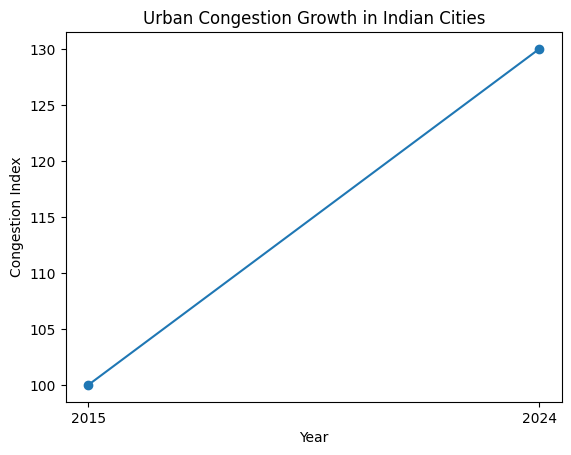
This chart shows a 30% rise in congestion over the past decade despite large investments in road infrastructure.
What this tells us:
Urban traffic in India grows faster than road capacity. Every new flyover temporarily eases congestion, but within months, the space is filled again. This is known globally as induced demand—when increasing road capacity encourages more people to drive.
Key insight:
You cannot solve congestion by building more roads. You solve it by reducing dependency on private vehicles.
🚗 Infrastructure ≠ Mobility
India’s Smart Cities Mission focused heavily on visible infrastructure:
- Roads
- Flyovers
- Smart signals
- Command centers
But mobility is not infrastructure—it’s experience.
Mobility means:
- How quickly someone reaches work
- How many mode changes they need
- Whether the journey is predictable
- Whether public transport is reliable
Without integration, infrastructure becomes fragmented and inefficient.
🌍 What Global Cities Do Differently
🇫🇮 Helsinki: Mobility as a Service (MaaS)
📊 Transport Mode Shift After MaaS Adoption

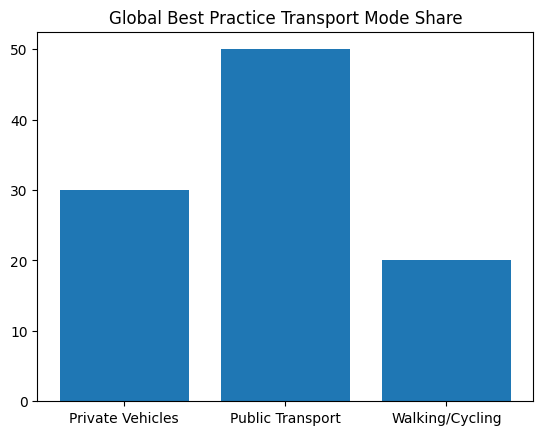
Helsinki integrated buses, metros, taxis, bikes, and car rentals into a single digital platform. Citizens could plan, book, and pay for travel in one place.
Impact:
- Private car use dropped
- Public transport usage increased
- Travel became more predictable
- Urban congestion declined
The key lesson?
When mobility becomes simple, people willingly abandon cars.
🇸🇬 Singapore: Policy + Technology Working Together
Singapore’s success is not technological—it is strategic.
📊 Visual Insight: V3
- Congestion pricing reduces peak-hour traffic
- Vehicle ownership is controlled
- Public transport is fast, clean, and reliable
Unlike most cities, Singapore uses policy to shape behavior, not just technology to manage chaos.
India has the technology—but hesitates on policy.
🇳🇱 Amsterdam: Designing for Humans, Not Cars
Amsterdam achieved what many cities struggle with:
- Fewer cars
- More cyclists
- Higher productivity
They achieved this by:
- Narrowing roads
- Expanding footpaths
- Making cycling safer than driving
This proves an important truth:
👉 Urban design influences behavior more than rules do.
🇮🇳 India’s Mobility Challenge in Numbers
📊 Urban Transport Mode Share
Mode. India. Global Best Practice.
Private Vehicles. ~60%. ~30%
Public Transport. ~30%. ~50–60%
Walking/Cycling. <10%. 20–30%
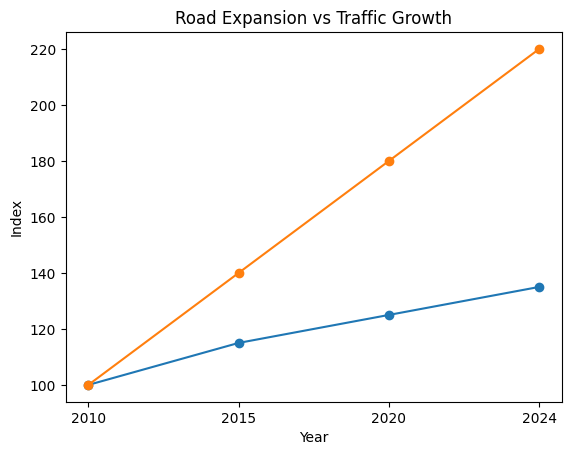
India’s cities are structurally biased toward private vehicles. This not only increases congestion but also worsens pollution, fuel imports, and inequality.
🔄 The Shift India Must Make: Mobility as a Service (MaaS)
✅ Action 1: Build Integrated MaaS Platforms
From Fragmented Apps to Unified Mobility
India already has the digital foundation—UPI, Aadhaar, and ONDC. What’s missing is integration.
A true MaaS platform would:
- Combine metro, buses, autos, cabs, and bikes
- Enable single-payment journeys
- Offer real-time routing
- Encourage subscription-based mobility
This transforms mobility from ownership-based to usage-based.
✅ Action 2: Decongest Cities Through Demand Management
📊 Visual 4: Road Expansion vs Traffic Growth
The chart clearly shows:
- Road expansion grows slowly
- Traffic demand grows exponentially
This is why congestion pricing works globally. It discourages unnecessary trips and spreads travel demand across time and modes.
India must move from road building to demand management.
✅ Action 3: Redesign Streets for People
Walkable cities are more productive, healthier, and economically vibrant.
When cities invest in:
- Safe footpaths
- Cycling lanes
- Transit-oriented development
They reduce congestion without spending billions on new roads.
This is low-cost, high-impact urban reform.
✅ Action 4: Use AI for Prediction, Not Surveillance
India collects massive traffic data but uses it mostly for monitoring.
AI should be used to:
- Predict congestion
- Optimize signal timing
- Improve emergency response
- Reduce fuel waste
The shift must be from reactive management to predictive planning.
✅ Action 5: Fix Governance Before Adding Technology
The biggest bottleneck isn’t money or tech—it’s fragmentation.
Cities need:
- Unified transport authorities
- Clear accountability
- Outcome-based funding
- Citizen feedback integration
Without governance reform, even the best technology fails.
🌍 The Bigger Picture
Mobility impacts:
- Economic productivity
- Air quality
- Public health
- Urban equity
- Talent attraction
Cities that move efficiently grow faster.
Cities that don’t… stagnate.
🔚 Final Thought
India’s smart city journey is not a failure—it’s unfinished.
The next phase must focus less on infrastructure and more on how people actually move.
Because the true test of a smart city isn’t how advanced its systems are
👉 It’s how effortlessly its people can live, work, and move.
#SmartCitiesIndia #MobilityAsAService #UrbanMobility #TrafficDecongestion #SmartInfrastructure #SustainableCities #FutureOfCities #LeadershipThoughts
From Signal to Strategy: The Enterprise Reckoning of Wireless Evolution.

Sanjay K Mohindroo
Wireless networks are shifting from pipes to platforms. A CIO-level view of cellular evolution, 6G, enterprise impact, and what truly matters next.
Cellular networks as decision engines, not data pipes
Wireless is shifting from pipe to platform. A CIO’s view on cellular evolution, 6G, and what enterprises must do next.
Wireless cellular networks no longer sit quietly in the background. They now shape business speed, risk, and reach. The journey from 1G voice to 5G real-time systems has been fast, uneven, and full of hard lessons. The road ahead—6G and beyond—changes the rules again.
This post explores the full arc of cellular evolution and where it is heading. It frames the shift through a CIO and enterprise readiness lens, where networks stop being utilities and start acting as intelligent systems. It maps use cases across manufacturing, defense, healthcare, communications, and public systems. It explains which skills will matter, which policy choices will decide winners, and which parts of today’s infrastructure will not survive the decade.
This is not a prediction piece. It is a readiness check. The core message is simple: wireless strategy is now business strategy. Enterprises that accept this will shape markets. Those who delay will inherit limits they did not choose. #Wireless #5G #6G #EnterpriseIT #CIO
Wireless began as a promise of freedom. No wires. No desks. No fixed place. At first, it delivered voice and little else. Over time, it grew into data, then speed, then scale. Today, it delivers timing, trust, and control.
Most leaders still speak about cellular networks as if they are faster Wi-Fi. That view is outdated. Modern wireless networks shape how fast decisions move, how safe systems remain, and how much work can be done without people in the loop.
The shift now underway is deeper than any jump in speed. The network is becoming aware. It senses load, risk, and context. It adapts in real time. It works with compute and data at the edge. It acts.
For CIOs and enterprise leaders, this is the moment where silence becomes risk. The network is no longer neutral. It will either lift the business or cap it.
The Long Arc of Cellular Progress
From analog voice to aware systems
The early generations of cellular were simple. 1G carried analog voice. 2G turned the voice digital and added text. 3G brought data that was slow but usable. Each step solved a clear pain and unlocked a clear gain.
4G changed the shape of work. It turned phones into computers and networks into pipes for cloud services. Video, apps, and mobile work became normal. Enterprises adapted, often late, but they adapted.
5G did something different. It broke the idea that all traffic is equal. Latency, jitter, and reliability became first-class goals. The network could now serve machines, not just people. Private networks entered the boardroom. Edge computing moved from theory to the budget line.
6G pushes the arc again. Speed matters, but it is not the point. Awareness is the point. The network senses motion, load, and risk. It blends radio with computing, data, and AI. It supports systems that act on their own.
This is where many leaders pause. Not because the tech is unclear, but because the impact is large. #CellularEvolution #NetworkShift
6G and Beyond
Networks that think, sense, and act
6G is not an upgrade to 5G. It is a change in role. Until now, cellular networks have moved data. With 6G, networks begin to understand context, sense the physical world, and support decisions without waiting for human input.
That shift matters more than peak speed.
Yes, 6G targets extreme throughput—hundreds of gigabits per second in lab settings. Yes, it explores sub-THz and THz spectrum. But those are enablers, not the headline. The real change is that the network becomes part of the system logic. It does not just carry signals. It helps decide outcomes.
At the core of 6G sits AI-native design. This is not AI layered on top of operations. It is AI woven into how radios form links, how spectrum is shared, how paths are chosen, and how faults are handled. The network learns traffic patterns, risk states, and intent. It adapts in real time.
Another defining trait is integrated sensing and communication. Radios do more than talk. They detect motion, position, shape, and environment. A factory network sees how machines move. A transport network senses flow before congestion forms. A defense network detects anomalies without extra sensors. Communication and sensing collapse into one fabric.
Latency expectations also reset. Milliseconds no longer suffice for many systems. Autonomous machines, human–machine interaction, and real-time control demand microsecond responses. This forces compute, storage, and decision logic closer to action. The edge becomes the default, not the exception.
6G also breaks the boundary between ground and sky. Satellites, high-altitude platforms, drones, and terrestrial cells operate as one network. Coverage becomes continuous. Resilience improves. Location stops being a hard limit.
Beyond 6G, research moves into more speculative ground. Concepts often labeled 7G or 8G explore planet-scale networks, cognitive systems that reconfigure themselves, and early forms of quantum-safe or quantum-assisted communication. These ideas are not deployment plans. They are pressure tests for physics, security, and governance.
For enterprises, the message is clear and uncomfortable. 6G is not about replacing radios. It demands trustworthy data, AI that can act, and architectures built for autonomy. Without those, the promise stays locked in labs.
The organizations that treat 6G as a distant telecom topic will arrive late. The ones that see it as a system shift—spanning IT, OT, data, and risk—will shape how work is done in the next decade.
This is the point where wireless stops being background noise and becomes a strategic voice in every decision.
Direction of Travel
Networks that sense, decide, and adapt
The future of wireless follows five clear vectors.
First, intelligence moves into the network. AI stops being a tool at the edge and becomes part of how the network runs.
Second, compute moves closer to action. Data no longer travels far before a choice is made.
Third, timing becomes strict. Systems expect answers in microseconds, not seconds.
Fourth, space joins the grid. Satellites, high-altitude platforms, and ground networks act as one fabric.
Fifth, trust becomes dynamic. Security shifts from static rules to live judgment.
These shifts matter because they change who controls value. When the network can decide, the enterprise that shapes the network shapes the outcome.
The CIO Readiness Lens
From connectivity owner to system steward
For a CIO, wireless strategy now cuts across architecture, risk, and growth.
The first shift is mental. The network is no longer plumbing. It is a system that affects uptime, safety, and speed.
The second shift is structural. Cloud-first thinking gives way to edge-first design. Workloads move based on need, not habit.
The third shift is cultural. Teams used to slow change must support live systems that adapt on the fly.
The fourth shift is economic. Spend moves from big cores to many small edges.
A CIO who treats 6G as a future upgrade misses the point. The real work begins now, with data quality, AI trust, and system design. #CIOView #EnterpriseReadiness
Manufacturing and Industry
Factories that act before faults appear
Manufacturing stands to gain first and most.
In modern plants, delay costs money. Sensors feed control loops. Robots share space with people. Systems must react at machine speed.
5G made private networks viable. 6G makes them precise.
Digital twins move from charts to living models. Machines predict wear and shift load. Quality checks happen in real time. Downtime shrinks.
Smart Assembly Plant
A global auto supplier deployed a private 5G network with edge computing. It cut defect rates by 18 percent through live vision checks. In early 6G trials, the same plant synced robots with human motion sensing. Safety stops dropped. Output rose.
This is not about speed. It is about trust in the loop. #Industry40 #SmartFactories
Defense and Security
Resilient networks under stress
Defense shapes the edge of wireless design.
Modern defense systems operate across land, sea, air, and space. They face jamming, loss, and attack. They cannot pause.
Future networks must heal, reroute, and adapt without human input.
6G concepts fit this need. AI-driven routing. Dynamic spectrum use. Secure links that shift shape.
Joint Field Network
A defense lab tested a mixed satellite and ground mesh. When links failed, the network reformed in under a second. Command delay dropped by half. Human control stayed at a high level.
Civil systems will benefit later, but defense proves what is possible. #DefenseTech #ResilientNetworks
Healthcare and Life Sciences
Care that reaches without delay
Healthcare adoption moves more slowly, for good reason. Lives are at stake.
Still, the pull is strong. Remote care needs trust. Robotic assist needs timing. Data privacy needs local control.
Edge-based wireless systems allow analysis near the patient. Data stays local. Decisions move fast.
Remote Stroke Care
A regional hospital network used private cellular and edge AI to scan patients on arrival. Diagnosis time dropped by minutes. Outcomes improved. Trials with lower latency links aim to support remote assist.
Healthcare will not rush, but when it moves, it commits. #HealthTech #DigitalCare
Communications and Media
Experience as a live system
Media and comms feel the change in demand first.
Live events expect perfect streams. Games expect no lag. Work expects presence.
Future networks support shared scenes, not just streams. Users interact in real time, from anywhere.
For enterprises, this shapes training, sales, and support. #MediaTech #LiveSystems
Skills That Shape the Decade
From network admins to system thinkers
The skill shift is sharp.
Pure radio experts will always matter, but fewer are needed. Systems thinkers rise.
Key skills include edge system design, AI operations, real-time data handling, and security for autonomous systems.
Leaders also need staff who can link tech to risk and value. This is rare and prized.
Enterprises that reskill early will move faster with less fear. #FutureSkills #TechLeadership
Spectrum as Strategy
From regulation to leverage
Spectrum policy shapes markets.
Static licenses give way to shared use. AI assigns bands in real time. Enterprises seek direct access for private systems.
Regions that allow this will see faster growth. Those who do not will lag.
For CIOs, spectrum knowledge moves from legal footnote to board topic.
#SpectrumPolicy #PrivateNetworks
Infrastructure That Survives
Edge, openness, and autonomy
Central cores alone will not scale.
Future systems rely on many small edges, open interfaces, and live control loops.
Closed stacks limit choice. Open systems invite speed.
The winners will build for change, not comfort. #EdgeComputing #OpenSystems
The network is now a business actor
Wireless networks no longer wait for instructions. They sense, adapt, and act.
For enterprises, this changes accountability. Decisions move faster than meetings. Systems act before reports arrive.
CIOs who face this head-on will lead with clarity. Those who delay will manage limits they did not set.
The question is no longer about speed. It is about intent.
What role will your network play?
#Wireless #5G #6G #EnterpriseIT #CIO #EdgeComputing #PrivateNetworks #SpectrumPolicy #Industry40 #HealthTech #DefenseTech