
Sanjay K Mohindroo
The Leadership Decision That Defines Transformation
A real-world look at what happens when business urgency collides with IT discipline, and why the best leaders stop treating it as a conflict and start treating it as a design problem.
The Collision Most Organizations Misunderstand
Every major transformation eventually reaches the same moment.
The business wants results now.
IT wants to reduce risk.
Both believe they are protecting the organization.
Both are right.
The problem is that many leadership teams frame this as a battle between speed and control. In reality, it is a failure of alignment. The organizations that outperform their peers are not the ones that choose one side. They are the ones that redesign how decisions are made when priorities collide.
The Meeting Every Executive Has Seen
When Growth Targets Meet Technology Reality
A few years ago, I sat in a steering committee meeting that looked perfectly normal on the surface.
The business team wanted to launch a new digital offering before a major industry event. Revenue projections were strong. Competitive pressure was increasing. Delaying the launch meant losing market momentum.
The CIO's team pushed back.
The platform architecture was not ready.
Security testing was incomplete.
Integration risks remained unresolved.
The business viewed IT as a bottleneck.
IT viewed the business as reckless.
The discussion quickly became emotional.
Deadlines were defended.
Risks were amplified.
Trust began to erode.
What interested me was not the disagreement.
It was the assumption underneath it.
Everyone assumed the problem was technology.
It wasn't.
The problem was decision-making.
The organization had no shared framework for balancing opportunity against risk.
So, every discussion became a negotiation instead of a leadership decision.
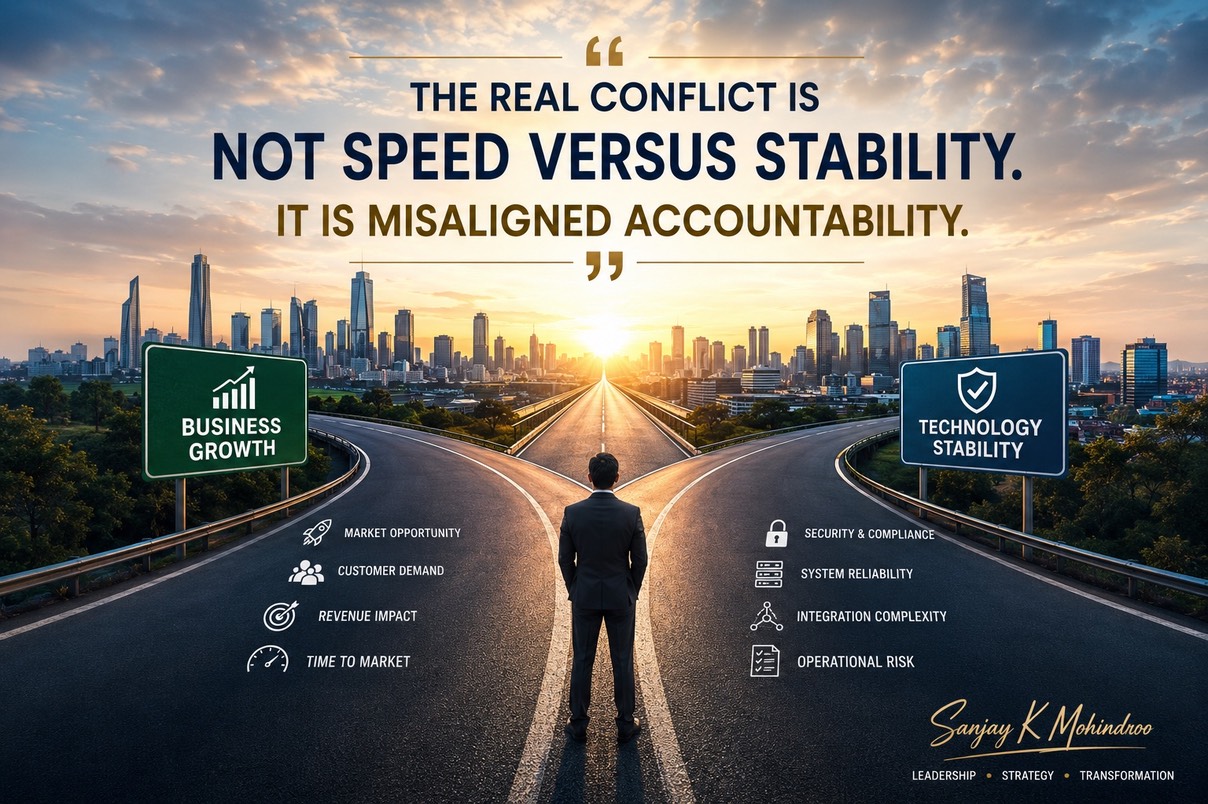
The Real Issue Is Not Speed Versus Stability
It Is Accountability Versus Ownership
When business and IT priorities collide, leaders often frame the debate incorrectly.
The business asks:
"Why can't IT move faster?"
IT asks:
"Why is the business accepting so much risk?"
Neither question gets to the heart of the issue.
The better question is:
"Who owns the outcome?"
In many organizations, accountability is fragmented.
Business leaders own revenue.
IT leaders own systems.
Security leaders own compliance.
Operations leaders own execution.
Yet customers experience the company as one organization.
They do not care which department made the decision.
They only experience the result.
This is why siloed accountability creates organizational friction.
Everyone protects their domain.
Few optimize for the enterprise.
The most effective leadership teams establish shared accountability before major decisions are made.
The conversation changes immediately.
Instead of defending functions, leaders begin evaluating trade-offs.
That shift sounds simple.
In practice, it changes everything.
Why Most Escalations Are Symptoms of a Deeper Problem
Misaligned Incentives Create Predictable Conflict
In boardrooms around the world, I continue to see the same pattern.
The business rewards speed.
IT rewards reliability.
Operations rewards consistency.
Finance rewards efficiency.
Each function behaves rationally according to its incentives.
The conflict is predictable.
What leaders often miss is that no amount of governance fixes conflicting incentives.
You can create more committees.
You can add more reporting.
You can schedule more review meetings.
The friction remains.
The organizations that scale effectively align incentives around enterprise outcomes rather than functional success.
When leaders are measured against the same outcome, priorities become clearer.
Decisions become faster.
And the quality of execution improves.
Alignment is not a communication exercise.
It is a structural choice.
Speed Is Rarely the Problem
One of the most common beliefs in leadership circles is that IT slows down business growth.
I disagree.
In most organizations, speed is not the problem.
Unclear decisions are.
I have seen companies deploy technology rapidly and still fail.
I have also seen organizations move cautiously and outperform competitors.
The difference was not pace.
The difference was clarity.
When priorities are clear, teams move with confidence.
When priorities are unclear, organizations create the illusion of activity while decisions remain unresolved.
Many executives ask how to accelerate transformation.
A better question is:
"What decisions are we avoiding?"
That question usually reveals the real bottleneck.
And it is rarely technology.
What High-Performing Leadership Teams Do Differently
Turning Conflict into Competitive Advantage
The strongest leadership teams do not eliminate tension between business and IT.
They use it.
Constructive tension improves decisions.
It forces assumptions into the open.
It exposes blind spots.
It prevents costly mistakes.
The objective is not agreement.
The objective is clarity.
The best teams establish three principles.
First, every major initiative has a single business outcome that everyone understands.
Second, risks are quantified rather than debated emotionally.
Third, decisions are made at the appropriate level and documented clearly.
This creates trust.
And trust accelerates execution more than any technology investment ever will.
When people understand how decisions are made, they spend less time protecting themselves and more time delivering results.
Questions Every Leadership Team Should Ask
Before your next major transformation initiative, ask:
- Are business and IT measured against the same outcome?
- Have we defined acceptable risk levels?
- Are we debating facts or defending functions?
- Who ultimately owns the result?
- What decision are we avoiding because it is uncomfortable?
These questions often reveal more than months of status reports.
The Best Transformations Are Leadership Transformations
Technology rarely creates the biggest challenge.
People do.
More accurately, leadership choices do.
Every organization eventually faces a moment where business urgency collides with technology reality.
The outcome is rarely determined by the platform, the architecture, or the budget.
It is determined by how leaders think.
Organizations that treat business and IT as opposing forces create endless friction.
Organizations that align both around shared outcomes create momentum.
The difference is not strategy.
The difference is leadership.
And leadership becomes most visible when priorities collide.
#CIO #Leadership #DigitalTransformation #BusinessStrategy #TechnologyLeadership