
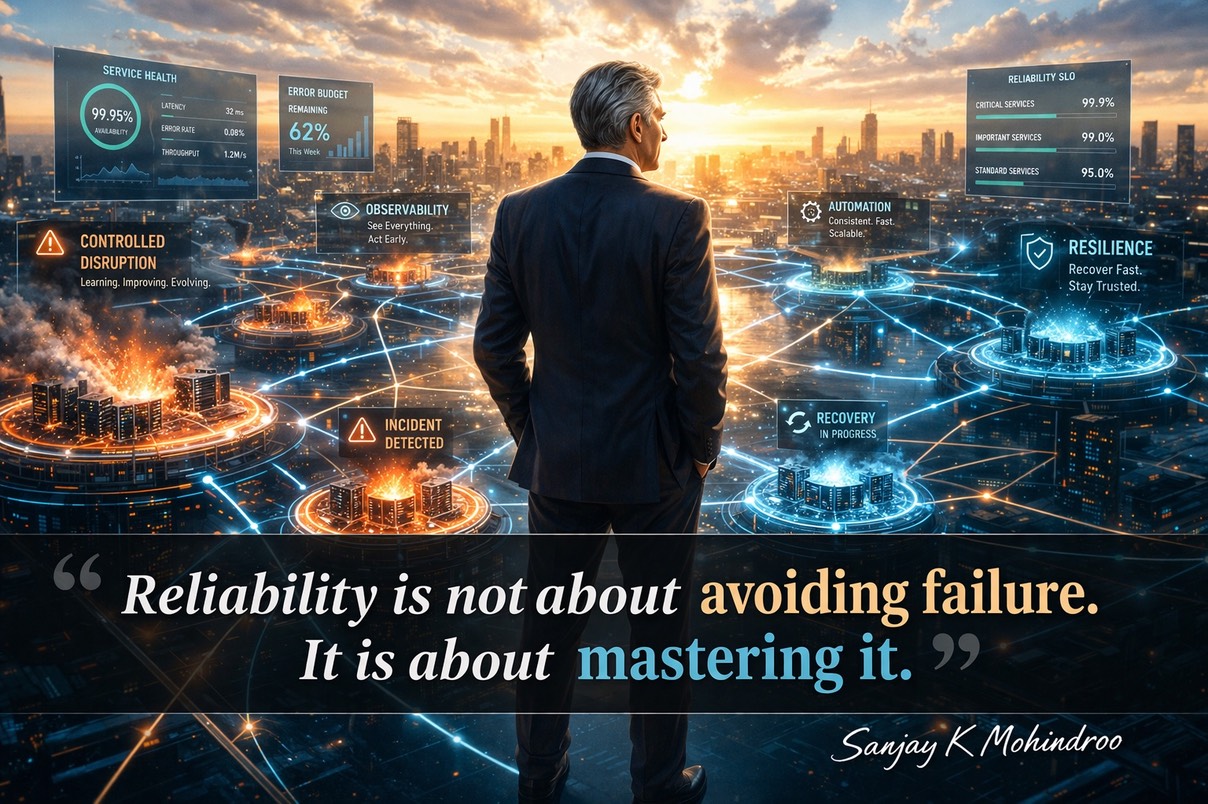
Sanjay K Mohindroo
Rethinking SRE from the Boardroom.
A senior IT leader’s perspective on SRE, balancing reliability, speed, and cost, and why reliability is a strategic business decision.
Site Reliability Engineering has moved from an engineering practice to a business priority. Yet many organizations still treat it as a technical discipline.
That is where the gap begins.
SRE is not about uptime alone. It is about balancing reliability, speed, and cost to support business outcomes.
In my experience, organizations that get SRE right do not chase perfection. They define acceptable risk, align it with business priorities, and build systems that operate within those boundaries.
This piece explores what SRE really means for leadership, why common approaches fall short, and how to embed reliability into decision-making at scale. #SRE #CIO #Leadership
The outage that cost more than downtime
A few years ago, I was reviewing a major production incident with a global team. The system was down for less than an hour.
Technically, it was resolved quickly.
Commercially, the damage was far greater. Lost transactions, customer frustration, and reputational impact.
What stood out was not the failure itself. It was the absence of clarity.
No one could answer a simple question.
“How much reliability do we actually need?”
That is the conversation most organizations avoid.
What SRE Really Means
Reliability is not an engineering metric. It is a business choice
SRE is often reduced to metrics. Availability percentages, latency thresholds, and error rates.
These matter. But they are not the starting point.
The starting point is business impact.
Different systems require different levels of reliability. A customer-facing payment platform demands near-perfect availability. An internal reporting tool does not.
Yet many organizations apply uniform standards across all systems.
This leads to over-engineering in some areas and under-investment in others.
In one organization, we categorized services based on business criticality. Reliability targets were aligned accordingly.
This brought clarity to investment decisions. It also reduced unnecessary effort.
Because not everything needs to be perfect.
The Balance Between Speed and Stability
You cannot optimize for both without trade-offs
There is a natural tension between speed and reliability.
Business wants faster releases. Engineering wants stability.
SRE provides a framework to manage this tension.
Error budgets are a powerful concept. They define how much failure is acceptable within a given period.
When error budgets are consumed, focus shifts to stability. When they are healthy, teams can move faster.
In practice, this creates a disciplined approach to trade-offs.
In one transformation, introducing error budgets changed behavior across teams. Conversations became more grounded. Decisions became more balanced.
It moved the discussion from opinion to structure. #DigitalTransformation
The Contrarian View
Zero downtime is not the goal. Controlled failure is
There is a strong belief that systems should aim for zero downtime.
It sounds logical. It is also unrealistic.
Chasing zero downtime leads to high cost, complexity, and slower innovation.
Every additional layer of redundancy adds overhead. Every safeguard introduces latency.
The goal is not to eliminate failure. It is to manage it.
I have seen organizations spend millions chasing marginal improvements in uptime while neglecting recovery capabilities.
The better approach is resilience.
Systems should fail gracefully. Recover quickly. Minimize impact.
In one case, we shifted focus from preventing every incident to improving recovery time.
The result was a more robust system and a more confident organization.
Because failure, when managed well, becomes part of the system rather than a threat to it. #Resilience
Designing SRE into the Organization
Reliability must be built, not inspected
SRE cannot be an afterthought. It must be embedded into how systems are designed and operated.
This starts with architecture. Systems should be modular, scalable, and fault-tolerant.
It continues with automation. Manual processes introduce variability and delay.
And it requires observability. Without visibility, reliability cannot be managed.
In one global rollout, we introduced standard observability practices across all services.
It did not just improve monitoring. It improved understanding.
Teams could see how systems behaved under load, where risks existed, and how failures propagated.
That visibility changed decision-making.
The Role of Culture
SRE works when blame is removed, and learning is prioritized
Technology alone does not deliver reliability. Culture does.
In high-performing organizations, incidents are treated as learning opportunities, not failures to be punished.
Blameless post-incident reviews are critical. They focus on what happened, why it happened, and how to improve.
Not who made the mistake.
I have seen teams transform when this mindset is adopted.
Engineers become more open. Issues surface earlier. Improvements happen faster.
Without this cultural shift, SRE becomes a compliance exercise.
The Leadership Imperative
Why SRE is a board-level concern
Reliability impacts revenue, customer trust, and brand reputation.
It is not just an operational issue. It is a strategic one.
For CEOs and boards, this means asking different questions.
What is our acceptable level of risk
How does reliability impact customer experience
Are we investing in resilience or just prevention
For CIOs, the role is to translate technical realities into business language.
To make trade-offs visible. To align reliability with business priorities.
This is where leadership creates value.
What Gets in the Way
The quiet challenges that derail SRE
SRE implementation often faces subtle barriers.
Lack of clarity on service criticality
Misaligned incentives between teams
Over-reliance on tools without process discipline
Resistance to cultural change
These issues are rarely discussed openly. Yet they are the primary reasons SRE efforts stall.
Addressing them requires leadership attention, not just technical expertise.
What senior leaders should act on
Define reliability in business terms, not just technical metrics
Align service levels with business criticality
Introduce structured trade-offs between speed and stability
Invest in resilience and recovery capabilities
Embed observability and automation into core systems
Foster a culture of learning and accountability
Ensure leadership understands and supports reliability decisions
Reliability is a leadership decision
SRE is not about engineering perfection. It is about disciplined decision-making.
The organizations that succeed are not the ones that avoid failure.
They are the ones who understand it, manage it, and recover from it effectively.
Reliability, at its core, is a reflection of how an organization thinks and operates.
And that makes it a leadership responsibility.
#SRE #SiteReliabilityEngineering #Leadership #CIO #DigitalTransformation #Resilience #ITStrategy #EnterpriseIT #TechnologyLeadership #OperationalExcellence