
Sanjay K Mohindroo
Growth begins when curiosity stays stronger than ego, even when advice feels uncomfortable.
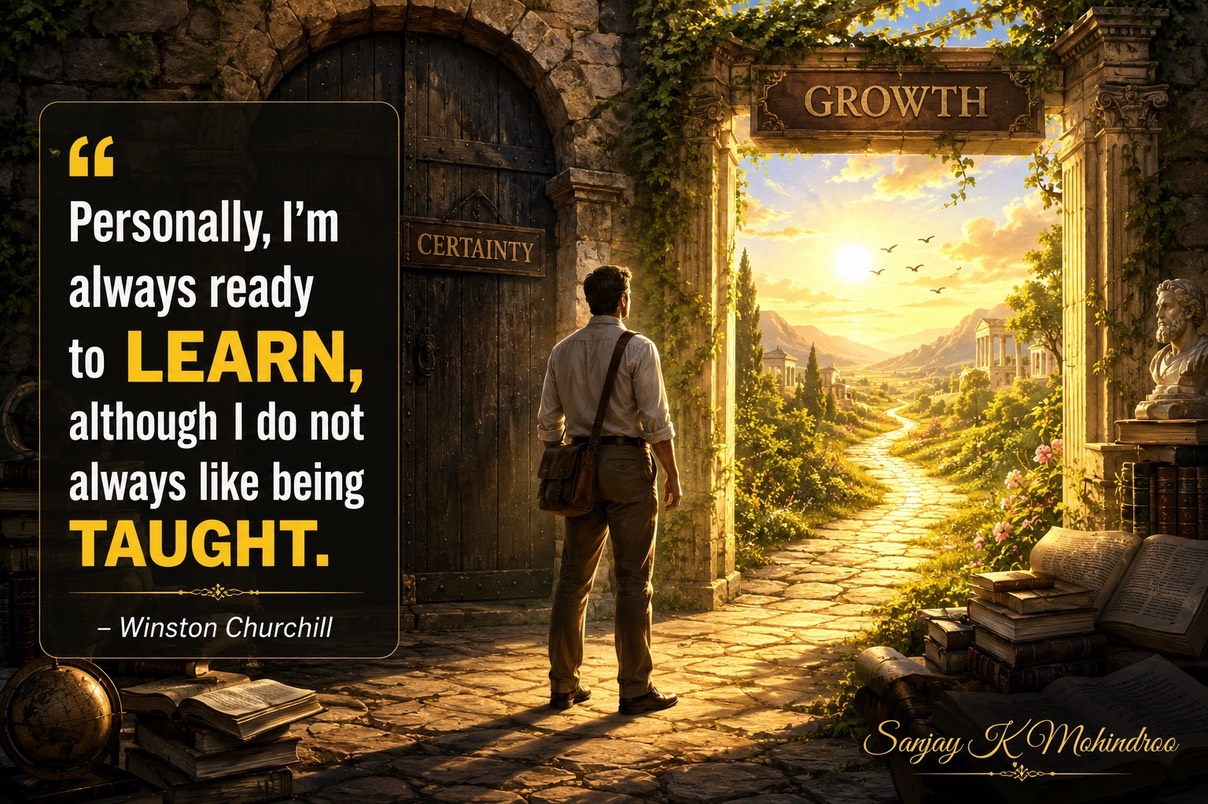
Most people enjoy gaining knowledge. Far fewer enjoy being corrected. That tension sits at the heart of one of the most honest observations ever made: "Personally, I'm always ready to learn, although I do not always like being taught." — Winston Churchill.
This quote captures a truth that often goes unspoken. We admire growth, yet we resist the discomfort that usually comes with it. Being taught can challenge our assumptions, expose mistakes, and remind us that we do not know everything. The statement is not a rejection of education. It is a recognition of the emotional struggle that often accompanies personal growth. It points toward a deeper question: Can we stay open to improvement when it feels uncomfortable?
The Quiet Battle Between Curiosity and Pride
Growth Often Arrives Disguised as Discomfort
Every meaningful lesson carries a small challenge to our identity. We like seeing ourselves as capable and informed. When someone points out a gap in our understanding, that image can feel threatened.
This reaction is natural. No one enjoys feeling wrong. Yet progress rarely comes from protecting our pride. It comes from examining ideas honestly, even when they unsettle us. The people who continue growing are not those who avoid mistakes. They are the ones willing to face them. That is the spirit behind #PersonalGrowth and lasting self-improvement.
Knowledge Without Openness Has Limits
Information Alone Does Not Create Wisdom
Modern life offers endless access to information. Books, courses, videos, and conversations are available everywhere. Yet access does not guarantee growth.
Real development requires receptiveness. A person may collect facts for years and remain unchanged. Another may accept one difficult piece of feedback and transform completely. The difference lies in attitude.
Wisdom grows when curiosity becomes stronger than defensiveness. It appears when people ask questions rather than defend assumptions. This mindset fuels #Leadership, #Success, and meaningful achievement in every field.
The Strength of Being Teachable
Confidence and Humility Can Exist Together
Many people confuse teachability with weakness. The opposite is often true. It takes confidence to admit there is more to understand.
The strongest professionals, leaders, and creators share a common trait. They remain students long after achieving success. They recognize that expertise is not a finish line. It is a responsibility to keep improving.
Humility does not reduce authority. It strengthens it. People trust individuals who can adapt, listen, and grow. A closed mind may protect the ego today, but it limits tomorrow's possibilities.
Challenging the Quote
Should We Accept Every Lesson?
The quote also invites an important distinction. Being teachable does not mean accepting every opinion without question.
Critical thinking matters. Some advice deserves scrutiny. Some lessons arrive with bias or incomplete understanding. The goal is not blind acceptance. The goal is thoughtful consideration.
A mature learner listens carefully, evaluates fairly, and decides wisely. Growth comes from balancing openness with judgment. That balance turns information into insight and experience into wisdom.
The Lifelong Student
Progress Begins Where Certainty Ends
The most successful people rarely believe they have reached the end of learning. They understand that every achievement opens another door.
Life keeps presenting new situations, challenges, and perspectives. The willingness to adapt becomes a lasting advantage. Those who remain curious continue moving forward, while others become trapped by certainty.
This mindset creates better leaders, stronger relationships, and richer experiences. It keeps the mind active and the future full of possibility. It reflects the heart of #Mindset and #SelfDevelopment.
The greatest obstacle to growth is rarely a lack of opportunity. More often, it is the desire to protect what we already believe. Winston Churchill's observation reminds us that learning is not only an intellectual process. It is an emotional one.
The people who achieve lasting growth accept the discomfort that comes with being challenged. They choose progress over pride and curiosity over certainty. In doing so, they unlock one of life's most valuable advantages: the ability to keep becoming better.
#PersonalGrowth #Leadership #Success #Mindset #SelfDevelopment #ContinuousLearning #GrowthMindset #Wisdom #Humility #Learning
Winston Churchill was a British statesman, writer, and former Prime Minister of the United Kingdom. He led Britain through some of its most difficult moments during World War II. His reflections on leadership, character, and human behavior continue to influence readers across generations.