

Cataloguing Strategic Innovations and Publications
CIO's First 90 Days: A Field-Tested Plan
Sanjay K Mohindroo
A practical CIO 90-day plan for building board trust, reducing enterprise risk, prioritizing investments, and delivering measurable business value from day one.
A new CIO does not have 90 days to understand the technology. They have 90 days to establish why the business should trust their judgment.
That distinction can determine whether the next three years deliver measurable business value or become another expensive exercise in transformation theatre.
After nearly three decades working across industries, geographies and executive leadership environments, I have learned that the most consequential decisions a CIO makes early in their tenure are rarely technology decisions.
They concern capital, people, risk and priorities.
The conventional advice is familiar: spend the first 30 days listening, the next 30 developing a strategy and the final 30 presenting a roadmap.
I disagree.
The first 90 days are not an extended orientation programe. They are a test of executive judgment under imperfect information.
A successful CIO must diagnose the business, challenge assumptions, establish accountability and demonstrate progress, often simultaneously.
Here is the approach I would recommend.
Why the Traditional CIO 90-Day Plan Falls Short
Most organizations already have a technology strategy, an investment portfolio, and a long list of initiatives described as critical.
What they often lack is clarity about which investments are actually producing business outcomes.
Consider a global manufacturer operating across multiple markets.
Its technology leadership might inherit dozens of active projects, a substantial annual technology budget and competing requests from regional business heads.
The instinctive response is to review every project, commission an architecture assessment and develop a comprehensive transformation roadmap.
That may appear disciplined. It can also consume the entire first quarter without changing a single business outcome.
The more important questions are different.
Which initiatives directly support revenue, margin or customer retention? Which systems represent unacceptable operational exposure? Which investments continue because nobody has challenged their original assumptions?
A CIO who cannot answer these questions is not yet in control of the technology agenda, regardless of how detailed the roadmap looks.
The Five Decisions That Define the First 90 Days
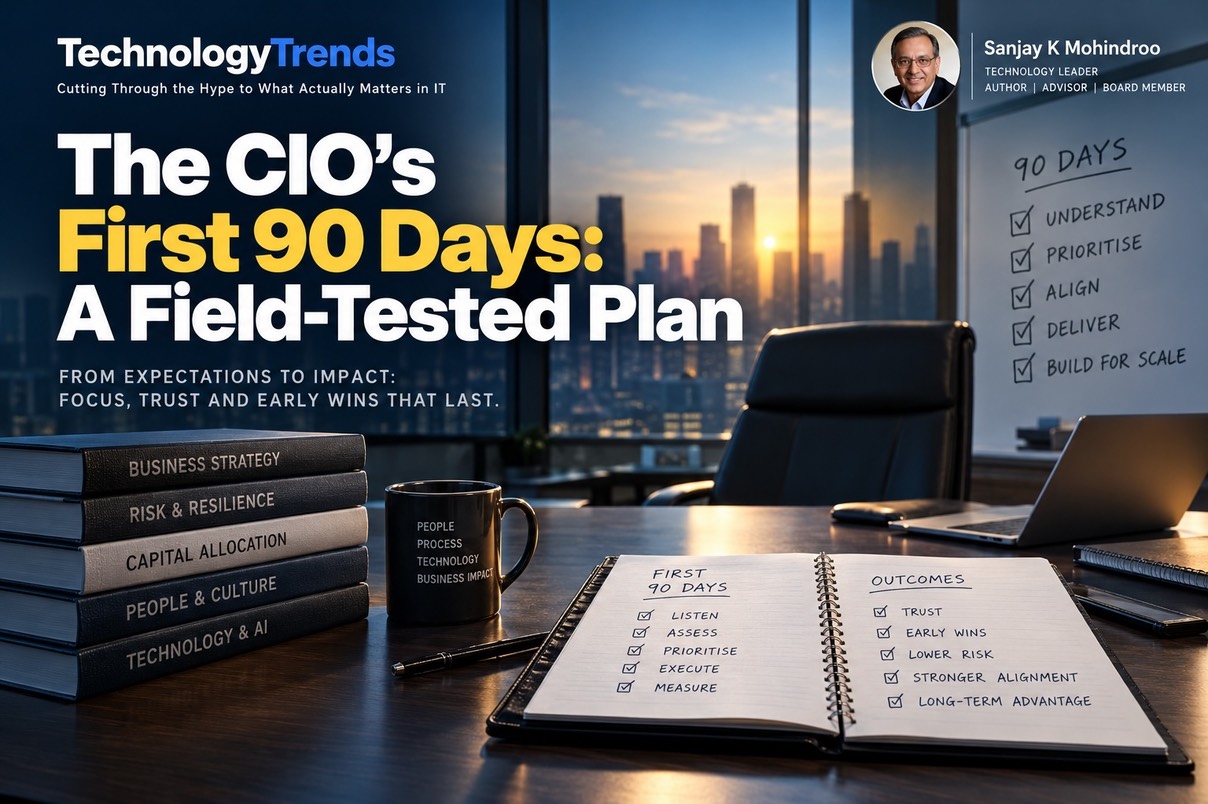
I use a simple framework: Understand, Prioritize, Align, Deliver, and Build for Scale.
These are not five sequential phases. They are five executive responsibilities that overlap throughout the first quarter.
1. Days 1–15: Understand the Business Before Assessing the Technology
The priority is to establish where the organization creates value and where it is vulnerable.
Meet the CEO, CFO, business unit leaders, risk leadership, and selected customers where appropriate.
But avoid the predictable question: "What do you expect from IT?"
Instead, ask:
· What are the three business outcomes we cannot afford to miss this year?
· Where is technology currently constraining growth, productivity or customer experience?
· What operational failure would cause the greatest financial or reputational damage?
· Which technology investments would you reconsider if capital became scarce?
These conversations expose the difference between stated priorities and actual business needs.
Alongside them, examine four facts: technology spending, critical operational dependencies, major delivery commitments, and leadership capability.
By day 15, the CIO should have a preliminary business-risk map, not a technology wish list.
It should identify where value is being created, where money is being absorbed, and where the enterprise is exposed.
2. Days 15–30: Prioritize Ruthlessly and Challenge Existing Commitments
One of the most difficult responsibilities for an incoming CIO is deciding what not to do.
Technology portfolios accumulate commitments over time. Projects survive leadership changes, business cases become outdated and sunk costs are mistaken for reasons to continue.
A new CIO has a narrow window in which to challenge this inertia.
I recommend assessing significant initiatives against four criteria:
1. Business value: What measurable financial or operational outcome will this deliver?
2. Risk reduction: What exposure does this eliminate or materially reduce?
3. Time to impact: When will the business experience a meaningful benefit?
4. Execution confidence: Do we have the leadership, capacity and organizational commitment to deliver?
Every major initiative should receive one of four decisions: accelerate, continue, redesign or stop.
Stopping a project is not evidence of failure. Continuing an unjustified investment because it is politically convenient is.
Imagine a portfolio containing 40 active initiatives.
A structured review might reveal that 10 have weak business ownership, five duplicate capabilities, and several depend on assumptions that no longer hold.
These numbers are illustrative, but the underlying issue is common: portfolio activity is not the same as portfolio value.
The objective is not indiscriminate cost reduction. It is better capital allocation.
By day 30, the CEO and CFO should know which technology commitments deserve continued investment and which require intervention.
3. Days 30–45: Align Accountability, Not Just Stakeholders
Business-IT alignment is one of the most overused expressions in enterprise technology.
In many organizations, alignment means holding meetings, establishing steering committees and securing agreement on a presentation.
That is insufficient.
Real alignment means the business and technology leadership jointly own outcomes.
If an initiative promises a reduction in customer onboarding time, the business executive responsible for onboarding must share accountability for achieving it.
If an automation programe promises productivity gains, the relevant operational leader must own the process changes required to realize those gains.
The CIO cannot deliver business transformation while the business remains a spectator.
I recommend establishing a compact accountability charter for every major initiative.
It should identify the executive sponsor, expected business outcome, investment envelope, decision rights and success measures.
The measures must be intelligible to the board.
Revenue contribution, cost-to-serve, operating resilience, working capital and customer retention are meaningful.
The number of applications migrated, or features deployed, may be useful operational measures, but they are rarely sufficient measures of business success.
By day 45, every material technology investment should have a named business owner and an agreed definition of success.
4. Days 45–75: Deliver an Early Win That Actually Matters
The pressure to demonstrate early success is understandable.
Unfortunately, it can encourage cosmetic victories.
A new dashboard, an internal chatbot demonstration, or a highly publicized pilot may generate enthusiasm without improving enterprise performance.
The right early win should satisfy three tests.
It must address a recognized business problem, produce measurable evidence and create confidence in the organization's ability to execute.
For example, reducing a recurring order-processing bottleneck may be more valuable than launching a new digital platform.
Eliminating a material control weakness may create more enterprise value than announcing an ambitious AI programe.
Improving the reliability of a revenue-critical process can establish credibility faster than a polished technology vision.
The early win should also be proportionate.
Do not destabilize a critical operation to prove that the new CIO is decisive.
A useful target is to demonstrate a measurable improvement within 60 to 75 days, supported by a credible baseline and verified by the business owner.
Where the outcome takes longer, demonstrate that a material risk has been removed or a previously stalled decision has been resolved.
Early wins should build institutional confidence, not personal publicity.
5. Days 75–90: Build for Scale and Establish the Next 12 Months
By the final month, the CIO should be able to explain the technology agenda without relying on technical terminology.
The CEO and board need answers to five questions.
Where are we investing? What business outcomes will those investments produce? What risks remain? What capabilities must change? Who is accountable?
The resulting 12-month agenda should distinguish between three categories:
Protect the enterprise: Cybersecurity, resilience, regulatory obligations and critical operational dependencies.
Improve enterprise performance: Productivity, process simplification, customer experience and cost efficiency.
Create future advantage: Data capabilities, AI, differentiated digital services and new business models.
The balance will vary by organization.
A regulated financial institution facing material resilience concerns may need to emphasize protection. A consumer business facing declining customer loyalty may prioritize experience and differentiation.
The mistake is to assume every organization needs the same transformation agenda.
The final deliverable should be a concise, financially grounded investment plan with milestones, owners, dependencies, and explicit trade-offs.
What the Board Should Expect by Day 90
A board should not judge the incoming CIO by the number of meetings conducted or the sophistication of a technology presentation.
It should expect evidence of improved executive control.
Dimension Evidence by Day 90
Business understanding: Agreed enterprise priorities and constraints
Capital discipline: Investment decisions with clear rationale
Risk management: Material exposures identified, owned and addressed
Accountability: Named business and technology owners
Execution: At least one verified improvement or material risk reduction
Future direction: A credible, funded 12-month agenda
These are not administrative deliverables.
They establish whether technology leadership is becoming an effective instrument of enterprise performance.
The Counterargument: What About Listening and Building Trust?
Some leaders will argue that 90 days is too short to challenge established investments or make consequential decisions.
There is merit in that concern.
An incoming CIO who begins cancelling projects without understanding the organization's history can destroy trust and overlook critical dependencies.
But listening and acting are not mutually exclusive.
The solution is to distinguish between reversible and irreversible decisions.
Clarifying accountability, challenging business cases and stopping unnecessary new commitments can often happen quickly.
Major platform replacements, structural reorganizations and irreversible capital commitments require deeper evidence and appropriate governance.
Decisiveness is not the same as haste.
The best CIOs know when to act, when to investigate and when to resist pressure for a premature announcement.
The Real Test Begins on Day 91
The first 90 days will not transform an enterprise.
They should, however, change the quality of decisions the enterprise makes about technology.
By then, the CIO should have earned the confidence to challenge priorities, redirect investment, confront uncomfortable risks, and hold both technology and business leaders accountable.
That is the foundation of sustained transformation.
The CIO who spends the first quarter trying to impress the organization with a grand vision may leave the underlying problems untouched.
The CIO who uses that period to establish clarity, discipline and measurable progress creates something far more valuable: the ability to deliver.
The first 90 days are not about proving that the CIO understands technology. They are about proving that technology leadership understands the business.
For CEOs, board members, and CIOs: what is the one decision a new CIO must get right in the first 90 days, even if it creates uncomfortable conversations?
Share your perspective in the comments, or subscribe to TechnologyTrends for more practical insights on technology leadership and enterprise transformation.
Future of AI: A Strategic Reckoning
Sanjay K Mohindroo
Microsoft, Google, and the Future of AI: A Strategic Reckoning
Microsoft and Google face an AI reckoning. Explore the lessons from Adobe, rising digital sovereignty, and why trust, choice, and returns matter.
Microsoft, Google and the Cost of Reinvention: The AI Stock Shock, Adobe's Warning, and the Rise of Digital Sovereignty
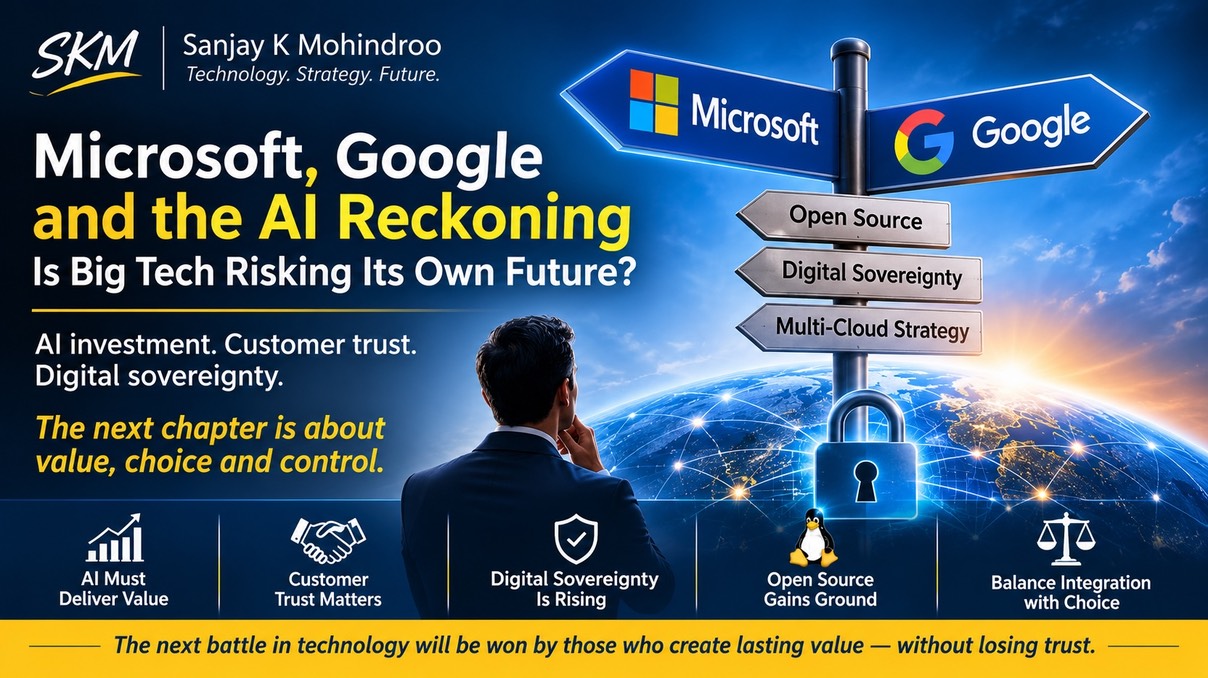
Microsoft and Google are investing billions to shape the future of computing. But investors are questioning the returns, customers are scrutinizing subscription costs, and governments are seeking alternatives to foreign technology platforms. The challenge is no longer simply to lead in AI. It is to reinvent the business without undermining the trust, economics, and customer relationships that made these companies powerful.
The price of changing direction
Microsoft and Google built their dominance by becoming essential to everyday computing.
Microsoft made Windows and Office central to enterprise operations. Google became a gateway to online information and built an advertising business around that position. Both expanded into cloud computing, security, developer tools, and enterprise services.
Artificial intelligence now threatens to reshape the foundations of both businesses.
Microsoft is moving from desktop productivity toward AI-powered workflows, Copilot, and cloud infrastructure. Google is transforming search into an AI-driven information experience while trying to protect the advertising economics that made it successful.
Their ambitions are understandable. Neither company can afford to let a new generation of AI platforms displace its products and control the customer relationship.
But reinvention comes at a price. Data centers, advanced chips, model development, and AI services require enormous investment. Meanwhile, the products funding that investment could themselves be disrupted by the technologies the companies are building.
The October 2026 technology sell-off brought this tension into focus. Investors grew increasingly concerned about the scale of AI infrastructure spending and the time required to translate that spending into sustainable returns. Reuters reported on October 30 that more than $2 trillion in Nasdaq-100 market value was at risk during the month's sell-off as concerns about AI spending intensified. Reuters' October 30 market report.
This was not proof that AI had failed. It reminded investors that technological potential and investment returns are two different things.
At the same time, governments and enterprises are reconsidering their dependence on proprietary technology ecosystems. They want greater control over data, infrastructure, costs, and the ability to change suppliers.
These developments share a common theme: the companies building the next generation of computing must prove that their ambitions create durable value for investors and customers alike.
Microsoft: Beyond Windows and Office
Microsoft is repositioning itself around Azure, Copilot, enterprise AI, cybersecurity, and intelligent business workflows. Windows and Office remain important, but the company's future growth increasingly depends on how effectively it embeds AI across its broader platform.
The opportunity is substantial. Microsoft already has access to enterprise customers, productivity applications, identity systems, business data, and cloud infrastructure. It can introduce AI into existing workflows rather than build a customer base from scratch.
Consider a conventional productivity task. An employee opens Excel to analyze data, PowerPoint to prepare a presentation, and Outlook to communicate the findings. An AI assistant could coordinate much of that work through a single instruction.
Microsoft wants Copilot and its agents to become the interface through which employees interact with these applications and business processes.
Yet this strategy creates a paradox.
If AI makes individual applications less visible, Microsoft must demonstrate why customers should continue paying for the underlying products—and why they should pay extra for AI capabilities.
The company also faces the economics of infrastructure. AI requires data centers, advanced accelerators, networking, electricity, and ongoing model development. Microsoft can afford substantial investment, but its scale does not guarantee attractive returns.
Its central challenge is to convert AI adoption into profitable growth without weakening the value proposition of its existing business.
There is also a customer-trust risk. Enterprises may accept higher prices when new capabilities deliver measurable benefits. They are less likely to welcome rising costs for features they do not need, cannot use effectively, or cannot justify to their finance departments.
Microsoft's existing ecosystem gives it significant switching-cost advantages. But switching costs should not be confused with customer loyalty. Customers can remain locked into a platform while actively looking for ways to reduce their dependence on it.
Google: Reinventing search without damaging its economics
Google faces a related but distinct challenge.
Its search business connects users with information, services, and advertisers. Generative AI changes that interaction by providing synthesized answers, comparisons, recommendations, and plans instead of relying exclusively on lists of links.
Google is responding by integrating Gemini and AI-powered experiences across Search, Android, Chrome, Workspace, and Google Cloud.
The opportunity is to make its services more useful and maintain Google's position in information discovery. The risk is that the new experience may undermine the economics of the old one.
Traditional search advertising has an established commercial model. AI-generated answers may require different advertising formats and could reduce the number of conventional searches and website visits.
Google must therefore solve two problems simultaneously: make AI useful enough to compete with new entrants, and build a sustainable commercial model around the resulting experience.
Moving too slowly could allow competitors to capture users. Moving too aggressively could disrupt profitable search economics before replacement revenue has matured.
Google's AI investments also require substantial infrastructure spending. Its custom silicon, data centers, and model development may strengthen its competitive position, but the company must demonstrate that these investments produce durable financial returns.
The strategic question is not whether Google can build capable AI. It is whether it can transform how people discover information without weakening the business that funds the transformation.
The stock shock: AI investment is no longer enough
The October 2026 sell-off reflected a growing divide between confidence in AI's potential and confidence in the economics of pursuing it.
Technology companies have committed enormous sums to data centers, accelerators, networking, and AI infrastructure. Investors increasingly want evidence that this spending will generate sufficient revenue, margins, and cash flow.
The Financial Times also reported in October on the market's concerns about escalating AI capital expenditure and pressure on the financial returns from established technology businesses. Financial Times coverage.
The questions are straightforward:
- How much incremental revenue is AI generating?
- How much profit remains after infrastructure and operating costs?
- Are data centers being utilized efficiently?
- How quickly must hardware be replaced?
- What happens if customer demand grows more slowly than expected?
These are not arguments against AI. They are questions about capital allocation.
A technology can transform an industry while some companies investing in it still deliver disappointing returns. Likewise, AI can become essential to enterprise operations without every AI product or infrastructure project becoming commercially successful.
Microsoft benefits from a diversified enterprise business spanning productivity, cloud, security, and developer services. Google has a substantial advertising business, consumer distribution, cloud services, and its own AI infrastructure.
These strengths give both companies room to adapt. They do not eliminate the risk of overinvestment or misjudging how quickly customers will pay for new capabilities.
The market is shifting from rewarding AI ambition to demanding evidence of AI economics.
That is a healthy test, provided investors distinguish a temporary correction in expectations from a genuine deterioration in a company's competitive position.
Adobe's warning: Subscription revenue is not customer loyalty
Adobe offers a useful lesson in what can happen when a successful software business faces technological disruption and questions about its commercial model.
Its Creative Cloud transition established a recurring subscription business around products such as Photoshop, Illustrator, and Premiere Pro. The model provided predictable revenue and continuous product updates, while customers gained access to an established suite of professional tools.
Yet AI is changing the economics of creative work. New tools can generate images, video, and designs with simpler interfaces, while competitors such as Canva and other AI platforms are expanding their capabilities.
Adobe's challenge is to demonstrate that AI strengthens its professional ecosystem rather than making important parts of it easier to replace.
Investor concerns have extended beyond technology. In March 2026, Reuters reported that Adobe's shares fell after CEO Shantanu Narayen announced plans to step down, adding leadership uncertainty to concerns about AI disruption. The report noted that strong sales results had not eliminated those concerns. Reuters' Adobe report.
Adobe also faced scrutiny over its subscription practices. In March 2026, it reached a $150 million settlement related to a U.S. government lawsuit alleging that it concealed termination fees and made cancellation difficult. The same month, the UK's Competition and Markets Authority opened an investigation into early cancellation fees. The UK investigation was an inquiry, not a finding of wrongdoing. Reuters coverage of the subscription issues.
These are separate issues: AI competition challenges Adobe's future product economics, while subscription disputes concern customer trust and commercial practices. Together, however, they illustrate a broader risk.
Recurring revenue is valuable only when customers continue to see value in the relationship.
A subscription can be financially predictable for a vendor while feeling restrictive to a customer. When alternatives improve, pricing becomes harder to justify, or cancellation feels unnecessarily difficult, customers become more willing to reconsider the relationship.
Microsoft and Google should take this lesson seriously.
What Microsoft and Google must learn
Customer dependence is not customer satisfaction
Customers may remain with a vendor because migration is expensive, data is deeply integrated, or alternatives are immature. That does not mean they are satisfied.
Microsoft should not assume that organizations using Microsoft 365, Windows, Entra, and Azure will automatically accept every new AI product or price increase.
Google should not assume that its position in search guarantees user loyalty as AI changes information discovery.
Both need to distinguish between customers who actively value their services and those who stay because leaving is difficult.
AI must deliver measurable value
An impressive demonstration does not establish a viable business case.
Enterprise customers need to know whether AI reduces task completion time, improves accuracy, increases throughput, reduces costs, or improves decision quality.
Vendors should also distinguish between theoretical time savings and realized economic benefits. Saving an employee an hour does not automatically reduce payroll costs. The benefit becomes tangible when the time is redeployed productively, capacity requirements fall, or business outcomes improve.
AI adoption statistics are useful, but they are not substitutes for evidence of customer value and sustainable margins.
Pricing and licensing must preserve trust
Customers should understand what they are buying, what AI features cost, and whether those features are optional or necessary for their workflows.
Clear pricing, straightforward cancellation, and flexible licensing are not administrative details. They affect whether customers trust the vendor.
A company that makes it easier for customers to choose may build a more durable relationship than one that relies on making departure difficult.
Protect the core while building the next business
Microsoft must modernize productivity without making customers question the value of Office. Google must evolve search without undermining its established advertising model.
Neither company should assume that every new AI capability deserves a premium price or that every existing feature must be replaced.
The objective should be to preserve what customers value, improve it where AI creates genuine benefits, and develop new products where the technology enables better outcomes.
Why governments are pursuing digital sovereignty
The pressure on Microsoft and Google extends beyond the stock market and subscription economics.
Governments increasingly view technology dependence as a question of resilience, economic competitiveness, and control over critical infrastructure.
Digital sovereignty does not necessarily mean producing every technology domestically or excluding foreign suppliers. It means retaining sufficient control over data, software, infrastructure, and procurement to make independent decisions and manage risk.
The European Union has made this a policy priority. On June 3, 2026, the European Commission adopted a package of measures intended to strengthen European technological sovereignty, including initiatives involving open source, semiconductors, cloud infrastructure, and AI. The Commission has stated that the EU relies on non-EU countries for more than 80% of key digital products, services, infrastructure, and intellectual property. European Commission: Strengthening Europe's Tech Sovereignty.
The EU's Open Source Strategy also emphasizes open technologies, interoperability, reuse, and reduced vendor lock-in. European Commission: Open Source Strategy.
These initiatives are not simply campaigns against American technology companies. They reflect a wider concern about dependence on a small number of suppliers for cloud infrastructure, software, AI, chips, and other critical capabilities.
Several factors are driving the change.
Jurisdiction and data control. Governments need clarity about where sensitive information is stored, who can access it, and which legal regimes apply.
Supply-chain resilience. Dependence on a few providers can create exposure to geopolitical disputes, export restrictions, service disruptions, or changes in commercial policy.
Commercial leverage. When migration is difficult, suppliers can exert greater influence over pricing, licensing, and future technology decisions.
Long-term maintainability. Critical systems must remain supportable and adaptable over many years.
Domestic capability. Investment in local developers, service providers, cloud infrastructure, and open-source communities can strengthen regional innovation.
These concerns are especially important when one vendor provides productivity applications, identity, collaboration, security, and cloud infrastructure. The convenience of an integrated ecosystem can become a strategic vulnerability if the organization has no credible way to change direction.
Are countries abandoning Microsoft and Google?
There are real public-sector migrations and policies intended to reduce dependence on proprietary technology. But it would be inaccurate to say that entire countries have abandoned Microsoft or Google.
Germany's Schleswig-Holstein state government has pursued a transition toward open-source software, including LibreOffice and Linux. France has also advanced initiatives aimed at reducing technology dependencies and expanding the use of open digital tools.
These are meaningful examples of governments reconsidering established arrangements. They are not evidence that every department or government employee has left Microsoft's ecosystem.
Nor does moving to Linux automatically mean leaving Azure, Microsoft 365 on the web, or Microsoft's security services. Operating systems, productivity software, identity, and cloud infrastructure are separate procurement decisions.
The significance lies in the direction of travel.
Governments are increasingly willing to invest in alternatives and develop the skills and support ecosystems needed to use them. Public-sector demand can support local implementation partners, developers, and training providers. As these ecosystems mature, alternatives may become more practical for private businesses as well.
The result may be gradual erosion of the assumption that customers will remain within a single vendor's ecosystem indefinitely—not an immediate collapse in revenue.
Sovereignty is not free, and open source is not automatically cheaper
Open-source software can improve control, transparency, portability, and freedom to modify or maintain systems. It can also reduce licensing dependence.
But open source is not automatically cheaper, easier to manage, or more secure.
Organizations still need skilled employees, implementation partners, support, maintenance, security processes, and clear accountability. Migrating thousands of users can create substantial costs involving documents, macros, integrations, training, and changes to established workflows.
A poorly planned migration can cost more than it saves.
The right question is not whether open source is always better than proprietary software. It is whether the organization has credible alternatives and can select technology based on cost, risk, control, and business requirements.
Sovereignty is most valuable when it creates genuine choice—not when one form of dependence is simply replaced with another.
Three possible futures for Microsoft and Google
Scenario one: AI strengthens their existing businesses
Microsoft and Google integrate AI successfully, demonstrate customer value, and generate returns that justify their infrastructure investments.
Microsoft strengthens its position through Azure, Copilot, security, and workflow automation. Google evolves search and expands Gemini and Cloud while preserving a sustainable advertising model.
Their existing customer relationships become foundations for another generation of growth.
Digital sovereignty initiatives continue, but primarily encourage better portability, contractual protections, and diversified architectures rather than widespread abandonment of major providers.
Scenario two: Growth continues, but pricing power weakens
AI adoption expands, but customers become more selective about subscriptions, AI add-ons, and infrastructure commitments.
Enterprises adopt multi-vendor strategies, use open-source alternatives for selected workloads, and negotiate more aggressively. Some customers remain deeply integrated into Microsoft and Google ecosystems; others replace individual services and gradually reduce dependence.
Neither company needs to collapse for this scenario to matter. They could remain highly profitable while facing slower growth, greater competition, and less freedom to raise prices.
Scenario three: AI changes the market faster than incumbents can adapt
AI agents become effective substitutes for significant portions of conventional software and information discovery. New competitors capture valuable interfaces and workflows, while open-weight models and specialized providers reduce the cost of delivering certain capabilities.
Microsoft could face pressure if customers access business functions through platforms less dependent on Windows and Microsoft 365. Google could face pressure if AI-driven discovery weakens the economics of conventional search.
Both companies would retain valuable assets, including cloud infrastructure, security services, enterprise relationships, and technical expertise. But their historical advantages would have to be rebuilt around a different market structure.
This is not a prediction that either company will fail. It is a reminder that dominance in one computing era does not guarantee dominance in the next.
What CIOs should do now
For CIOs, these developments call for a more deliberate approach to technology architecture and procurement.
First, identify critical dependencies. Understand where a single provider controls multiple layers of the technology stack and what it would cost to change suppliers.
Second, assess AI on business outcomes rather than demonstrations. Measure improvements in cost, quality, productivity, and customer experience.
Third, test portability. Where practical, ensure that applications, data, and AI workflows can be moved without rebuilding the entire architecture.
Fourth, evaluate alternatives realistically. Linux, open-source productivity tools, alternative cloud providers, and competing AI models may be appropriate for selected workloads, but migration costs and operational requirements must be included in the business case.
Finally, treat sovereignty as a risk-management objective. The goal is not to avoid major technology vendors. It is to retain enough flexibility to respond when pricing, regulation, technology, or business requirements change.
The strongest technology strategy is not necessarily the one with the fewest suppliers. It is the one that balances integration and efficiency with resilience and credible alternatives.
The next phase of Big Tech will be decided by trust and returns
Microsoft and Google are right to invest in AI. The technology has the potential to reshape information discovery, productivity, software development, and enterprise operations.
But the October 2026 stock shock underscores a critical point: investors will not reward spending indefinitely without evidence of sustainable returns. Adobe's experience adds another warning: technical strength and recurring revenue do not eliminate the risks of customer dissatisfaction, competitive disruption, or declining confidence in a company's direction.
Meanwhile, governments and enterprises are reassessing their dependence on proprietary technology platforms. Europe's digital sovereignty initiatives show that control, resilience, interoperability, and credible alternatives are becoming explicit strategic priorities.
These developments do not mean Microsoft and Google are destined to lose their positions. Their scale, distribution, infrastructure, and customer relationships remain substantial advantages.
They do mean that past dominance is no longer enough.
The companies that emerge strongest will combine technological ambition with financial discipline. They will make AI useful without forcing every customer into the same adoption model. They will build integrated platforms while preserving customer choice. And they will demonstrate that recurring revenue reflects continuing value, not simply the difficulty of leaving.
The ultimate test is whether Microsoft and Google can make the future of computing better for customers while making it economically sustainable for themselves.
If they succeed, AI could strengthen their positions for another generation. If they fail, competitors may not need to replace them entirely. They may only need to replace the parts of their ecosystems where customers feel overcharged, underserved, or excessively dependent.
Technology markets rarely change simply because an incumbent disappears overnight. More often, they change when customers discover that the alternatives have become good enough—and the cost of staying has become too high.
In the AI era, innovation will matter. So will capital discipline, openness, and trust. For the technology giants, these may prove just as important as the models they build and the infrastructure they own.
The Next Computing Shift: Control Over Speed
Sanjay K Mohindroo
AI, ARM, and open source are reshaping enterprise IT. Discover why boards must rethink vendor dependence, technology spending and long-term control.
The Next Computing Revolution Is About Control, Not Speed
Why AI, ARM, open source, and custom silicon are forcing boards to rethink technology dependence, enterprise economics, and competitive advantage.
For thirty years, the safest technology decision in most boardrooms was also the easiest: standardize on the dominant ecosystem.
That decision is becoming a strategic risk.
A generation of enterprise technology leadership was built around a straightforward proposition. Choose established vendors, standardize the environment, negotiate enterprise agreements, and reduce complexity.
Windows became the default desktop environment. Intel and AMD processors powered business computers. Microsoft Office defined workplace productivity. Google became the gateway to information.
These were not necessarily poor decisions. They brought consistency, compatibility, scale, and predictable support.
But the business environment that made those decisions sensible is changing.
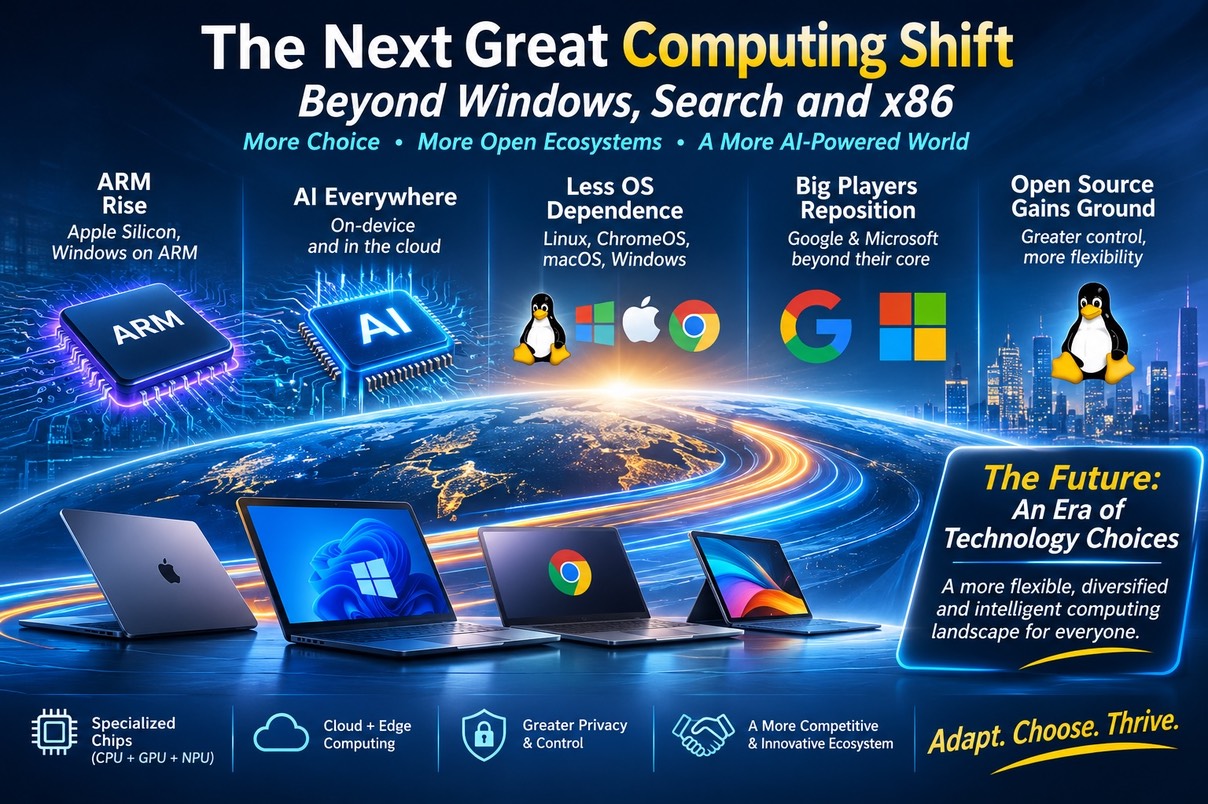
Artificial intelligence is challenging how employees interact with applications. ARM processors are providing credible alternatives to traditional x86 computing. Cloud services have made many applications less dependent on operating systems. Open-source technologies are expanding the range of enterprise choices.
Meanwhile, major technology companies are investing heavily in specialized processors, AI models, and new platforms to defend their positions.
Most commentary treats these developments as separate technology trends.
I believe that misses the larger point.
We are moving from an era in which enterprises purchased technology ecosystems to one in which they can increasingly assemble their own.
The real question is whether organizations will use this freedom to improve their competitive position or simply exchange one form of dependence for another.
The Hidden Cost of Enterprise Technology Standardization
Standardization has always been one of the central principles of enterprise IT.
It simplifies procurement, training, security management, support, and integration. For a large organization operating across multiple countries, these benefits are substantial.
But standardization also creates concentration.
Consider a hypothetical global manufacturer with 20,000 employees, dependent on one vendor for productivity software, operating systems, identity management, collaboration, and a significant portion of its cloud infrastructure.
A 10% increase in a hypothetical annual technology contract worth $20 million represents an additional $2 million in recurring expenditure.
That is not necessarily a problem if the organization receives corresponding value.
The problem arises when the organization has limited ability to reject the increase, reduce its consumption, or move workloads elsewhere without substantial disruption.
At that point, a procurement decision has become a strategic dependency.
I have long believed that the quality of an enterprise technology decision cannot be measured solely by how efficiently it solves today's problem.
It must also be judged by how much freedom it preserves for tomorrow.
The next computing transition makes that distinction increasingly important.
AI Is Changing Who Controls the Enterprise Workflow
The most disruptive aspect of AI may not be its ability to generate text, summarize documents, or write code.
It is the possibility that employees will no longer need to interact directly with many of the applications they use today.
Consider a finance executive preparing a quarterly business review.
Traditionally, the process involves extracting data, working in spreadsheets, creating presentations, reviewing reports, and distributing conclusions.
An AI-enabled workflow could begin with a single instruction:
"Review the quarter's performance, identify the largest deviations from plan, explain the likely causes, and prepare a management summary."
The employee is no longer selecting applications.
The employee is specifying a business outcome.
The applications, databases, and analytical tools may still exist, but the interface through which the employee interacts with them changes.
This is why Microsoft's investment in Copilot and Google's investment in Gemini are strategically important.
They are not simply adding AI features.
They are competing to remain central to how work gets done.
For Microsoft, the challenge is protecting the relevance of its established productivity ecosystem as interaction shifts toward AI-assisted workflows.
For Google, the challenge is protecting the economics of information discovery as users increasingly receive synthesized answers instead of navigating conventional search results.
Both companies understand that controlling the interface can be as valuable as controlling the underlying application.
For enterprise leaders, this raises an uncomfortable question.
If an AI assistant becomes the primary interface for employees, who controls the relationship between the organization, its information, and its business processes?
That question deserves more attention than the number of AI licenses deployed.
ARM Versus x86: Why Processor Choice Has Become a Business Decision
For decades, processor architecture was largely invisible to enterprise boards.
Most business computers operated on x86 processors supplied by Intel or AMD. The choice was familiar, supported, and commercially convenient.
Apple's transition to its own ARM-based silicon demonstrated that a major computing platform could move away from this convention.
Qualcomm's ARM-based Windows processors have expanded the range of alternatives available to business users.
The significance is not that ARM will eliminate x86. I do not expect that outcome.
The significance is that organizations have more credible options.
ARM-based devices may offer advantages in energy efficiency, battery life, and integrated processing capabilities.
x86 remains highly relevant for established applications, workstations, and demanding computing environments.
The boardroom implication is straightforward.
Why should every employee receive the same class of computer when their requirements differ?
A field executive, financial analyst, software engineer, and contact-center employee may have very different needs.
A role-based device strategy could improve total cost of ownership, employee experience, and operational efficiency.
However, there is a catch.
A device with impressive battery life is commercially useless if it cannot reliably run essential enterprise applications, security software, or management tools.
Technology leadership must evaluate the complete business environment, not isolated hardware specifications.
The winning architecture will not necessarily be the newest.
It will be the one that delivers the required outcome at the lowest sustainable cost and acceptable risk.
AI PCs and the Economics of Local Versus Cloud Intelligence
The emergence of AI-capable computers adds another dimension to enterprise decision-making.
Modern devices increasingly include specialized processors capable of handling certain AI workloads locally.
This creates an opportunity to reconsider where information should be processed.
Some activities, such as document summarization, transcription, and selected forms of information retrieval, may be suitable for local processing.
More demanding analysis and enterprise-wide AI workflows may continue to rely on cloud infrastructure.
The likely future is a combination of both.
This matters because every cloud-based AI interaction can carry costs relating to computing, data movement, security, and infrastructure consumption.
Local processing may reduce some of those costs while improving responsiveness and limiting the movement of sensitive information.
But local AI is not automatically cheaper or more secure.
Organizations must account for device replacement costs, management requirements, model quality, and the controls needed to protect information.
A new laptop with an AI processor does not create business value merely because it has an AI label.
The value appears when a defined workload becomes faster, cheaper, more reliable, or more secure.
That distinction should guide procurement.
Custom Silicon Is Changing the Economics of Cloud Computing
Another important shift is happening inside the data center.
Apple, Google, Microsoft, Amazon, and NVIDIA are pursuing different strategies around specialized computing hardware.
Google has developed Tensor Processing Units. Amazon offers Graviton and Trainium. Microsoft has introduced its Maia and Cobalt silicon initiatives. NVIDIA has built an extensive accelerated computing ecosystem.
The underlying business logic is clear.
Different workloads benefit from different computing architectures.
General-purpose processors remain important, but AI training, inference, and other demanding workloads may be handled more efficiently by specialized hardware.
For cloud providers, this is a question of performance, capacity, margins, and infrastructure economics.
For enterprise customers, it creates both opportunity and risk.
Specialized infrastructure may reduce the cost of certain workloads.
But it may also deepen dependence on a particular cloud provider's services, tools, and pricing model.
The lowest quoted processing price is not necessarily the lowest long-term business cost.
Boards should pay attention to the economics of complete workloads, including data movement, integration, resilience, and the cost of changing providers.
The next competitive advantage in cloud computing may come less from raw processing power and more from the ability to deliver useful computing at sustainable economics.
Linux, Open Source, and the Return of Digital Sovereignty
There is a tendency to treat open source as a technical preference or a way to reduce software licensing costs.
That is too narrow.
Open-source technologies can provide greater visibility into software, more flexibility in deployment, and alternative sources of support.
For governments, they can also contribute to digital sovereignty.
Consider the public-sector initiatives in Germany's Schleswig-Holstein state, where authorities have pursued a transition toward open-source alternatives.
The important lesson is not that every government should abandon proprietary software.
It is that governments and enterprises are increasingly willing to question dependencies once considered unavoidable.
Digital sovereignty is not simply about where data is stored.
It concerns who can access critical systems, who controls the software roadmap, which jurisdictions apply, and whether essential services can continue when commercial or geopolitical conditions change.
For multinational enterprises, these concerns are becoming part of operational resilience.
However, open source is not free from cost or risk.
Migration, training, support, security maintenance, and integration require investment.
An unsupported open-source environment can be more expensive and dangerous than a well-managed proprietary platform.
The correct objective is not ideological independence.
It is practical control over critical capabilities.
The Software Subscription Model Faces a Value Test
Enterprise software vendors have benefited enormously from recurring subscription revenue.
Customers receive updates, support, and access to continually evolving capabilities.
Vendors receive predictable income and stronger commercial relationships.
But AI is introducing another layer of subscription spending.
Organizations may now pay additional fees for AI assistants, advanced analytics, automation, and specialized productivity capabilities.
This raises a fundamental question.
Are enterprises buying measurable productivity improvements, or simply paying more to retain access to increasingly complex software ecosystems?
Imagine an organization purchasing 10,000 AI add-on licenses at a hypothetical $25 per user per month.
That represents $3 million in annual expenditure.
If only a small percentage of employees use those capabilities meaningfully, the investment case becomes difficult to defend.
The relevant measure is not the number of licenses activated.
It is the economic value generated.
A board should expect evidence of reduced processing time, improved output quality, lower operating costs, or increased revenue capacity.
Subscription revenue may be attractive to vendors.
But recurring customer value must remain the foundation of a sustainable commercial relationship.
The Boardroom Framework: Six Decisions That Matter
I would encourage boards and CEOs to examine the next computing transition through six practical decisions.
These are not instructions to replace established systems. They are a way to ensure that technology strategy remains aligned with business interests.
1. Challenge default technology standards
Require management to explain why existing platform choices remain appropriate for different employee groups and business processes.
Standardization should be a conscious decision supported by economics, not an inherited policy.
Board question: Which technology standards would we choose differently if we were starting today?
2. Measure strategic vendor dependence
Identify the vendors whose commercial, technical, or operational decisions could materially affect the organization.
Review switching costs, contractual flexibility, concentration risk, and credible alternatives.
Board question: Which supplier relationships have become too difficult or expensive to change?
3. Make AI investments accountable to business outcomes
Evaluate AI spending against defined operating improvements.
Track cost per completed task, quality, employee capacity, and measurable financial benefits.
Board question: What business result justifies the next increase in AI expenditure?
4. Preserve flexibility in AI and cloud architecture
Avoid unnecessary commitments that make future changes prohibitively expensive.
Where commercially sensible, retain the ability to change models, services, or infrastructure providers.
Board question: Could we change a critical AI supplier without rebuilding the underlying business process?
5. Reconsider where computing takes place
Evaluate the financial and operational implications of local, cloud, and hybrid processing.
Include privacy, reliability, energy consumption, and the total cost of ownership.
Board question: Are we processing information in the most economically and operationally appropriate environment?
6. Review software subscriptions as investments
Challenge unused licenses, overlapping functionality, automatic upgrades, and AI premiums without demonstrable value.
Evaluate the cost of achieving a business outcome rather than the cost of individual products.
Board question: Which recurring technology expenses would fail a fresh investment review?
These six decisions can be reviewed annually alongside capital allocation, cybersecurity, and enterprise risk.
They also give the board a way to discuss technology strategy without becoming involved in technical implementation.
The Counterargument: More Choice Can Mean More Complexity
There is an important qualification.
A more open computing environment is not automatically a better one.
Multiple operating systems, cloud platforms, AI models, and software providers can increase integration costs and complicate accountability.
A tightly integrated ecosystem may still be the best option for many organizations.
Apple's model demonstrates the value of controlling the complete experience. Microsoft's enterprise ecosystem continues to offer substantial advantages in compatibility, management, and support.
The objective should never be maximum diversity.
It should be maximum strategic flexibility consistent with operational discipline.
An enterprise that adopts five competing technologies without clear ownership may end up with higher costs and weaker security.
Equally, an enterprise that relies on one provider for everything may discover that convenience has become dependency.
The difficult leadership decision is knowing where standardization creates value and where competition preserves it.
That balance will vary by industry, geography, regulatory exposure, and business model.
What the Next Five Years Could Look Like
I expect the next three to five years to bring a more diverse enterprise computing environment rather than a wholesale replacement of established platforms.
Windows will remain important. x86 processors will continue to serve demanding workloads. Microsoft, Google, Apple, Amazon, and other major providers will retain considerable influence.
But the boundaries between their traditional markets will become less rigid.
More organizations will evaluate ARM devices for selected roles.
AI processing will be distributed between local devices and cloud infrastructure.
Open-source alternatives will receive greater attention, particularly where sovereignty, flexibility, or licensing economics matter.
Enterprises will increasingly consider multiple AI models rather than assume one model should handle every business requirement.
Software subscriptions will face closer financial scrutiny.
Perhaps most importantly, AI assistants may increasingly become the interface through which employees interact with enterprise systems.
That shift could redistribute economic power across the technology industry.
The companies controlling applications may not always control the user relationship.
The companies supplying processors may not always control the computing platform.
And the companies providing AI models may not necessarily capture the largest share of enterprise value.
The Real Competitive Advantage Is the Ability to Choose
Technology leadership has never been about selecting the most fashionable platform.
It is about making decisions that enable the business to perform, adapt, and compete.
The next computing revolution will offer organizations more choices than they have had in decades.
But choice alone does not create advantage.
It requires disciplined architecture, financial accountability, commercial awareness, and the willingness to question long-standing assumptions.
I would not advise a CEO to abandon Microsoft, Google, Windows, x86, or any other established technology simply because alternatives are emerging.
I would advise that CEO to understand precisely where the organization depends on those platforms, what that dependence costs, and what credible alternatives exist.
The greatest risk is not choosing the wrong technology. It is building an enterprise that can no longer afford to choose differently.
For boards and CEOs, that may be the most important lesson of the next computing transition.
Where has technology standardization created genuine competitive advantage in your organization, and where has it quietly become a constraint?
Subscribe to TechnologyTrends for practical perspectives on enterprise technology, leadership, and the business decisions behind the next wave of innovation. Share your experience in the comments.