
Sanjay K Mohindroo
AI is not eliminating jobs—it is shifting value across roles. A strategic perspective on who wins, who struggles, and what leaders must do now.
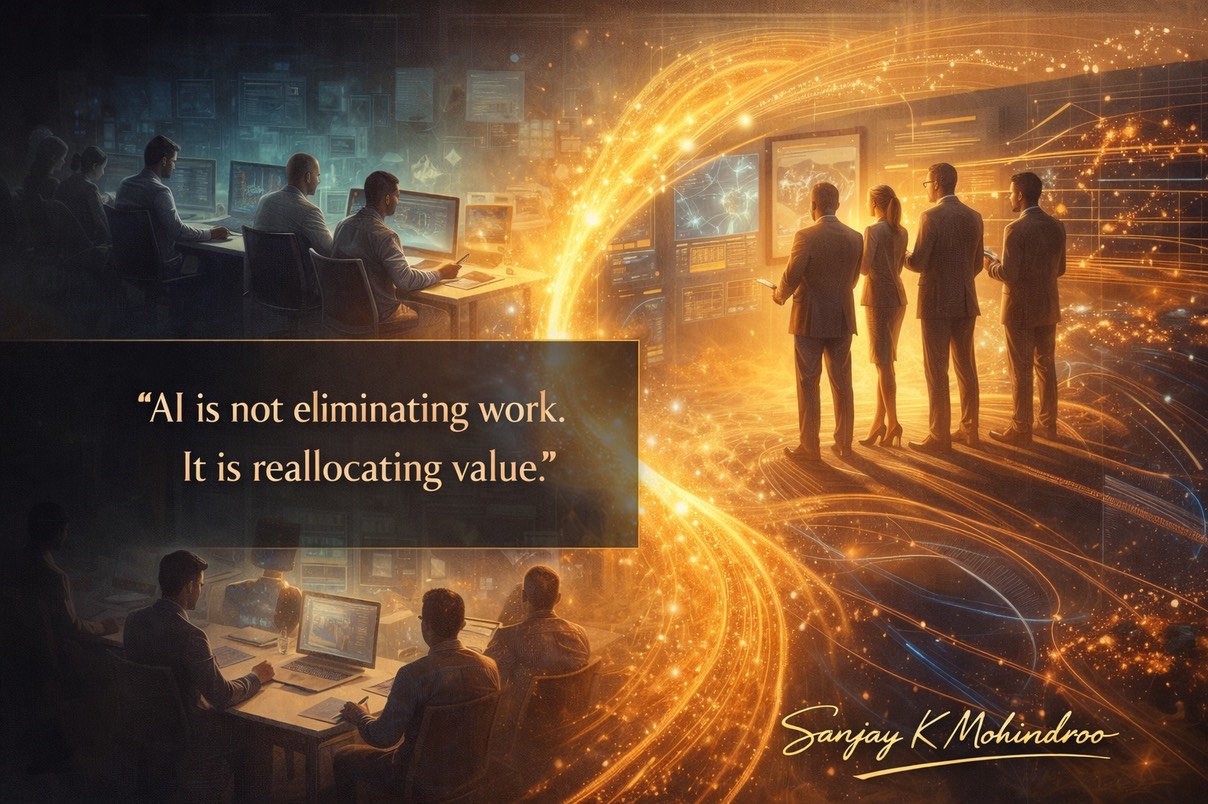
AI is not eliminating work. It is shifting
where value sits inside organizations.
Execution is becoming cheaper. Judgment, context, and systems thinking are becoming
scarce.
The winners will not be those who work harder. They will be those who move closer to decision-making and value creation.
This shift is already underway. Most organizations just haven’t labeled it yet.
The Quiet Shift Leaders Are Missing
In boardrooms, the conversation still circles a
familiar concern:
“Which jobs will AI replace?”
It’s the wrong question.
After three decades of leading technology transformations across industries, I’ve learned that disruption rarely announces itself clearly. It shows up as small shifts in relevance. A role loses a bit of influence. A team becomes slightly less central. Decisions move elsewhere.
And then one day, the structure looks completely different.
That’s what AI is doing right now.
Not with noise. With precision.
The real shift is not job loss.
It is value migration.
And if you don’t track where value is moving, you will miss where your organization is weakening. #Leadership #AI #CIO
Blue Collar Work Is Not Disappearing. It Is Being Elevated
From effort to oversight
On the ground, the change is visible but often misunderstood.
Machines are taking over repetitive execution. That part is clear. What is less discussed is what replaces it.
The role is not vanishing. It is being reshaped.
Work is moving from:
- Doing tasks
- To manage machines that perform those tasks
This sounds incremental. It is not.
The skill set shifts from physical execution to:
- Interpreting machine output
- Diagnosing issues
- Adjusting processes in real time
The gap between those who adapt and those who don’t will widen quickly.
I’ve seen this pattern before in manufacturing transformations. The highest performers were not the fastest operators. They were the ones who understood the system behind the machine.
That principle now applies across sectors.
White Collar Work Is Facing Its First Real Compression
Execution is no longer a differentiator
For years, white-collar roles were protected by complexity.
Writing reports, analyzing data, and creating presentations—these were considered skilled tasks.
AI has changed that equation almost overnight.
Execution is becoming:
- Faster
- Cheaper
- Widely accessible
Which means it is losing value.
The real shift is subtle but powerful:
From:
- Completing tasks
To:
- Defining the right problems
That distinction separates relevance from redundancy.
AI can generate answers at scale.
It cannot determine which questions matter in a business context.
That requires:
- Judgment
- Context
- Experience applied with clarity
This is where leaders must recalibrate expectations.
High output is no longer impressive.
High-quality thinking is.
#FutureOfWork #DigitalTransformation
Middle Management Is at an Inflection Point
Coordination is being automated out of existence
If there is one layer where the impact will be most visible, it is middle management.
For decades, organizations relied on managers to:
- Track progress
- Coordinate teams
- Escalate issues
- Consolidate reporting
AI is quietly absorbing much of this.
Dashboards replace status meetings.
Automation replaces follow-ups.
Real-time data replaces summaries.
This creates an uncomfortable reality.
Managers who rely on coordination as their core value will find themselves squeezed.
The role is not disappearing. It is evolving.
The new expectation is clear:
- Design systems
- Enable flow of work
- Remove friction at scale
In simple terms, managers must shift from controlling work to architecting work.
That is a very different capability.
Leadership Is Entering a Continuous Strategy Cycle
Planning is no longer periodic
At the executive level, the shift is more strategic—and more demanding.
AI is accelerating:
- Market signals
- Competitive moves
- Customer expectations
The traditional planning cycle is under pressure.
Annual strategy reviews are starting to look outdated in fast-moving environments.
The new reality is continuous adaptation.
Leaders must now:
- Reassess assumptions more frequently
- Make decisions with incomplete data
- Act faster without losing direction
This is not about reacting. It is about staying aligned while the ground moves.
In my experience, the leaders who succeed here are not the most technical. They are the ones who maintain clarity under pressure.
AI amplifies complexity. Leadership must simplify it.
#CIO #BusinessStrategy #AILeadership
AI Is Not Eliminating Jobs. It Is Exposing Mediocrity
The real disruption is not where most people are looking
There is a widely accepted narrative:
AI will replace jobs, and new jobs will emerge.
That framing is incomplete.
What AI is actually doing is exposing the difference between:
- Value creators
- Task performers
Average performance used to be sustainable. Organizations had enough inefficiency to absorb it.
That buffer is shrinking.
AI does not tolerate mediocrity well. It replaces it quietly.
This is uncomfortable but necessary to acknowledge.
Experience alone is losing weight.
Effort alone is not enough.
Titles do not guarantee relevance.
What matters now is:
- Clarity of thinking
- Ability to adapt
- Ownership of outcomes
This is not a technology shift. It is a performance shift.
And most organizations are not ready to address it openly.
Strategic Takeaways for Leadership
The implications are direct and actionable:
- Reevaluate role design
Focus on where value is created, not just where work happens
- Invest in thinking capabilities
Problem framing and decision-making must be developed deliberately
- Redefine management expectations
Move from coordination metrics to system effectiveness
- Shorten strategy cycles
Build mechanisms for continuous alignment, not periodic reviews
- Address performance honestly
AI will expose gaps. Leadership must respond with clarity, not avoidance
Direction Will Decide Outcomes
AI is not a future concern. It is a present force.
The shift is already underway. It is just uneven.
Some roles are evolving rapidly. Others appear stable—for now.
But the direction is clear.
Value is moving:
- Away from execution
- Toward judgment and system thinking
Organizations that align early will gain a disproportionate advantage.
Those who delay will not fail immediately. They will drift.
And drift is far more dangerous than disruption.
Because by the time it is visible, it is already late.
#AI #Leadership #CIO #FutureOfWork #DigitalTransformation #BusinessStrategy #WorkforceTransformation #EnterpriseAI #ExecutiveLeadership #TechnologyLeadership