
Sanjay K Mohindroo
AI should multiply workforce capability, not just cut headcount. A board-level framework for automation, cognitive capital, governance, risk, and growth.
In three decades of enterprise technology, I have seen one pattern repeat: when a new technology arrives, management first tries to force it into the economics of the old operating model.
With AI, that usually becomes one question: “How many FTEs can we remove?”
That question is measurable, board-friendly, and dangerously incomplete.
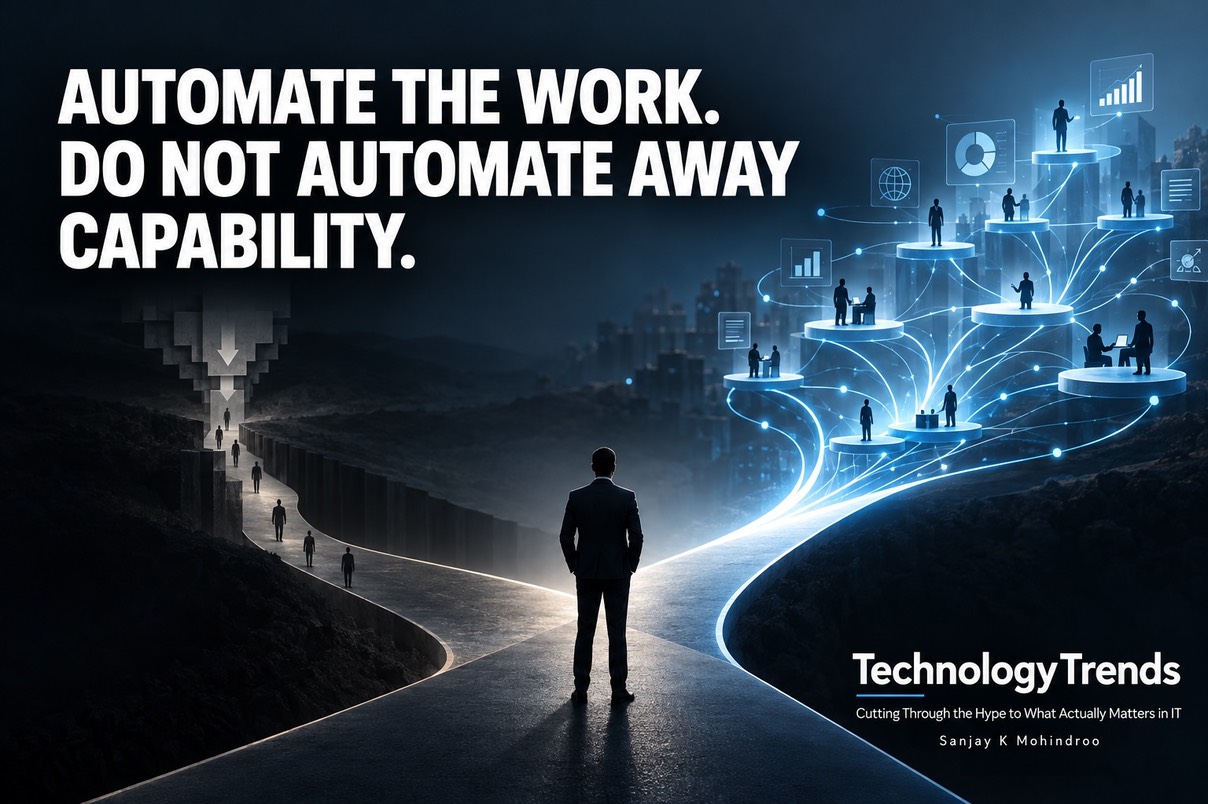
The conventional wisdom says AI transformation should convert automation directly into labor savings. My view is the opposite: if your first AI KPI is headcount reduction, you may destroy the very business capability that makes the technology valuable.
AI Transformation Is Not Workforce Reduction
There is no point pretending AI will not eliminate work. It will.
Some tasks will disappear. Some roles will shrink. Some positions will ultimately become unnecessary. Boards should expect that.
But workforce reduction should be an outcome of transformation, not the definition of transformation.
Consider a team of 100 people. AI removes 30 percent of repetitive work. The traditional response is simple: reduce the team by 30.
The better question is harder: what could the same 100 people achieve with 30 percent more capacity?
Could they serve more customers, reduce risk, accelerate product launches, improve quality, enter new markets, or solve problems the organization has been postponing for years?
That released capacity is not waste. It is an asset.
If management turns every productivity gain immediately into a cost reduction, it captures only one form of value, and often the least strategic one.
The Hidden Asset on the Balance Sheet
Experienced employees carry something most automation business cases fail to price: institutional knowledge.
They know which customer exception matters, which report is unreliable, which supplier requires escalation, which control cannot be bypassed, and why a process that looks inefficient was designed that way in the first place.
AI can process the documented procedure. It does not automatically inherit the undocumented judgment around it.
This matters because a company can save salary costs while simultaneously weakening its operating system.
I call that cognitive capital: the accumulated domain knowledge, judgment, exception-handling ability, historical context, and decision experience that allows an organization to function when the standard process breaks.
Boards track financial capital, physical capital, technology assets and intellectual property. They should start asking whether AI transformation is increasing or decreasing cognitive capital.
The real risk is cognitive debt.
Technical debt appears when shortcuts create future engineering cost. Cognitive debt appears when an organization outsources too much thinking to machines and no longer retains enough human capability to challenge, explain, or recover the process.
You see it when teams cannot operate without AI, experts disappear, exception handling deteriorates, or nobody can reconstruct why a decision was made.
That is not efficiency. It is dependency.
The Four-Layer AI Operating Model
A mature AI strategy needs four systems working together.
First, AI automation: what can machines execute reliably?
Second, human capability: what must people continue to understand and be able to do?
Third, workforce transformation: how do today’s roles evolve into AI-enabled roles?
Fourth, AI governance: what is AI allowed to do, with what data, under what conditions, and with what degree of autonomy?
Most companies over-invest in the first layer because it produces the easiest business case.
That is precisely the mistake.
Higher automation combined with lower human capability and weaker institutional knowledge creates a more fragile enterprise, not a more advanced one.
The Board Must Govern Autonomy, Not Just Adoption
The next phase of enterprise AI is not simply copilots. It is agents that can analyze, decide and execute across workflows.
That changes the governance question.
The issue is no longer only, “Can AI do this?”
It becomes, “Should AI do this, and what happens to human capability if it does?”
Autonomy should rise with evidence, predictability, reversibility and control, not merely because the model is technically capable.
A low-risk reconciliation process may justify bounded autonomy. A regulatory interpretation, strategic pricing decision or crisis response may not.
And “human in the loop” is not a sufficient control if the human merely clicks approve repeatedly.
For important decisions, management needs to define where humans intervene, what exceptions trigger escalation, who remains accountable, and whether the organization can still operate if the AI is unavailable.
One simple test is an AI-off exercise.
Can the team still diagnose the problem, perform the critical process, handle exceptions, and explain the reasoning behind a decision?
If the answer is no, the organization may have automated faster than it has learned.
A Six-Part Board Framework for AI Capability
I would ask boards and CEOs to apply six principles to every major AI transformation.
1. Automate work, not capability
Automate repetitive, low-value work aggressively. But identify the human expertise embedded in the process before it disappears.
The right question is not whether AI can perform the task. It is whether the organization can afford to lose the capability associated with it.
2. Upskill before you replace
Give experienced employees AI tools before concluding that their role is redundant.
The people who know the process are often the best people to teach the organization how to redesign it. They know the exceptions, dependencies, and workarounds that formal documentation misses.
3. Redeploy capacity before reducing capacity
Every successful automation creates an AI dividend.
If a process once consumed one million hours and AI reduces that to 600,000, management has created 400,000 hours of capacity.
Some of that capacity may eventually become cost reduction. But first ask whether it can generate revenue, improve customer experience, accelerate innovation, strengthen controls, or open new markets.
4. Preserve human judgment
Not every decision deserves the same degree of automation.
Routine, reversible work can move toward autonomy faster. High-impact decisions need stronger human judgment, escalation, and accountability.
The objective is not to keep humans clicking approval buttons. It is to keep human judgment where it creates economic and risk value.
5. Increase autonomy with evidence
AI agents should earn greater authority through demonstrated reliability.
Track success rates, escalation rates, intervention rates, policy violations, reversals, and business outcomes.
Build what I would call an agent flight recorder: an auditable history of what the agent was asked to do, what data and tools it used, what actions it took, where humans intervened, and what outcome resulted.
Autonomy without evidence is not innovation. It is unmanaged operational risk.
6. Measure capability, not just cost
If executives are rewarded mainly for FTE reduction, AI will become a headcount program.
The scorecard must be broader: hours saved, cycle-time improvement, quality, exception rates, revenue enabled, new capacity, critical-skill retention, institutional knowledge captured, internal mobility and AI-off resilience.
The objective is not maximum automation.
It is maximum business value per unit of human capability.
The Counter-Argument: What If Cost Reduction Is the Goal?
There are situations where headcount reduction is economically rational.
If work is repetitive, low-risk, well-documented, easily reversible, and carries little strategic knowledge, aggressive automation may be exactly the right decision.
The mistake is not reducing cost.
The mistake is treating all work as if it has the same capability value.
Boards should distinguish between low-value labor that can be removed and high-value expertise that should be amplified.
That distinction is where strategy begins.
The CEO Question Has to Change
The old question is easy:
“How many people can AI replace?”
The better question is more demanding:
“If AI gave us 30 percent more organizational capacity without increasing the workforce, what could we accomplish that we cannot accomplish today?”
That question changes the investment case.
It connects AI to growth, customer acquisition, product expansion, resilience, quality and competitive advantage.
It also changes accountability. Management can no longer declare victory because a cost line fell. It has to show that the enterprise became more capable.
The strongest AI operating model is therefore not:
Automate → Eliminate
It is:
Automate → Augment → Upskill → Redeploy → Transform → Grow
That sequence does not reject efficiency. It captures efficiency without automatically sacrificing capability.
AI will remove work. It should.
But if the people who understand the business become the first casualties of automation, the company may discover too late that it automated away the knowledge required to run the business well.
The board-level measure of AI success should not be, “How many people did we replace?”
It should be, “How much more capable did the organization become?”
Where do you draw the line between legitimate automation-driven cost reduction and dangerous loss of human capability?
Subscribe to TechnologyTrends, or share your view in the comments.