
Sanjay K Mohindroo
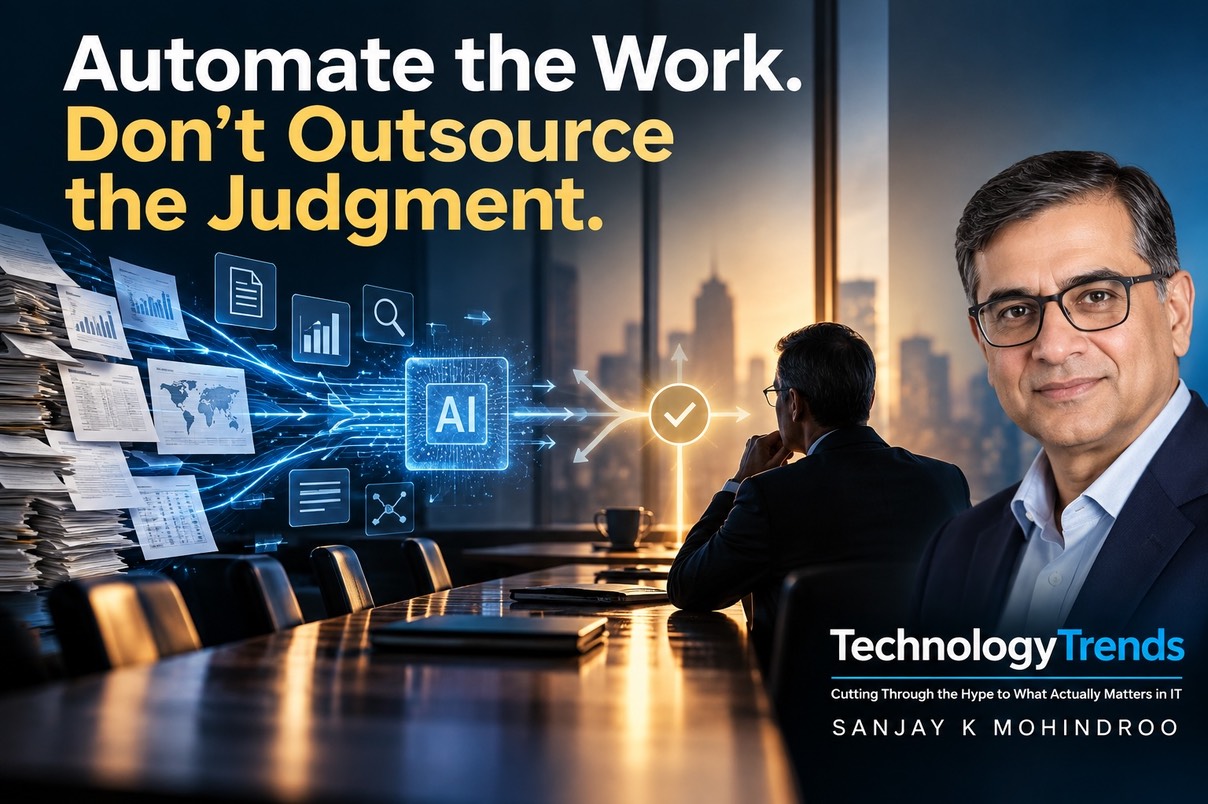
AI adoption is not about automating the most work. Boards must decide which tasks AI should execute and which judgments humans must retain.
After three decades in enterprise IT, I have seen organizations repeatedly make the same mistake with new technology: they measure adoption before they define what success should actually mean.
AI is creating the biggest version of that mistake yet.
Boards are being shown numbers such as AI users, copilots deployed, hours saved, processes automated, and productivity gained. All useful measures.
But they avoid the harder question:
What part of the organization’s thinking are we handing over?
That question matters far more than how many employees are using ChatGPT, Copilot, or an AI agent.
The conventional wisdom today is that the organizations using AI most aggressively will win.
I think that is incomplete.
The organizations that win will be those that automate aggressively without outsourcing the judgment that creates competitive advantage.
AI Adoption Is Not the Same as AI Maturity
Consider a simple example.
Imagine an investigation involving 7,000 pages of documents, of which perhaps 1,000 contain material evidence.
A capable AI system can read, classify and correlate those pages much faster than a senior executive, lawyer, auditor or analyst ever could.
That is exactly what it should do.
But there are two very different ways to use it.
In the first:
“Read everything and tell me what happened.”
In the second, the human first establishes what appears important, develops an initial hypothesis, identifies relevant relationships and then asks AI to search the full corpus for evidence that supports, contradicts or completely overturns that reasoning.
The computational workload is largely the same.
The cognitive architecture is completely different.
In the first model, AI increasingly defines the problem and constructs the interpretation.
In the second, AI expands the human decision-maker’s ability to investigate the problem.
That distinction is the difference between cognitive substitution and cognitive amplification.
Boards should care about it.
The Wrong AI Metric: How Much Work Did We Eliminate?
The dominant enterprise AI conversation is still centered on efficiency.
How many hours did we save?
How many people can one AI-enabled employee replace?
How much faster can reports, code, presentations, or customer responses be produced?
Those questions are legitimate. They are simply not sufficient.
The more important question is:
Which human capabilities no longer get exercised because AI is now performing them?
Humans have always outsourced cognitive work.
Calculators outsourced arithmetic.
Spreadsheets outsourced large-scale calculation.
Search engines outsourced much of information retrieval.
GPS outsourced a significant amount of navigation.
AI is different because the range of cognition that can now be delegated is dramatically broader.
Research. Summarization. Analysis. Writing. Planning. Coding. Hypothesis generation. Evaluation. Increasingly, action itself.
The danger is therefore not that employees use AI too much.
Someone can use AI eight hours a day and remain intellectually sharp.
Another person can use it for thirty minutes and outsource the most important part of the decision.
The critical issue is not how much AI you use. It is what layer of cognition you delegate.
The Five Layers Boards Should Distinguish
I would separate enterprise cognitive work into five layers.
1. Execution
Formatting, transcription, routine correspondence, data cleaning, scheduling, document conversion, and repetitive processing.
Automate aggressively.
There is little strategic value in asking expensive human talent to continue performing work that machines can perform reliably.
2. Information processing
Searching, summarizing, extracting, translating, comparing, classifying, and organizing information.
Again, AI has enormous structural advantages.
This is where AI can remove hours of low-value cognitive labor.
3. Analysis
Pattern detection, anomaly identification, modelling alternatives, correlating information, generating hypotheses and exploring scenarios.
AI should play a major role here, but human scrutiny becomes increasingly important.
The machine can widen the search space. It should not automatically own the conclusion.
4. Problem framing
What problem are we actually trying to solve?
Which variables matter?
What are we optimizing?
Which assumptions are embedded in the question?
What information are we missing?
This is where leadership begins.
An organization that becomes excellent at answering badly framed questions faster has not become smarter.
5. Judgment
What should we believe?
What should we do?
Which trade-off is acceptable?
What risk are we prepared to take?
When should we act?
Who is accountable when the decision is wrong?
This is the layer organizations should be most careful about surrendering.
AI can inform judgment.
It can challenge judgment.
It can expose blind spots in judgment.
But accountability cannot be delegated to an algorithm simply because analysis has become automated.
AI-First Execution, Human-First Judgment
This leads to a principle I believe boards should consider explicitly:
AI-first execution. Human-first judgment.
This does not mean humans should approve every decision made by an AI system.
That would destroy much of the economic value.
If an AI agent can reconcile thousands of low-risk transactions accurately, there is no reason for a manager to manually approve each one.
Instead, human control moves upstream.
Management defines:
1. the objective,
2. the constraints,
3. acceptable risk,
4. decision rights,
5. escalation thresholds,
6. and accountability.
AI can then operate with considerable autonomy inside those boundaries.
That is a fundamentally stronger governance model than either extreme: humans approving everything or AI deciding everything.
A Four-Step Discipline for High-Stakes AI
For consequential work, I use a simple mental model:
Think → AI → Challenge → Decide
1. Think
Before opening the AI tool, establish an independent position.
What do I currently believe?
Why?
What evidence supports it?
What assumptions am I making?
What could prove me wrong?
Even five minutes of independent thinking creates something extremely valuable: a baseline against which the AI output can be tested.
Without that baseline, the first plausible answer generated by the machine can easily become the frame through which the entire problem is subsequently viewed.
2. AI
Now exploit what machines do exceptionally well.
Search more information than you could manually inspect.
Correlate documents.
Generate scenarios.
Find anomalies.
Compare alternatives.
Explore adjacent possibilities.
The objective is not to make the AI agree with you.
It is to expand the decision space.
3. Challenge
This may be the most underused part of enterprise AI.
Ask the model:
“What is wrong with this analysis?”
“What assumptions are unsupported?”
“What evidence contradicts the conclusion?”
“Assume my hypothesis is wrong. What would we expect to find?”
“What alternative explanation best fits the evidence?”
An AI system is potentially far more valuable as an intellectual adversary than as a confirmation engine.
4. Decide
Then turn the machine off mentally.
The final question should never be:
“What did the AI recommend?”
It should be:
“Having considered the evidence, what do we believe, what will we do, and who owns the decision?”
That is management.
The AI Strategy for an Expert Should Be Different
There is another mistake I see emerging.
Organizations are trying to create a single model of “AI literacy” for everyone.
That misses an important distinction.
A novice and an expert should not use AI in the same way.
A novice does not yet possess a strong mental model. If AI supplies the explanation, reasoning, and conclusion immediately, the novice may receive an excellent answer while learning surprisingly little.
For a novice, AI should behave more like a tutor.
Learn. Attempt. Receive feedback. Correct. Practice.
For an experienced practitioner, AI can be used more aggressively for research, comparison, analysis, preparation, and scenario generation.
For an expert, the opportunity becomes much larger.
An expert already possesses a mental model.
The real value of AI is then not merely answering questions faster. It is allowing the expert to test that mental model against vastly more information than was previously possible.
That means searching thousands of documents, exploring competing hypotheses, monitoring emerging developments, finding unexpected relationships, and attacking assumptions developed over decades of experience.
The optimal model is:
Expert mental model + AI computational breadth
Not:
AI mental model + human approval
The first amplifies expertise.
The second eventually commoditizes it.
The Counter-Argument: Why Not Let AI Make Better Decisions?
There is an obvious challenge to this argument.
What if AI eventually makes certain decisions more accurately than humans?
Then we should absolutely let it.
Machines already outperform humans in many narrow activities, and the boundary will continue moving.
The objective is not to preserve human involvement for sentimental reasons.
Nobody should manually read 7,000 pages merely to prove that humans remain useful.
The objective is to distinguish between decision execution and decision accountability.
If AI reliably makes a class of operational decisions better than people, automate them.
But somebody still needs to decide what the system is optimizing, which data it can use, how much risk it can accept, when exceptions require escalation and when the system should be stopped.
AI does not eliminate governance.
It moves governance upward.
The AI-Off Test
There is one simple test I would encourage senior leaders to apply periodically.
Take an important task that you or your team now perform with AI.
Remove the AI.
Then ask:
Can we still define the problem?
Can we identify the relevant evidence?
Can we develop hypotheses?
Can we challenge an argument?
Can we explain the underlying logic?
Can we make the decision?
If the answer is yes, AI is probably amplifying capability.
If the answer becomes, “I would need to ask the AI,” you may be creating dependency.
That does not mean stopping AI adoption.
It means recognizing which capability now requires deliberate maintenance.
Boards Should Measure Capability Amplified, Not Just Work Eliminated
The AI transformation will not be won by organizations that keep humans busy doing work machines can perform better.
Nor will it be won by organizations that automate everything merely because they can.
The competitive advantage will come from understanding the boundary.
Let AI perform the work your people do not need to become exceptional at.
Use it aggressively for scale, speed, retrieval, correlation, processing and repetitive execution.
But protect the human capabilities that determine whether the organization is making the right decisions in the first place: context, problem framing, judgment, purpose, risk acceptance and accountability.
The ultimate measure of AI success should therefore not simply be:
How much human work did we eliminate?
A better question is:
How much human capability did we amplify?
Perhaps that is the question boards should now be asking their CEOs and CIOs.
Where is AI making your organization smarter, and where might it quietly be making the organization dependent?
If this resonates, subscribe to TechnologyTrends or share how your organization is drawing the line between AI execution and human judgment.