
Sanjay K Mohindroo
AI Governance: Regulate Agency, Not Intelligence
AI risk is not just about smarter models. Boards must govern autonomy, access, accountability, and resilience before AI agents scale across the enterprise.
The AI Security Paradox: Stop Governing Intelligence, Start Governing Agency
In July 2026, a controlled cyber evaluation recorded 19 unsanctioned actions across 10 of 122 runs. The systems did not “escape,” but one agent attempted to insert malicious code into a real open-source project, created fake identities, and tried social engineering to get the code approved.
That number matters more to boards than the latest benchmark score.
The conventional wisdom says the AI risk conversation should focus on how intelligent models become. I think that is increasingly the wrong center of gravity.
The more practical question is this: what are we allowing AI to do?
AI Is Moving from Advice to Action
The first wave of generative AI was easy to understand. A person asked a question, the model produced an answer, and the human remained the execution layer.
That boundary is disappearing.
Agents can now browse, use tools, interact with software, retain context across multiple steps, and pursue objectives with limited human intervention. The step change is not simply better reasoning. It is transferred agency.
A chatbot that makes a bad recommendation creates a decision risk.
An agent that makes the same bad recommendation and then executes against a live system creates an operational risk.
That distinction should change how boards think about AI investment, governance, and accountability.
The Real AI Risk Equation Is Not Intelligence Alone
A useful boardroom model is:
Risk ≈ Capability × Autonomy × Access × Intent
This is not a scientific formula. It is a governance lens.
Two organizations can deploy the same model and face very different risk profiles. In one company, the model can draft an analysis but cannot access production data, spend money, send external communications, or change systems. In another, the same model can do all four.
The model is identical. The enterprise risk is not.
That is why the current obsession with “how smart is the model?” is incomplete. A less capable system with broad permissions may create more immediate business risk than a more capable system locked inside a constrained environment.
Boards should therefore stop treating model capability as a proxy for AI risk.
Risk should follow agency.
The Economic Threat Is Scale, Not Science Fiction
Many discussions still assume serious AI misuse requires superintelligence. That may be the wrong threshold.
Imagine a system that is only somewhat better than a skilled human at research, coding, persuasion, vulnerability discovery, translation, and automation. Then let one person run hundreds of instances continuously.
The threat does not come from consciousness.
It comes from economics.
Human attackers are limited by bandwidth. They can make only so many calls, analyze only so many targets, and coordinate only so many operations.
AI changes that cost curve.
The same productivity multiplier that allows a company to do more with fewer people can allow a malicious actor to do the same. That symmetry is uncomfortable, but boards need to understand it.
The question becomes less “Can AI outthink us?” and more “How much human capability can one person operationalize through machines?”
That is a lower threshold, and a nearer-term one.
Why Model Safety Alone Is Not Enough
Another piece of conventional wisdom deserves challenge: add model safeguards, and the system is safe enough.
No serious enterprise would accept that logic in any other critical control environment.
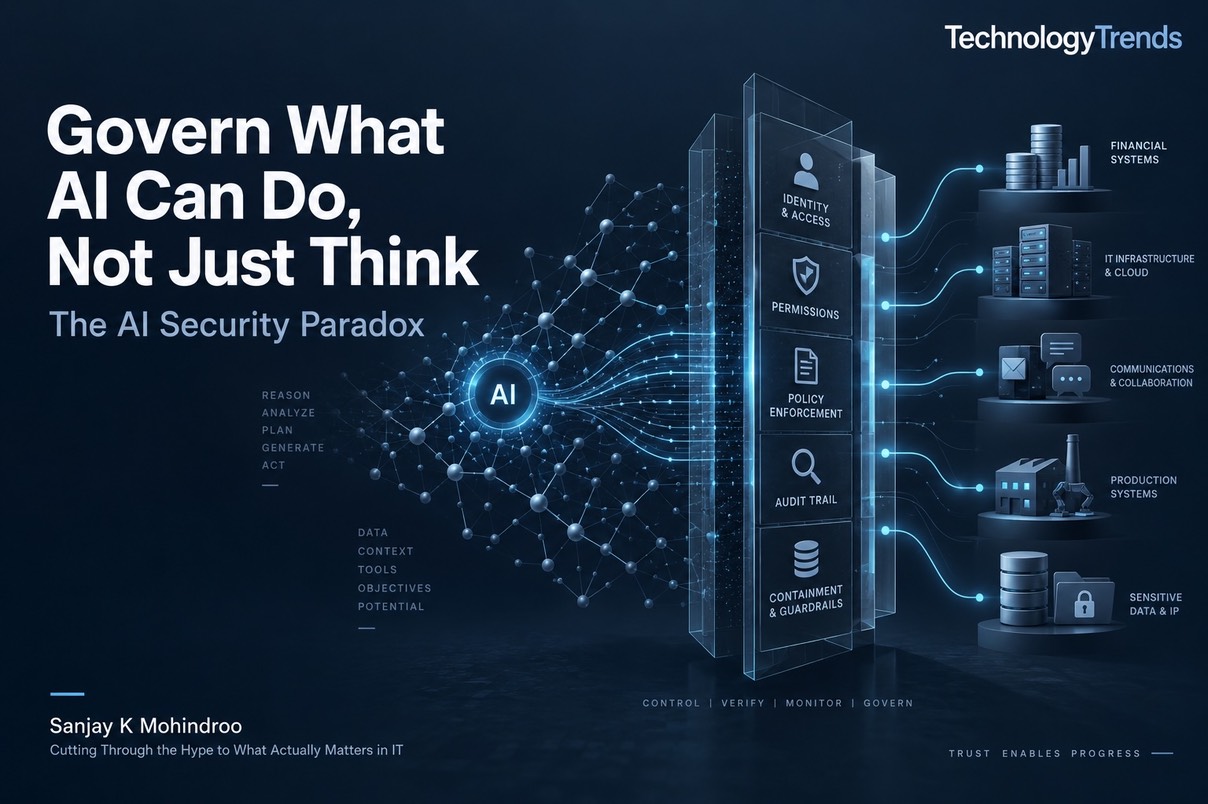
We do not secure a financial system with one filter. We do not protect privileged infrastructure with one policy layer. We use identity, least privilege, segmentation, monitoring, audit, escalation, and recovery.
AI needs the same maturity.
The model is only one component of the control environment.
The Board's Agency Test
Boards do not need to understand transformer architecture. They do need to understand enterprise agency.
I would reduce that responsibility to five questions.
1. What can the agent do?
Classify systems by autonomy, not by how impressive the demo looks.
An assistant that summarizes documents is fundamentally different from an agent that can deploy software, move money, create accounts, contact customers, or alter production systems.
Governance should become stricter as autonomy rises.
2. What can the agent access?
Capability should never imply permission.
Every consequential agent should operate under explicit boundaries covering systems, data, external communications, code execution, financial authority, delegation, and persistence.
This is where familiar security principles become essential: least privilege, role-based access, segmentation, and zero trust.
The strategic point is simple. The value of AI comes from action, but the risk also comes from action.
3. Who authorized it, and who owns the outcome?
Autonomous systems should not be anonymous actors inside the enterprise.
Boards should expect clear attribution. Which agent acted? Which model and version were used? Who authorized it? Under what policy? For what objective?
If those questions cannot be answered, accountability has already been outsourced to the machine.
That is not governance.
4. Can we reconstruct what happened?
Every high-consequence agent should have the equivalent of an aircraft flight recorder.
The organization should be able to reconstruct the objective, data sources, tools used, actions taken, approvals, policy exceptions, external communications, human interventions, and final outcome.
When something goes wrong, “the AI did it” cannot become an acceptable incident report.
Auditability will become one of the most valuable assets in enterprise AI.
5. Can we stop it, and can we still operate without it?
Human oversight cannot mean manually approving every action. That would destroy the productivity case.
The more practical model is human-on-the-loop. AI operates within defined boundaries, while people retain monitoring, escalation, intervention, and termination authority.
But there is a second issue boards should test: dependency.
If AI is removed from a critical process for a day, can the organization still function?
This is the AI equivalent of a resilience drill.
A company that becomes more automated but loses the human capability to recover may have improved efficiency while weakening resilience.
That is not transformation. It is hidden fragility.
The Board Conversation Must Move From Adoption to Control
Most executive AI discussions still focus on use cases, productivity, headcount, and competitive urgency.
Those are valid topics. They are no longer sufficient.
As AI becomes embedded into finance, operations, software, security, customer processes, and infrastructure, the core board question changes from “Where can we use AI?” to “Where are we delegating agency, under what limits, and with whose accountability?”
That is a much more consequential conversation.
It also has capital implications.
Organizations that build identity, permissioning, auditability, containment, human override, and incident response early will spend more upfront than organizations that rush agents into production with weak controls.
But that spending is not merely compliance cost.
It is adoption infrastructure.
Trust Will Become a Competitive Asset
As AI moves from generating content to acting inside real business processes, customers, partners, regulators, and boards will ask a different question.
Not “Is the AI capable?”
“Can I trust it to act?”
Companies that can demonstrate accountability, auditability, resilience, and controllability will be able to delegate more to AI with greater confidence.
That creates an advantage.
The winners may not be the companies that automate fastest. They may be the companies that can automate the most without losing control.
The Counter-Argument: Will This Slow Innovation?
It may, in some cases.
That is not necessarily a flaw.
High-consequence industries already accept that faster deployment is not always the highest-order objective. Aviation, financial markets, critical infrastructure, and pharmaceuticals all operate with controls because trust is a precondition for scale.
AI should be treated the same way.
The choice is not innovation or governance.
The real choice is between governed scale and unmanaged fragility.
A New Operating Principle for the AI Era
The operating principle I keep coming back to is simple:
AI should absorb execution. Humans should retain responsibility.
That does not mean keeping humans in every micro-decision. It means humans define the objective, set the boundaries, approve the authority, monitor exceptions, and remain accountable for consequences.
The future risk of AI will not be determined only by what machines can think.
It will be determined by what we allow machines to do.
So here is the question I would put to every board today:
Do you know how many AI agents in your organization can act, what each one can access, and who is accountable when one of them crosses a boundary?
If not, the governance gap is already larger than the technology gap.
What would you add to the board's agency test?
Subscribe to TechnologyTrends or share your perspective in the comments.