
Sanjay K Mohindroo
Why most transformation programs lose momentum after year one. A senior IT leader shares hard-earned lessons on leadership, execution discipline, and business alignment.
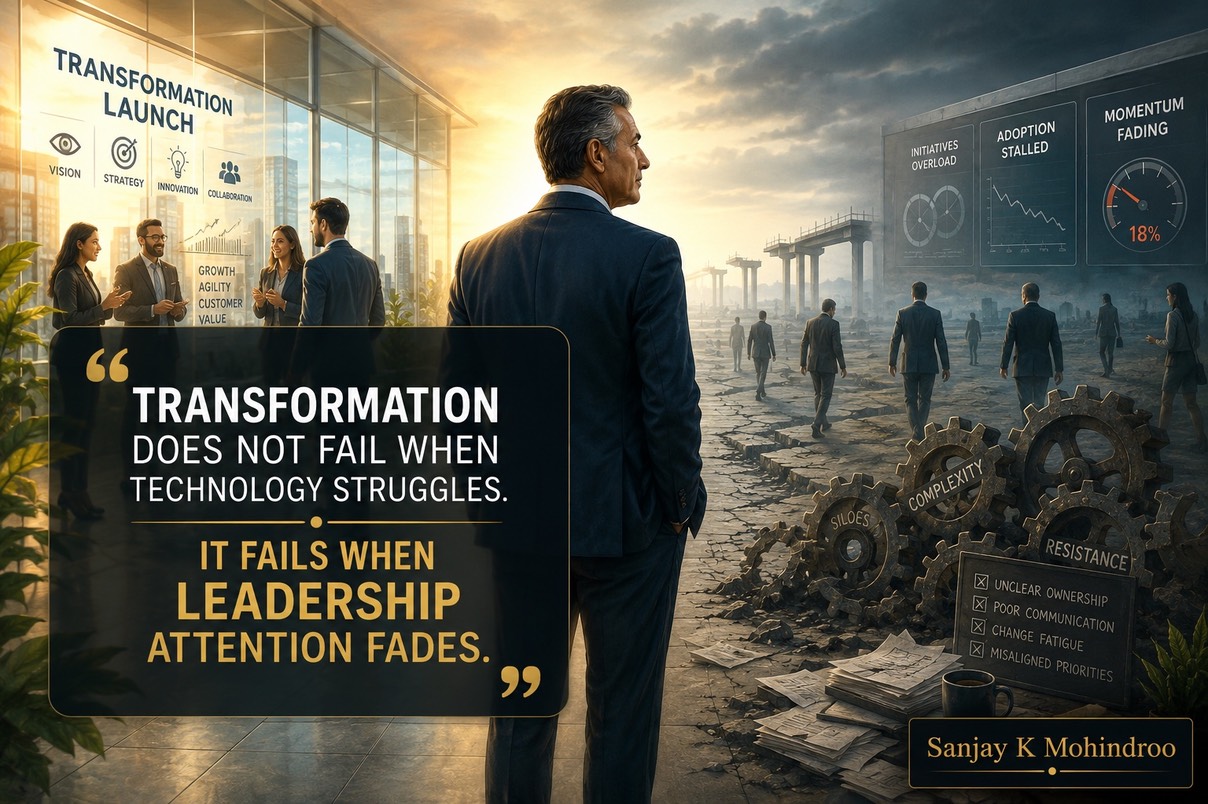
Most transformation programs do not fail in the beginning. They fail after the applause.
The first year usually looks impressive. New dashboards appear. Steering committees expand. Consultants present ambitious roadmaps. Leadership communicates urgency. Budgets flow.
Then momentum fades.
The reason is rarely technology. It is usually leadership fatigue, unclear business ownership, weak operational integration, and the absence of disciplined execution after the launch phase.
Over three decades leading global IT and business transformation initiatives, I have seen one pattern repeat itself across industries, geographies, and leadership teams: organizations underestimate the emotional and operational endurance required for long-term transformation.
Transformation is not an event. It is a sustained leadership behavior.
That distinction changes everything.
#Leadership #DigitalTransformation #CIO
The Excitement Phase Is Easy
Every organization loves the beginning of transformation
The first twelve months of a transformation program are usually full of energy.
There is visibility. There is executive sponsorship. There are workshops, town halls, design sessions, and strategy decks with ambitious timelines. The organization feels alive. Everyone wants to be associated with the initiative.
This is also the phase where technology vendors thrive.
Cloud migrations begin. AI pilots appear. Automation projects multiply. New platforms enter the ecosystem. The board sees movement. Investors hear the right language.
But activity is not transformation.
I once worked with a multinational organization that launched one of the most ambitious enterprise modernization programs I had seen in years. The first nine months were exceptional. Leadership alignment was strong. Funding was secure. Teams moved quickly.
By month fourteen, priorities shifted.
Quarterly financial pressure increased. Business leaders started protecting local metrics. Talent attrition hit critical delivery teams. Governance meetings became status reviews instead of decision forums.
The transformation did not collapse dramatically. It simply slowed down quietly.
That is how most programs lose momentum. Not through crisis. Through gradual erosion.
Technology Rarely Breaks the Program
Human systems break long before technical systems do
Most organizations still treat transformation as a technology exercise.
It is not.
Technology changes fast. Human behavior does not.
The hardest part of transformation is convincing experienced managers to abandon systems and processes that made them successful for twenty years. That resistance rarely appears openly. It shows up subtly.
Delayed approvals.
Endless requests for “additional validation.”
Parallel spreadsheets outside the official platform.
Meetings that revisit decisions already made.
This is why transformation leadership requires operational credibility, not just technical expertise.
Teams follow leaders who understand business pressure. They trust leaders who understand customer impact, margins, operational risk, and workforce anxiety.
In global programs, I have seen technically brilliant initiatives fail because leadership underestimated cultural friction. A process that works in one region may create political resistance in another. A centralized operating model may improve efficiency while damaging local accountability.
Transformation is deeply human work disguised as technology work.
That truth deserves more attention in boardrooms.
The Contrarian Reality
Digital transformation is not failing. Leadership discipline is.
For years, we have heard the same narrative: “Digital transformation programs fail at alarming rates.”
I disagree with that framing.
Most transformation strategies are directionally correct. The problem is execution endurance.
Organizations love transformation when it feels innovative. They struggle when it becomes operational discipline.
The second year is where reality begins.
That is when leaders must standardize processes. Reduce duplication. Remove legacy exceptions. Enforce accountability. Simplify governance. Measure adoption honestly instead of cosmetically.
That work is less glamorous.
There are no headlines for process simplification.
No executive excitement around retiring legacy workflows.
No standing ovation for cleaning enterprise data structures.
But that is where transformation becomes real.
One CEO told me during a difficult enterprise restructuring, “The organization wanted change. It just did not want inconvenience.”
That sentence captured the entire problem.
Transformation requires sustained executive consistency long after enthusiasm disappears.
Without that consistency, organizations return to old habits with astonishing speed.
#BusinessTransformation #ExecutiveLeadership
Too Many Programs Chase Speed Instead of Stability
Fast launches create fragile foundations
There is enormous pressure today to move quickly.
Boards want measurable outcomes within quarters. Investors expect visible modernization. Leadership teams fear appearing slow compared to competitors.
The result is predictable.
Organizations accelerate implementation while neglecting operating maturity.
I have seen companies deploy advanced analytics platforms without fixing data ownership. I have seen AI initiatives launched inside organizations with deeply fragmented processes. I have seen cloud programs migrate complexity rather than reduce it.
Speed without structural discipline creates expensive instability.
A successful transformation program should feel boring at times.
That may sound strange coming from someone who has spent decades leading large-scale change initiatives, but it is true.
Mature transformation is operationally calm.
Teams understand accountability. Governance becomes routine. Metrics become predictable. Technology stops being the center of attention as business performance takes center stage.
That is the real goal.
Transformation should eventually disappear into the operating model.
The Missing Layer Most Boards Underestimate
Middle management determines whether transformation survives
Senior leadership creates direction.
Frontline teams execute tasks.
Middle management determines whether transformation becomes culture.
This layer is often ignored.
Middle managers absorb the pressure from both sides. They manage operational targets while implementing change initiatives. They are expected to deliver business continuity while adapting new systems, processes, and reporting structures.
If they are exhausted, confused, or unconvinced, transformation slows immediately.
Strong transformation leaders spend significant time with this layer.
Not in ceremonial town halls.
In real operational conversations.
What is slowing adoption?
What incentives are misaligned?
Which processes create unnecessary friction?
Where are teams quietly bypassing the system?
Transformation success depends on operational honesty.
Many organizations still reward optimistic reporting instead of transparent reporting. That creates dangerous blind spots.
Leaders cannot fix what people are afraid to say.
#CIO #ChangeManagement #EnterpriseTransformation
What separates sustained transformation from temporary momentum
1. Treat transformation as an operating discipline, not an innovation campaign.
2. Measure behavioural adoption, not just technical deployment.
3. Keep executive sponsorship active after launch-year excitement fades.
4. Simplify governance relentlessly. Complexity kills momentum.
5. Invest heavily in middle management alignment.
6. Resist the temptation to overload the organization with simultaneous initiatives.
7. Tie transformation outcomes directly to business performance, customer experience, and operational resilience.
8. Communicate consistently. Silence creates organizational drift.
The organizations that succeed are rarely the loudest.
They are usually the most disciplined.
Transformation survives where leadership stays consistent
After thirty years in enterprise technology and business transformation, one lesson stands above the rest.
Transformation is not sustained by strategy decks, technology platforms, or launch events.
It is sustained by leadership behavior repeated consistently over time.
Organizations lose momentum after year one because leadership attention moves elsewhere. Operational discipline weakens. Governance becomes symbolic. Accountability fades. Complexity returns.
Technology cannot solve those problems.
Leadership can.
The companies that will lead the next decade are not necessarily the ones investing the most in technology. They are the ones building the strongest alignment between business strategy, operational execution, and human adaptability.
That work is harder.
It is also where lasting competitive advantage is built.
#DigitalTransformation #BusinessTransformation #CIO #Leadership #ExecutiveLeadership #EnterpriseTransformation #ChangeManagement #TechnologyLeadership #BusinessStrategy #OperationalExcellence #DigitalLeadership #TransformationStrategy