
Sanjay K Mohindroo
Transformation succeeds through portfolio management, not project execution. Learn the board framework that drives better capital allocation and business outcomes.
Transformation Is a Portfolio, not a Project: How Boards Should Actually Run It
Two weeks before a board meeting, a CEO proudly told me that 87% of the company's transformation projects were "green."
The board meeting did not go well.
Revenue growth had stalled. Margins were under pressure. Customer satisfaction had slipped. Despite hundreds of millions invested over three years, the business was losing market share to competitors moving faster and making bolder bets.
Every project was succeeding.
The transformation was failing.
After nearly three decades of working with executive teams across industries and geographies, I have seen this pattern repeat itself more times than I can count. Organizations become exceptionally good at managing projects while becoming surprisingly poor at managing transformation.
The distinction matters.
Projects deliver outputs. Transformation creates enterprise value.
Confusing the two is one of the most expensive mistakes a board can make.
The conventional wisdom says transformation succeeds through disciplined project execution, detailed roadmaps, and rigorous governance.
I disagree.
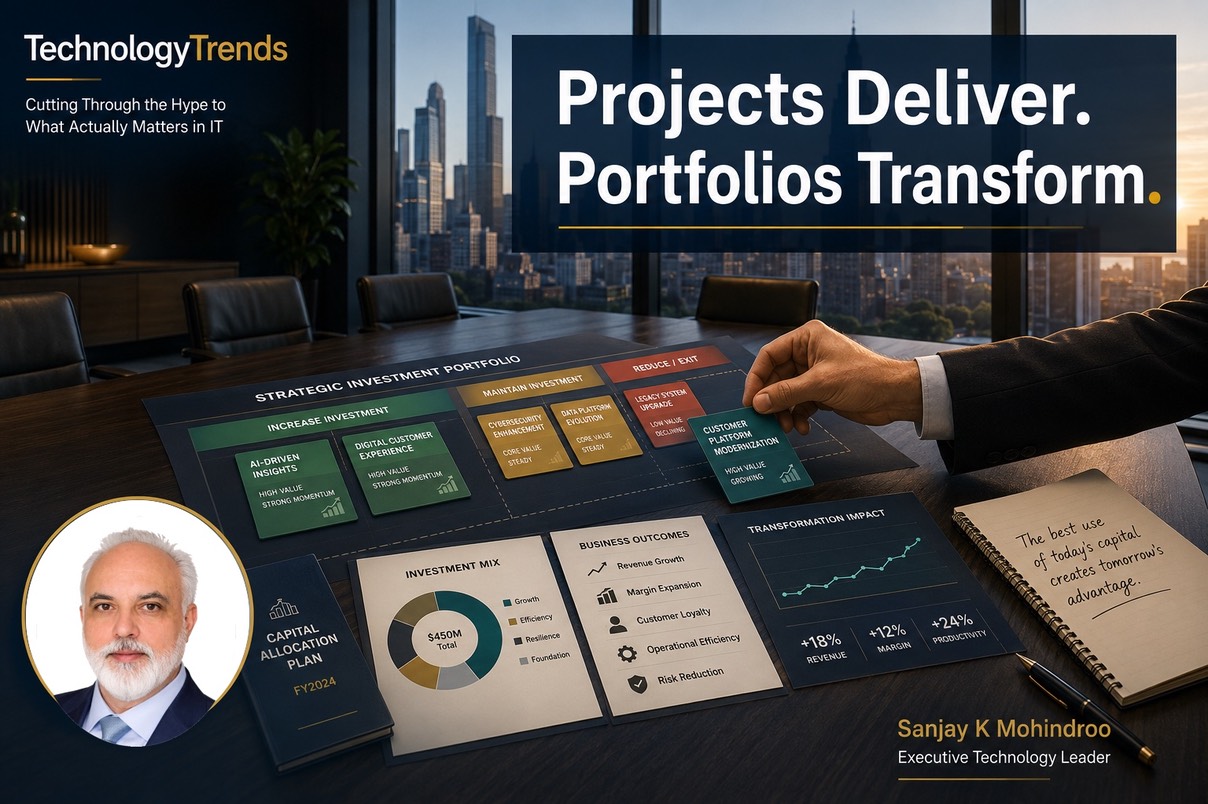
Transformation succeeds because leadership continuously reallocates capital, talent, and executive attention toward the bets that matter most. It is a portfolio management problem, not a project management problem.
That single shift in thinking changes almost every boardroom conversation.
Why Most Transformation Programs Underperform
Boards rarely approve a single transformation initiative.
They approve dozens.
There are usually ERP modernization, cloud migration, AI initiatives, cybersecurity investments, customer experience programs, operating model redesign, data platform upgrades, supply chain digitization, sustainability reporting, and multiple business unit initiatives running simultaneously.
Each project has its own sponsor.
Each project has its own steering committee.
Each project reports status independently.
Collectively, however, nobody owns the value created by the entire investment portfolio.
That is where transformation begins to fail.
I once worked with a global manufacturer operating across four continents. The company had more than 120 active transformation initiatives.
Every executive could explain the importance of their own program.
Nobody could explain which ten initiatives were expected to generate 80% of the strategic value.
That is not governance.
That is administration.
Boards often receive hundreds of pages of status reports.
Green.
Amber.
Red.
Milestones achieved.
Budgets consumed.
Risks mitigated.
Useful information, certainly.
But almost none of it answers the questions directors should actually be asking.
Is this investment still the best use of capital?
Should another initiative receive more funding instead?
What assumptions have changed?
If we had to stop 20% of our projects tomorrow, which ones would we shut down first?
Those are portfolio questions.
Very few organizations answer them well.
Projects Optimize Delivery. Portfolios Optimize Value.
A project manager is expected to deliver scope on time and within budget.
That is exactly what they should do.
A portfolio owner has a different responsibility.
Their job is to maximize enterprise value across competing investments.
Those objectives are not always aligned.
Imagine two initiatives.
Project A is progressing exactly according to plan.
Project B is struggling because market conditions have changed, new competitors have emerged, and customer demand is shifting faster than expected.
Traditional governance rewards Project A.
Portfolio thinking asks a different question.
Which project is now more strategically important?
Sometimes the struggling initiative deserves more investment because the opportunity has become larger.
Sometimes the successful project should lose funding because it is solving yesterday's problem.
That feels uncomfortable.
It also reflects how successful investors think.
No experienced investor keeps adding money to every stock simply because it was included in the original portfolio.
Markets change.
Businesses change.
Technology changes.
Investment decisions change with them.
Transformation should operate the same way.
The Wrong Metrics Create the Wrong Conversations
One of the first board packs I review during advisory engagements often includes metrics such as:
- Percentage complete
- Budget utilization
- Milestones achieved
- Issues closed
- Training completed
- Resources assigned
None of these are inherently bad.
They are simply insufficient.
Imagine applying the same logic to your investment portfolio.
Would you judge its success because every investment completed its paperwork on time?
Or because every investment generated superior returns?
Transformation reporting should work no differently.
Boards should spend less time discussing activity.
They should spend significantly more time discussing value creation.
That means asking questions such as:
- Which initiatives are increasing competitive advantage?
- Which initiatives have become less relevant because market conditions changed?
- Which projects should receive additional capital immediately?
- Which investments should be stopped despite being technically successful?
- What percentage of transformation spend is now delivering measurable business outcomes?
Those conversations are considerably harder.
They are also considerably more valuable.
The Sunk Cost Trap
One of the biggest barriers to effective transformation is psychological rather than operational.
Executives become emotionally attached to projects they sponsored.
Large budgets create political commitment.
Teams become invested in proving earlier decisions were correct.
The result is predictable.
Projects continue long after their strategic justification has disappeared.
This is classic sunk cost thinking.
Boards should actively resist it.
One financial services organization I advised had invested heavily in a customer platform that made perfect sense when approved.
Eighteen months later, competitor behavior, regulatory changes, and customer expectations had shifted dramatically.
The project remained technically healthy.
Commercially, it was becoming irrelevant.
The difficult decision was made to significantly reduce the scope and redirect investment toward a different customer capability that had emerged as strategically critical.
From a project perspective, it looked like failure.
From a portfolio perspective, it was disciplined capital allocation.
There is an important lesson here.
Stopping a project is not evidence of poor governance.
Sometimes it is evidence of excellent governance.
Boards should celebrate intelligent exits just as much as successful deliveries.
A Better Mental Model: Treat Transformation Like an Investment Fund
Instead of viewing transformation as a collection of independent projects, imagine managing an investment fund.
Every initiative competes for limited capital.
Every initiative has an expected return.
Every initiative carries uncertainty.
Every initiative should be reviewed against alternatives, not against its original business case alone.
The portfolio evolves continuously.
Some investments grow.
Some shrink.
Some are exited entirely.
Capital moves toward opportunities with the greatest expected strategic impact.
This is exactly how private equity firms think.
It is how venture capital funds think.
Ironically, many corporations that invest this way externally continue managing internal transformation as though every approved project deserves equal protection until completion.
It doesn't.
The moment an investment no longer represents the best use of scarce resources, leadership has a responsibility to reconsider it.
Transformation is not about finishing everything.
It is about maximizing enterprise value with the capital available.
The Board Framework: Five Questions That Change Transformation Governance
If transformation is a portfolio, then governance must evolve beyond project reviews.
Over the years, I have found five questions consistently separate organizations that create value from those that simply deliver programs.
1. Are We Funding Strategy or Funding History?
Every initiative was approved based on assumptions that were true at a point in time.
Markets move.
Customers evolve.
Competitors innovate.
Regulation changes.
Technology advances.
The first responsibility of the board is to determine whether those original assumptions still hold.
A project that was strategically essential eighteen months ago may now be delivering diminishing returns. Equally, a smaller initiative may have become far more valuable because market conditions have shifted.
Capital should follow today's strategy, not yesterday's approval.
2. What Is the Opportunity Cost?
Every dollar committed to one initiative is a dollar unavailable for another.
Yet opportunity cost is remarkably absent from many transformation discussions.
Boards routinely ask whether projects are on budget.
Far fewer ask whether that budget could create greater value elsewhere.
That distinction matters.
A transformation portfolio should never be viewed as a fixed collection of approved initiatives. It is a living investment strategy competing for finite resources.
The best organizations continuously ask one simple question:
"If we were starting today, would we still invest in this initiative?"
If the answer is no, continuing simply because work has already begun is not discipline. It is inertia.
3. Are We Measuring Enterprise Outcomes?
Project metrics matter.
Enterprise metrics matter more.
Boards should spend significantly more time reviewing measures such as:
- Revenue growth attributable to transformation.
- Margin improvement.
- Productivity gains.
- Customer retention.
- Speed to market.
- Risk reduction.
- Capital efficiency.
These are the outcomes shareholders ultimately value.
A project can meet every milestone and still fail to improve any of these measures.
Conversely, a project that required multiple course corrections may create exceptional long-term value.
Delivery performance should inform governance.
Business outcomes should drive governance.
4. Are We Reallocating Resources Fast Enough?
One characteristic consistently separates high-performing organizations from average ones.
It is not planning.
It is speed of reallocation.
Winning organizations move funding, talent, executive sponsorship, and organizational attention quickly when evidence changes.
Poor performers wait for annual planning cycles.
By then, competitors have often moved first.
Transformation portfolios require the same agility that investment portfolios demand.
Holding on to underperforming initiatives because governance cycles make change inconvenient is rarely a competitive advantage.
5. Who Actually Owns Portfolio Value?
This may be the most important question of all.
Most organizations have clear ownership for individual projects.
Fewer have clear ownership for the value created across the portfolio.
Someone must have explicit accountability for answering questions such as:
- Are we investing in the right mix of initiatives?
- Are dependencies creating hidden risks?
- Are multiple business units solving the same problem independently?
- Are we creating measurable enterprise value rather than localized success?
Without that accountability, transformation becomes fragmented.
Every project succeeds on its own terms.
The organization struggles to realize value as a whole.
Boards should insist on portfolio ownership, not simply project sponsorship.
Addressing the Common Counterargument
Whenever I present this perspective, one objection almost always emerges.
"If we keep changing priorities, won't transformation become chaotic?"
It is a fair question.
The answer lies in understanding the difference between discipline and rigidity.
Portfolio management is not about constantly changing direction.
It is about continuously validating whether current investments remain aligned with strategic priorities.
Good portfolio management introduces greater discipline, not less.
The strategic destination remains stable.
The investment path evolves as new information becomes available.
Think of navigating a long ocean voyage.
The destination rarely changes.
The course is adjusted repeatedly to account for weather, currents, and unexpected conditions.
No experienced captain would describe those adjustments as a failure of planning.
They are evidence of sound navigation.
Transformation deserves the same mindset.
The Leadership Shift That Matters Most
Technology has never been more capable.
Capital has never been more available for digital investment.
Boards have never had greater visibility into execution metrics.
Yet transformation success rates remain stubbornly inconsistent.
I believe one reason is that organizations continue solving the wrong problem.
They focus on delivering projects better.
The real challenge is making investment decisions better.
That requires a different leadership mindset.
Less emphasis on governance theater.
More emphasis on capital allocation.
Less discussion about project health.
More discussion about strategic relevance.
Less attachment to past decisions.
More willingness to reallocate resources toward future value.
That is what portfolio thinking delivers.
The companies that create lasting competitive advantage are rarely those that complete every transformation initiative exactly as planned.
They are the ones that repeatedly place better bets than their competitors.
Some projects succeed.
Some projects are stopped.
Some evolve into something entirely different.
Viewed individually, those decisions may appear inconsistent.
Viewed as a portfolio, they represent disciplined leadership.
The next time your board reviews a transformation update, resist the temptation to ask whether every project is on schedule.
Instead, ask a more valuable question:
If we were allocating this capital for the first time today, would we make the same decisions?
The answer will tell you far more about the health of your transformation than another dashboard full of green status indicators ever will.
What governance question has most improved transformation outcomes in your organization? Have you seen portfolio thinking change boardroom conversations, or do most organizations still manage transformation one project at a time?
If this perspective resonated, subscribe to TechnologyTrends or join the discussion by sharing your experiences in the comments.