
Sanjay K Mohindroo
A sharp, executive-level perspective on how the AI revolution differs from past disruptions, its impact on jobs, and what leaders must do to stay relevant.
Every major technological revolution has disrupted jobs, reshaped industries, and forced societies to adapt. From steam engines to computers, we’ve endured—and grown stronger.
But the AI revolution is not a repeat cycle.
This time, the speed is exponential—the impact cuts across both blue-collar and white-collar roles. Middle management is thinning. Decision-making itself is being automated.
Survival is not the question. Relevance is.
Leaders who understand this shift—and act early—will not just endure change. They will shape it.
The Comfortable Myth of “We’ve Been Here Before”
In every boardroom conversation about AI, I hear a familiar line:
"We’ve seen this before. People adapt. Jobs evolve."
That statement is comforting. It’s also incomplete.
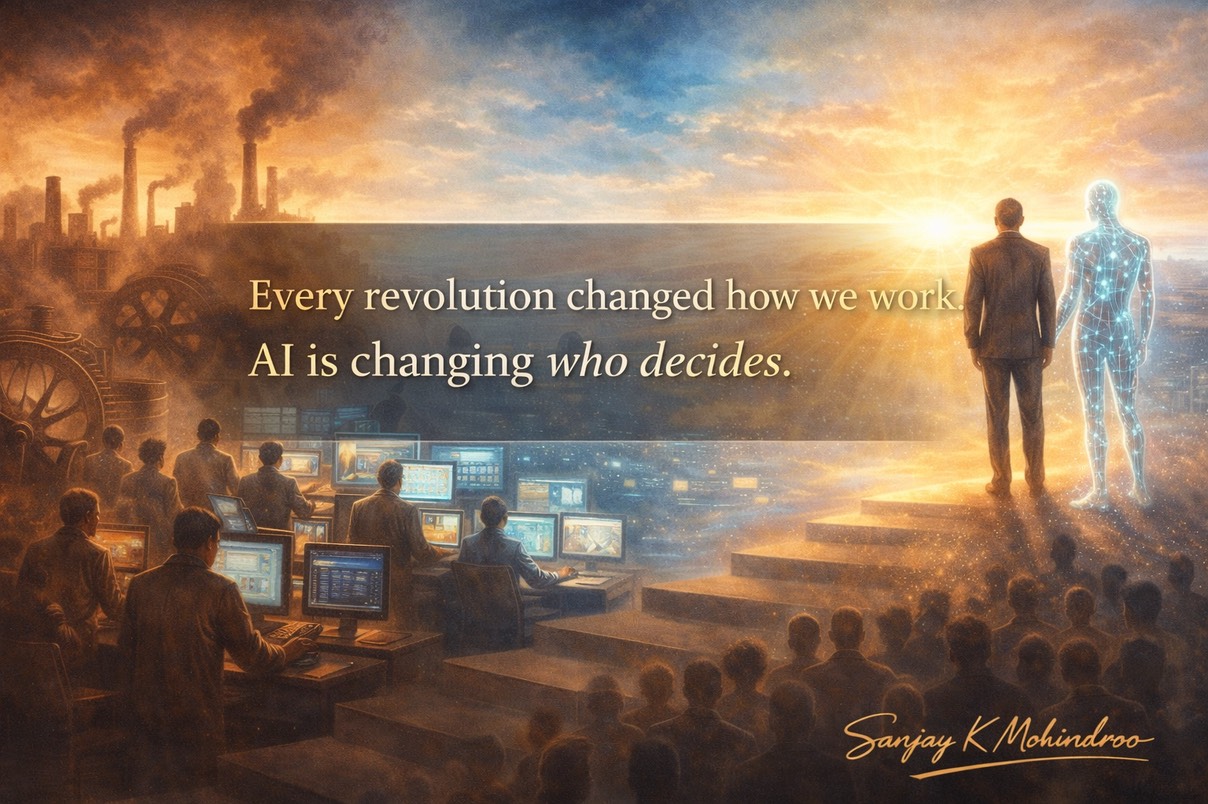
Yes, society survived the Industrial Revolution. Yes, we adjusted to computers and the internet. But those transitions had one common trait—they replaced how work was done, not who thinks.
AI is different.
For the first time, machines are not just executing tasks. They are participating in judgment, pattern recognition, and decision support. That changes the equation entirely.
And if leadership treats this as “just another wave,” they will be late—dangerously late.
Then vs Now: What Past Revolutions Actually Changed
From Muscle to Machine
The Industrial Revolution replaced physical effort, not human direction
The steam engine and mechanization shifted labor from fields to factories. Blue-collar roles changed, but human oversight remained central.
Work became more productive. It did not become autonomous.
From Paper to Digital
The Computer Revolution enhanced efficiency, not accountability
When computers entered the workplace, they accelerated processes. Spreadsheets replaced ledgers. Emails replaced memos.
But decision-making stayed human.
Even automation relied on structured inputs. The human brain still held the edge in ambiguity.
What Makes the AI Revolution Fundamentally Different
From Execution to Cognition
Machines are no longer just tools—they are participants
AI is not just optimizing workflows. It is entering domains that were once considered uniquely human:
- Drafting strategies
- Analyzing risk patterns
- Generating insights
- Supporting executive decisions
This is where the shift becomes structural.
The value chain is moving upward—from doing to deciding.
And that has deep implications for #Leadership, #CIO priorities, and workforce design.
The Silent Shift: The Erosion of the Middle Layer
Why Middle Management Is Under Pressure
Intelligent systems are compressing coordination roles
In most organizations, middle management plays three roles:
1. Translating strategy into execution
2. Aggregating information upward
3. Supervising operational consistency
AI is now doing all three—faster and with fewer biases.
Dashboards replace reporting layers. Predictive systems reduce the need for manual oversight. Decision-support tools shorten feedback loops.
The result?
A structural compression of the middle layers.
Not overnight. But steadily.
This is not about cost-cutting. It is about efficient architecture.
Blue-Collar Work: The Next Phase of Automation
From Mechanization to Autonomy
Physical work is no longer safe from intelligent disruption
Earlier automation replaced repetitive manual labor. Now, AI combined with robotics is moving into adaptive environments:
- Warehousing
- Logistics
- Manufacturing
- Field services
The difference is subtle but critical.
Machines are no longer just repeating tasks. They are adjusting in real time.
That reduces dependency on human intervention.
The impact will not be uniform. But the direction is clear.
“AI Will Create More Jobs Than It Destroys” Is Incomplete
The Real Issue Is Not Job Count—It’s Job Composition
This is where most conversations lose depth.
Yes, new roles will emerge. They always do.
But here’s the uncomfortable truth:
The rate of job creation will not match the speed of job displacement in the same skill bands.
That creates friction.
- Entry-level roles shrink due to automation
- Mid-level roles are compressed due to AI augmentation
- Senior roles expand—but require sharper thinking, not tenure
This is not a volume problem. It is a capability mismatch.
And that mismatch is where organizations—and careers—will struggle.
The New Survival Model: From Skill to Signal
Why Reskilling Alone Is Not Enough
The market does not reward effort. It rewards relevance.
Reskilling has become a popular answer. It sounds right. It often fails in execution.
Why?
Because most reskilling focuses on tools, not thinking.
Knowing a new platform does not increase relevance. Understanding how to create value with it does.
The shift required is deeper:
- From task execution → problem framing
- From process knowledge → decision quality
- From experience → adaptability
This is where professionals need to reposition themselves.
Not as operators. But as interpreters of complexity.
Relevance in the AI Era: What Actually Works
1. Build Decision Depth
Your value lies in how you think, not what you do
AI can generate options. It cannot own accountability.
Leaders who can evaluate trade-offs, assess risk, and make clear calls will remain indispensable.
2. Strengthen Business Context
Technology without business alignment is noise
Understanding revenue models, cost drivers, and customer behavior is now critical.
Pure technical expertise is no longer enough.
3. Reduce Dependency on Hierarchy
Authority is shifting from position to insight
Influence will come from clarity, not titles.
This is already visible in high-performing organizations.
4. Communicate with Precision
Clarity is becoming a competitive advantage
In a world flooded with AI-generated content, clear thinking stands out.
Leaders who can articulate complex ideas simply will lead conversations—and decisions.
Strategic Takeaways
- Treat AI as a structural shift, not a technology upgrade
- Redesign organizations, not just processes
- Expect compression in middle layers—plan proactively
- Invest in cognitive capability, not just technical training
- Align IT strategy with business outcomes, not tools
- Build cultures that reward thinking, not activity
This is where #DigitalTransformation becomes real.
Survival Is Guaranteed. Relevance Is Not
Human beings are resilient. We adapt. We move forward.
That will not change.
But relevance in this era will not come from experience alone. It will come from clarity, adaptability, and the ability to make better decisions under uncertainty.
The leaders who understand this early will not chase the future.
They will shape it.
#Leadership #AIRevolution #FutureOfWork #DigitalTransformation #CIO #ExecutiveLeadership #WorkforceStrategy #AI #BusinessStrategy #Innovation #OrganizationalDesign