
Sanjay K Mohindroo
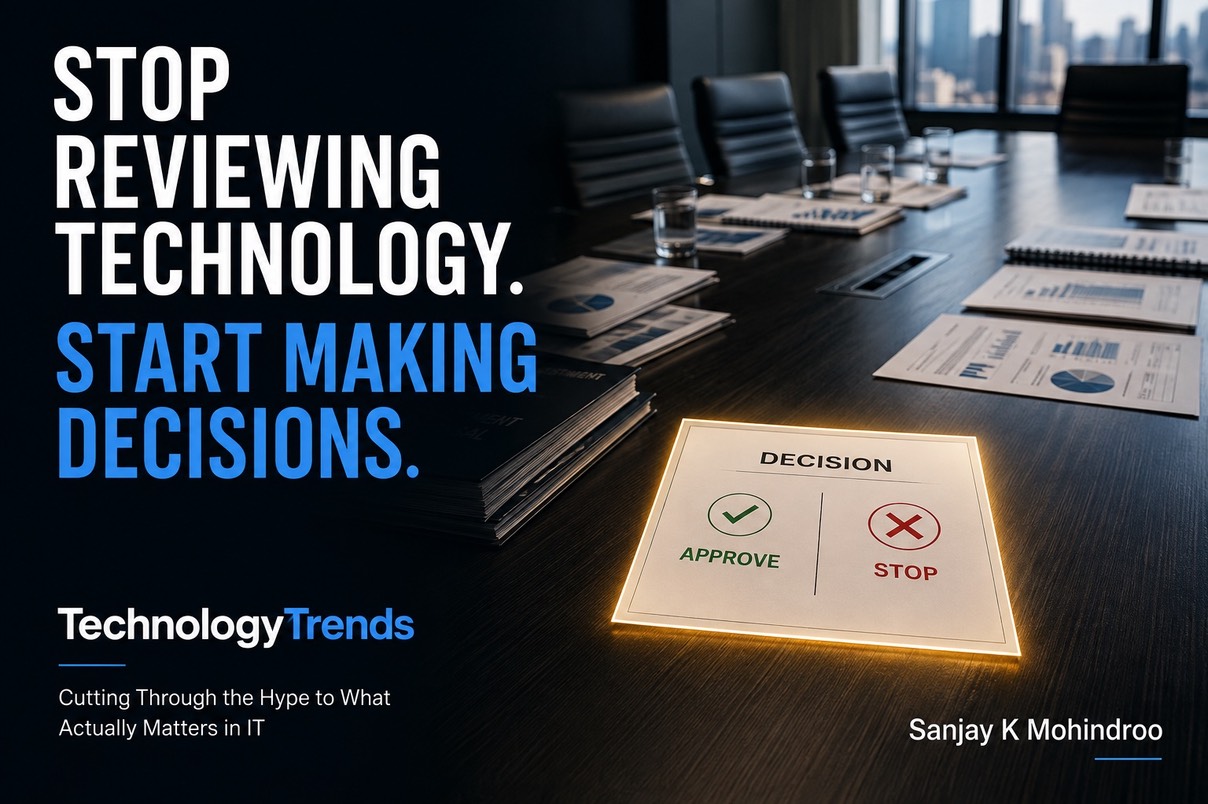
Most technology committees review more than they decide. Use the DECIDE framework to improve capital allocation, accountability, and technology outcomes.
How to Run a Technology Investment Committee That Actually Decides
A technology investment committee that ends with “come back with more detail” has usually not exercised prudence. It has postponed accountability.
Across three decades in enterprise technology, I have seen this pattern in different industries and different boardrooms: capable executives, substantial investment at stake, a detailed presentation, sensible questions, and no actual decision.
The conventional wisdom is that technology investment committees need better information.
I disagree.
Most already have more information than they can use. What they lack is a decision system.
A technology investment committee should not be a review forum for IT proposals. It should be a capital allocation mechanism that decides where the enterprise will place money, management attention, and risk.
That distinction changes everything.
The Real Problem with Technology Investment Committees
Many committees are designed around the presentation.
A proposal arrives with a business case, implementation plan, architecture view, risk register, vendor assessment, and a collection of financial projections. The committee reviews it. Finance challenges the assumptions. Technology explains the dependencies. Operations asks about disruption. Someone requests another sensitivity analysis.
The meeting ends with more work.
This feels responsible because nobody has made a reckless decision.
But indecision has a cost too.
A delayed technology decision can prolong operational risk, defer revenue, increase dependence on obsolete platforms, lock in inefficient processes or allow a competitor to move first.
The committee rarely puts a number against that delay.
That is the first mistake.
The second is more fundamental: many committees have never defined what they are actually there to decide.
Are they deciding whether an investment deserves capital?
Whether the proposed solution is the best option?
Whether the risk is acceptable?
Whether funding should be released now?
Or whether the programme should continue after its first phase?
Those are different decisions.
When the decision itself is vague, the discussion expands until every executive can find something else to investigate.
The result is governance theatre.
Lots of challenge. Very little choice.
Technology Governance Is Capital Allocation, Not IT Oversight
The most useful shift a board or CEO can make is to stop treating technology investment as a specialist technology conversation.
Technology consumes capital to change business economics.
The committee therefore needs to ask questions such as:
What business outcome are we purchasing?
What happens if we do nothing?
What risk are we removing?
What new capability becomes possible?
What is the cost of waiting?
What else could we fund with the same capital?
What evidence would cause us to stop?
These are boardroom questions.
Whether the investment involves cloud infrastructure, artificial intelligence, cybersecurity, ERP modernisation, customer platforms or data does not change the principle.
Technology terminology should not be allowed to obscure an ordinary capital allocation question: why is this the best use of the next unit of investment?
That is where I believe many governance models have become too comfortable.
They test whether a proposal is complete.
They do not test whether the decision is good.
The DECIDE Framework for Technology Investment Committees
I use six questions to think about whether an investment committee is capable of making a real decision.
They form a simple framework: DECIDE.
1. Define the Decision
Every proposal should begin with one sentence:
“The committee is being asked to decide whether…”
Not “review.”
Not “note.”
Not “provide guidance.”
Decide.
For example:
“The committee is being asked to approve the first phase of a customer platform modernisation, with funding released against three defined business milestones.”
That sentence immediately disciplines the conversation.
It also exposes proposals that have been brought to the committee prematurely.
If management cannot describe the required decision in one sentence, it is unlikely that twenty additional slides will fix the problem.
The decision should also have a time boundary.
A decision that can apparently wait indefinitely is usually one whose cost of delay has not been understood.
2. Establish the Economic Outcome
Technology teams naturally describe what a system will do.
Investment committees need to understand what the enterprise will gain, protect, or avoid.
I would expect the economic case to fit into a small number of categories:
- Revenue growth or protection
- Cost reduction or productivity
- Working capital improvement
- Risk reduction
- Regulatory necessity
- Strategic capability
- Competitive response
There may be several benefits, but one or two should dominate.
This matters because technology programmes often accumulate benefits during the approval process. A project begins as a cost reduction initiative, then becomes a customer experience programme, then a resilience initiative, then a data strategy.
By the time it reaches the committee, it apparently solves everything.
That should make decision-makers more skeptical, not less.
If the primary value cannot be stated clearly, accountability later becomes almost impossible.
A board does not need fictitious precision. It needs economic clarity.
For some investments, especially cyber resilience or regulatory technology, the right question is not conventional return on investment.
It may be value at risk.
It may be the consequence of a service failure.
It may be the probability and impact of a control breakdown.
The metric should fit the decision rather than forcing every technology investment into the same financial template.
3. Compare Real Alternatives
One of the weakest questions in many investment papers is also one of the most important:
What are the alternatives?
There should almost always be at least three:
1. Proceed with the proposed investment.
2. Choose a credible alternative.
3. Do nothing, defer, or continue with the current environment.
“Do nothing” is not an administrative formality.
It establishes the baseline.
I have seen technology proposals look compelling until management properly describes the economics of continuing with the existing solution.
The opposite happens too.
A large transformation can appear urgent because the current technology is old. Once the business quantifies the actual operational constraints, a targeted intervention can sometimes produce most of the value at a fraction of the risk.
This is where conventional wisdom around technology modernisation often needs challenging.
Old is not automatically bad.
New is not automatically strategic.
The committee should fund the option with the strongest business logic, not the most fashionable technology.
#Technology investments frequently fail this test because the recommendation has effectively been chosen before the committee sees it.
The alternatives section then becomes justification rather than analysis.
A serious investment committee should be willing to choose Option B when management arrives expecting approval for Option A.
Otherwise, it is not really a decision-making body.
4. Identify Risk, Reversibility and the Cost of Delay
Most risk registers are too long and too operational for senior decision-makers.
The committee needs a different view.
I would want to know four things:
What can materially destroy the expected value?
What happens if we delay?
How reversible is the decision?
What exposure are we accepting once we commit?
Reversibility is particularly important.
A six-month experiment with limited contractual commitments deserves a different approval threshold from a multiyear platform decision that changes operating processes across the enterprise.
This is why I prefer staged capital for uncertain technology investments.
Instead of approving the entire journey because management has produced a five-year business case, approve the next economically meaningful commitment.
Release further capital when evidence improves.
This is especially relevant to emerging technology.
A board does not need to predict with certainty which artificial intelligence use cases will create durable value.
It needs to control the size of the bet while management generates evidence.
That is better governance than demanding an artificial level of certainty before approving anything.
5. Design the Decision Rights Before the Meeting
One uncomfortable truth about committees is that consensus is often mistaken for governance.
It is not.
Consensus can be useful, but requiring everyone to be comfortable with every decision is one of the fastest ways to create slow, conservative capital allocation.
Someone must own the decision.
The committee charter should make clear:
- Which investments require committee approval
- Who recommends
- Who challenges
- Who decides
- Who can veto, and on what grounds
- What happens when the committee disagrees
- Which decisions are delegated to management
A committee where every member can delay but nobody can decide is badly designed.
This is particularly damaging when technology decisions cut across functions.
The CFO may focus on capital discipline.
The COO sees operational disruption.
The CIO understands technical debt and execution complexity.
The business leader sees revenue or customer impact.
Those perspectives should improve the decision.
They should not create six unofficial vetoes.
Good governance means structured challenge followed by clear authority.
6. Enforce Post-Decision Accountability
This is the step most investment committees neglect.
They approve.
They move on.
Months later, the project returns because it needs more money, more time, or a revised scope. The original economic assumptions have disappeared beneath programme status reporting.
That is not investment governance.
Every significant technology decision should leave the committee with a short decision record:
What was approved?
How much capital was committed?
Which outcome justified the investment?
Who owns that outcome?
What assumptions mattered most?
What milestones release the next tranche of funding?
What conditions would cause the organisation to stop, redesign or reduce the investment?
The committee should then review the investment against the logic that justified it.
Not simply against whether the implementation is “green.”
A programme can be technically on schedule and economically wrong.
It can also experience implementation difficulty while remaining strategically valuable.
Those are different conversations.
Stop Funding Projects. Fund Evidence.
One of the most important implications of this approach is that large technology investments should not always be approved as single events.
Capital should follow evidence.
Consider the kind of decision faced by a global enterprise replacing a core operating platform.
The conventional approach is to create a multiyear programme, estimate the total benefit, calculate the total cost, secure approval and begin.
The problem is that the organisation has its least reliable information at the moment it is being asked to make its largest commitment.
Instead, the committee can approve the programme in stages.
The first investment might prove integration feasibility, business adoption and the economics of one operating region.
The second tranche is released only if those assumptions hold.
This does not mean endlessly piloting and never scaling.
It means increasing commitment as uncertainty decreases.
Boards understand this logic in acquisitions, new markets and capital projects.
Technology should not be exempt.
But Won’t This Slow Everything Down?
This is the usual counter-argument.
More disciplined governance sounds like more meetings, more gates and more bureaucracy.
It should produce the opposite.
A well-designed investment committee accelerates decisions because management knows exactly what evidence is required and exactly who can decide.
Weak governance creates repeated presentations.
Strong governance creates explicit thresholds.
The objective should not be to send every technology expenditure through the same committee.
Routine infrastructure renewal, small enhancements and investments within established product portfolios should normally operate inside delegated authority.
The investment committee should spend its time where executive judgement matters:
Large commitments.
Irreversible choices.
Strategic dependencies.
Material risk.
Cross-enterprise trade-offs.
New areas where evidence is limited.
If the committee spends twenty minutes debating a routine software renewal, the problem is not governance discipline.
The problem is governance design.
The CEO’s Test: Can the Committee Kill a Technology Investment?
There is one question I would ask any CEO evaluating their technology investment governance:
When was the last time the committee stopped something?
Not delayed it.
Not requested another business case.
Stopped it.
A committee that only approves proposals is probably sitting too late in the process or challenging too little.
Equally, a committee that repeatedly rejects investments may be seeing weak proposals because the organisation has no effective portfolio discipline before they reach the boardroom.
Healthy governance produces all four outcomes:
Approve.
Approve with conditions.
Redesign.
Stop.
Each should be considered legitimate.
Stopping an investment is not evidence that management failed.
Continuing to invest after the economic case has disappeared is.
What a Technology Investment Committee Should Actually Measure
If I were reporting the effectiveness of the committee to a board, I would not start with the number of meetings held or proposals reviewed.
I would look at measures such as:
Decision cycle time: How long does a material proposal take from being decision-ready to receiving a decision?
Capital concentration: Where is technology investment actually going across strategic priorities?
Benefits ownership: What percentage of major investments have a named business executive accountable for the economic outcome?
Stage-gate performance: How often does evidence change the amount or direction of subsequent investment?
Stopped or redirected capital: How much spending has governance prevented from continuing when assumptions no longer held?
Outcome realisation: Are the business outcomes used to secure approval actually appearing?
These measures tell a board whether governance is allocating capital intelligently.
A beautiful committee pack does not.
The Committee Must Be Designed Around Decisions
Technology will continue to consume a larger share of executive attention because increasingly there is no meaningful separation between business strategy and technology strategy.
That makes investment discipline more important, not less.
The mistake is to respond by building larger committees, requesting more documentation and adding more approvals.
The better response is simpler.
Define the decision.
Establish the economic outcome.
Compare real alternatives.
Understand risk and reversibility.
Make decision rights explicit.
Return later and hold the investment to the logic that justified it.
That is the DECIDE framework.
A technology investment committee should not exist to make executives feel that technology has been thoroughly reviewed.
It should exist to make better choices about capital.
And sometimes the best evidence that it is working is not what gets approved.
It is what never gets funded.
How does your organisation know whether its technology investment committee is improving decisions, rather than simply adding another layer of review?
Subscribe to TechnologyTrends or add your perspective in the comments if this is a debate your leadership team is having.