
Sanjay K Mohindroo
Digital India: When Digitization Does Not Translate into Better Governance.
India's digital transformation is one of the country's most visible governance stories of the past decade. Applications have moved online. Payments can be made digitally. Certificates sit in DigiLocker. Grievances can be filed from a phone. Government services that once required repeated visits to an office can increasingly be initiated from home.
Digital India was built around precisely this ambition. Its original vision included not just digital infrastructure, but "Governance and Services on Demand", integrated services across departments, electronic application tracking and greater public accountability.
There is little doubt that India has made enormous progress in building this digital infrastructure.
But there is a more uncomfortable question that deserves attention:
Has digitizing government actually made government more accountable to the citizen?
For many citizens, the answer can depend heavily on what happens after they press "Submit."
And this is where the gap between Digital India as infrastructure and Digital India as governance reform becomes visible.
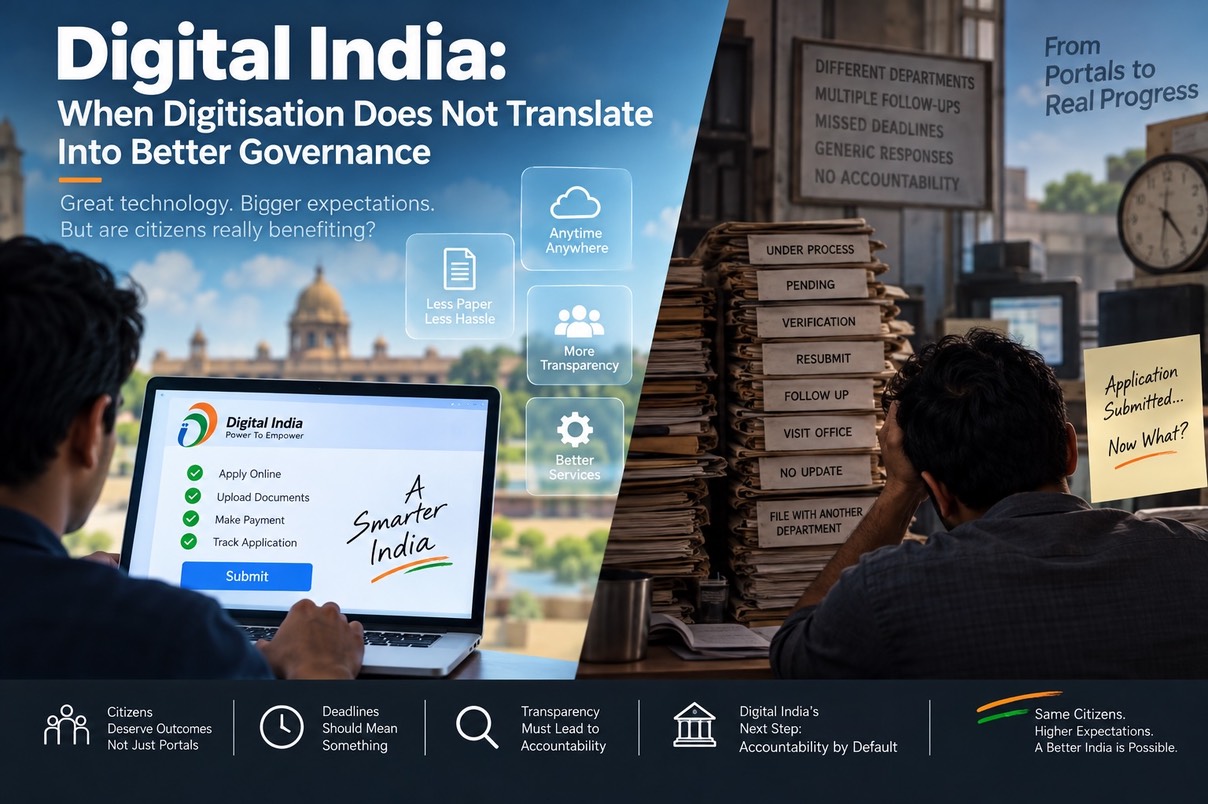
A digital application is not the same as a digital service
Imagine a fairly ordinary interaction with government.
A citizen applies online for a license, certificate, approval, pension, benefit, or registration.
The portal accepts the application.
A reference number is generated.
Payment is taken digitally.
Documents are uploaded.
Verification is completed.
The dashboard shows that the application is "under process."
Then nothing happens.
The deadline passes.
The citizen checks the portal again. The status has not changed.
A helpline redirects the citizen to a department. The department asks the citizen to visit the office. The office says the file is with another officer. Emails are sent. A grievance is filed. Another reference number is generated.
Eventually, the citizen discovers that while the application process has been digitized, the accountability process has not.
This is perhaps the biggest unresolved challenge of India's digital-governance journey.
The front end may be twenty-first century.
The back end can still operate through files, discretion, departmental silos, follow-ups and personal intervention.
We may be measuring the wrong things
Government technology programmes naturally produce impressive numbers.
Number of users.
Number of applications.
Number of transactions.
Number of services available online.
Number of grievances disposed.
Number of villages connected.
These are useful indicators. But they are predominantly output indicators.
Citizens experience government through outcomes.
Was the licence issued?
Was the pension credited?
Was the certificate corrected?
Was the grievance genuinely resolved?
Did the citizen have to visit the government office despite completing the entire process online?
Was the application completed within the promised period?
Was someone accountable when it was not?
That distinction matters enormously.
Consider grievance redressal. CPGRAMS has become a large national digital grievance system. In July 2026 alone, Central ministries and departments received more than 2.20 lakh grievances and reported redressal of about 2.17 lakh, with the average disposal time during 2026 reported at 12 days.
Those numbers demonstrate impressive administrative capacity.
But government data also reveal why "disposed" and "resolved" should not automatically be treated as synonyms.
Between January 2025 and February 2026, approximately six lakh citizens provided feedback on grievances recorded as resolved on CPGRAMS. 69.8% rated the resolution satisfactory.
That is a useful achievement, but it also means that the disposal statistic alone cannot tell us whether the citizen believed the underlying problem was solved.
A governance dashboard that says "grievance closed" therefore tells us something.
A dashboard that says "citizen's problem resolved" tells us considerably more.
Digitization can make inefficiency more visible without eliminating it
One of the great advantages of digital government is traceability.
Paper files can disappear into administrative systems.
Digital applications leave timestamps.
The system knows when the citizen applied.
It knows when documents were submitted.
It often knows when verification took place.
It knows which department is handling the application.
It knows when the promised deadline expired.
That should fundamentally change accountability.
If a government system knows that an application was supposed to be completed on Monday and remains pending on Friday, why should the citizen need to lodge another complaint telling the government something its own database already knows?
Yet this remains a common design flaw in digital governance.
The government digitizes the citizen's obligation to apply, but not always the government's obligation to act.
The citizen is expected to upload documents on time.
The citizen must respond to queries on time.
The citizen must make payment correctly.
But when the government misses its own service timeline, the consequences can be far less automatic.
This is where technology risks becoming a digital layer placed on top of an unchanged administrative culture.
The problem is not simply technology
This is also why blaming portals alone misses the point.
A well-designed website cannot compensate for an unclear chain of responsibility.
An app cannot fix an approval process involving five departments that do not communicate with one another.
A dashboard cannot create accountability if no consequence follows when a deadline is breached.
Even the Government's Digital India framework recognized this from the beginning. Its e-Governance pillar called for processes and forms to be simplified and integrated, rather than merely converted into electronic versions.
This distinction is crucial.
Putting a fifty-year-old administrative process online does not automatically constitute administrative reform.
Sometimes it simply creates a digital version of the same bureaucracy.
Infrastructure itself illustrates the problem
The same principle applies beyond individual citizen services.
The Comptroller and Auditor General's 2026 performance audit of BharatNet examined whether one of India's flagship rural broadband programmes translated infrastructure expenditure into functioning connectivity and service delivery. The very existence of such performance audits highlights why implementation must be evaluated beyond headline rollout statistics.
The relevant question for a village is not merely:
"Has fibre been laid?"
It is:
"Does the connection work reliably, and can people actually use it?"
Similarly, the relevant question for a digital government portal is not:
"Does an online service exist?"
It is:
"Can the citizen complete the service successfully from beginning to end?"
The difference between infrastructure being created and infrastructure being usable is the same difference between government being digitized and government being digitally transformed.
This is why some citizens perceive digital governance as hype
When digital systems work, citizens experience something genuinely transformative.
A payment that once required standing in a queue happens in seconds.
A document that once required visiting an office can be downloaded immediately.
A benefit reaches a bank account directly.
These are real improvements and should not be dismissed.
But perceptions change dramatically when the digital system works only until it encounters administrative discretion.
If a citizen:
- applies online but must repeatedly visit the office;
- tracks an application but cannot discover why it is delayed;
- files a grievance but receives a standard response;
- appeals but must again pursue officials manually; or
- sees a statutory deadline expire without any automatic consequence,
the citizen understandably begins to ask what exactly has been transformed.
From that perspective, a portal can start looking like a digitized reception counter rather than a reformed government service.
And when policy communication celebrates transactions, registrations and applications while the citizen continues struggling for the underlying service, Digital India can be perceived as more hype than governance reform, even where considerable technological progress has genuinely occurred.
That perception should not simply be dismissed as cynicism.
It should be treated as feedback about programme design.
India already knows what the next step looks like
Interestingly, some governments have already experimented with a stronger model.
Haryana's Auto Appeal System, integrated with its Antyodaya SARAL service platform, is designed around a simple principle: if a designated officer fails to provide a notified service within the stipulated timeframe, an appeal can be generated automatically and escalated to higher authorities. DARPG describes the intended result as either satisfactory delivery of the service or fixing responsibility for the failure.
That changes the underlying philosophy.
The conventional model says:
Government misses deadline → Citizen must complain.
An accountability-by-design model says:
Government misses deadline → System must explain and escalate.
That is a far more powerful use of technology.
From Digital by Default to Accountability by Default
The next phase of Digital India should therefore not simply be about putting more services online.
It should be about making government commitments digitally enforceable.
Every major citizen service could have five basic features:
A clearly defined service timeline.
A named authority responsible for the application at every stage.
Automatic escalation when the timeline is breached.
A recorded reason whenever the government delays or rejects a service.
Public reporting based on actual citizen outcomes, not merely file disposal.
Then government dashboards could evolve.
Instead of reporting:
98% applications disposed
they could report:
91% services delivered within statutory time
4% completed after automatic escalation
2% pending beyond timeline
2% successfully appealed
1% rejected with recorded reasons
Citizen satisfaction: 84%
That would tell citizens and policymakers far more about how government actually functions.
The real test of Digital India
Digital India has already demonstrated that India can build technology at extraordinary scale.
The harder challenge now is institutional.
Can technology change the relationship between the citizen and the state?
Can it reduce discretion?
Can it eliminate unnecessary visits?
Can it identify where a file is stuck?
Can it ensure that deadlines mean something?
Can it make responsibility visible?
And most importantly:
Can it shift the burden of accountability from the citizen chasing the government to the government explaining itself to the citizen?
That should be the next benchmark for digital governance.
Because ultimately, citizens do not experience Digital India through the number of portals launched, transactions recorded, or dashboards created.
They experience it when they need something from the government.
If that service is delivered simply, transparently and on time, digital governance becomes meaningful.
If the citizen still has to chase files, locate officials, send repeated emails and physically visit offices after completing an online process, digitization may have changed the interface without changing governance.
The success of the next decade of Digital India will therefore depend less on whether more government becomes digital and more on whether digital government becomes accountable